La Meridienne and La Sieste

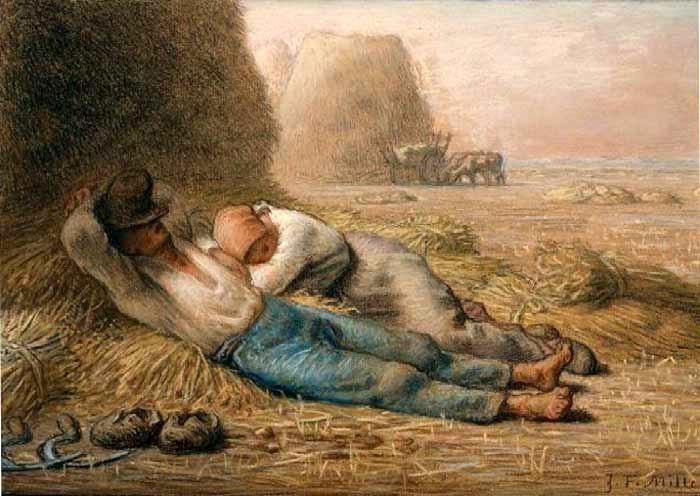
Jean-Francois Millet, La Méridienne, 1866

Jean Francois Millet, famous for his paintings of farmers and field workers, sets a different tone in this painting, The Nap. The turmoil and hardships of France’s lower class agricultural workers is often depicted in Millet’s paintings through his own experiences. The paintings, which shocked the upper class that viewed them from the comfort of cushy Paris art galleries, displayed workers in the midst of their labor. The Nap shows a couple resting in the shade of a bale of hay as the day wears on. Tools for haying lay next to the couple as well as the man’s shoes. The scene seems almost intrusive, as if somehow we have stumbled upon the sleeping workers on their bed of hay and should back away slowly as not to wake them.

The most striking this about this painting is how un-striking it is. The muted colors and the hazy quality make for a peaceful sight. The style of the painting is similar to typical Impressionist style, with that characteristic out of focus haziness and defined brushstrokes. Millet painted the painting towards the end of his life at the age of 51 (he only lived to be 60) and the influences of other prominent Impressionists can be seen in his brushstrokes. The qualities of La Meridienne are a far move from his earlier works (such as The Gleaners, in which the figures are much clearer and brushstrokes less defined). Millet’s move towards typical Impressionism does not make his work any less unique; he still is among the only Impressionists to paint domestic laborers.
Vincent Van Gogh, La Sieste (d'après Millet), 1889
Vincent van Gogh had always been an admirer of Millet, often writing letters about his fondness for Millet’s subjects, and Millet’s influences can be seen in van Gogh’s early work. While committed to an insane asylum in the late 19th century, van Gogh made copies of twenty-one of Millet’s works. In this particular copy of Millet’s The Nap, van Gogh has made the painting his own with more saturated colors and more prominent brushstrokes, as well as switched the composition of the painting. Both paintings are beautiful, whether viewed separately or alone, however something about van Gogh’s vibrant rendition is even more captivating than Millet’s original sleepy creation.
  • 7:00 AM

Battle of Preveza

Ye Pirate Bold
Dead Men Tell No Tales
Curated by Sonia Larbi

Ohannes Umed Behzad, Battle of Preveza 1538, 1866
The naval maneuvers that took place around the island of Preveza became Hizir Barbarossa's most successful battle. After Aruj ascended to the throne and withdrew from pirating, Hizir, and his magnificent auburn beard, was sent to police Ottoman holdings in the Mediterranean Sea. Many conquered islands sat in close proximity to the Italian and Greek mainland and were subject to frequent invasions. Usually, invasions by Italian city-states were small-scale, disorganized, and easily repelled. This time, Pope Paul III wanted his islands back for good. He created the Holy League, a coalition of soldiers and sailors from Spain, Venice, the Papal States, Genoa, and Malta to complete the task. The Holy League succeeded in temporarily capturing Tunis and other smaller port cities in proximity to Algiers. Now, they were preparing to take back the scattered islands under Ottoman rule, starting with Preveza.

60,000 soldiers in around 300 ships assembled on a neighboring island. Andrea Doria arrived with the Spanish-Genoese fleet and was put in charge. Before that, the Papal fleet had already engaged the Ottoman ships. Barbarossa succeeded in repelling the forces from Preveza. After the small tiff, Doria had enough intel to make a decision. Barbarossa was only 122 ships and 12,000 men strong. A head-on attack at sea would quickly take care of the pirate fleet.

The day of the battle, the Holy League was taken off guard by the fleet of Ottoman ships heading towards them. Doria was not expecting such a daring and offensive move from a fleet so incredibly outnumbered. But as the Christian fleet tried to band into formation to meet the pirates, they found they had no wind to fill their sails. Barbarossa had calculated correctly. He was sailing at full speed with the wind while the Holy League sat in the water, completely immobile. The main gunships were out of range of Barbarossa and had to watch while the nimble pirates boarded and sank almost half the fleet.

By the end of the battle, 3,000 Christian soldiers were taken prisoner. Barbarossa's men suffered 800 casualties and 400 deaths, but succeeded in conquering the largest Christian fleet in the Mediterranean. He also signed a peace treaty with Venice that transferred ownership of strategic islands in four different regions to the Ottoman Empire and paid 300,000 ducats of gold to his brother, Aruj. With the momentum from Preveza, Hizir liberated Tunis and the other port cities the Holy League occupied on the Barbary coast. Even though Hizir's beard wasn't fiery red like his brother's, he still catapulted the Barbarossa name into eternal infamy.

  • 9:00 AM