Two Girls With Parasols

John Singer Sargent, Two Girls with Parasols, 1889. 

In John Singer Sargent's career he painted over 900 oil paintings and 2,000 watercolors, which doesn't even include the endless sketches and charcoal drawings. After the scandal of Madame X, Sargent's portrait career ended in Paris but eventually grew in Britain and America. Sargent painted Two Girls with Parasols five years after his strapless gal got him in hot water. The tree and the woman in the center create a barrier from the lush green on the right and the rough browns on the left. The contrast of the colors is not harsh, instead it flows.

Sargent's brushstrokes smoothly sweep across the canvas, which allows the colors to not only stand on their own, but look like they belong. These strokes allow the painting to move, not just because the women are facing left. The brushstrokes start in the top right and slide down to the bottom left, aiding the woman in pushing the viewer's eye. 

The most interesting feature of this painting is the faceless women. Is he allowing the identity to be anyone, or is he hiding the true identity from the scandal of Madame X? Is Sargent's reputation still harmed five years later, that he wouldn't paint the faces of his models? The unrevealing dresses, shade from the tree, and shade from the parasol seems to put the women in the dark; they even seem constrained. Even though there is space for the action to move, the shadows and the clothing make the women timid. Their gaze does not meet the viewer (the lack of eyes help), and it seems to be a passing moment of hiding.
  • 7:00 AM

La Meridienne and La Sieste

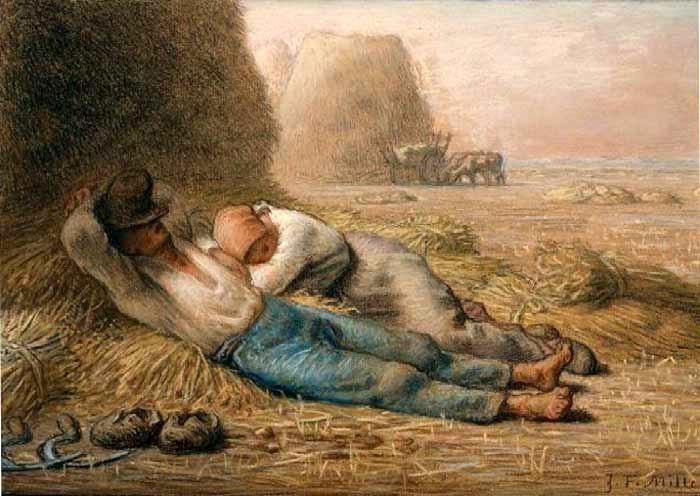
Jean-Francois Millet, La Méridienne, 1866

Jean Francois Millet, famous for his paintings of farmers and field workers, sets a different tone in this painting, The Nap. The turmoil and hardships of France’s lower class agricultural workers is often depicted in Millet’s paintings through his own experiences. The paintings, which shocked the upper class that viewed them from the comfort of cushy Paris art galleries, displayed workers in the midst of their labor. The Nap shows a couple resting in the shade of a bale of hay as the day wears on. Tools for haying lay next to the couple as well as the man’s shoes. The scene seems almost intrusive, as if somehow we have stumbled upon the sleeping workers on their bed of hay and should back away slowly as not to wake them.

The most striking this about this painting is how un-striking it is. The muted colors and the hazy quality make for a peaceful sight. The style of the painting is similar to typical Impressionist style, with that characteristic out of focus haziness and defined brushstrokes. Millet painted the painting towards the end of his life at the age of 51 (he only lived to be 60) and the influences of other prominent Impressionists can be seen in his brushstrokes. The qualities of La Meridienne are a far move from his earlier works (such as The Gleaners, in which the figures are much clearer and brushstrokes less defined). Millet’s move towards typical Impressionism does not make his work any less unique; he still is among the only Impressionists to paint domestic laborers.
Vincent Van Gogh, La Sieste (d'après Millet), 1889
Vincent van Gogh had always been an admirer of Millet, often writing letters about his fondness for Millet’s subjects, and Millet’s influences can be seen in van Gogh’s early work. While committed to an insane asylum in the late 19th century, van Gogh made copies of twenty-one of Millet’s works. In this particular copy of Millet’s The Nap, van Gogh has made the painting his own with more saturated colors and more prominent brushstrokes, as well as switched the composition of the painting. Both paintings are beautiful, whether viewed separately or alone, however something about van Gogh’s vibrant rendition is even more captivating than Millet’s original sleepy creation.
  • 7:00 AM