Les Demoiselles d'Avignon

Pablo Picasso, Les Demoiselles d'Avignon, 1907

Hey, ladies.

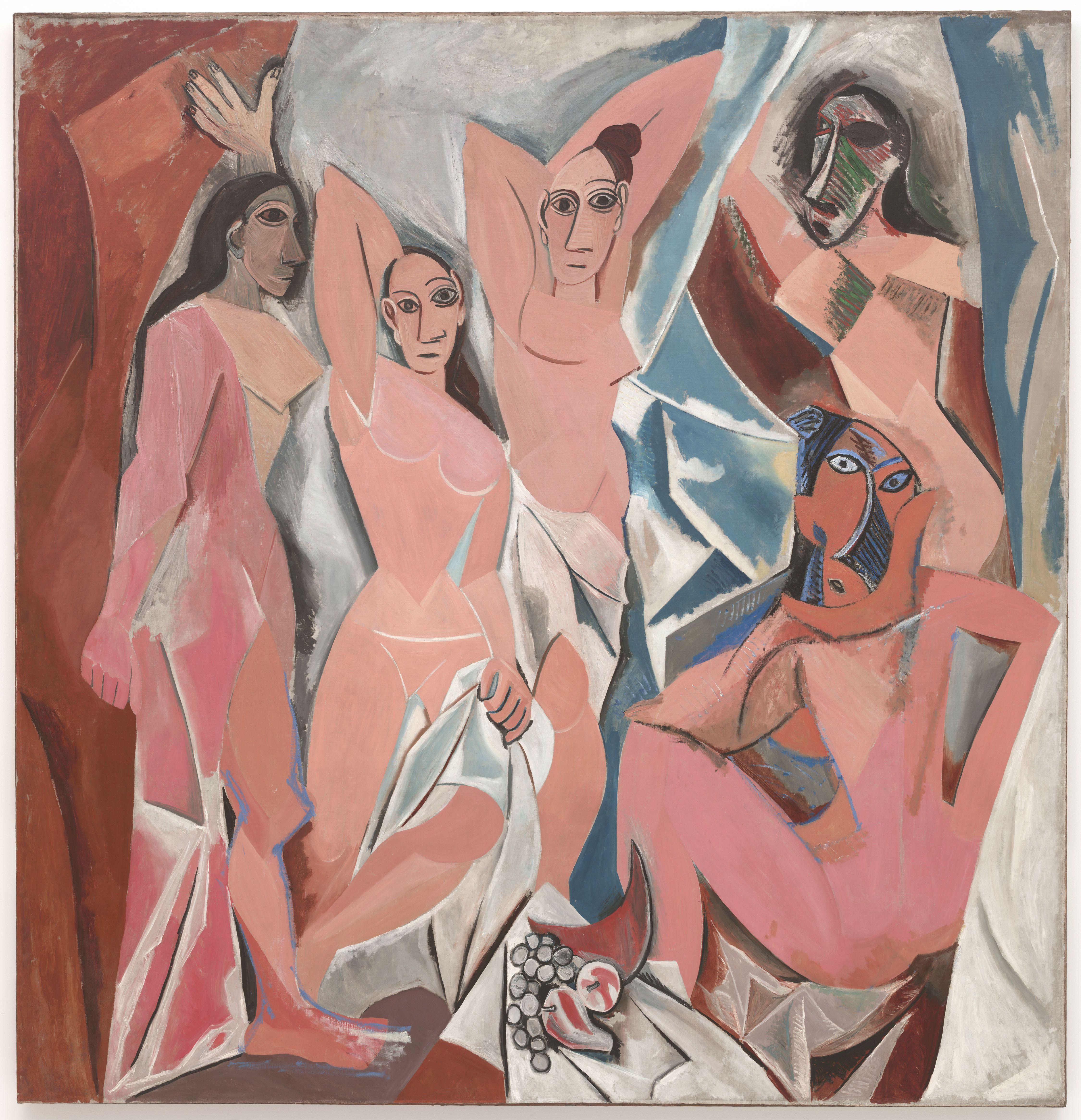
Pablo Picasso's Les Demoiselles d'Avignon (The Ladies of Avignon) depicts five unconventionally-painted prostitutes, subjects from a brothel on Carrer d'Avinyó in Barcelona.  (The title comes from that street name, not the French city.)  The painting has a study of the human form accentuated by a small, central still-life.  Although he completed the first draft in 1907, he repainted the two rightmost heads after a breakup with a lover and did not exhibit the completed piece until 1916.  His display was met with fervent criticism as he was accused of destroying the human and womanly forms, reducing them to crude, unfeminine shapes.

Picasso drew inspiration from various sources of art from across time.  The composition and poses are reminiscent of post-Impressionist Cézanne's The Bathers.  The ladies' confrontational manner is supplanted from Manet's Olympia.  Between 1906 and 1909, after his Rose Period, Picasso modeled many of his works after African indigenous art, such as the mask above from the Dogon people of central Mali.  The faces of the three women on the left are instead interpretations of Iberian masks, with large, triangular noses and almond-shaped eyes.  (As hideous as art critics thought that the Demoiselles d'Avignon were, their facial features actually indicated feminine beauty in different cultures.)  The still-life of fruit is an exercise that many painters performed, but in Picasso's painting, it creates a lush feeling, the curvaceous fruit juxtaposed with the angular, unusually-formed women.

I chose this painting as a blog subject because it demonstrates techniques of early Cubism (proto-Cubism).  Cubist theory stems in part from an assertion by Cézanne that the shapes of natural objects could be reduced to cylinders, spheres, and cones.  New postulations in science about the nature of time, like Einstien's Theory of Relativity, influenced artistic visions.  Cubists often strove to evoke contemporaneity in simultaneous but different perspectives of the same subject.  At the same time, others sought to make their works seem like an incidental, miraculous intersection of many planes, a goal that Les Demoiselles d'Avignon appears to match more closely.  Beyond the techniques that distorted conventional shapes and viewpoints, cubists still wanted a unity across the canvas, as Les Demoiselles does with complimentary colors and neutral shadows and accents.  The painting marked a transition into a new and influential period of modern art that questioned standard perceptions of time, beauty, and form, trying to find the most basic possible representation of humans.

  • 7:00 AM

Gentlemen's Club - Les Demoiselles d'Avignon

Gentlemen’s Club
Courtesans and Seductresses Depicted in Art
Curated by Gabbi Fenaroli
Pablo Picasso, Les Demoiselles d'Avignon, 1907
"Women are machines for suffering"
-Pablo Picasso

Originally titled The Brothel of Avigon, Picasso painted this controversial piece in 1907 but did not show it to the public until 1916. Looking past its poor reception, Les Demoiselles d’Avignon opened the way for cubist art. The paintings importance was not fully recognized until the mid 1920s. The painting provoked thought and conversation, each viewer seeing the image from their perspective. The influences from artists like Cezanne are clear. The lines of the woman are not feminine nor beautiful, they are hard and blatant. The figures are full of life though. The violent angles add motion to the painting. Although a fairly flat painting, Picasso defies the norm at the time by using such controversial subjects and distorting the bodies to look animalistic.

Anxiety and fear fill the viewer. These woman are not inviting, they look cruel and unattached. Georges Braque went as far as to say, “"Picasso was drinking turpentine and spitting fire." Most critics agreed with Braque, the painting was ghastly. Picasso does not sugar coat the women’s work; their business is savage and crude. Prostitutes are businesswoman, calculating their earnings as each costumer arrives and leaves. They are prostitutes in a brothel. Picasso doesn’t leave the work open for interpretation. The viewer gets what they pay for - a vulgar and emotionless act.

  • 8:00 AM

Progression of Human Form - Les Demoiselles d'Avignon


Pablo Picasso, Les Demoiselles d'Avignon, 1908

Pablo Picasso’s Les Demoiselles d'Avignon completely reinvented and advanced painting as an art form. Les Demoiselles d'Avignon” completely abandons perspective and all previously conceived notions of painting resulting in a work that appears disjointed and chaotic. Picasso moves away from traditional two-dimensional painting and ventures into the world of three dimensions. This form of painting is known as cubism, a genre that attempts to break up, reassemble, and analyze the fundamental qualities of a figure. Furthermore, cubism, as the name suggests, places an emphasis on geometrical shapes and deconstructing the world around us into simpler shapes and forms. Line, contour, color, perspective, lighting, and composition are given up, revolutionizing the way we interact with artwork and perceive the human form.

  • 12:00 AM

Cubism


Les Demoiselles d'Avignon, Pablo Picasso, 1907
The cubism movement was led by Pablo Picasso and Georges Braque. In cubism objects are broken up, analyzed, and re-assembled in an abstracted form. They began to depict objects from multiple viewpoints instead of one viewpoint. The idea was that natural objects could be reduced and simplified to the forms of the cylinder, the sphere, and the cone and to move inside as well as outside of an object, below and above it, in and around it.

Les Demoiselles d'Avignon by Pablo Picasso, painted in 1907, really set the tone for the cubism movement. Being one of the first of its kind, Demoiselles, was controversial. It caused anger and disagreement among people, including Picasso's close friends. This particular work was influence by African tribal masks, which is obvious in the faces of the five women portrayed. Also, through the faces the different perspective points are evident.

Cubism evolved from paintings and works, like
Les Demoiselles d'Avignon, to more colorful and abstract forms of cubism. Cubism moved beyond single point perspective and broke humans and objects down to their most simple forms. 

  • 12:00 AM