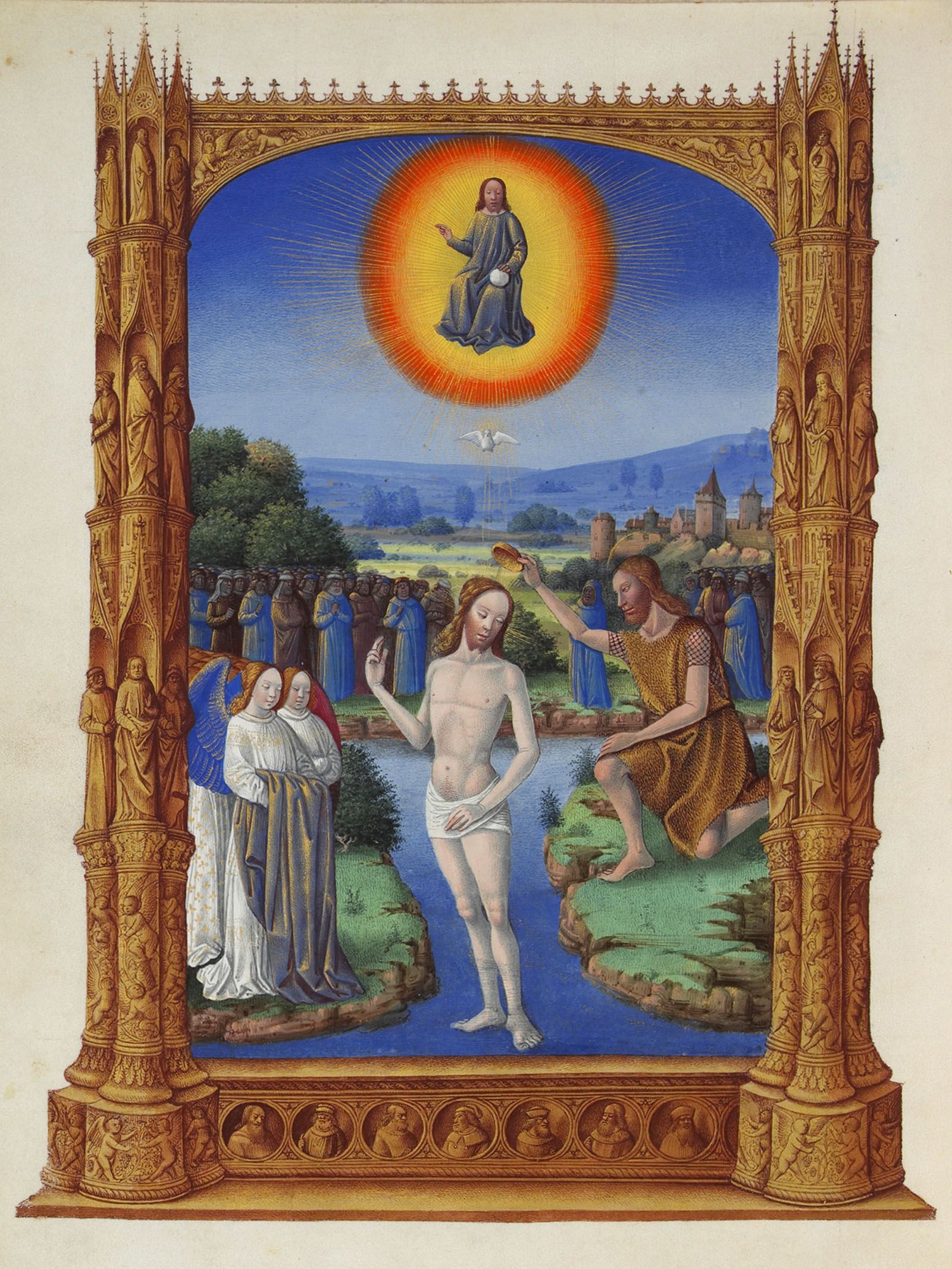
Art History Hotties: The Baptism of Christ

The Baptism of Christ, The Limbourg Brothers

By LIBBY ROHR

Jesus is a professional model.  He speaks in that Zoolander voice. He knows how to pose. He's the kind of hot that doesn't even have to look in the mirror. He doesn't have to comb his hair, but he did spend six hours the other day styling his beard. The two pointed look is really en vogue right now. He's bringing sexy all the way back to 15th century. No wonder Christianity caught on. Look at those abs. That muscle definition. The soft alabaster skin. The flowing hair. The sloping calves. The tiny white mini-skirt. What more could you want from the Lamb of God? If God created this Jesus in his image, then God must be smoking. Even the angels agree. They're blushing so hard their wings are turning color. That never happens. Even John the Baptist can't help but to stare. I mean look at those collarbones! It makes me consider the literal interpretation of a "divine glow." Holy men congregate in hordes behind him. They're not staring at his butt in that insanely short wrap. Of course not. They're definitely just here for the spiritual stuff. Definitely. This Jesus is making idolatry pretty tempting. Forget your "french girls," Leo, paint me like 15th century Jesus.

Well done, Limbourg brothers. From the trio that brought us a slew of over-the-top rich people festivals and a line of farmers using the chamber pot,  Paul, Jean, and Herman Limbourg now grace us with the presence of sexy Jesus, one of the most appealing forms of Jesus out there. Hey, if you can't get them interested in scripture, maybe you can entice some converts with this masterpiece. Unfortunately for the masses, these French masters were experts at illumination and in particular creating illustrations for customized books for the upper class. 

Often time religious works of this era were created to educate, stir emotion, and add a visual accompaniment to help better understand these stories as the life of the son of God. As a result, many frescoes in the early Renaissance featured nondescript, "ordinary" faces that reflect the type of people that would be seeing their works in an effort to connect the audience to the stories. The figure of Jesus, obviously, offered the least room for interpretation. He is always pictured with relatively dark hair that curls at the bottom and a full beard in an effort to ensure the accuracy of the image. Yet, looking at works like this one it would be hard to believe it wasn't at least slightly tailored to the audience. For one thing, these figures are all European, not Middle Eastern like Jesus would have been. The the incredibly white skin and the auburn hair for one suggest that the Jesus in this image is french like its onlookers. Furthermore the landscape of this work, from the sloping mountains, deciduous trees, and the Gothic castle behind them, is decidedly French. Between these connecting factors, the accuracy of the image presented, the vibrancy and the skill of the painting itself, and Jesus's glorious form, this illumination goes above and beyond its requirements and showcases the (smokin') work of true masters.
  • 7:00 AM

Très Riches Heures du Duc de Berry: Janvier

Limbourg Brothers, Trés Riches Heures du Duc de Berry, 1412-1416 
By SAI GONDI

Saddle up folks, its fiesta time. Très Riches Heures du Duc de Berry is a manuscript comprised of twelve works  intended for their loyal patron the Duke of Berry. The creators of these works are simply known as the Limbourg Brothers. Jean, Paul, and Herman spent the early 1400s creating their coveted illuminated books. Très Riches Heures uses a calendar style to portray the Duke of Berry and life around his palace. Each individual month exhibits different scenarios throughout the year using gothic styles and bright, vibrant colors. 

For those who followed us throughout our Spring Break series, Janvier, or January, is a perfect piece for that collection of wild works. In January, the Duke, dressed in a peculiar Peacock robe, sits in his decorated palace flooded with delicacies, guests, and gifts. The event is actually to commemorate the generous month of January known for being the time of gift exchanging. This is seen through the surplus of gold pots objects being examined and presumably traded by the gentlemen on the left. The Brothers use stunning blues, reds, and golds to captivate the viewer and help glorify the Duke. 

There are some elements of this painting I can not necessarily explain. The major one being the accessories hanging off the vintage fanny packs around the two gentlemen in front. Such presumable key chains will likely confuse the viewer into thinking they represent something a little more inappropriate for younger audiences. Then again, I have no insight on 15th century jewelry trends. 

January is, in my opinion, one of the best by the Limbourg Brothers for its use of colors and all around inclusion of depth and three dimension, something rather revolutionary for Renaissance art.  
  • 7:00 AM

Les Très Riches Heures du Duc de Berry: October


Limbourg Brothers, Les Très Riches Heures du Duc de Berry: October, 1413

The book of hours, as seen in Shrek, is a prayer book that came in to popularity in the early 15th century. The most common type of surviving illuminated transcript, books of hours normally consisted of prayers, psalms, and meditations. Being an illuminated manuscript, in addition to the text, the book contained decorations. The decorations required highly-detailed work, especially with the miniatures - small-scaled medieval paintings that were popular at the time of illuminated manuscripts. The most impressive surviving book of hours is Les Tres Riches Heurs, painted by the Dutch Limbourg brothers. They began the work in 1413 and left it incomplete at their deaths in 1416. They were still in their thirties, and their cause of death most likely due to the plague that was ravaging Europe. The book of hours was completed seventy years later by a French painter Jean Colombe around 1485.

The Limbourg brothers painted the Tres Riches Heures for Jean de France, Duke de Berry, who was the third son of John II and an important member of nobility in 15th century France. He was a connoisseur of visual arts of the medieval period, and loved art and literature. His collection consisted of castles, gems, and a magnificent collection of books, which included the Tres Riches Heures. The Limbourg brothers painted on 206 vellum leaves, the highest quality available at the time. Vellum is the highest quality of parchment, which was normally reserved for important manuscripts, and lasted far longer than papyrus.

The painting for the month of October gives the most accurate and complete view of the Louvre of Charles V. The Louvre, originally a fortress in the 12th century, underwent several alterations before becoming the museum we know today. It was altered by Charles V in the 14th century, then converted into a residence in the early-16th century under Francis I. In the early 18th-century there was wide spread talk of creating a gallery, to showcase the Royal collection. The Royal museum became reality under Louis XVI and became free to the public, with 537 paintings, three days of the week after the fall of the monarchy. The museum's collection would continue to increase through Napoleon’s military conquests.

  • 7:00 AM

Les Très Riches Heures du Duc de Berry: June

Limbourg Brothers, Les Très Riches Heures du Duc de Berry: June, 1411-1416
The vividness of the Limbourg Brothers calendar attracts the viewer immediately. Especially for simple minded art lovers like me, the colors in which the Limbourg Brothers used for June was extremely pleasing. The symmetry that exists in Les Très Riches Heures du Duc de Berry: June inexplicably makes this calendar painting vibrate with a warm feeling. The color of the women’s dresses in the foreground, the light and dark blue, match exactly with the sky in the back and the rooftops of the castle in the background.

Because June is the harvesting season, the farmers are busy reaping their goods for the season. However, the details also show a distinct division between social classes. Barriers block the peasants from the castle, from the fences to the line of trees.

The facial expression that the brothers portray on their characters also attracted me. From afar, they seemed placid and emotionless. However, zoom in and we see that the farmers, not surprisingly, are rather disgruntled as they toil in the field.

The Limbourg Brothers create an array of work in the form of calendars, however the method in which they create it - the depth, radiant colors, expressions, and social commentary - make their works my favorite pieces of the pre-Renaissance era.


  • 6:39 PM