This Girl is On Fire: At The Moulin Rouge, The Dance

This Girl is on Fire
Woman as Goddess
Curated by Emma Krasnopoler

Henri Toulouse-Latrec, At the Moulin Rouge, The Dance, 1890


You see her from across the room, there, on the dance floor. She dances with passion, each movement as energetic and animated as the last. She does not stop, does not falter. Men come up to dance alongside her, only to discover that they cannot keep up. She is electric.

It’s no wonder why Henri de Toulouse-Lautrec was so captivated by the dancing, music, and excitement of the Moulin Rouge. The cabaret music was like nothing found anywhere else in the city. It was a circus of dancers and singers and entertainers. This scene portrays a crowded dance floor where couples mingle and the hustle of bodies overwhelms. Yet, amid it all, one dancer is the most prominent. It is this woman, adorned in scarlet, who catches Lautrec’s eye. She is bright and energetic, from her fiery hair to her stockings. She is in motion, twirling and jumping and sliding around the floor, unlike the other women who stand still, without emotion or animation. Her face is hidden, allowing her body to tell us her story. She moves with passion, a fury of tapping and bucking and twisting. Her movements are unrestrained and spontaneous; she is the living definition of “Dance like nobody’s watching.”

There is something about her that hypnotizes me. Perhaps it is the way I can sense her energy emanating from the painting, or how I can feel the rhythm of her body. I feel privileged to be able to watch her, as if by doing so I may take away a portion of her intensity and immersion. She is absorbed in her dance, yet I, like Lautrec, cannot take my eyes off of her.

  • 7:00 AM

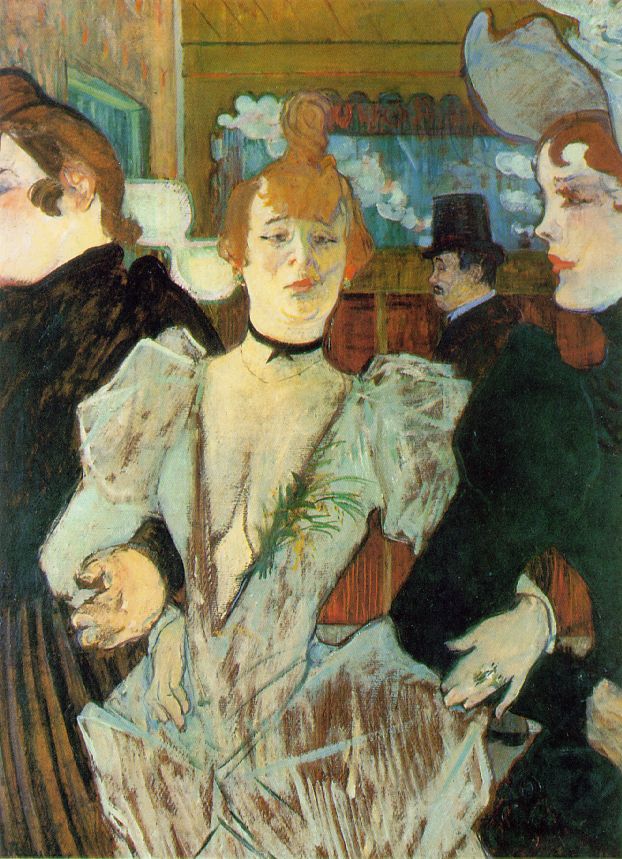
La Goulue Arriving at the Moulin Rouge

Henri Toulouse-Lautrec,
La Goulue Arriving at the Moulin Rouge, 1892 
She walks into the room. Everyone turns their heads. The sound of her swishing skirts seem to drown out the music of the band, the loud salon music that reverberates off of the Moulin Rouge's crowded interior. The Belle Epoque is in full swing, and La Goulue reigns over Paris as its high-kicking queen.

Louise Weber would not have achieved such celebrity without some help from her artistic friends, especially Henri Toulouse-Lautrec. He adopted La Goulue ("the glutton") as his muse, immortalizing her image in paintings that lined gallery walls and posters that littered the streets of Paris, advertising her as the forward dancer with free-flowing skirts. Lautrec glorifies the movement that La Goulue embodies in her dance. This mastery of subject is the product of years spent together, considering he followed the starlet from her debut to the end of her fame. Even when La Goulue isn't dancing in his depictions, Lautrec manages to evoke a sense of lively movement and a certain unrestrained spirit.

Lautrec combines the sense of grand entrance with a spirited personality in La Goulue Arriving at the Moulin Rouge. The lady occupies most of the portrait's space, framed by her gentleman dance partner to the left and her sister to the right. The viewer can admire both her wily red hair and unmissable decolletage from beyond the painting. However, if the viewer dares to stare too long, s/he may encounter the gaze of the subject. Her eyes appear tired, but once combined with the pursed lips, an appearance of a smirk begins to emerge on her famed countenance. In regards to movement, Lautrec achieves a sense of chaos ready for release by painting furiously brushstrokes across the fabric of her dress, criss-crossing every which way. Obviously, La Goulue cannot be contained. Let the entertainment begin.
  • 12:00 AM