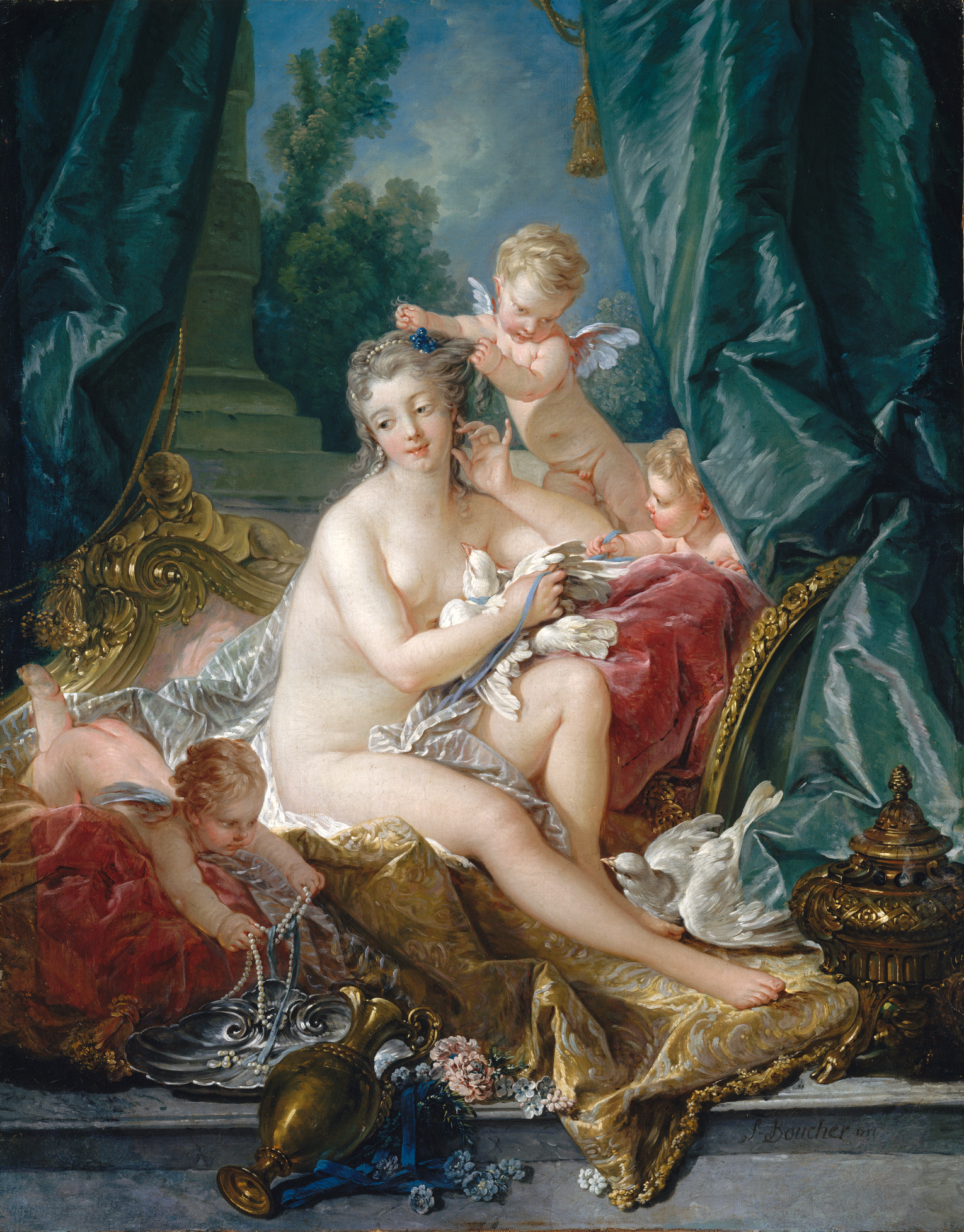
Toilet of Venus

Boucher, Toilet of Venus, 1751
By MADELINE VASQUEZ

In early 18th century Paris, Rococo style art began. Delicate colors and curvy lines surrounded the painting, making it extremely masterful. Concepts of love, nature, goddesses, and youth, bring about the complexities of the ornamental arts of the Rococo period. Although not everyone may be interested or intrigued by this form of art, each one has depth and meaning behind it. One of the most amazing artists of this time was Francois Boucher. The feeling that people get when looking at his art is utter amazement, and you will hopefully feel the same.

Boucher is known for his pleasant, sensual paintings that usually revolve around pastoral scenes and exquisite goddesses. His mythological scenery depicts such passion and emotion that you feel what he is painting through expression, no matter the emotion in it. His paintings have a sense of theatrical staging as if you were looking at a staged show. This layout is captivating and makes the painting more enjoyable to look at and costly.

In Toilet of Venus, created in 1751, Boucher depicts the mythological scene of the Goddess of Love. This painting contains Venus sitting on a stage, with a natural backdrop, surrounded by cherubs admiring her and playing with jewelry and ornaments that are tumbling over the edge of the stage. This represents the concept of luxury which draws wealthy buyers in because they are able to relate to the painting more so than others. The pastel and soft colors make the Toilet of Venus overall harmonious and delicate, but also detailed. The body of Venus and her cherubs are soft and playful. The intricately folded red velvet and golden couch, silk, and drapery are beautiful and eye catching. When looking at this painting you feel peace and tranquility, but also empowered in the sense of richness.

Personally, I would see this painting appealing to wealthy women in this day in age. It could be given as a gift that could be greatly admired in a luxurious bedroom or bathroom. Thus, relating to Boucher painting this for Madame de Pompadour, for a series of panels for her bathroom. Knowing a sophisticated woman as herself would want Boucher, one of her favorite artists, to paint for her, is in itself a reason that this painting is worth buying.

Editor's Note: The authors were asked to write sales copy for Edme-François Gersaint, the prominent rococo art dealer who offered a printed catalog of available works.
  • 7:00 AM

This Girl is on Fire: Venus at Her Toilet

This Girl is on Fire
Woman as Goddess
Curated by Emma Krasnopoler


Diego Velasquez, The Toilet of Venus, 1650


When Velasquez painted The Toilet of Venus in 1647, nudity in Spain was heavily denounced. Except for the old masters’ paintings of gods and goddesses, contemporary artists were forbidden from painting nude figures, especially female nudes, which were considered disgraceful. The price for painting a nude painting was condemnation, banishment, and even excommunication. Everyone thought Velasquez would be subject to these consequences, yet somehow, due to favoritism or just fame, Velasquez managed to display his Venus without punishment. Philip IV proudly displayed the painting along with other paintings of nudes by Titian and Rubens.

But this post isn’t really about Velasquez. It’s about the woman in the painting. I feel as though I am interrupting a private moment between this woman and her reflection. She is enthralled with the face in the mirror, and I doubt she even realizes I am watching her. Who is she? Although the chubby Cupid beside her designates her as a goddess, she does not look like the typical Venus figure that appeared in many mythological paintings before this. Her buxom figure, pink flesh, and plain face differentiate her from other Venuses, yet Velasquez still calls her a goddess. What does she lack that other Venuses have? She has the youthful glow, perfect complexion, and enviable figure. While she may be a daughter of some court member, or even a prostitute, she also could very well be Venus.

I chose this painting to commence this series not because this woman is doing anything extraordinary, or because she is the most beautiful or progressive woman, but because she defies the standards of her time that condemned female nudity and demonstrates that any woman can be a goddess.

  • 7:00 AM

The Toilet of Venus


Sticking to Boucher's ultra-extravagent style, The Toilet of Venus perfectly exemplifies a Rococo piece.  Rococo art was most popular during the reign of King Louis XV. In this piece, Venus is modeled after a good friend of Boucher named Madame de Pompadour. Madame de Pompadour was a mistress of King Louis, which helped jump-start Boucher's career. Not only did the painting have a strong tie to politics at the time, but it also possesses many other Rococo aspects. In many Rococo pieces, there are upper class people doing something elegant. Though the painting is of Venus, it shows the elaborate lifestyle the wealthy French experienced. 

The cherubs dressing Venus immediately reminded me of Snow White being dressed by the animals of the woods. The painting is so elaborate that it is obvious that its sole purpose was to showcase extreme wealth. The casual chaos of the jewelry and flowers show how the wealthy felt they were too good to care about even the nicest of things. The curtains in the background also provide a feeling of acting. Though the lack of realism of the setting is acceptable for Venus, it is meant to play up the luxuriousness of Madame de Pompadour. In addition, though the grace of God is not shown through beams of lights, Boucher uses white doves to represent de Pompadour's religious side.

  • 7:00 AM

Toilet of Venus

Diego Velazquez, Toilet of Venus, 1647-51
While this Toilet of Venus lacks the grandeur of Boucher's Rococo-styled Venus (painted in 1703), it stands as an important representation of Velasquez work. It's subject matter was rare and quite bold as it went against what the Catholic Church found tasteful. For this reason, very few female nudes were done at the time of the Inquisition. This painting is Velasquez's only piece depicting a female nude that has survived to this date, but only barely. In 1914, The Toilet of Venus had suffered a malicious attack at its home in the National Gallery in London.

In the early twentieth century, England was undergoing a violent suffragette movement. One afternoon, one Mary Richardson entered the National Gallery, which was open to the public. She carried in with her a meat grinder. Mary Richardson approached the Velazquez and dealt several slashes. This attack was one of several on the National Gallery, which lead them to denying entry to women for a brief time. The message this group of militant Suffragists were attempting to get across reverberated through to the frames of these canvases. Mary hated the way men would ogle Venus' naked body before her viewers.

As a self-proclaimed art student, Mary Richardson made a statement over the power the gallery held; although, the act of slashing the painting was a dramatic form of revenge. Emmaline Pankhurst was an activist and major voice in the movement for women's voting rights. When the Conciliation Bill did not pass, which would have granted women's suffrage, Pankhurst lead a violent revolt where "women were thrown from one policeman to another who punched them with fists, striking the women in their faces,breasts and shoulders." She was then jailed for the chaos. Mary Richardson had destroyed the painting in protest of her imprisonment. "I have tried to destroy the picture of the most beautiful woman in mythological history as a protest against the Government for destroying Mrs Pankhurst, who is the most beautiful character in modern history."While all the damage was successfully restored, these attacks were horrific actions that jeopardized Velazquez's triumphant nude.


  • 7:00 AM