Art History Hotties: Vision of Ezekiel

Vision of Ezekiel, 1518 - Raphael
Raphael, Vision of Ezekiel, 1518
By NATALIE BEYER

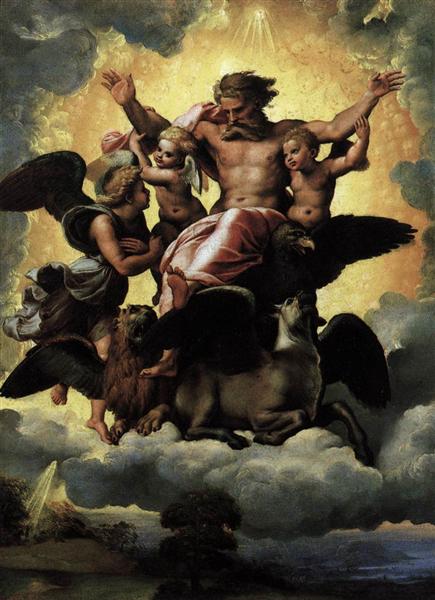
Flowing hair, chiseled abs, luscious beard - everything you could ever want in a guy. Descending from heaven with a throne made up of a pegasus, lion, eagle, and an ox. How dreamy is that? Does he also have children? Could he be a great father? I'd consider this aspect a plus in my book. This painting also reminds me of a man's Facebook profile picture. But, like all Facebook profiles, we all know deep down that this picture doesn't accurately represent who this man truly is. But you say to yourself, "Hey let's give him a try." After a dating a man like this, how could you downgrade anymore if you were to break up? He's the whole package.

This Vision of Ezekiel definitely lands under the topic of "Art History Hotties." His gleaming skin, his golden hair, his, as Dr. Roark says, "big, capable hands". Should I go on, because I most obviously could. Can you see the tiny figure standing in the beam of light shining in the bottom left corner? Well, that's the man who wishes he could be God coming down from heaven. But, sadly, he's not and probably never will be.

Painted in 1518, Raphael wanted to capture Ezekiel, a Hebrew prophet's vision of God. We can see that Raphael was attempting to possibly add the components of both Greek and Roman Gods. God, in this painting, does not look like like he typically would in a painting during this time. The abs give are the dead giveaway for this. Raphael also tried to accentuate God's features by making the background bleak and dark, as compared to God and his creatures colors and glow.

  • 7:00 AM

Vision of Ezekiel

Raphael, Vision of Ezekiel, 1516
Behold! A painting as equally bad-ass as its subject matter. Ezekiel fills the central space, his arms reaching out, seeming to almost pull open the heavens. His posture almost seems to say, "Look at the greatness I show to you!" Such heavy weight lies in the bottom of the painting, but it doesn't change the balance of the piece. A darkened Earth is completely eclipsed by the holy light Ezekiel seems to pull from the sky. The first psalm in the Book of Ezekiel serves as the model for this light, describing "a stormy wind [blew] from the north, a great cloud with light around it, a fire from which flashes of lightning darted, and in the center a sheen like bronze at the heart of the fire" (Ezekiel 1:4-6). One thing I love about this piece is how strong and non-threateningly imposing Ezekiel looks. His name literally translates to "God will strengthen," and that meaning is so evident in every facet of Ezekiel's figure.

Equally formidable, the other characters form a U beneath Ezekiel and support him into the sky. The book of Ezekiel reads, "In the center I saw what seemed four animals. They looked like this. They were of human form. Each had four faces, each had four wings. …As to what they looked like, they had human faces, and all four had a lion’s face to the right, and all four had a bull’s face to the left, and all four had an eagle’s face. Their wings were spread upward; each had two wings that touched, and two wings that covered his body;.." (Ezekiel 1:7-12). Raphael takes a different approach to the figures, focusing more upon the aesthetics of the creatures rather than giving form to the whole four-winged, three-faced idea. Each animal holds their own spiritual meaning; the eagle represents rising above the Earth, and in the piece he is Ezekiel's main support; the bull denotes power and strength, though in the piece he looks rather like a horse; the lion is a sun symbol and usually serves as an emblem of Christ, the "light of the world."

Ezekiel's vision itself is God-given, showing him the Four Cherubim who cover the Throne of God... and God's entire Plan of Salvation, shown by the animal symbols supporting his flight into the heavens. Only two cherubim are shown here, holding him up by his arms. On the left is an angel looking upon him, the angle of its gaze helping push the focus of the piece upward. Raphael creates an all-inclusive scene of Ezekiel's vision, each character's placement exactly where they fit best, and an onlooker immediately understanding the message Raphael gives. There is something incredibly poignant about the symbols Ezekiel receives totally supporting him into the light, each character integrated with focus to their true meaning as well as their aesthetic value.

  • 7:00 AM