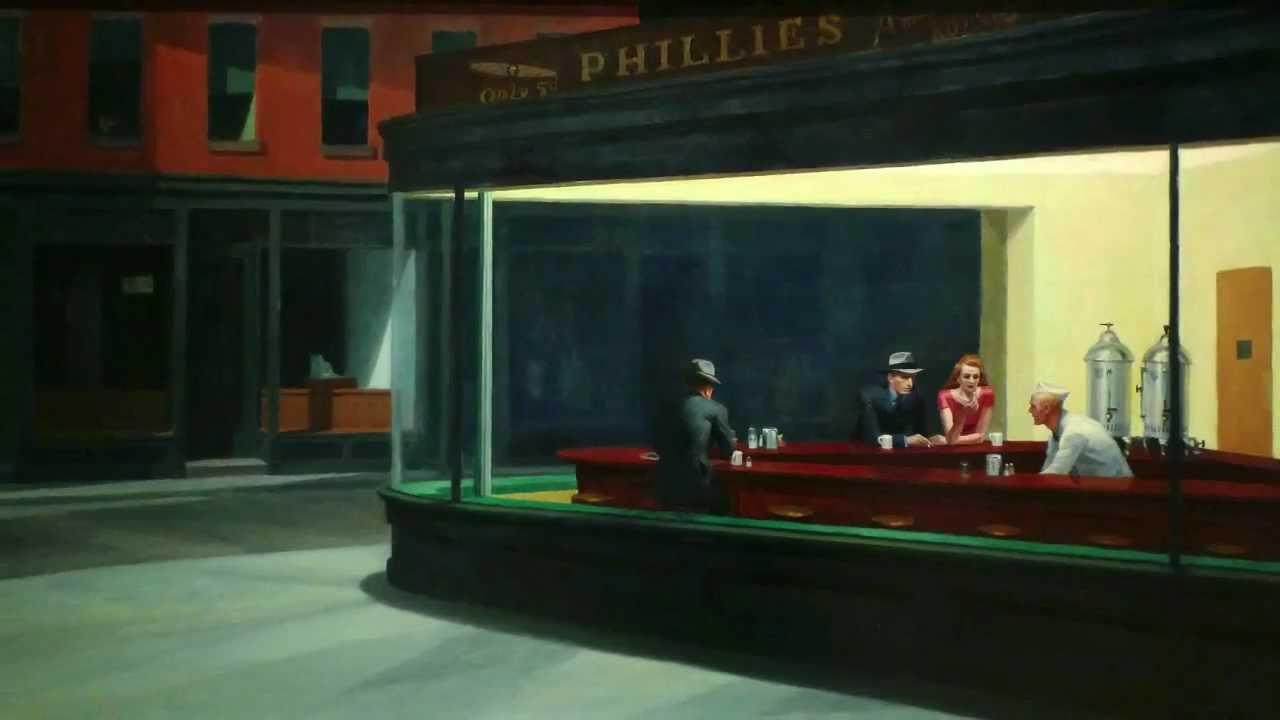
Nighthawks

Image result for edward hopper nighthawks
Edward Hopper, Nighthawks, 1942
"Bar Time" 
By BILLY COLLINS

In keeping with universal saloon practice,
the clock here is set fifteen minutes ahead
of all the clocks in the outside world.

This makes us a rather advanced group,
doing our drinking in the unknown future,
immune from the cares of the present,
safely harbored a quarter of an hour
beyond the woes of the contemporary scene.

No wonder such thoughtless pleasure derives
from tending the small fire of a cigarette,
from observing this glass of whiskey and ice,
and cold rust I am sipping,

or from having an eye on the street outside,
when Ordinary Time slouches past in a topcoat,
rain running off the brim of his hat,
the late edition like a flag in his pocket.


Editor's Note: Students were asked to pair a poem and painting with no explanation of the connection. 


  • 7:00 AM

A Man Walks into a Bar: Nighthawks

Edward Hopper, Nighthawks, 1942

A Man Walks Into A Bar...
By ELLIE SCHNEIDER

New York City, the city that never sleeps. Nighthawks depicts a couple, waiter, and man in a bar. All of the people are minding their own business, enjoying the quiet in the city that is so loud by day. While they are all there together, yet each of them seems lonely. Hopper said, “If you could say it in words there would be no reason to paint.” What is Hopper trying to tell us with his brushstrokes? I think he wants us to see that the restaurant is a safe haven for the night owls, or night hawks. The restaurant serves as a place for them to gather, but also stay in their own thoughts.

This restaurant on the dark street corner emits eerie light and acts as a beacon of light for the night owls of the city. As the viewer, we are drawn to the bright scene, but are shut out by huge glass window panes. Or, the windows are closing the people in. Since, the people inside are unique in that they are night owls, and so they are isolated from the rest of the city that is asleep. The painting appears quiet, inside the restaurant and out on the street corner.

While we know where the restaurant is (in New York), the painting is also universal, it could be any bar at any time. The fact that the restaurant is open at all hours speaks to American consumer culture with the constant need for a way to spend money, but furthermore speaks to human nature and cravings. In today’s world, there are many stores or restaurants that are open 24-hours, but if people can always get a beer or buy food, when do people stop and relax. Especially in the city, people are always about and rushing from one place to the next. While the night owls are buying into the 24-hour culture, they appear frozen in time, allowing the bustling city of New York to take a breath and relax.

As the viewer, imagine that all of your thoughts and sorrows are trapped, frozen in time behind those huge windows. Take a deep breath and relax.
  • 7:00 AM

Summer Evening

Edward Hopper, Summer Evening, 1947
By LILI TUCKER

In (I believe) the 2014 Senior Video, teachers gave advice to seniors in the form of a tweet. While I don't remember the exact words, Dr. Ketchell's tweet contained the phrase "late-night eateries" that completely opened the floodgates and reduced me to a blubbering mess. I remember feeling so much for this 140 character tid-bit because it described, in 3 words, the very distinct type of fun you have as a young adult.  

The road trips at a drop of the hat, the eating Sonic at 2 a.m. or IHOP at 4 a.m. while wearing a toga, playing tennis in a bathing suit or basketball in complete darkness.  This kind of simple fun. No fireworks or four-step-plans. No deposits or reservations, of any kind. You forget who you are -- you forget where you are because it doesn't matter. Those late-night eateries are simply your last attempt at spending just one more half hour with the people you care about. You feel the night coming to a close so you grab their hand and take a sharp left turn onto State Line and you claim you've run out of milk and you simply must get some this instant. Or in the case of this painting, you linger on their doorstep hoping that the earth stops turning just long enough to muster up the courage to kiss her. 

For anyone who knows me well, one of my favorite things in the entire world (besides Gary Whittaker) is grocery stores after  9 p.m. The echo of your shoes hitting the linoleum, the whispering, the florescent lights. In Hopper's painting the Night Hawks, Hopper attempts to capture the feeling of the newly invented florescent lights with a switch to zinc paints. While he never uses zinc paint again, I argue that he never stops capturing that florescent light aura. Or at least the grocery store at 2 a.m. one.  

Many people call Hopper's work lonely. And while I agree that it is about 65% lonely, the term lonely oftentimes implies a sense of melancholy. I contend that Hopper's work is not lonely-- not melancholy but timeless. Hopper so wonderfully captures the moments in life that are timeless. The moments in life that exist in your memory without context, you may or may not remember what happened before or what would happen after but there are moments that can exist without knowing those things. You remember laughing so hard you cried and then crying so hard that your stomach hurt and you couldn't speak anymore so you just sat and watched tv- not saying anything and not needing to. Even though you know what comes next- what does it matter? The road trip ends, Sonic closes, you leave the camping section of Wal-mart, you go home, and you go to bed. You graduate. We all know what happens next. Hopper captures a loneliness of moving on, un-pausing, and growing up. It's not sad because when you look back, you only ever see the during, the meanwhile, the hush - the silence and the stillness. You see the florescent lights and the food on your plate and the people around you. You see time stop. 
  • 7:00 AM

Nighthawks and The Decameron

Edward Hopper, Nighthawks, 1942

"And so they were secretly in love with each other. The young woman was longing to be with him... how they could meet?"
- Boccaccio, The Decameron

When I look at the painting Nighthawks by Edward Hopper, the first thing that I notice is the loneliness of it all. The couple seen in the painting sit together, but the way the lines divide them from the others gives the appearance of isolation. In The Decameron's fourth day, first story, I feel this same isolation in the story of Ghismonda and Guiscardo. Ghismonda's father, Tancredi, refuses to allow her to marry, so she must hide her love for Guiscardo, along with their subsequent affair. They are together, but their togetherness must be hidden, and in this way they are isolated. Tancredi eventually finds out about their affair, however. He kills Guiscardo in retaliation and gives Guiscardo's heart to Ghismonda. She cannot bear to be alone, so she drinks his heart-blood mixed with poison to be with him in death. 

The couple in this painting seem to also be together, they are sitting quite close and drinking together. however, they are also alone. The are separated from each of the other two, and the rest of the painting is just empty space. However, the way the bar sits perpendicular to the wall draws the focus to these two. Whether they found each other in the diner that night or they're a married couple, their presence late at night in a near empty diner says that although they may be alone, they are alone together and seem to prefer it that way.

  • 7:00 AM

Isolation: Office in a Small City

Isolation
Solitude and Painting
Curated by Tommy Dunn

Edward Hopper, Office in a Small City, 1953

This is a series of posts about isolation. The first of these posts focuses on a painting by Hopper. This painting has always been beautiful to me, and I think that I feel this way because of how powerfully Hopper manages to convey a sense of isolation. A man sits in his corner office. Despite some ornamentation that can be seen on some of the other buildings, his building and his office within are completely bare. No signs of life exist anywhere in the painting other than the man himself. This adds to his isolation. The color scheme also creates an increased sense of loneliness. Everything feels washed and a little faded. It feels as though the emotion and vibrancy of the city can't be felt from inside that man's office.

It honestly feels pretty sad, which is I think something Hopper loves to make people feel. This image of loneliness has stuck with me as powerful ever since I first saw this painting. The plain, rather dimensionless lines of the painting mean that nothing clutters it emotionally. It exists to convey one single message. I chose to start off my series with this painting because I think it is the single work that, in terms of intent and execution, most clearly conveys a crippling, overpowering sense of isolation. I hope you enjoy.

  • 7:00 AM

Sherlock and Nighthawks

Edward Hopper, Nighthawks, 1942

(This post refers to the clip from 22:57, where the video should start, to 27:13).

BBC's Sherlock is only one of countless adaptations of Sir Arthur Conan Doyle's 19th-century mystery stories.  But the British channel remodels Sherlock Holmes and Dr. Watson's adventures and situates them in present-day London, fundamentally changing each mystery with the advent of cell phones, fast transport, and the internet. Each episode echoes one of Doyle's works -- "A Study in Scarlet" becomes "A Study in Pink," "The Sign of Four" turns into "The Sign of Three," and so on.  But despite the evolved stories, the aspect of the show that has been most altered is the characters.  Sherlock Holmes' most well-known quality, in both the books and the television series, is his power of deduction, by which he can surmise most peoples' life stories at a glance. He becomes a self-proclaimed "consulting detective," solving crimes with New Scotland Yard with the help of new colleague Dr. John Watson. He lives for intellectual stimulation by solving crimes and suffers from an otherwise constant state of manic-depressive boredom, conducting science experiments and shooting holes in the walls of his ill-kept flat.

The central figure of "Nighthawks" sits alone at the bar, evidently isolated but also trapped in the exit-less building, staring at either the social interaction across the room or maybe his drink. A similarly dressed man with his white mug in the same position as the central figure's sits next to the woman in red, so the figure might even envision himself by her side, a surrogate of himself caught up in the alien banter. The man with the turned back, in any case, does not seem quite content in his solitude.

The clip above comes from the newest season and shows Sherlock's slow evolution into a sympathetic character. At the beginning of the scene, John has just asked a dumbstruck Sherlock to be his best man, and the video transitions to Sherlock's best man speech at John's wedding. While his written words are eloquent, he cannot quite seem to understand his audience's reactions and is uncomprehending when they get teary and need him to pause. He, ironically, has acute powers of perception but cannot comprehend others' emotions.  Sherlock is Hopper's man with the turned back, observing from afar but never quite in touch with others.  It is no wonder that he leaves the wedding early and alone. Other characters speculate on Holmes' mental condition and seeming inability to empathize, labeling him a psychopath (to which he counters, "high-functioning sociopath"). Sherlock wears his self-diagnosed mental illnesses like a shield against emotion and acknowledging his loneliness.

The figure in the painting could also be John Watson, a recently returned and psychologically average Afghanistan veteran who becomes Sherlock's flatmate. Sherlock recruits him on his adventures for his skills as an army doctor, and Watson eagerly follows along. He allegedly seeks a normal life and relationship away from government and criminal intrigue despite his continual involvement in it. Sherlock asserts that John has an addiction to a dangerous lifestyle, as many of the people around him that he has befriended turn out to be psychopaths with shady histories (but no spoilers). The dismayed Watson refuses to accept this part of himself but also will not turn away from the people he has welcomed into his life.

The innovation of BBC's adaptation comes from the binary character study and the evolution from two lonely people, as in "Nighthawks," into a tentative and unique friendship.

  • 7:00 AM

Eleven A.M - The Great Gatsby

Edward Hopper, Eleven A.M.

"I began to like New York, the racy, adventurous feel of it at night, and the satisfaction that the constant flicker of men and women and machines gives to the restless eye. I like to walk up Fifth Avenue and pick out romantic women from the crowd and imagine that in a few minutes I was going to enter into their lives, and no one would ever know or disapprove. Sometimes, in my mind, I followed them to their apartments on the corners of hidden streets, and they turned and smiled back at me before they faded through a door into warm darkness. At the enchanted metropolitan twilight I felt a haunting loneliness sometimes, and felt it in others—poor young clerks who loitered in front of windows waiting until it was time for a solitary restaurant dinner young clerks in the dusk, wasting the most poignant moments of night and life." 
—F. Scott Fitzgerald, The Great Gatsby

Eleven A.M., like majority of Edward Hopper’s paintings, reflects solitude and missed connections. Here we see a woman staring aimlessly at events unfolding on the streets of New York. Although the outside is not shown, we can easily assume a busy morning start in the restless city, which echoes with Nick Carraway’s perception of New York as “racy, adventurous” and filled with the “constant flicker of men and women.” In the ever-expanding metropolis in the 1920s, a subtle placelessness seems to be growing as well. It is easy for individuals to feel like “just a number,” and Fitzgerald depicts just this spiritual emptiness in flamboyant lifestyle of the riches. 

Realistic, firm and direct construction of buildings was Hopper’s calling card. The straight lines on the door frames, curtains and cabinet suggest sureness, coldness even, and gives a sense of solitude to the painting. Sunlight falls on the woman, making her isolated from the crowds of solid, dark background. Outside the window we see the top of another building, suggesting a relative high place this bedroom is. Therefore the woman is physically separated from the people or events outside. With her legs slightly apart, arms resting on her knees, she leans towards the window yet still sits deeply in the chair. Hopper conveys her indifference and detached attitude from body position without painting a single facial feature. 

Similarly, Nick Carraway senses his own sense of loneliness at the high of New York party scene. Returning from Gatsby’s elaborate gatherings, he walks and fantasizes about romantic encounters with strange women. I find this idea oddly compelling. Nick prefers personal imagination of intimacy over the enforced, physical closeness at parties. His sense of solitude, much like the woman in Eleven A.M., reaches high in the restless modern urban life. 

  • 7:00 AM

Office in a Small City

Edward Hopper, Office in a Small City, 1953

At the end of sophomore year, a year ago right about now, I really wasn't familiar with art in any way. I could probably identify the most famous paintings, but I had no appreciation for art. I signed up for art history, and I thought it would probably be a pretty fun class. However, I wasn't really sure what to expect or whether I would ever develop an affinity for paintings in sculpture. Then, when I took the final exam for my English class, I discovered the first painting that I really connected with emotionally.

Hopper's works almost always resonate with me, but this one in particular had a vibe that I could understand. It felt easy to me to put myself in that man's shoes. I could empathize with him for some reason in a way that I rarely ever feel. He sits in the nicest office in his building, and yet he seems only more isolated for it. I love the color scheme--the washed-out beige tones and the faded blue sky seem to suck even more emotion out of the painting. I don't know what it was about that painting. Maybe it was that I saw it in conjunction with Raymond Carver's "Why Don't you Dance?" one of my favorite short stories. Whatever it was, that painting changed my perception of art forever. It made me understand that looking at paintings wasn't something that had to be done in cold, academic sense.

Paintings could be fun and interesting and evoke emotions in a reader that other media could not. In this past year I have seen a lot of art work. I'm not sure I have found one that I enjoy as much as this one. On that day in the middle of the whirlwind of finals, Edward Hopper taught me that art could be cool.

Editor's Note: The students were assigned to write about the artwork that has impacted them the most. These pieces will run for  about two weeks. 

  • 7:00 AM

Office in a Small City

Edward Hopper, Office in a Small City, 1953
Hopper's painting accesses a unique emotional dichotomy. It communicates a loneliness, an empty, blank perspective, a man who, while above the city, has no connection to it. He sees the city as it truly is, and thereby separates himself from it.  The simpleness, the pure uncluttered nature of Hopper's piece builds on the emotion, or lack thereof, of the painting. On the other hand, the soft tones and easy lines make the piece consumable. It's easy to look at, to take in. It'scomfortable.

Beyond these two elements, however, lies a third: it's relatable. Not person among us hasn't felt empty, or meaningless, at some point. Everyone views themselves, in one way or another, as detached from society. Most of all, everyone has sat at a desk, looked out a window, and wished themselves somewhere else.

"My aim was to try to give the sense of an isolated and lonely office interior rather high in the air, with the office furniture which has a very definite meaning to me," Hopper said in regard to his work. He attempts, and succeeds, at creating a separated and elevated sense of space. The man looks down at the city from its highest point, but by doing so removes himself from it. Or vice versa: he separates himself in order to view the city from above. Superiority comes at the cost of loneliness.
  • 7:00 AM

New York Movie

Edward Hopper, New York Movie, 1939
At first glance, Hopper's piece bespeaks loneliness and seclusion. The doorwoman, excluded from the people and the screen, seems to hide in the back of the theatre. But I choose to view her separation from a different perspective. What if, instead of stuck back there in some sort of banishment, the doorwoman seeks a kind of refuge from the noise, the light, the rustling of popcorn chewers? Rather than exiled to this niche, she chooses this banishment to escape from all the motion of the movie. She simply takes a break from everyone else's life, and uses it to reflect on her own.

These moments are the ones I treasure. Not for the memories they create, but for the relief they give. True, these little breaks won't be things you look back on in your old age, or the stories that you tell your children and grandchildren, but these are what get you through the day. When you can take a step back from the crowd, and appreciate the moment.

  • 7:00 AM

Evening Wind and The Ducks

Edward Hopper, Evening Wind, 1921

"He got out of bed and went to the window. It was black outside and he could see nothing, not even the rain. But he could hear it, cascading off the roof and into a puddle under the window. He could hear it all over the house. He rain his finger across the drool on the glass.


When he got back into bed, he moved close to her and put his hand on her hip. 'Hon, wake up,' he whispered. But she only shuddered and moved over farther to her own side. She kept on sleeping. 'Wake up,' he whispered. 'I hear something outside.'" -
Raymond Carver, The Ducks

Clashing violently with the black walls of the room, the snow white portal to the outside holds no comfort or warmth in its depths. Only the elements and the howling winds, which thrust the curtains into the room with each gust, lay in wait outside the home. And caught in nature's crossfire the woman sits on all fours, vulnerable, naked and alone. She will find no comfort in the sheets that share the same snowy color as the wild unknown. There is no escape for her.

When I first saw this sketch I was reminded of Raymond Carver's short story "The Ducks," which explores the relationship of an unnamed man and woman through the death of the man's colleague and a night spent making love during a heavy rain storm. As in many Carver stories, the couple has a broken relationship, one lacking real love; instead their connection gets built upon lust and convenience. Though they are together, they are completely alone, just like the figure in Hopper's work. The woman seems to harbor genuine feelings for her lover, but he remains distant and cold to her, at least until a failed attempt at love making. Deep in the night he goes to the window and becomes frightened by what lays beyond, and finally turns to her for comfort, but finds that he cannot wake her up.

He has only himself.

Vulnerable....Naked....

Alone.

  • 8:00 AM

Hotel Lobby and The Lost Art of Reading

Edward Hopper, Hotel Lobby, 1943
Like most of Hopper's painting, the sense of isolation and loneliness are well depicted. The foyer is dominated by cool colors. The decoration is unusual in terms of a hotel lobby, which  should be warmer and more customer-friendly. The green line on the floor segments the couple from the girl and leads our eye towards the darkness and uncertainty in the back. The couple seems anxious. The husband cannot sit still, and the wife's red dress only makes the frame bleaker and more alienated. Harsh light, rigid lines. All above, Hopper creates a carefully constructed uncomfortable environment.

However, if you look closely at the blond girl in the right corner, sitting with her legs crossed, reading a book and with a flush on her face, she seems quite comfortable. Contrasting to the couple waiting desperately for something unknown, the blond girl looks relaxed and occupies her time with reading. She is by herself, oblivious to her surroundings, but we might also tell that her minds travels through another world and temporarily escapes from this desperate environment through reading

In the book The Lost Art of Reading, David L.Ulin describes his feeling about reading: " I recall the joy of contemplating that portrait, the way it made me feel as if a world had opened up in the palm of my hands. It is this, I think, that draws us to books in the first place, their nearly magical power to transport us to other landscapes, other lives." We will never know if Hopper suggests reading as the ultimate way to save us from this modern, lonely world. Nevertheless, being in such a world today, we might think about reading as an option besides playing with your phone and looking for friends on Facebook when you are waiting in a hotel lobby. Calm down, pick up a book, and treat it like your temporary company - not necessarily to learn anything, but to help keep the loneliness at bay.

  • 12:11 PM

Gentlemen's Club - The Girlie Show

Gentlemen’s Club
Courtesans and Seductresses Depicted in Art
Curated by Gabbi Fenaroli
Edward Hopper, The Girlie Show, 1941
“Being a woman is a terribly difficult task, since it consists principally in dealing with men"
-Joseph Conrad

Edward Hopper usually associates himself with serene city scenes or cramped quarters in lonely rooms. Nudes are not in his usual repertoire. However, in The Girlie Show, painted in 1941, explores Hopper’s travels to the West in the 1940s. The piece is not meant to seduce the viewer, Hopper is simply doing what he does best: painting what he sees. The art of burlesque dates back to 16th century. Over time culture and society has changed the ideas behind burlesque, but the principle remains the same. The act is meant to be humorous and provide a good show for the audience. American burlesque sets itself apart by having minimal clothing or even sometimes even no clothing, sexually suggestive dancing, quick-witted humor and a series of short routines and sketches.

The Girlie Show represents a form of American culture in the 1940s. Burlesque was meant to be harmless and fun a way to enjoy and gaze upon the female body. The performer shows off her body as though she was fully clothed. The dance does not represent a sexual desire of urges, it simply represents American entertainment.

This exhibit, Gentlemen’s Club, deals with the perception of women. The woman’s body holds the key to man’s hearts. With sex, she holds power. The art of being a seductress and the job of a courtesan leave woman with the upper hand. In the collection, all the women have one thing in common: they know what they want and they know how to get it.

  • 8:00 AM

Not Your Average Female Portrait - Hotel Room


Not Your Average Female Portrait
Ways in which you wouldn't normally view a woman
Curated by Lily Johnston
Edward Hopper, Hotel Room, 1931
Honestly disturbing, Edward Hopper's Hotel Room, leaves the viewer in remorse for a women's hotel room full of shame. What would usually be thought of as a happy arrival at the St. Regis, seems more Motel 8 after a rough night on the streets. Head down, hands on knees, note in hand, our protagonist or maybe even anti-hero, reads a note perplexed at how a lover left her with nothing but the one piece of clothing she wears on her back.

The olives, oranges and auburns paint the room sullen like a sour cocktail party.  The horizontals push back and draw towards the black window shade, but the white walls push up in eerie light that reminisces of some hope. Her hat sits untouched, just waiting to be worn to the nearby flapper joint. But we see the sad woman behind doors, hiding from her average life. A normal painting would show her out and about or in this room in a different set of company, instead of reading the note that changed her life, most probably for the worse.

Everything that matters hides in the shade; her face, her legs (for dancing), her torso and the sofa (for relaxing). The only parts of the room lit mirror her normal sad life; her thighs (self-explanatory) and her forearms (holding the note). Leading a seemingly sad life, this woman hides in the confounds of her hotel room, shielding her emotions from the public. Hopper obviously has a point. Not all happy people are indeed happy.

  • 9:00 AM

A Room with a View - Girl at Sewing Machine


A Room with a View
Examining the Film through an Art Historian's Lens
Curated by Melissa Martin

Edward Hopper, Girl at Sewing Machine1921
"I don't care what I see outside. My vision is within! Here is where the birds sing! Here is where the sky is blue!" - Mr. Emerson Yet again, Mr. Emerson provides dramatic insight while dealing with a delicate situation. His passion and conviction give a reality check to the decorum-obsessed characters in the Edwardian era film. While his peers remain focused on the outward appearance of things (i.e. the view outside a hotel room), Mr. Emerson chooses to develop his own self, his very soul. Perhaps Edward Hopper incorporates this sentiment in his works, especially those like Girl at Sewing Machine. A vast number of Hopper's paintings feature empty rooms in the city with lonely subjects washed in the bright light of a window. In the harsh world of a bustling metropolis, Hopper's characters must turn inwards to preserve their personal oases. Girl at Sewing Machine epitomizes this attitudethat one should rely on their vision within when stuck in the middle of a concrete jungle.
  • 12:00 AM

Gas


Edward Hopper, Gas, 1940
Wanderlust. It's a contagious disease that develops in the subconscious and spreads to your very soul. A few major symptoms include desperate yearning for adventure and heightened awareness of your surroundings. But how do you cure it? Only one solution remains apparent: trek from the redwood forest to the Gulf Stream water until you stumble across self-discovery.

It is this sentiment that Edward Hopper conveys in his iconic masterpiece, Gas. This composition from 1940 offers a glimpse into the Route 66 culture, which emerged around the same time that Hopper’s career gained traction in the art world. Everyday American life inspired the quiet artist immensely, as evidenced by his seemingly endless depictions of New England architecture and mundane city life. Considering his track record, Hopper’s choice to paint America’s burgeoning highway system seems odd at first, but then the work speaks for itself.

Among the happy-go-lucky families on vacation and the rushed business travelers hide sufferers of inherent loneliness: those who traverse the nation looking for answers, Jack Kerouac-style, or those who get lost in the shuffle. Hopper decidedly focuses on the latter. He identifies with the sole attendant who tends the three Mobilgas pumps. Empty pavement stretches out behind him, while a forest of ominous pines traps him in his little corner of the world. The attendant, much like Hopper, must remain a lonely witness to the never-ending stream of passersby, unsympathetic to the victims of wanderlust.
  • 12:00 AM

Nighthawks and The Killers


Edward Hopper, Nighthawks, 1942. 

The door of Henry’s lunch-room opened and two men came in. They sat down at the counter. … Outside it was getting dark. The street light came on outside the window. The two men at the counter read the menu. From the other end of the counter Nick Adams watched them. He had been talking to George when they came in... ‘That’s the dinner,’ George explained. ‘You can get that at six o'clock.’

George looked at the clock on the wall behind the counter.

‘It’s five o'clock

‘The clock says twenty minutes past five,’ the second man said.

‘It’s twenty minutes fast.’

‘Oh, to hell with the clock,’ the first man said.”

- Ernest Hemingway, The Killers

Only a dim street light and interior lighting of a diner illuminate the shadowy recesses of Hopper’s street in his painting, Nighthawks. An accurate portrayal of American culture in the 1940s, Hopper’s subject matter was influenced by Hemingway’s 1927 short story The Killers. The quiet atmosphere and serenity of the night mutes the subtle, predatory current that taints the tranquility of the scene.The painting’s indifferent protagonists, a white-clad barman, two fedora’d men and a woman who resembles a starlet rather than a common streetwalker, avoid eye contact with the painting’s audience. Their ignorance effectively emphasizes the barrier that Hopper creates as means of separating his audience from the dangers residing in Nighthawks.

Hemingway, in The Killers, sets his tale in another 24 hour diner.  As a small town’s local restaurant serves its steady flow of clientele in the post-afternoon snack and pre-dinner mealtime, two hit men disrupt the business’s peace.  Their superiority spark the staff’s tentative frustration and Nick Holden’s downplayed courage. In his attempts at defending the diner’s negro employee, Nick finds himself tied to the cook, while the two hit men impatiently plan their impending murder. Dramatizing the suave brashness of a mafia, Hemingway initially introduced the two hit men as common trouble makers who refused to adhere to the diner’s menu policies. Of course, their innocence was quickly strangled by their mission to “kill [a Swede] for a friend. Just to oblige a friend.”  To make matters worse, the diner’s broken clock confuses the hit men and the reader, creating a timeless quality to the dangers that Nick and the restaurant staff face.  Hopper mimics this same infinite, through paranoia, by isolating and ostracizing the diner from any mechanism that alludes to the passage of time. His painting does not include a clock that assures the sun rise in few hours. Instead, the blanket of shadows that shroud the abandoned streets push the viewer closer into the diner’s radiant interior -- closer to danger. 

  • 11:40 PM