Portrait of Comtesse d’Haussonville


Ingres, Portrait of Comtesse d’Haussonville, 1845
BY REMY JACOBS

Painted in 1845, Ingres', Portrait of Comtesse d'Haussonville focuses on the beauty and wealth of women during this time. At first glance, I thought this was a photograph because it looks almost too realistic to be true. The painting was started in the summer of 1842 and finished in the summer of 1845, because the Comtesse was constantly traveling and at one point she had a child. 

Her family comes from a long line of wealthy individuals. In fact, her great-grandfather was the financial director of Louis XVI, and granddaughter to Madame de Stael, a well-known woman through Europe.  

The colors of this are stunning: from the periwinkle dress to the red ribbon in her hair. The dress also helps to bring the focus to her. The painting is mostly anatomically correct, with the exception of her face. It seems to be a little to small compared to her body.

  • 7:00 AM

Theme and Variations: Napoleon I on his Imperial Throne

Theme and Variations
Relating Music and Art
Curated by Becky Reilly

Jean-Auguste-Dominique Ingres, Napoleon I on his Imperial Throne, 1806


The Neoclassical era represented a departure from the supposed frivolity of the Baroque and sought a return to Classical civilization.  Art became more subdued and stately, and Roman and ancient Greek symbolism began to infiltrate architecture, music, and other media.  Jean-Auguste-Dominique Ingres, Napoleon Bonaparte's contemporary, bedecked his emperor in such in Napoleon I on his Imperial Throne.  He holds Charlemagne's scepter in his right hand, recalling the glory of the Holy Roman Empire, and celebrates the earlier Romans with his golden, Caesar-like laurel wreath.  On the rug, elevated by the step, lies the French Imperial Eagle, Bonaparte's own battle standard.  As Napoleon had seized the art stores of conquered kingdoms and transported them to the Louvre, Ingres had the opportunity to model his paintings on those of the old masters.  But critics disliked his interpretation of Napoleon at his coronation for its seeming confrontation and coldness.

Beethoven initially named his Third Symphony (Eroica, 1804) for Napoleon, believing he embodied the admired tenets of the French Revolution.  But Napoleon realized that stability was more crucial for France than continued pursuit of revolutionary idealism.  When Napoleon established his imperial rule in France, however, Beethoven denounced him as a dictator and destroyed his symphony's title page that carried the dedication.  The lengthy piece displays a large range of emotion, even within each movement.  It portrays the cycle of life, from a heroic march to funereal music and back.  The driving rhythm and incorporation of martial instruments evoke combat and triumphal marches.  The piece testifies to military and ideological heroism, enlightenment in the face of absolute monarchy, an idea it will not relinquish even as its movement in France dissolves.

Beethoven and Ingres present quite different portraits of the emperor.  Ingres, a student of Napoleon's court painter Jacques-Louis David, attempts to portray Napoleon as a new Augustus Caesar, founder of an empire.

  • 7:00 AM

Napoleon on His Imperial Throne

Jean-Auguste-Dominique Ingres, Napoleon On His Imperial Throne, 1806

Looking regal as ever, Napoleon is covered from head-to-toe in abundant robes, tassels, embroidery, and furs. The portrait shows the newly self-appointed emperor on the day of his coronation, in the moment that he sat upon his throne for the first time as Emperor. He resembles Jupiter in Ingres’ Jupiter and Thetis, where both men radiate patriarchal dominance, although Napoleon is slightly more overdressed.

On his head sits a gold leaf crown, much like the one worn by Julius Caesar. At his feet lays an eagle, or rather, the French Imperial Eagle chosen by Napoleon himself as the symbol of the French Army.
  In his hands he holds the scepter of Charlemagne and the Hand of Justice.  He looks as a leader should -- powerful, stationary, firm, exquisite.  But something seems off. Napoleon does not command the respect and authority that the portrait intends him to. 

No, Napoleon looks less like a Roman god or emperor and more like a boy playing dress up. His gaunt face looks flat, bored.  The small features and stony eyes don’t quite match up to the extravagance of the rest of the painting. His expression would look more at home at a funeral than on a gilded throne.  The robes, the crown, and the lace overwhelm him. I do not see a powerful man in this picture. I see a man who just now realized what he has gotten himself into. Everything about this seems to show authority, power, and fortune, except Napoleon who seems to be thinking something along the lines of, “I have got to get out of these tassels.”

But the funny thing is, Napoleon never sat for this painting.  Ingres had been chosen, along with five other artists, to paint portraits of Napoleon to be distributed to French towns. Perhaps Napoleon felt he was above sitting for portraits, or perhaps he had bigger things to deal with. But Ingres painted him with all the finery and pizzazz any French provincial peasant could have imagined. This portrait would not exactly convey a strong sense of faith in the new emperor.

France had just experienced the horrors of Revolution and Robespierre and Napoleon was supposed to be the hero to save and secure her. This picture is a far step from military leader Napoleon, who at least looked confident enough to instill hope and faith into the French people. But this new Napoleon? Will he carry France upon his padded shoulders? Will he rule with an ornately gloved hand? Will he pave the way for a New France with his delicate silk slippers?

  • 7:00 AM

The Grand Odalisque


Jean-Auguste-Dominique Ingres, The Grand Odalisque, 1814

As European empires continued to expanded their territories through the 19th century, the African and Asian countries that once were only seen by the most adventurous explorers, such as Marco Polo, were gradually unveiled, and provided the Europeans endless fascination. The legends and tales about far-off lands and people provided Europeans with wild and exotic images about those mysterious terrains. Artists like Ingres captured those popular imaginations on their canvas. Here, Ingres presented his French fellowmen an invitation to the mysterious, licentious world to the east.

Commissioned by Napoleon's sister Queen Caroline Murat of Naples, (unfortunately she was no longer the Queen when the painting was finished), The Grand Odalisque depicts a concubine in the harem, surrounded by oriental settings, in a pose that reminds me of Titian's Venus of Urbino. It's hard for me to understand how her left leg connects to her pelvis. However, her elongated, voluptuous body nevertheless is of great sensuality. And her cold, distant yet inviting facial expression arouses just the right amount of excitement; she acknowledges the presence of the voyeur, yet only offering a restrained temptation. In a sense, it almost seems like the Orient invites the European to come to their world, which is understood by Europeans as with force. But one has to understand it's an European interpretation of the Eastern world. Several other Ingres's work, such as The Turkish Bath, present a similar theme. In a way, these images of sexually promiscuous women lure Europeans to conquer and march into their bedrooms; at the same time, they help justify colonial expansion in that such immoral culture needs Western guidance. After all, when looking at this painting, who would say no to her invitation?

  • 7:00 AM

Jupiter and Thetis

Jean-August-Dominique Ingres, Jupiter and Thetis, 1811

Few pictures have so thoroughly creeped me out as did Jupiter and Thetis. The way that Thetis looks up at the god just really scares me. The two look like they need to be separated. 

This scene depicting Jupiter and Thetis is not quite so explicit as Ingres’ depiction suggests. Thetis, the mother of Achilles, journeyed to Olympus to plead for support in her son’s battle against the Trojans. Jupiter acquiesces, and in a roundabout way, Achilles gets the battle that he wants (Achilles needed a military defeat to prove to Agamemnon that he was key to the fight). The furious goddess floating in on a cloud at the top left of the painting is Juno. Juno is not too happy to see Thetis back cuddling against Jupiter’s thigh; Jupiter is Thetis’s former lover.

Jupiter, famous for his carnal exploits, looks the part of the cold, unfeeling playboy in Ingres’ painting. He stares stonily straight ahead as Thetis tugs lovingly at his beard and Juno stares laser beams into the back of his head. I think that Ingres does a great job in this painting of depicting Jupiter as the essence of power. His body language is aggressive. He sits with his arms flung out to either side and his feet widely set, filling out his massive throne. He gazes directly at the viewer. I feel like he’s trying to stare me down. Juno, however, is another story. She seems almost unfinished—I know this is not the case, for he painted this at the age of 31 and submitted this to the Salon—but it is undeniable that he screwed her up.

That said, I like this painting. I like Ingres’s use of color, and I think his figures, though not anatomically correct, are pleasing to look at. This jibes pretty well with the picture history gives us of Ingres; it is said that when he saw a sick person with visible sores, his wife would throw her shawl over his face to shield his eyes. I love Ingres’ palette here too—the eggshell blue of the sky and the Jupiter’s rose toga dovetail nicely. Unfortunately, many contemporary critics did not agree with me, for they panned it. They hated the way Ingres had drawn Jupiter and Thetis, not to mention Juno. As I look at the painting more, I kind of agree with their complaints. Thetis’s left foot definitely looks pretty weird.

Apparently, Ingres never really got over the terrible reception this painting received. He continued painting, obviously. He continued painting well. But even late in his life he still talked about the terrible reception this painting got. I get that there are technical problems with the painting. I understand why that’s a problem. But I still think this painting’s got value. Jupiter looks incredible, and I think Ingres does a great job of showing emotion in Thetis’ face. Above all, this painting is beautiful.

  • 7:00 AM

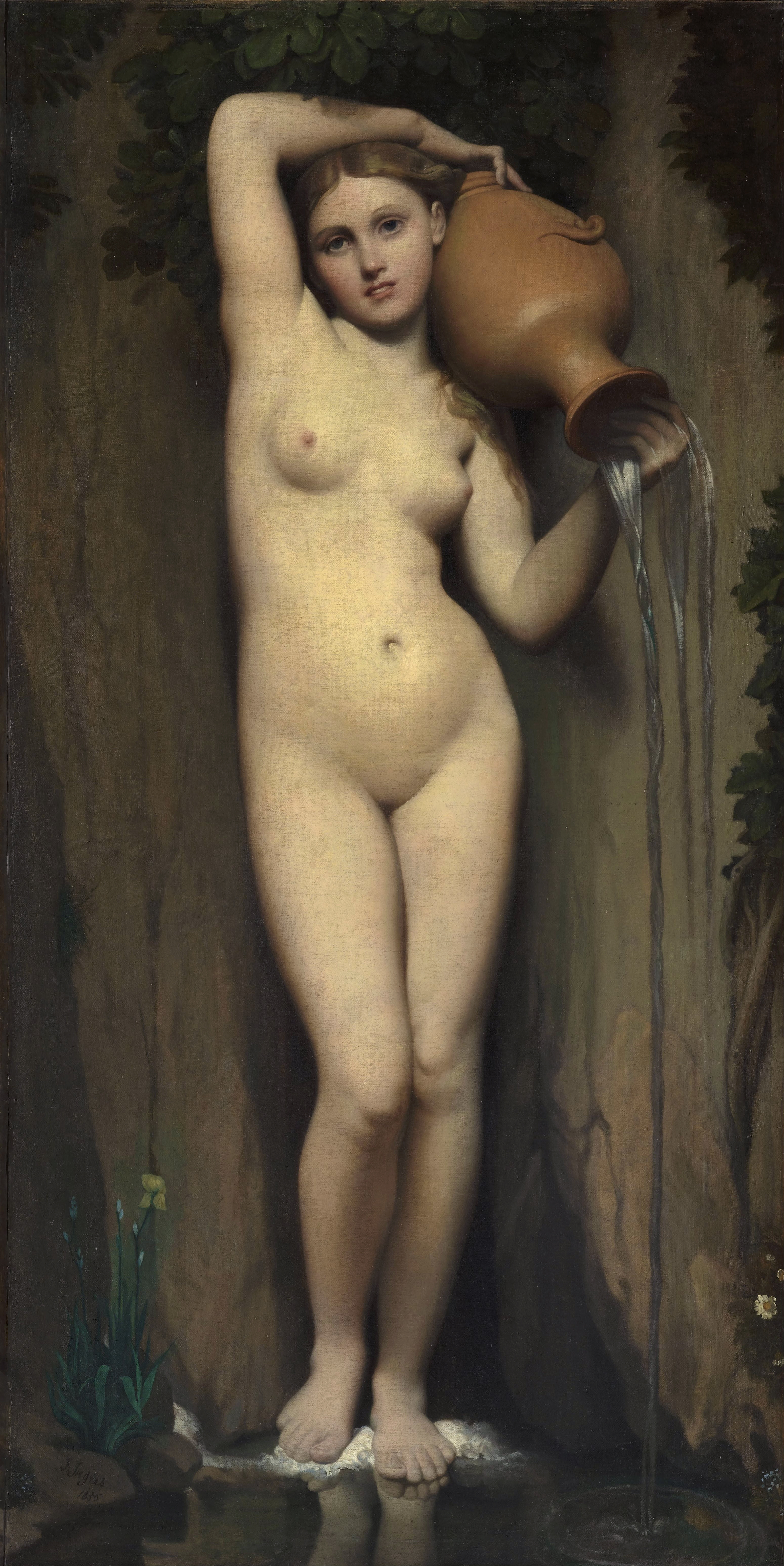
The Source

Jean Auguste Dominique Ingres, The Source, 1856

Ingres searched for perfection in his nude female figures by exaggerating and elongating their forms, creating sensual curves and strangely attenuated poses. However, The Source, which he left unfinished for more than 30 years, depicts a woman with more realistic proportions and sculptural smoothness, pouring a silvery stream of water into the pool at her feet. The water is just beginning to ripple, not yet disturbing the reflection of her feet, leaving her image frozen in time. Her undeniable sexuality is tempered by the body of water separating her from the viewer and her cold expression. The smooth, simplified curves of her body and the matte texture of the paint make her resemble a sculpture more than a living woman. She represents a natural spring, as well as a Muse and a source of poetic inspiration.

The painting was first exhibited in 1856, when Ingres was seventy-six and well advanced in his career. The first owner displayed it surrounded by flowers and aquatic plants, emphasizing its connection to the earth:  the delicate flowers on either side of the figure suggest an image of purity, while ivy was sacred to Dionysus, god of wine and totally sick parties. The effect of the surrounding greenery supposedly emphasized the painting’s realism even more. The Source has often been praised as one of Ingres’ best works, or even “the most beautiful figure in French painting.” The smooth, sculptural treatment and allusions to Greek myth place it firmly in the realm of superb Neoclassical paintings.
  • 7:00 AM

Gentlemen's Club - Grande Odalisque

Gentlemen’s Club
Courtesans and Seductresses Depicted in Art
Curated by Gabbi Fenaroli

Jean Auguste Ingres, Grande Odalisque, 1814

"Women are like tricks by sleight of hand,
Which, to admire, we should not understand"
- William Congreve

Revealing just enough to excite the viewer, but not enough to give it away. The Odalisque playfully glances back and acknowledges the viewers presence She remains unmoved by their entry though. The viewer attends to her schedule. Jean Auguste Ingres painted Grande Odalisque in 1814 for Napoleon’s sister Caroline Murat. Opposed to classic European influences, Ingres enjoyed the exotic. He places the odalisque in a sumptuous interior full of Middle Eastern influences. The peacock fan, the hookah and the turban all point to Ingres' fascination with orientalism. Many other nudes of the time incorporated mythology; however Ingres mythology and magic reside in a far away land.

The painting received criticisms over the anatomy of its subject. The woman’s back contains more vertebrae than in reality. Some suggest this was done purposely by Ingres to highlight the fact the odalisque has one use only. By adding more vertebrae, the pelvic area is highlighted. Her social role defines everything about her life. Her existence revolves around pleasing and pleasuring her master.

What separates Grande Odalisque, from different paintings of seduction, remains that nothing is shown. She turns away from the viewer into a secretive pose. Unlike Olympia who acknowledges her place in the space, Odalisque shies away from the gaze of the viewer. She appears sensuous, yet reserved, beckoning the viewer to engage her.

  • 8:00 AM