The Swallows

Edouard Manet, The Swallows, 1873
I'm thankful for the countryside. For any day that I can lie lazily lounging in the open air, as the wind rushes through fields of Kansas blue stem. I am thankful for the rusty-palette and quiet splendor of autumn, the biting chill of winter on my cheeks, the budding beauty of spring, the sweat of summer nights. I am thankful for the hot July night, two years back, when I saw thousands of fireflies flicker between the trees, like the willow-the-wisps of folklore, so that the night sky and the woods around became as one. For the afternoon I spent at the pumpkin patch on Holmes with my sister, laughing and racing through the corn maze, willingly losing ourselves in the winding aisles of crop. For the days before my license, when Michael, Adam, Will, Deko, Chris, and I would trek for an hour just to waste the day at the park or wander the aisles of Price Chopper. The nights that we would steal out of our homes to play Manhunt.

And with these last two, I've touched upon something that I had not considered when I set out writing this post: That these moments stand out because they are shared. I've enjoyed my share of lonely days wandering the hills and creek beds near my grandparents' home, and I cherish those evenings of self discovery. But those shared moments of glory - whether the wonder was lost on my company or not - are those that truly shine.

Just two weeks ago, Max and I fixed up bikes in the driveway of his new home, desperate to set off in search of adventure in the last hours of sunlight. Our repairs made, we mounted up and raced through his neighborhood, up sidewalks and down asphalt roads, past joggers and couples and children playing in yards. In that moment we were free. We smiled like we hadn't since the year began.

  • 7:00 AM

Gentlemen's Club - Olympia

Gentlemen's Club
Courtesans and Seductresses Depicted in Art
Curated by Gabbi Fenaroli
Édouard Manet, Olympia, 1863 
“So sweet and delicious do I become,
when I am in bed with a man
who, I sense, loves and enjoys me,
that the pleasure I bring excels all delight,
so the knot of love, however tight
it seemed before, is tied tighter still.”
- Veronica Franco

Gazing into the eyes of Manet’s Olympia, it becomes difficult to look away. The private moment Manet has created for the viewer does not go unnoticed. What shocked the masses at the 1865 Paris Salon was not her bare breasts and exposed body. They took offense to her provocative gaze, and the blatant fact that she was a courtesan. Some items pointing to her profession include the orchid in her hair, the black ribbon that contrasts her pale flesh, and the playful slipper falling of her foot. What sets Olympia apart from other paintings featuring a bare model, is that she is attainable. She exists in modern culture.

Paintings record history and depict events occurring in society, and prostitution was not a piece of history Parisians wanted recorded. In contrast with the painting that inspired Olympia, Sleeping Venus by Giorgione, Olympia appears more boyish than Venus.

Olympia undermines the female bargaining power of sex, since her job trades pleasure for money. Olympia threatens women’s power, especially in 19th-century Paris, because of what she offers to men - no strings attached, no guilt involved.

  • 8:00 AM

Mother Liberty and the Seducer - Berthe Morisot with Veil

Berthe Morisot with Veil
Mother Liberty and the Seducer
Curated by Alex McDonald

Curator's Note: The Mother Liberty and Seducer story arc has come to a close. I now leave you with two stories of thematic importance.

Manet’s brush pushes against the canvas. Colors blend. Shapes take form. Sweat dribbles down the artist’s brow. He works with a mission.

We are going to get your voice heard, Berthe, he promises. There are worse artists out there prospering. Why should you have to starve because of your sex?
            
Manet hears a muffled reply.

Speak up, darling. I can’t hear you.

He does not make out the next gurgled cries.

Berthe, this isn’t going to work if you can’t sit still.


Manet’s portrait stands close to completion. He hopes for his painting to attract attention to his suffering sister in law’s art career. A woman can’t make it anywhere in the world, Manet tells himself. She needs his help. If he can show the world through his art that Morisot demands the critics' attention, she can make it big. Like him. His talent will be the tool she uses to foster her own.
          
I am almost done. I just need to complete the mouth.
A raspy croak sounds from the other side of the canvas. Manet doesn’t look up.

Be quiet, I don’t want to get this wrong. Manet looks up and drops his brush in shock.

Morisot’s mouth is sewed shut. Her eyes stare at Manet with an accusing gaze. A gaze that says all the words Morisot’s mouth cannot say.
  • 12:00 AM

Le Suicide

Edouard Manet, Le Suicide, 1877 
"Singer left his luggage in the middle of the station floor. Then he walked to the shop. He greeted the jeweler for whom he worked with a listless turn of his hand. When he went out again there was something heavy in his pocket. For a while he rambled with bent head along the streets. But the unrefracted brilliance of the sun, the humid heat, oppressed him. He returned to his room with swollen eyes and an aching head. After resting he drank a glass of iced coffee and smoked a cigarette. Then when he had washed the ash tray and the glass he brought out a pistol from his pocket and put a bullet in his chest." 
- Carson McCullers, The Heart is a Lonely Hunter

Beautiful in its own morbidity, Manet's Le Suicide significantly departs from the delicate forms of his well known nudes, such as Olympia, and replaces them with a horrific, yet calm, image of self-destruction. The man's position on the edge of the bed, and his decision to fire into his gut as opposed to his head denote a reluctance in the act. However, his facial expression seems to be one of bewilderment, more so than pain or regret. He gazes up at the ceiling, towards the sky, and thus towards "heaven." These elements, combined with what is believed to be a painting of a monk on the back wall, and the placing of his body, have led some to believe that the piece represents the crucifixion of artists, with possible autobiographical sentiments from Manet.

Manet had a fondness for creating portraits of Jesus being accosted, such as in his piece Jesus Mocked by the Soldiers. His fascination with such scenes seemed to go hand in hand with the poor reviews that he received throughout his career. The constant flow of negative reviews and the stress from not meeting expectations led Manet to sympathize with to figures such as Christ, who took on unspeakable pain for others. Manet, some claim, seems to be suggesting through works such as Jesus Mocked by Soldiers and Le Suicide that the burden of the artist was similarly painful. John Singer, the deaf-mute protagonist from Carson McCullers masterpiece The Heart is a Lonely Hunter, feels this same burden when he is given care of the trust, hopes, and downfalls of four people in a Georgia town. In the end, the burden, as well as his loneliness lead him to take his own life. In much the same way, Manet seems to suggest that the burden on artists to create meaningful and popular works creates a weight that few can truly carry.


  • 12:00 AM

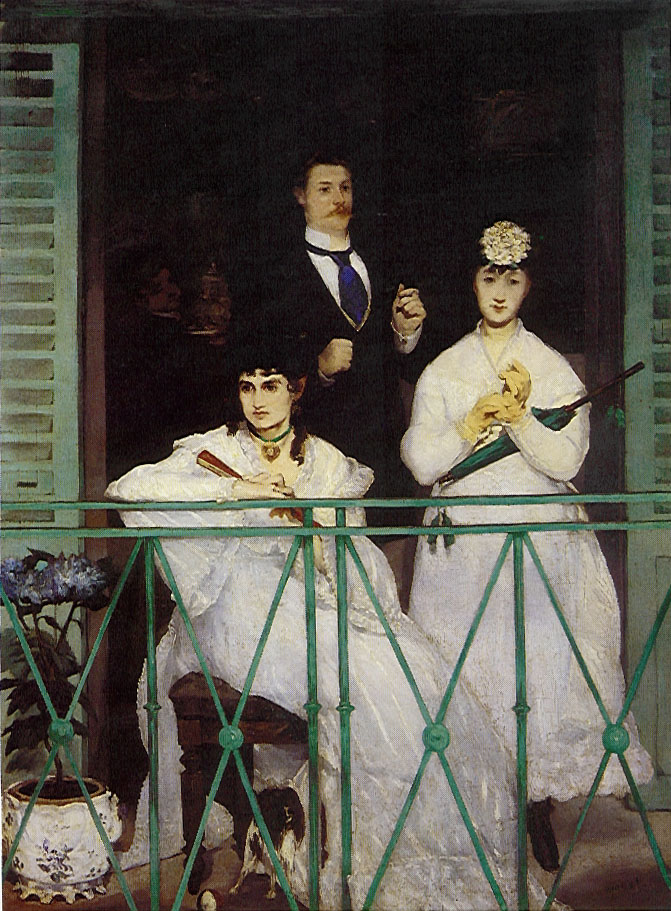
The Balcony


Edouard Manet, The Balcony, 1868-1869
Edward Manet’s 1868 oil painting, The Balcony, was first exhibited at the Paris Salon of 1869.  Obvious inspiration comes from Goya’s The Majas at the Balcony, which stems from the themes of class structure. Two intimidating male companions oversee two young and smiling upper-class women.  In The Balcony a stiff and awkward trio replaces the balanced quartette in The Majas at the Balcony. Manet also exchanges Goya’s sinister balcony setting for a spruced up minty green version. He seeks to express the life of the upper class, and succeeds in unveiling the rigidness beneath the poised façade.

The three polished subjects, who were all friends of Manet, seem disjointed, as if they were taken from other works and pasted together on the canvas. Berthe Morisot, on the left, sits like a romantic waiting for her suiter. Her piercing eyes are the most defined, but send gazes away from the viewer and off the painting. Antoine Gilement, a painter, displays a look of indifference and rigidity. Finally, a young violinist, Fanny Claus, seems completely uncomfortable with the entire situation. She stands holding her hand together and on her tiptoes as if she were to leave the scene at any moment. A small boy carrying a tray in the background is Manet’s son, Leon. Born out of wedlock to Suzanne Leenhoff, Leon, posed often for his father and was the subject in many of Monet’s paintings.

Adding Leon in the background of The Balcony slightly taints the sophisticated rigidity of the painting, but offers a connection to the artist that the viewer does not see within the subjects of the painting.

  • 12:00 AM

Luncheon on the Grass

Edouard Manet, Luncheon on the Grass, 1863
Édouard Manet’s Luncheon on the Grass stands out to me as one of the finest examples of impressionist era pieces because of Manet’s freshness, attention to his audience, juxtaposition of figures and setting, and willingness to paint the taboo. French citizens first got a taste of Manet’s thought-provoking, scandalous work in 1863. Two finely dressed gentlemen sit back comfortably, immersed in discussion, seemingly unmindful of the two naked women that encircle them.

The brilliance of this work, like most impressionist era paintings, stems not from the technical precision of the composition, line, perspective, form or figures like the classical masters delivered. Rather, the work's raw brushstrokes, harsh lighting and rough qualities seem to provoke and shock the viewer, who Manet intends to catch off guard.         

The painting, ironically, exudes a level of tranquility that seems unfit considering the subject matter. Manet juxtaposes the figures by clothing the men while scantily dressing the woman bathing and leaves the works foremost figure completely bare. Manet challenges the audience to judge the women, as if they are saying, “Yes, we are enjoying our perfectly peaceful picnic naked, what are you going to do about it?” By choosing a serene forest scene, Manet illustrates that the real abnormality comes from the clothed men. Indeed the nude women seem to belong more in this setting.
  • 12:00 AM