Retrograde and The Temptation of St. Anthony

Matthias Grünewald, The Visit of St Anthony to St Paul and Temptation of St Anthony, 1515


One of the most interesting features of the Northern Renaissance was its push towards permutation, not only of different artistic styles but also of different attitudes. Religious paintings became increasingly secular in aim and focus, while more secular works took on a transcendental/religious quality. Of the works that exemplify this shift, Grünewald's The Visit of St. Anthony and Temptation of St. Anthony shows just how gorgeous this permutation can be.

The painting itself is religious almost to a fault. The two scenes depicted show St. Anthony in various phases of his life, showcasing not only his permanence, but also his challenges as he attempted to bring his fiery rhetoric to non-believers. This sentiment, of austerity and boldness, is contrasted brilliantly by the languid and overgrown.

Enter James Blake.

James Blake's 2012 album Overgrown is largely an album of unrequited romances and failed ambitions. Nowhere on the album is that stated more boldly than the title track where Blake states, "I don't want to be a star/but a stone on the shore/a lone doorframe in a wall when everything's overgrown." Blake's production matches his sentiment, blending modern electronic beat programming and bass with a saturated piano line and elegiac pop strings. This idea of permanence, and having a message that lasts beyond your lifetime and into infinity, is at the root of St. Anthony's portrayal here.

Grünewald's presentation here is quite telling--not only are the colors somewhat darkened and disconnected, but the characters also exhibit a disconnection from their location in time. St. Paul, who lived way before St. Anthony, casually has a conversation with Anthony as if his anachronistic placement is nothing more than a slight misstep. The temptation has a similarly timeless quality, its monsters taken straight from a Bosch or Dali painting. All of this alludes to a divorce from notions of time and impermanence that Blake captures perfectly in "Overgrown."

  • 7:00 AM

The Great Piece of Turf

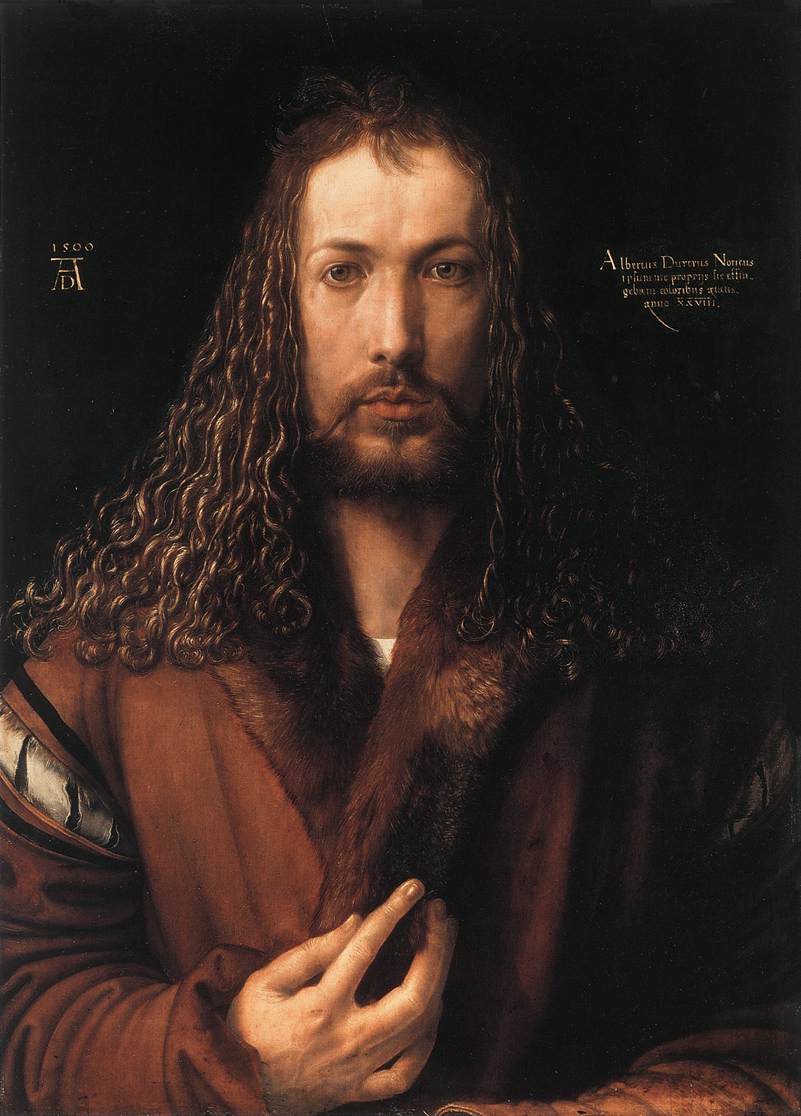
The Great Piece of Turf would make a terrible superhero name. Good thing Dürer is his own favorite superhero.
Albrecht Dürer, The Great Piece of Turf, 1503

Leave it to Albrecht Dürer to make grass look divine.

Really, in almost any other context or with any other painter, a painting of turf would be exactly what you'd expect it to be--lifeless, plain, or insubstantial. But left to Dürer (read: Jesus), being a self-styled king among artists, it gains a depth, weight and an unexpected experimental edge that no one would've expected otherwise. But to anyone not looking deeply enough, it's turf. Gorgeous turf, but turf nonetheless. But let's just get one thing clear before going on:

Not looking is a grave mistake.

The most immediately interesting thing that Dürer presents comes in the form of the plants themselves. Full of life and variety, the collection lacks the uniformity of "regular" grass. While there are patches of similarity, they're punctuated by smaller sprouts that pop up and vie for the sunlight. Dürer captures this push for life perfectly, even without including external imagery like a sun or a sky. In addition to that, each plant is rendered in painstaking detail, to the point where even modern photographic technology struggles to match it. It's amazing even now to think of the hours, the days, that Dürer spent gazing at the ground, hoping to God (read: himself) that he could render it correctly.

But aside from this, there can't be anything else interesting about this painting, right?

Wrong.

Aside from the variety Dürer brings to this turf, there's also a wonderfully subtle degree of depth lent to the painting that helps it feel real, in a way that many nature paintings (or Renaissance paintings in general) lack. The leaves of the plant (please excuse my dearth of horticulture knowledge) sit elegiacally at the front of the painting, contrasting with the urgency that the sprouts provide.
Good god look at the depth!
Albrecht Dürer, The Great Piece of Turf (detail), 1503

There's almost a spiritual component to it in that the hierarchies that prevail throughout nature feel so perfectly rendered and accepted. Even the dirt, created using jarringly experimental watercolors, feels in place. Despite featuring an amazing amount of variation and detail, the painting never feels cluttered or forced, everything is in its right place. But aside from that, there's a certain tranquility to zooming into any part of the painting and finding a new layer or new bit of detail.

Ultimately, this painting demonstrates a lot of things. First and foremost would be, to most, Dürer's outstanding ability as a painter (mind you, this is post Jesus-self-portrait), but it also showcases a lot of the ways that the Northern Renaissance represented a mindshift.

In the North, there was a greater shift towards tangible, secular ideas, a recognition of science and economics and brutality. But this shift wasn't absolute, and there are bits of spiritual and religious tradition that slip into a lot of otherwise secular paintings. But this painting demonstrates the merging of the two traditions, that there could be something divine, something transcendent, about an absolutely scientific painting of grass.

All of that in a painting of grass, and you'd be crazy not to look deeper.

  • 7:00 AM

Know Your Chapeau: David

Donatello, David, 1440?

Donatello's David, renowned as the first free-standing bronze sculpture of the Renaissance, was quite controversial at time of release. While heralded as a great modern (at the time) work by some patrons, others considered it risque, especially in its nude and effeminate depiction of David. But one thing about the statue that has drawn considerable attention is David's hat. Being the only real article of clothing on the statue, it was bound to be imbued with speculative myths and hackneyed meaning.

But the actual hat itself is also quite enigmatic. The design of the hat is anachronistic of the time, it being more of an Italian mercenary's hat than anything that could have come out of the Biblical Era. And while the rest of the sculpture screams masculinity ...not, the hat at least conjures up the image of the violent Goliath and his supposed indomitable nature. But then there're the flowers.

While the hat itself seems out of place, what's weirder still is the presence of laurels and other flora. Taking an anachronistic hat and putting laurels (which are native to the Mediterranean region) on as accents seems like a bold move. But, this may make the sculpture better, at least historically. Unlike the Davids of other artists (read: Michelangelo), this David may indeed be more adherent to the Bible, depicting David as a somewhat weaker-looking person. In the narrative, David's weakness is extolled as a virtue, making its symbolic depiction here seem intentional.

  • 7:00 AM

Pazzi Chapel and Baxandall

Brunelleschi, Pazzi Chapel, 1460?


Brunelleschi, as an artist, ostensibly lost perspective. A perpetual number two to Ghiberti, his relief and painting work was also often overlooked in favor of other people's work. But, in the world of architecture, he was almost unrivaled in his brilliance. From the beautifully austere exteriors of his buildings (see: Pazzi Chapel), to their placement and humanist features, the architectural work of Brunelleschi trumps any of his other work, putting him in a building league all his own.

Michael Baxandall, a noted art historian, notes that Brunelleschi was a "rediscoverer" of perspective as an artistic positioning tool. His use of perspective in all of his different mediums showed him to be a special breed of academian, one that could take his pitfalls as a painter and fix them in his sculpture or his architecture. The somewhat rudimentary implementation of perspective in his paintings became wonderfully symmetrical architecture. The weird and uncouth dimensions on some of his figures would beget the sleek lines and perfect proportions of buildings like the Pazzi Chapel. Moreso than his greatest rival Ghiberti, Brunelleschi was a true renaissance man.

  • 7:00 AM

Know Your School of Athens Polymaths: Ptolemy

Raphael, School of Athens, 1511

What an exquisite back. I'm sure, at some point in time, someone looking to get their artistic weight up said something to that effect while looking at Ptolemy in Raphael's School of Athens. In fact, someone not looking deeply would likely mistake Ptolemy as an extra, one of only a handful of purposeless people in a sea of Super Important People.

Despite this cameo-as-afterthought, Ptolemy is actually just as important as Plato or Diogenes with regards to his contributions to the academic community. Known for his theories on mathematics and astronomy, he was one of the first to publish a book theorizing the distance between the Earth and the other planets. This tome, called the Almagest, was the main point of reference for astronomers and amateur stargazers alike for the next few hundred years. He also published a book called The Geography, which compiled the best and most comprehensive maps of the regions into one (somewhat) concise book.

  • 7:00 AM

Jacob and Esau

Lorenzo Ghiberti, Jacob and Esau, 1425-52

This relief, titled Jacob and Esau, is another relief from Ghiberti's magnum opus, the East Doors or Gates of Paradise. Crafted sometime between 1425 and 1452, the relief looks to tell the story of the twin brothers as they fight over their respective birthrights. While other parts of the story (e.g. the selling of Esau's birthright for stew) are depicted in the periphery, the ultimate end to the the biblical story, their reconciliation, is depicted in the front of the relief.

Looking at this relief for the first time, one of my biggest and most pressing questions was, "How"? With any ornate and detailed work of art there will be questions of how they decided to frame certain things or construct a scene, but for me this piece stands as both a technical achievement and an artistic one. Something that Ghiberti became known for, at least with his casting and relief work, was his exquisite detailing and positioning. His casts, unlike many of the ones at the time, possessed a level of detail and thematic consideration that was lost on contemporaries like Brunelleschi.

In this relief, we see Ghiberti's excellent workmanship at the forefront. The raised figures in the front lend it an acute sense of depth, and the structures (the building on the left and the circular veranda) are well done in their proportions and perspective. But the one thing that strikes me as "off" about this relief is how cluttered it seems. While there are many individual elements that are downright awesome, there is too much going on to identify what exactly the focus should be. The scene in the front where two factions appear to be confronting each other or the scene in the back in the mountains? While the scenes individually could make for a great relief, together they're at odds with each other. Despite this grievance, I still feel as though this piece only cements Ghiberti's reputation as an unparalleled goldsmith and relief crafter. 

  • 7:00 AM

The Gates of Paradise

Lorenzo Ghiberti, Gates of Paradise, 1425-52

There's something to be said for obsession. While never good in a vacuum, certain forms of obsession can help to create monumental things. This sentiment is evidence in Ghiberti's magnus opuses, a pair of gold and bronze doors dubbed by Michelangelo the "Gates of Paradise." Worked on excessively by Ghiberti through two commissions over 25 years, the doors show a meticulousness and attention to detail that is distinctly Ghiberti. While hardly resembling a gate (Michelangelo always did have a problem with distinctions), the so-called Gates of Paradise do indeed live up to a heavenly ideal, with their beautiful gold plates, all realizing scenes from the Bible. Ghiberti expertly crafted almost every part of this masterwork, lending an awesome amount of detail to each panel. Each face is emotive and relevant, even his own.

While Ghiberti's first work with the church through statue commissions and contests showed hints to the kind of intricate creations he was capable of, these doors stand as the most prominent and perfect presentation of his prowess as an artist.

  • 7:00 AM

Aftermath of the Obliteration of Eternity and The Wife of Bath

Yayoi Kusama, Aftermath of Obliteration of Eternity, 2009
“’Had God commanded maidenhood to all, marriage would be condemned beyond recall, and certainly if seed were never sown, how ever could virginity be grown? Paul did not dare pronounce, let matters rest, his master having given him no behest. There’s a prize offered for virginity; catch as catch can! Who’s in for it? Let’s see! ‘It is not everyone who hears the call on whom God wills He let His power fall. The Apostle was a virgin, well I know; nevertheless, though all his writings show he wished that everyone were such as he, it’s all mere counsel to virginity." - Geoffrey Chaucer, The Canterbury Tales, “The Wife of Bath’s Prologue”

Wow. If there was ever a point where eschatological claims rooted in sexual desire and progressive challenge of double standards meet, it’s here. The woman here, obviously not one for conventional marriage structures, comes off almost philosophical here, using notions of divine will and religious precedent as a straw man for her tiff against maidenhood. It takes a certain boldness to condemn these structures with such scathing wit. And while Chaucer isn’t a woman, his writing reflects what I would assume was a thought that entered many women’s minds. 

That’s where Kusama comes in. As one of the dominant figures in pop art and feminist art, she essentially embodies everything that the narrator was talking about—a uniquely critical lens on traditional religious ideas of self, intention and purpose mixed in with a feminist critique of such. Kusama’s Aftermath is on the surface tranquil and almost underwhelming—lights in a room with mirrored walls. But the title provides a fair bit of context for the installation itself. Aftermath of Obliteration of Eternity packs quite the punch, especially when trying to interpret what exactly the lights are. They could be stars, souls or any number of material elements that make up the fabric of the cosmos.

In 1975, Kusama was admitted to a mental hospital for having hallucinations, as well as for statements that were regarded as harmful to herself and others. It became a tipping point in her life, one where she began to blur the lines between her visions, her idea of infinity and her art. Part of that is present in Chaucer’s linear depiction of this woman, but it’s mostly in the context, the ideas people must have had about this woman, the conception she has of herself as a renegade, an affront to the clergy and the citizenry of the time. This may be how the woman sees herself, but it’s definitely what Kusama is.

  • 7:00 AM

Tughra of Sultan Suleiman


Unknown artist, Tughra of Sultan Soleiman, 1520

This 16th century piece is interesting both for its composition and its purpose. Created for the exaltation of Sultan Suleiman the Magnificent (1494-1566), the piece is a clear standout in the tughra style itself, using a more ornate and colorful arrangement than other tughras of the time. While the picture's a bit heavy on the left, it’s balanced slightly by the long tail of the script. The specific makeup of the script, its massive curves and stacked writing, are all emblematic of the tughra form and carry specific meaning: the loops on the left represent the extent of the Sultan’s control, while the three risen strokes near to the center represent the flags of the Ottoman empire, as well as their independence. Interestingly enough, the script is written in Turkish, not Arabic, a more common language in Islamic art. As striking as the art may be, no artist is credited with it as the tughra was meant to be the official seal of the Ottoman sultan. 

For me, this painting is striking not in its reservations, but in its relative bombast. As opposed to allegories or compositional symbolism, the tughra art form, and this artist in particular, eschew any kind of pretense and use script as the main factor for portraying the grandeur of its subject. It's showy, it's gorgeous and it's clearly made with imperial aspirations in mind. It's both religiously reserved and boastful, representing clearly a sultan who was larger than life, but still beneath God. Much like more Western pieces, this tughra communicates the core tenets of empire without feeling over-the-top or superficial. Upon further analysis I was surprised that this work, like a minimalist portrait, conveys all we need to know about the Sultan but does so in a way that still falls within the tughra style. 

To me, the piece carries a distinct and stately feel to it, undoubtedly because of its complex design. The large calligraphy and ornate patterns feel luxurious, especially when juxtaposed with the bare off-white background. The color scheme too seems to carry an air of royalty, with the mostly blue and gold patterns and scripts evoking other royal seals from other preeminent empires (the English coat of arms comes to mind). During the reign of Suleiman he undoubtedly wanted to put the Ottomans on par with other mostly Western imperial powers like the English and Spanish, and this seal gets that message across quite concisely. 


  • 7:00 AM