Retrograde and The Temptation of St. Anthony

Matthias Grünewald, The Visit of St Anthony to St Paul and Temptation of St Anthony, 1515


One of the most interesting features of the Northern Renaissance was its push towards permutation, not only of different artistic styles but also of different attitudes. Religious paintings became increasingly secular in aim and focus, while more secular works took on a transcendental/religious quality. Of the works that exemplify this shift, Grünewald's The Visit of St. Anthony and Temptation of St. Anthony shows just how gorgeous this permutation can be.

The painting itself is religious almost to a fault. The two scenes depicted show St. Anthony in various phases of his life, showcasing not only his permanence, but also his challenges as he attempted to bring his fiery rhetoric to non-believers. This sentiment, of austerity and boldness, is contrasted brilliantly by the languid and overgrown.

Enter James Blake.

James Blake's 2012 album Overgrown is largely an album of unrequited romances and failed ambitions. Nowhere on the album is that stated more boldly than the title track where Blake states, "I don't want to be a star/but a stone on the shore/a lone doorframe in a wall when everything's overgrown." Blake's production matches his sentiment, blending modern electronic beat programming and bass with a saturated piano line and elegiac pop strings. This idea of permanence, and having a message that lasts beyond your lifetime and into infinity, is at the root of St. Anthony's portrayal here.

Grünewald's presentation here is quite telling--not only are the colors somewhat darkened and disconnected, but the characters also exhibit a disconnection from their location in time. St. Paul, who lived way before St. Anthony, casually has a conversation with Anthony as if his anachronistic placement is nothing more than a slight misstep. The temptation has a similarly timeless quality, its monsters taken straight from a Bosch or Dali painting. All of this alludes to a divorce from notions of time and impermanence that Blake captures perfectly in "Overgrown."

  • 7:00 AM

The Sickness Unto Death Pt. VI: Isenheim Altarpiece

The Sickness Unto Death 
A Musically Guided Exploration of Artist's Struggle with Mortality
Curated by Aaron Dupuis


Matthias Grünewald, Isenheim Altarpiece, 1512

"Every bitter night into an empty room I plead my caseEvery night I pray that in the morning when I wake
I'll be in a familiar place and find that I'm recovered and I'm sane
and I'll remember everything
I'll remember what I was like before that bug bit me"
"The Sickness Unto Death," Typhoon 

Of all of the paintings of the crucifixion, this one hits me the hardest. Critics can talk all they want about the strides that Caravaggio made in making Christ accessible to the public at large. I won't disagree with them. However, this is the only work I have ever seen that fully reduces Christ to a human form. There is no grace. There is no dignity. There is no beauty. Instead Grünewald gives us a hanging corpse, skinny and ragged. He gives us ugliness. The true ugliness of death.

Though this particular panel depicts no sense of holiness - not even the faint halo of Mantegna's Lamentation over the Dead Christ - the other panels hidden from view in the above photo depict a scene of glorious resurrection and ascension into the blinding lights of heaven. By portraying Christ's as a deformed corpse and later as a risen angel, Grünewald conquers the fear of death, not for his own sake, but for the sake of the wretched masses who would have seen the altarpiece in the Monastery of St. Anthony. The Monastery, you see, served primarily as a hospital, and served the lepers and cripples of Isenheim, helping to alleviate their suffering and make their final days on earth as comfortable as possible.

And so the Isenheim Altarpiece's ugliness is only surface level. Beneath the grime and gore lies the beauty of compassion and human empathy. And there too lies the belief that our time on earth is what we should dread most. Death is nothing at all.

  • 7:00 AM

Crucifixion

Crucifixion
Curated by Bryan Lundgren

Matthias Grunewald, Crucifixion, 1512-1515
Throughout the seven paintings of the crucifixion, the audience can notice certain elements to enhance their knowledge on Jesus’s love.  The first Crucifixion, by Grunewald, illustrates Jesus’s powerful love to humanity.  Matthias constructs a beautiful piece with symbolic representations and a certain light placement to complete his message.

Overall the painting demonstrates a black background.  Using darkness, Grunewald emphasizes the light on Jesus, Mary, and The Lamb.  Either sin or human pain, the painter illustrates Jesus’s suffering in the face of darkness.  Grunewald also wants society to recognize Mary.  In a biblical reading, Jesus gave Mary as our Mother.  The Queen of Peace delivers guidance and a motherly nurture to our world.  When death and despair reins over society, Grunewald constructs The Lamb of God to undermine a lively presence.  Using the crucifixion, Grunewald wants to remind civilization of God’s love and interaction when facing despair. 

  • 7:00 AM

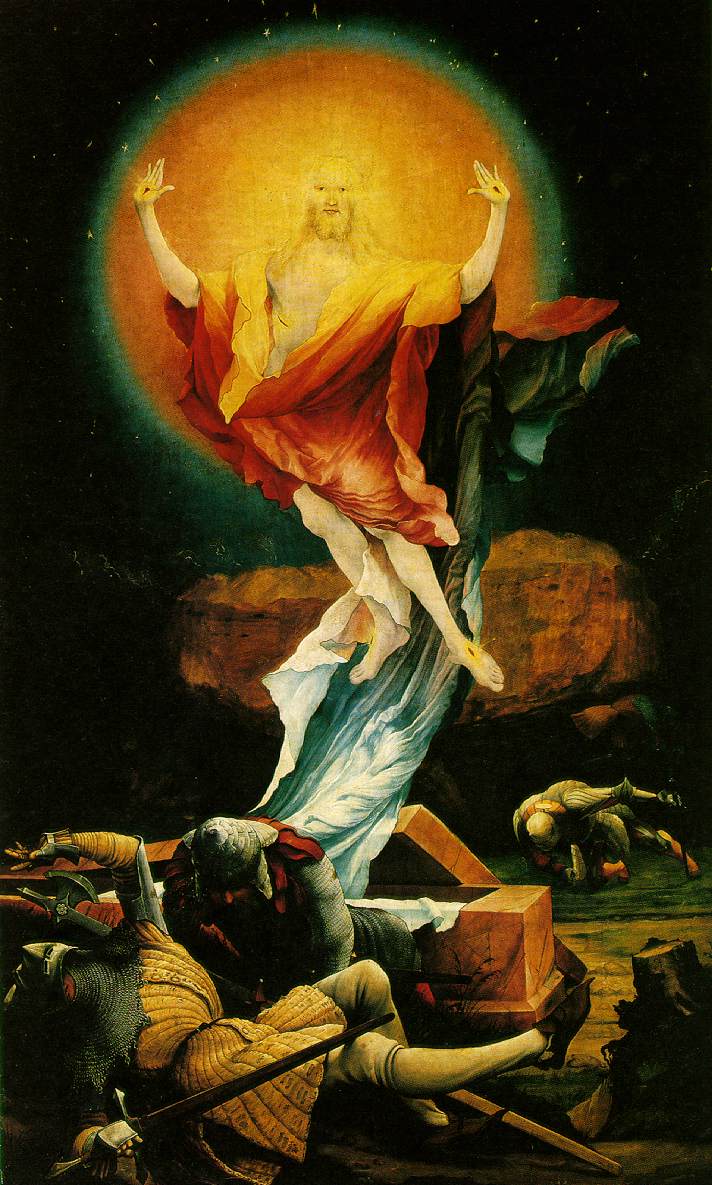
Resurrection

Grunewald, Resurrection, 1512-1516
There exists somewhere in the galaxy a giant spaceship watching the daily life of the human race. At the helm is Ashtar Command, a benevolent conscience that has decided to take the fate of the human race under its wing. A chosen few are allowed to ascend to such a spaceship to experience life, not as a mortal body, but as an elevated conscience. These individuals return to Earth as Light Workers, chosen to spread the message of Ashtar and encourage others to ascend to the fourth dimension. All of humanity must learn to ascend, or else, in a time of need, only few will be able to escape danger while the non-believers are left behind. 

Grunewald paints Jesus like he's a Light Worker ascending to the Ashtar Command. The cosmic energy vibrates around him, ready to take him to the fourth dimension to join the rest at the helm. The non-believers slumber at his feet, unable to wake up to their cosmic openness. 


  • 7:00 AM