American Infamy

Roger Shimomura, American Infamy, 2007
by LISA MAEDA

At our core, we are just people, regardless of our skin tone, ethnicity, or culture.

Roger Shimomura spent a considerable chunk of his childhood sitting within the confines of the Minidoka internment camp in Idaho. There, Japanese-Americans lived out their lives as best they could, boxed in by barbed wire and watched by soldiers. Their housing quarters were less than sanitary, and their food practically inedible. Many of the internees had mentally removed themselves from their home country entirely, so the prospect at being held hostage because of their ethnicity naturally came as a huge betrayal. Still, despite the inhabitable nature of the internment camps, very few skirmishes were had overall.

American Infamy depicts a shadowy, anonymous soldier watching over the community of Japanese-Americans. Unlike the edgy, anti-Japanese caricatures that Shimomura often reprises from the past, the people below are, for the most part, a normal community of people. There’s no fishy business to be had and no spies in sight (except for the American soldier, ironically), just an overall sense of community. The prisoners are dealing with the reality of their internment in all sorts of ways. Adults chat and walk about like normal, perhaps to ease the children who have taken to their new life by idly playing. Some, however, stare out past the fence with longing. An elderly woman collapses by her window.

Much like Shimomura’s other pieces, American Infamy is a deeply political painting. It criticizes American mistakes of the past, and recollects a shared human experience that we have since forgotten.
  • 7:00 PM

Hands

Alfred Stieglitz, Hands, 1918
By LISA MAEDA

Hands are integral to the artist.

Alfred Stieglitz met Georgia O’Keeffe at the age of 52. His photography had propelled him to fame in the art world, and his work is still considered to be the best of the best. Georgia O’Keeffe was 28 years old at the time, teaching art at a quaint school in Texas.

Despite their 24 year age gap and their tremendously different positions, the couple fit together. Stieglitz took no time in divorcing his wife to move in together with O’Keeffe, who he loved to photograph. Naturally, their relationship developed significant strains, but the initial passion between the two was unmatchable. The portraits of O’Keeffe that Stieglitz had photographed were intimate and erotic. Yet, sometimes, they exhibited her beauty in ways unrelated to her sexual body.

I’m particularly fond of Stieglitz’s series of Hands. He photographs O’Keeffe’s hands in various positions. They are graceful, interlocked, and sometimes violent. In this photograph, however, O’Keeffe’s face also makes an appearance. Her slender fingers compliment her stern face. The solemn expression does not detract from her raw beauty. Stieglitz’s publishing of these photographs are a testament to the love he felt for her. Despite their ups and downs, the work created from their love is undeniably gorgeous.
  • 7:00 AM

The Daughters of Edward Darley Boit

John Singer Sargent, The Daughters of Edward Darley Boit, 1882
By LISA MAEDA

Who knew that a painting with so many people, could feel so lonely?

Influenced by Diego Velásquez, John Singer Sargent painted the four daughters of Edward Darley Boit with the intention of documenting their lives and their lavish household. Instead, Sargent paints a black hole in the Boit’s apartment, which the girls fade into. The painting was positively received, but viewers couldn’t help but criticize the void at the center. Why was it so sinister?

Perhaps Sargent had some insight into the personalities of his subjects. After all, the girls standing in the back, swallowed by the shadows, were the problem children. Florence, on the left, simply rejected the ladylike ideals pressed upon her. She didn’t care to attend any social events, and immersed herself in golf. Her sister on the right, Jane, was a different story. Unstable, physically and emotionally, her outbursts brought her to various mental institutions. The younger girls who stand in the light, Julia and Mary Louisa, lived fairly normal lives, contrasting with their spinster sisters.


Truthfully, this painting makes me feel like an adult. The days of my childhood have long passed, and I’m in a darker, lonelier world than these four girls before me.

  • 7:00 AM

Fêtes and Follies: The Roses of Heliogabalus

Lawrence Alma-Tadema, The Roses of Heliogabalus, 1888
By LISA MAEDA

Oh, the glory of spring time. After months of coating-wearing and heater hogging, Nature gently reminds us that the world outside can feel, well, just right. 'Tis the season for animals (and people) to withdraw from their confined existence, and revel in their new found sunlight. For the average squirrel, this means going out, eating a bunch of food, and finding a mate. For the average teenage Roman emperor... well, it's essentially the same.

Elagabalus (Heliogabalus) was elected emperor at only 14 years old, and was assassinated only four years later. His reign was, to say the least, interesting. Like most youngsters with too much power, he frolicked in worldly pleasures. Wild rumors surrounded him throughout the empire, accusing him of freely prostituting himself to other men. He frequently sought out the company of the most attractive, well-endowed men he could find.

This painting is a testament to Elagabalus's short reign. He lays on his stomach, relaxed and draped in gold with a pensive, yet content smile. Behind him, a woman plays music and dons leopard fur around her hips, a tribute to the lusty Dionysus. A statue Dionysus, the Greek god of all things party, embraces his lover, a satyr boy named Ampelus, referencing Elagabalus's bisexual nature.

Roses seep through the bottom left of the painting, like incoming ocean waves onto the shore. It grows into the crowd of people, seemingly hiding their erotic ventures. Yet, they are drowning. Only the royals are safe from this public smothering. Yes, Elagabalus's rule may have been opulent, but only for him. This painting, though initially gay and full of life, enshrouds people below Elagabalus in flowery restrains. They are dazed, sinking further into their own pleasures. Rome needs a leader, and yet their ruler, though young, seems to care more about who he command to be his next lover, rather than commanding a country.

*** Editor's Note: Students developed the topic of Fêtes and Folly to chronicle elegant celebrations, bad dates, late nights, or other things related to that time in Spring where barbaric yawps can be heard from backyards, beaches, or the more familiar rooftop. Enjoy their revelry, cheeky overstatement, and occasional tales of ribaldry over the next couple of weeks.

  • 7:00 AM

The Wave VIII


August Strindberg, The Wave VIII, 1901
By LISA MAEDA

Powerful. Violent. Somber. Meaningless? 

"What does it mean?" asks the average gallery visitor, stumped by the eccentricities of modern art. What kind of statement is the artist trying to make?

Richard Brettell argues: "That there is a very strong and literary-charged subject here, the crashing sea, is undeniable. Yet Strindberg conveyed that subject in ways that have little to do with standard illusionism, and removed any sense of internal narrative from the canvas" (189).

So, essentially, it means nothing.

"Really?" I ask, doubting Brettell's roundabout logic. Don't get me wrong, Brettell is a fun read — but I couldn't find myself agreeing. Strindberg was an author at heart, and to say his paintings were without narrative seemed like an utterly ridiculous assertion. Surely Strindberg, writer of intense dramas that bit into social roles and norms would paint with a storyteller's hand. I believe that the internal narrative remains preserved, a rich element of the cardboard canvas in which Strindberg painted.

The Wave VII is a self-explanatory title. This wave is not Strindberg's first, nor his last. Despite the chaotic focus of the ocean and clouds, the horizon takes its place as the heart of the painting. Surreal, yet gentle, the pale orange light continues to shine past the wave's attempt at extinguishment. Like sunrise over a battlefield, it signifies a peaceful future.

I wonder, if I had a closer view of this painting (18 inches away, to be exact), if it would feel like a Rothko. Strindberg emulates Rothko's double rectangle formula before Rothko's time, and yet the distinct presence of a subject breaks that illusion. And while Brettell acknowledges that subject, he doesn't at the same time, simply by attributing The Wave VIII to his concept of "anti-iconography." 

Perhaps, rather than following vague explanations about how some art doesn't mean anything, we can define art on our own terms.
  • 7:00 AM

Mont Sainte-Victoire

Paul Cezanne, Mont Sainte-Victoire, 1902
By LISA MAEDA

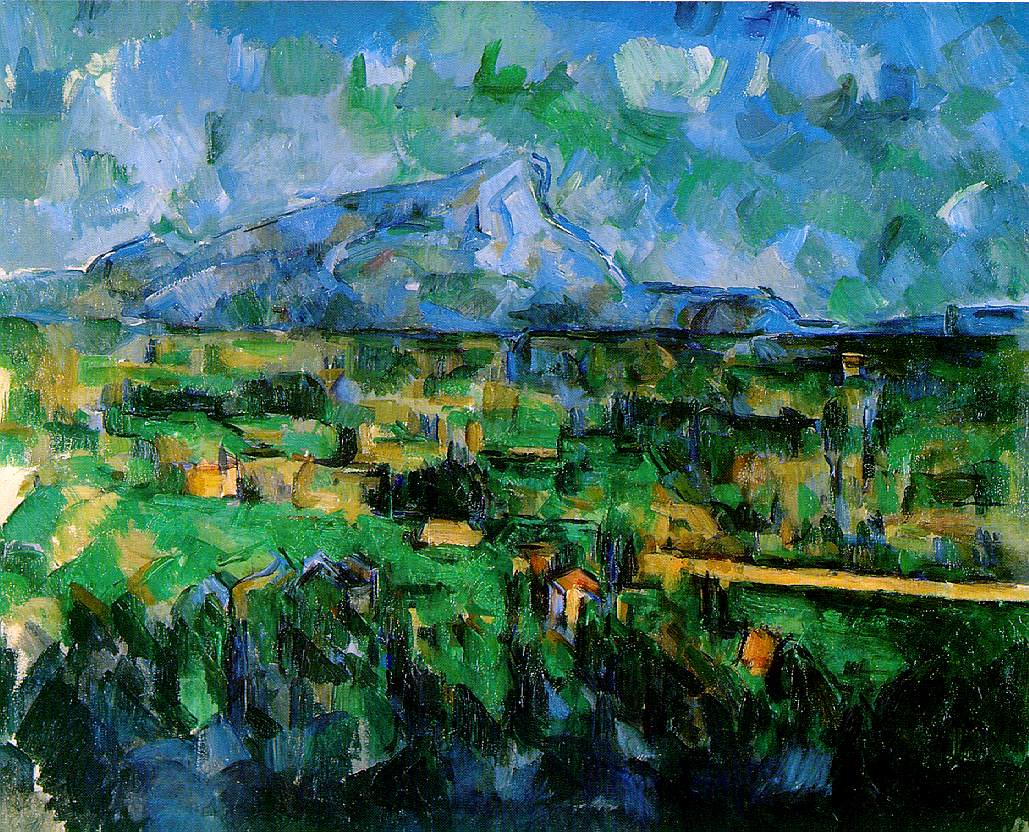
She was the love of Paul Cezanne's life. They grew up together, in the small town of Aix-en-Provence. Time and time again, she would model for him at all angles, never shying away from her beauty. Decades passed, and he would still visit with paints and a canvas in hand. Though the years had aged him, she never did. Perhaps he found her timeless charm irresistible. Maybe it was her height (3,317 feet tall) that enraptured him so. What about her gentle, quiet demeanor? After all, mountains can't speak.

Cezanne was born moody. He simply couldn't stand it whenever his little sisters or mother bossed him around, but was glad to let them do all the work. Even when painting his mistress, later wife, she appeared cold, stiff, and homely. It's probably pretty clear by now that Cezanne had a hard time with people, and he wouldn't hesitant to break ties over pettiness. With his hostile attitude and hermit-like tendencies, of course it makes sense for Cezanne connect so emotionally to Miss Mont Sainte-Victoire. No backtalk, no bossiness, no human feelings. She was "his" best model.

What makes Mont Saint-Victoire so special? There had to be something great about her, considering Cezanne painted her about 60 times. The mountain served as a sort of experimental ground for the artist. He used all sorts of varying techniques, developing the concept of flat-depth. In many of Cezanne's landscapes, he uses space to indicate an understanding of depth. However, he denies his landscapes detail, and therefore giving them a sense of flatness. Only a master painter could so emotionally conjoin these two opposites into one piece.

The Mont Sainte-Victoire series is one of the reasons many artists title Paul Cezanne as the Father of Modern Art. His genius revolutionized the art world, and just like the mountain, his legacy will continue past his death.
  • 7:00 AM

Orpheus Leading Eurydice from the Underworld

Jean-Baptiste-Camille Corot, Orpheus Leading Eurydice from the Underworld, 1861
By LISA MAEDA

Ah, nothing quite like a trip to the underworld. Fiery pits, bone-filled deserts, and the cries of the dead — a truly unforgettable, inescapable place. Or not.

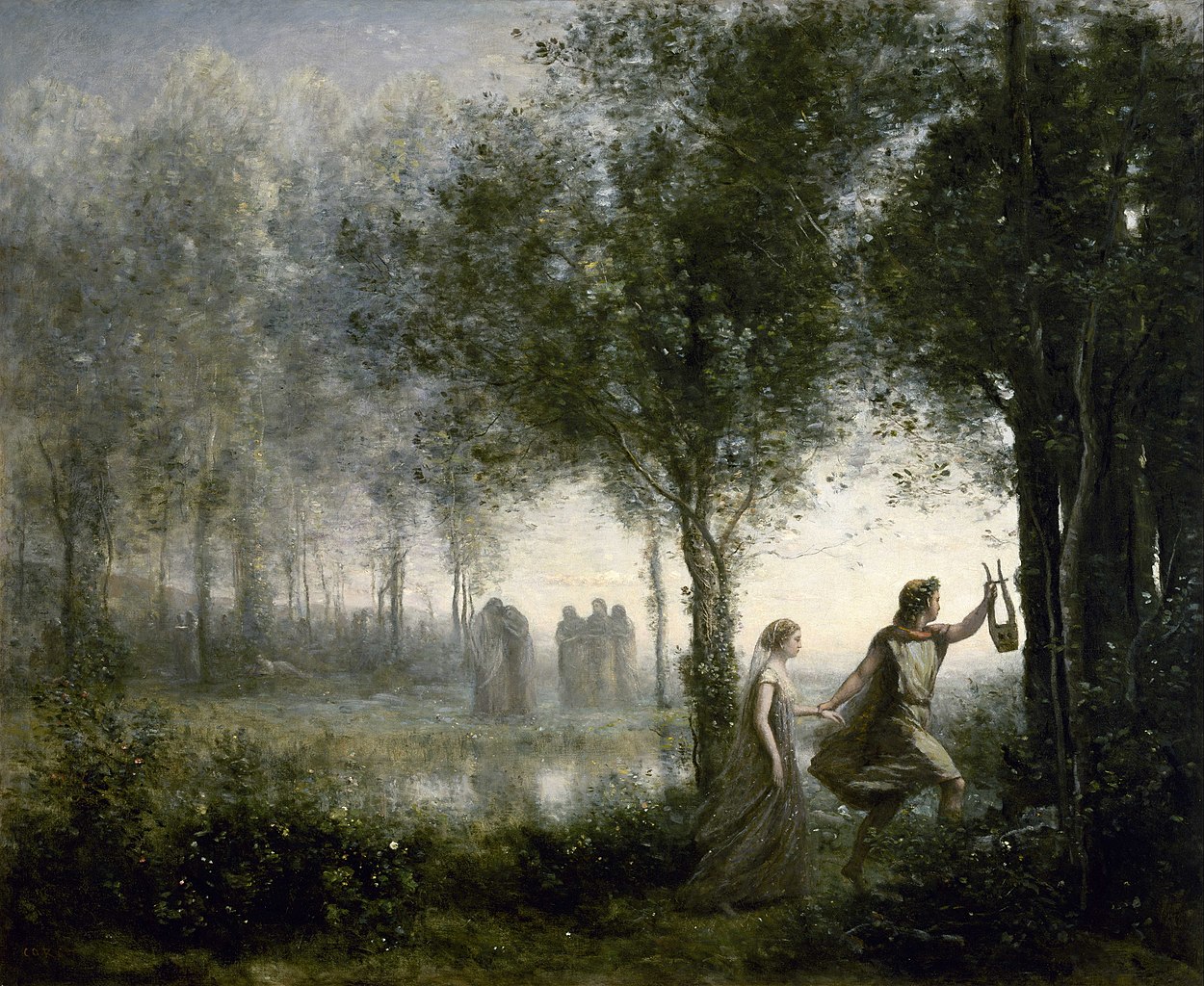
Only the most charming musician can charm Hades, and that musician is Orpheus. He had just married the love of his life, Eurydice. Unfortunately, not even hours after the wedding, she strays from Orpheus and gets bitten by a snake. Virgil's version of the story blames Aristaeus, keeper of the bees, for chasing Eurydice as she denies his affections. Pretty uncool, considering she literally just married another guy. Ovid's telling simply states she went to pick flowers with her bridesmaids. Either way, Eurydice dies tragically, leaving a brokenhearted Orpheus. Unable to cope with the death of his late wife, he decides to ask Hades, "Hey, can I have my wife back?" in song form, and it actually works. There's only one catch: Orpheus must lead Eurydice and cannot look back at her until they have reached the surface.

We watch the reunited couple as they ascend on their trek upwards. The scenery is lush, a harsh contrast to the blazing inferno that we usually associate with the underground. Yet, tension overpowers any semblance of hope.

  • 7:00 AM

Art History Hotties: The Floor Scrapers

Gustave Caillebotte, The Floor Scrapers, 1875
By LISA MAEDA

"What image am I trying to capture? Uh, you know. The toils of labor."

I like to imagine what sort of things Gustave Caillebotte must have said to his models. "Yes, your shirts have to be off for this." "Just bend over and pretend to scrape the floor." "It's not weird guys, it's art!"

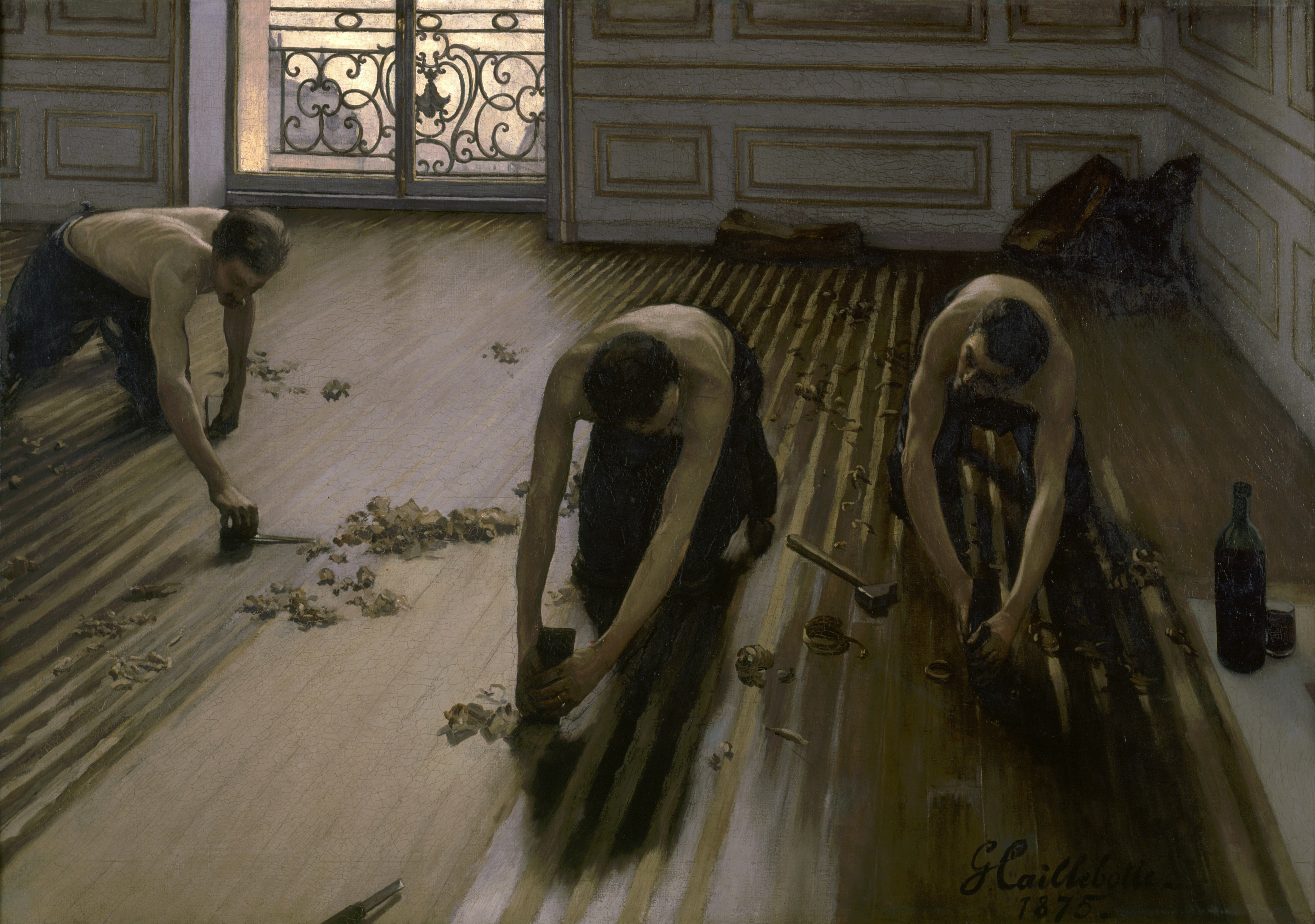
With confidence, Caillebotte submited The Floor Scrapers, or Les raboteurs de parquet, to France's Salon with high hopes. He replicated the gloomy morning light as it shone onto the floorboard. Lean, characterless men hunched over, scraping away dutifully. Just a simple piece of workers in the early hours of the day. Seems innocent enough, right? Surely the Salon would approve.

The response: a solid rejection. Immediately, Caillebotte received his entry back thanks to its "vulgar subject material." It seemed that the Salon saw something different, something less earnest. Perhaps they were right to think that, but either way, Caillebotte took great offense. At the time, male nudity in art yielded to the female nude, which dominated interest. One critic remarked on the precision of the scene, claiming that the painting was optically accurate, but was limited because of it. Amusingly, another claimed that the models simply weren't attractive enough. If Caillebotte wanted to paint nudes, why not go all the way?

Perhaps unbeknownst to them, Caillebotte had indeed painted handsome male nudes, and would continue to do so. Notable works such as Homme au bain, and Man Drying his Leg popped up only a few years later, evidence of Caillebotte's refusal to deny himself the subject matter.

Never give up on what you love. Caillebotte loved painting naked dudes, and nobody, not even the Salon, could stop him.

  • 7:00 AM

Portrait of My Dead Brother

Salvador Dali, Portrait of My Dead Brother, 1963
By LISA MAEDA

There's a certain Slant of Light
By Emily Dickinson

There’s a certain Slant of light,
Winter Afternoons –
That oppresses, like the Heft
Of Cathedral Tunes –

Heavenly Hurt, it gives us –
We can find no scar,
But internal difference,
Where the Meanings, are –

None may teach it – Any –
‘Tis the Seal Despair –
An imperial affliction
Sent us of the Air –

When it comes, the Landscape listens –
Shadows – hold their breath –
When it goes, ‘tis like the Distance
On the look of Death –

Editor's Note: Students were asked to match a poem of their choice with a painting of their choice. The relationship between the two shall be determined by the viewer/reader.
  • 7:00 AM

Renunciation of Worldly Goods


Giotto, Renunciation of Worldly Goods, 1300
By LISA MAEDA

Good to see you, Giotto. I haven’t seen your 28 fresco series, The Legend of St. Francis, since last year. I distinctly remember sitting in class on a late August day in 2014, starting at grainy black and white prints surrounded by text. I didn’t know what to make of this painting, much less any others featured in our assigned reading packets. “I don’t get it,” I’d think, “What is this supposed to mean to me?” The seniors around me, Art History veterans, articulated their thoughts beautifully. It was as if they were looking at a different painting — a stunning, more meaningful piece of art.

So then I wonder, as the Art History newcomers saw Mark Rothko’s paintings at the beginning of the year, did they think the same thing? We can’t compare Rothko’s abstract expressionism with Giotto’s early Renaissance frescoes, but they do share one thing in common. We probably didn’t “get it” at first glance.

Giotto, an Italian painter, spearheaded the early Renaissance movement. Successor to Duccio and Cimabue, he primarily painted for churches. Many other Renaissance artists continued this trend, painting unique visions of biblical scenes. At first glance, I saw a primal piece of work in Renunciation of Worldly Goods. False perspective, anatomically flawed bodies, and all around stiffness plagued my eyes. Only when our class started to discuss the painting did I stop to think about how this must have looked in the 14th century. Later, we learned about the period eye, conceptualized by Michael Baxandall. Cultivating an understanding through a circumstances of the time in which it was created is an integral part of appreciating historical art. 

Needless to say, Renunciation of Worldly Goods won me over in the end. St. Francis stares off into heaven, and a reply signals down with a gentle hand. Everything, even his clothes, has been renounced in the name of God. Surrounding him, displeased townspeople, glaring at the public display. A stern looking churchman covers St. Francis, and refuses to look at the true saint before him. Despite all that makes this painting funny, weird, or just uncomfortable, there are genuine elements of humility and purity.

Dear juniors and seniors, this painting is my gift to you. Stick with Art History, be it here or in college. Though I signed up for Art History on a whim, I consider what I’ve learned here to be deeply valuable.


Editor's Note: Students were asked to give a painting to someone or something they cared for. These are their moving responses.
  • 7:00 AM

Two Old Men Eating Soup

Francisco Goya, Two Old Men Eating Soup, 1819
By LISA MAEDA

With a title like Two Old Men Eating Soup, one would expect a picture of fragility, even peace. Instead, Francisco Goya paints us a scene straight out of a nightmare. The Black Paintings, a set of 14 murals painted on the walls of Goya's house, evoke horror created from both Goya's illness and sociopolitical views. Contrary to his earlier work, he explores the darkest creative corners of his mind and paints accordingly.

Before, Goya often favored to be passive in times of political strife, despite whatever views he might have held. Years later, he finds himself sick and dying, and the turbulence of the Spanish government only strengthens his distaste for mankind. He channels that distaste into the Black Paintings, a series never meant for the public eye. Twice had he fallen into severe sickness, and those near-death experiences loom over him as he paints. Violence, witchcraft, and corruption set the standard of these murals, derived from Goya's severe perceptions of those around him.

Two Old Men Eating Soup is the smallest of the series, sitting above the door frame to the dining hall. Like unwelcome guests joining you for a meal, they sneer and point to the paintings on their left as if to acknowledge their company. Some speculate that the pair may not be men at all, but witches. Directly to the left of them is Two Old Men, a painting similar in subject but different in nature. An old man grips a cane as another who resembles a pig-like monster, whispers into his ear. Like Two Old Men Eating Soup, Two Old Men features one "normal" looking man and one that could barely be called human, yet both are the same in their respective titles.

Our class took a day to indulge in poetry, and was told to apply a piece to our next blog post. William Blake's The Tyger stood out particularly for it's criticism of a creator. "What immortal hand or eye / Dare frame thy fearful symmetry?" asks Blake. Goya's Black Paintings are Blake's tiger. How could the same man who painted the Black Paintings paint gentle, quiet portraits just years before? 

Though Goya's Black Paintings never intended these murals to be seen, I believe they would be best viewed in the long lost house from where they originated. Unfortunately, rejoining these murals, which have been transferred to canvas, with their siblings back to their home would be a near impossible feat. We can only imagine Two Old Men Eating Soup watching the scene of Two Old Men together with devilish geniality. "Accept it. We are one and the same," they cackle. "Man and death."
  • 7:00 AM

Diana Leaving the Bath

Francois Boucher, Diana Leaving the Bath, 1742
By LISA MAEDA

Let's be honest. Upon encountering this scene, these ladies would make sure you would leave with a face full of arrows. Luckily for you, they won’t notice, as Francois Boucher has conveniently frozen them in place.

Boucher puts us in an awfully uncomfortable position. We peep in on an intimate scene meant to be shared by only Diana, an esteemed Roman goddess, and her assistant. Freshly bathed, they emerge from the waters to their repose on land. She poses, cross legged and relaxed. Her helper leans forward, examining the fair deity to assure her cleanliness. Remnants of today’s excursion hang off Diana’s bow – a not so subtle reference of her hunting excellence. Yet, even with that blunt reminder of the goddess’s ferocity, the Diana of the moment is unaware of our presence.

Though the two women are at the focal point of the picture, Diana takes precedence. She adheres to the bodily fashion of the times, an intentional gesture by Boucher to make the painting more appealing to collectors. It’s no wonder that his character was brought under scrutiny after he began producing paintings more on the bare side. Even more so, when he reduces divine women into vulnerable young girls. Diana Leaving the Bath is a prime example of this concept. Everything seems a smidge too perfect, especially from a man’s point of view. Her bow has been tossed aside to focus on her unblemished figure, a testament to her oath to remain pure. Rather than a goddess, she is reduced to an idealized symbol of virginity. Way to be gross, Boucher.

So why buy it? To show that you’ve tamed the goddess, of course. Sure, she’ll never take a man’s hand in marriage, but that doesn’t mean a man can’t own her. Put it up on your mantle and have a good laugh with the guys! Or, thoroughly upset your wife. Either way, this pervasive piece of art will make an unforgettable impression.

Editor's Note: The authors were asked to write sales copy for Edme-François Gersaint, the prominent rococo art dealer who offered a printed catalog of available works.
  • 7:00 AM