Baroque Records Project


Greetings art history denizens,

Recently, as we were researching the aristocratic Baroque in France, the Netherlands, and that tiny island nation, the students uncovered a treasure in an oversized Rubens monograph.

The book, Ruebens and the Rubenesque by Wilhem Gregorius Sprinklesleeves, actually functioned as a type of safe. Junior Missy Rosenthal sprung the book safe open by accidentally holding page three at 30 degree angle for 15 seconds.  The attendant BOING sound and Ms. Rosenthal's audible gasp caused a collective head-turn that witnessed a small hydraulic lift that raised nearly one foot above the open book. After the taking necessary safety precautions, we determined that the objects on the lift were long-playing records, those things known today as vinyl, wax, or platters.

Oddly, all of the records had covers that were paintings from the era, and there were as many albums as there were us, so we each took a record to explore. You can read the student findings over the next few days. Mine, dear reader, you can peruse below.


Dead Onion and Birds
The Anatomy Lesson 
1974 Ruysch Records
Creem Magazine Review by Bester Langs

In her younger days, Dead Onions and Birds frontwoman Jacoba van Heemskerck would sit on a milk crate at her parents' flower booth on Singel Street in Amsterdam and sing traditional Dutch folk songs to passerby. Early one fine spring morning several years ago, rock impresario Bill Graham was stumbling back to his hotel room at the Intercontinental Amstel when he heard Jacoba singing "Wees nu verblijd in 't mensen heelal" (roughly translated as "Now be happy in the human universe"). Graham dropped to his knees in front of her, produced a template contract he kept in his jacket and begged Jacoba to come to the recording studio immediately. When she demurred, he wrote her a check for 35,000 guilders.

Within a week, Graham had his girl,  a host of session musicians (Johnny Leyster, Bon Frelminum, and Pilly Vander Snal), and masters for Dead Onions and Birds breakout debut "Nightwatch." Jacoba's Dutch-eyed-soul carried a strange fusion of folk, jazz, and pop and was cut with Snal's singular backbeat, the fuzzed weirdness of Frelminum's lead guitar, and the ska-tinged off-beats of Leyster's bass explosion. The record simply exploded in the U.K. after an earth-shaking performance on Top of the Pops where the band, clad in 17th century breeches and collars, ripped through their first single "Steenasty" and a haunting cover of Velvet Underground's "Waiting on My Man." Arena tours followed and the record shot to #1 on the U.K. charts.

Tensions within the band were played out in shocking honesty on their second record "Syndics of the Draper's Guild." Each band member wrote two songs for album and they all recorded their own parts at the studio without the presence of the others. The proof, as they say, was in the pudding, as the record earned dreadful reviews, including the memorable Robert Christagau line "Syndics stinks like like dead onions and deader birds."

But now - but a year later - the band has returned to form with The Anatomy Lesson, a product of a long trip to Morocco, where they spent time with Paul and Jane Bowles, read a book on Maria Merian  (whose painting graces the album's cover) and put their petty jealousies aside. The new record has the greasy nastiness of T. Rex, forays into deep funk, Pet Sounds instrumentation and Jacoba's startling, sometimes staccato delivery.

 It's unconventional music for a politically turbulent time. Since Tricky Dick would not approve, we gladly do.

9.5/10
  • 7:00 AM

Art History Hotties: Jean Cocteau

Amedeo Modigliani, Jean Cocteau, 1916
By MARK LUCE

Some of you of a certain middle-age may remember when Julia Roberts married Lyle Lovett back in 1993. Conventional wisdom wondered what a beauty like Roberts could possibly be doing with a beast like Lovett; ever the contrarian, I wondered what woman was remotely cool enough to be with the wryest songwriter on the planet. Lovett was a personal musical hero, a man whose lyrics mined the sardonic and ironic as much as the Byronic. For all the tracks such as "I Married Her Just Because She Looks Like You," he'd have a heartfelt ballad like"Nobody Loves Me Like My Baby" perfect for that staple of 1990s romance - the mix-tape.

When the students said they wanted to write about Art History Hotties, I balked. Too many innuendos, too much room for run-away puns, the pictures would be too risque. The students, though, were relentless, and in the end my inner mischief trumped whatever sense of public decorum I supposedly still possess. As I read through their responses, I found myself repeatedly snickering and being reminded that Modigiani's portrait of Cocteau looked a smidge like Lyle. And then I recalled my favorite Lovett lines. In "Here I Am," old Lyle speaks the following:

"Given that true intellectual and emotional compatibility
Are at the very least difficult
If not impossible to come by
We could always opt for the more temporal gratification
Of sheer physical attraction.
That wouldn't make you a shallow person
Would it?"

For our purposes - no, it does not make us shallow at all. It simply makes us appreciate the beauty of the human form. Right? Right. Right...it makes us appreciate the hot human form. 
  • 7:00 AM

We Must Imagine Sisyphus Happy


Rothko in Antwerp
A note from the editor: 

After a lengthier than imagined hiatus, I am happy to report that My Kid Could Paint that will return in full tomorrow. We ran into any number of technical issues with the re-design, and we also found that several of our authors had virtually “disappeared” with their graduation and attendant removal from the Barstow e-mail system. 


Over the course of the next few months, we will do some needed housecleaning - getting the tags right for alumni authors, replacing images that have vanished and generally making the site easy to use. We encourage you to follow us on Facebook or Twitter, as each day’s article will be posted upon the social networks. 


The students started this year by reading John Logan’s Red, which traces Mark Rothko’s decision to cancel a large commission for the Four Seasons in the Seagram’s building. We watched an episode on Rothko from Simon Schama’s Power of Art, read Camus’ “Myth of Sisyphus” and traversed the futile landscape of Waiting for Godot. The students’ first posts simply made me smile. They are personal and probing, bold and brainy. Watching students gain intellectual confidence provides me with all the rewards I need from this profession. What will follow here: another group of students who will impress with their insight, wit and words. 
  • 7:00 AM

South Wall

Barstow Art History Students, South Wall, 2005-2014
By MARK LUCE

Over the years, often on lazy Friday afternoons, students in Art History willfully destroy pretty books. Lest ye think vandals run the asylum, please understand that the classroom’s south wall has become one giant collage culled from all sorts of art textbooks, catalogs and books.

On the first day of this year, though, I asked the students to put their hand on one picture that they were intrigued by. Surprisingly, they obeyed.

Next, I told them to take everything down except the works they were touching. We don’t want to take it down, their hang-dog eyes said, we like how it looks.

I explained, in my strongest teacher voice, that what was on the wall was not art, but only mechanical reproductions of art. They had learned from Magritte that ceci nes pas une pipe; by extension I was only asking them to take down pulped paper stained with ink. Art was not involved in this calculus. Stop looking at me, and get to work already.


How disingenuous. Of course art remains thoroughly involved in said calculus. The students cringed at destroying “art,” and their discomfort encouraged me. I wanted them to build a wall for themselves and to discover new works as they decorated. I wanted them to see that pictures scissored out of books and pasted on drywall with double-sided tape serve as their own kind of museum. Further, good museums change their exhibitions regularly.

The works the students chose to keep form the first round of blog posts for this semester. I am thrilled to introduce you to this year’s class of Renaissance Art History. We have nearly a dozen new writers and a couple of seasoned seniors.  I hope you enjoy their passion, insight and energetic writing as much as I do. 


  • 7:00 AM

The Purification of the Temple and Goodtime Jesus

El Greco, The Purification of the Temple, 1600

Goodtime Jesus
By James Tate

Jesus got up one day a little later than usual. He had been dream-
ing so deep there was nothing left in his head. What was it?
A nightmare, dead bodies walking all around him, eyes rolled
back, skin falling off. But he wasn't afraid of that. It was a beau-
tiful day. How 'bout some coffee? Don't mind if I do. Take a little
ride on my donkey, I love that donkey. Hell, I love everybody.


Editor's Note: Students were asked to match a poem to a picture. They could do so with or without comment; they could be serious or playful. We will leave it to our dear readers to make the connection. 
  • 7:00 AM

A Certain Type of Woman: Part V of V.


Antonio Canova, Detail of Venus Victrix, 1505-1508
Detail of Venus Victrix
So, let’s take a look at Pauline as Victorious Venus. She lies sumptuously upon the softest bed of marble you’ll even witness. And in her hand she holds the apple prize. 

The work, life size, stuns with its smooth lines, unbelievable detail and charged sensuality.

Her back bows gently, the drapery folds are extraordinary.

And her head seems to me among the most beautiful I can think of in sculpture. She’s as stunning as she is strong. No-nonsense Venus, the “that’s right I’ve won and I shall wear what I want” Venus.

Pauline, of course, loved the sculpture, for it captured her at the height of her allure and beauty. Camillo was appalled, and quickly had taken to Turin where Pierson Dixson tells us, “it was rarely allowed to be seen.” For her part, though, Pauline reveled in the scandal. She told those that asked about posing nude for the sculptor that “Oh, Canova is not a real man,” or else, “Every veil must fall before Canova.” If she was feeling particularly impish, she would claim, “There was a good fire in the room, so I didn’t take cold.”

Now shall we take cold either, since we have built a small fire in the room with these two subversive women and the stories behind their art.

Editor's note: This week's series was adapted from an earlier lecture. 
  • 7:00 AM

A Certain Type of Woman: Part IV of V.

Antonio Canova, Venus Victrix, 1505-1508
By MARK LUCE

There was another woman who cut a swath through Europe. She was outspoken, vain, and once told her first husband she would come back to Paris only if he gave her “100,000 francs.” She was also a serial philanderer, taking men as quickly as Napoleon took territories. After the death of her first husband, and about the time her older brother Napoleon was taking over France, Pauline Bonaparte married Camillo Borghese, a powerful Roman noble who could help Napoleon further his reach.

Only the headstrong Pauline grew to dislike what she saw as the restrictive conventions of life as a Roman princess. So she did what she did best. She acted out, making Roman jaws drop with her promiscuity, bad-mouthing her sister-in-law Josephine, quarreling with her mother-in-law and spending money, oh so much money on the latest fashions. She quickly grew estranged from Camillo, who seemed uninterested in Pauline in any way, and they lived apart from one another. Even Napoleon, her own brother, said this, “Tell her from me she is no longer beautiful, and she will be still less so in a few years, it is important to be good and esteemed.”

In the midst of this social maelstrom, she did what any self-centered, gorgeous but aging Princess would do. She decided to stay beautiful forever by commissioning the greatest living sculptor to portray her as a life-size Venus… nude and reclining. And she got her husband to pay for it.

Antonio Canova can be considered the greatest sculptor since Bernini, his works certainly define the neoclassical style that dominates the late 18th and early 19th century. [A small aside – Barstow graduate Elyse Nelson, 2005 – is currently working on a PhD at New York University in Art History. Her dissertation is on Canova.] He had commissions upon commissions, and tried to tell Pauline that he was too busy. However, to hear Pauline’s attendant tell it, Canova was so struck by Pauline’s beauty, he started within a month. However, when Canova hinted that Pauline should be portrayed as Diana, the virgin huntress, Pauline retorted “Nobody would believe in my chastity.”

A quick myth break – grumpy goddess of strife and discord and all things chaotic Eris was miffed that she didn’t get an invite to the wedding of Peleus and Thetis (their son is Achilles). Instead of playing nice, Eris crashed the wedding and tossed out a golden apple that said “The Fairest,” or something to that effect. Venus, Juno and Diana all laid claim on the fruit. They wanted Zeus to judge who was the fairest. Zeus, for once, refused to interfere and appointed Paris, a mere mortal, as the judge. He deemed Venus the hottest, thus she got the apple.

Editor's Note: This week's posts are an adaptation of a lecture given in January. Enjoy.
  • 7:00 AM

A Certain Type of Woman: Part III of V

Agnolo Bronzino, Guidobaldo il della Rovere, 1531

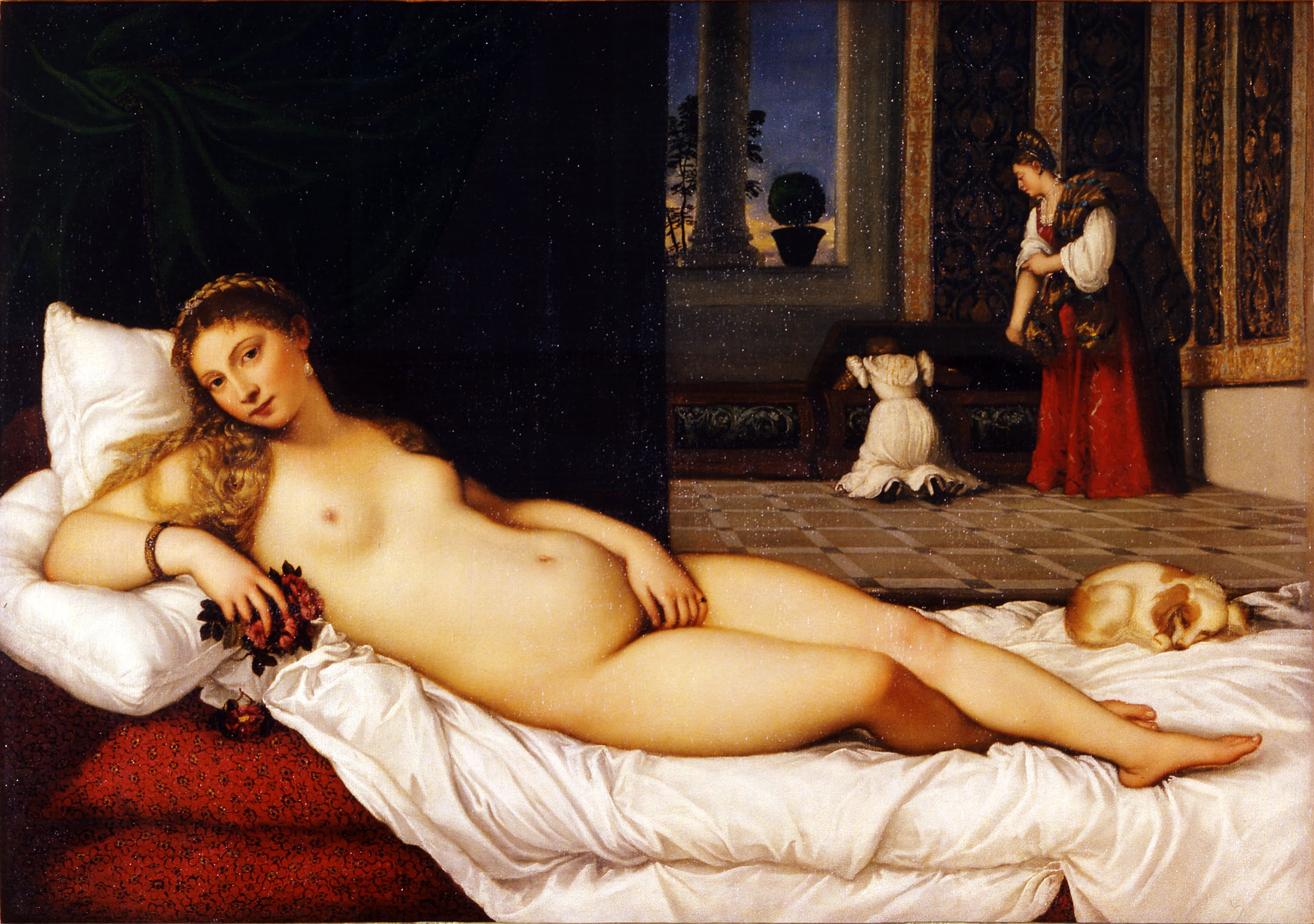
Titian, never one to let an opportunity for profit pass (and perhaps on the hint of Aretino) decided to do something rather naughty. He had Angela model for a portrait, the one we now call Venus of Urbino. Titian, perhaps letting his bawdiness get the best of him, thought Ippolito would get a kick out of this souvenier of Ippolito’s presumably enjoyable evening.

Only Ippolito never came to pick up the painting. And thus it sat in the studio for more than five years, until Guidobaldo il della Rovere, the young Duke of Camerino, saw it while sitting for a portrait.

On March 9, 1538 he told his agent in Venice to pick up the portrait and a picture of a nude woman. But there was a catch, Guidobaldo was a bit cash poor, and worried that Titian might sell the work. So he asked his mom for some money – seriously- she agreed and Guidobaldo received the painting before he took over the dukeship of Urbino in October of 1538.
Titian, Detail - Venus of Urbino, 1538

Oh, and another thing, Guidobaldo was married (for political and economic reasons, of course) to Guilia Varano in 1534. He was 20. She was 10. So, could it be possible that this unconventional Venus, the one who stares directly at us and seemingly invites us to sit on her daybed, actually be more an instructional gift from Guidobaldo to his young bride? This, my sweet, is how we do things her. This is how we how we pose artistically. Don’t worry, the servants will get your dresses.

We will never know quite for sure what Guidobaldo wanted with the portrait – whether what Mark Twain deemed high-class smut, or as the matrimonial embodiment of the most beautiful goddess. We do know, however, that our Venus of Urbino cuts a rather broad swath through the next 400 years of Western painting.

Editor's Note: This week's posts are an adaptation of a lecture given in January. Enjoy.

  • 7:00 AM

A Certain Type of Woman: Part I of V

Titian, Venus of Urbino, 1538
By MARK LUCE

Titian had been painting certain kinds of women since he was an apprentice with Venetian master Giorgione, who also painted certain kinds of women. Only most of Titian’s commissions were for women with names like Mary, Virgin Mary, Madonna, Mary Magdalen, or simply Mary. While Titian was not only a shrewd businessman, but also an incredibly talented painter - one who felt at home painting the Annunciation, the mythic Danae, or even portraits of high-society Venetians, Popes and Kings. While Titian’s brushwork and colors can be incredibly bold, it wasn’t until the early 1530s, that he painted what would become, posthumously, his most brazen work.

In polite company we call her Venus, as it’s okay to look at people without clothes if they are mythic and nude. No less a humorist than Mark Twain had a chuckle at such attitudes when in Tramp Abroad he wrote, "There are pictures of nude women which suggest no impure thought -I am well aware of that. I am not railing at such. What I am trying to emphasize is the fact that Titian's Venus is very far from being one of that sort. Without any question it was painted for a bagnio and it was probably refused because it was a trifle too strong. In truth, it is a trifle too strong for any place but a public art gallery.While Twain has a chuckle at the expense of museums, on some level he’s right. For you see Titian’s Venus of Urbino, well, she’s certainly an unconventional woman.

Over the years I have learned more than a few varying accounts of the commissioning and purpose of the painting, most of them claiming the painting was explicitly for a gentlemen’s pleasure, perhaps of his mistress, or his favorite courtesan - or both.

But if that’s the case, then why do servants pull clothes from a marriage chest, a traditional gift of matrimony? Even the most callous philanderer wouldn’t have a painting commissioned that showed his mistress reclining nude in his wife’s boudoir. Or would he?

Editor's Note: This week's posts are an adaptation of a lecture given in January. Enjoy.
  • 7:00 AM

Black Lines/Several Circles

Kandinsky, Black Lines, 1913
Kandinsky, Several Circles, 1926


Starting on Monday, the students of the Modern Art History class will post writings that link painting and film. What makes me happy about this - they are the ones that came up with the idea. 

As I thought back to film that actually made me think about art, I came back to the adaptation of John Guare's play Six Degrees of Separation. In the 1993 film (and play) a young confidence man, Paul, intrudes upon the rarefied world of Flan and Ouisa Kittredge. Flan looks to sell a mid-period Cezanne to a Japanese syndicate, but his plans are temporarily interrupted by the arrival of Paul, who claims to be friends with the Kittredge's kids. The film and play each explore questions of identity, self-absorption and empathy. They are also each littered with literary and artistic references ranging from a theory on Holden Caulfield's cap to a non-existent Kandinsky. 

The rotating Kandinsky, which would be quite cool, doesn't actually exist. Guare invented it to help deepen the themes of chaos and control that define the lives of Ouisa and Flan. The paintings now live  at the Guggenheim, but they were painted 13 years apart. I have always loved each side of the Kandinsky - the vibrant, often violent abstractionist and geometrically-obsessed Apollonian. Here, though, it's Flan's quotation of Kandinsky that brings me a smile. 

Kandinsky said, "It is clear, therefore, that the choice of object that is one of the elements in the harmony of form must be decided only by a corresponding vibration in the human soul." In other words, the work must speak to us on a level that can't necessarily be expressed. Learning to see will always be a part of any Art History class; however, what I hope you can see in all the posts here is the rather joyous process of students learning how to hear and feel the vibrations of art. 

  • 7:00 AM

Mrs. Richard Bennett Llyod and Edith Wharton

Joshua Reynolds, Mrs. Richard Bennett Llyod, 1775-76

“It was not the first time that Selden had heard Lily’s beauty lightly remarked on, and hitherto the tone of comments had imperceptibly coloured his view of her. But now it woke only a motion of indignant contempt. This was the world she lived in, these were the standards by which she was fated to be measured! Does one go to Caliban for a judgment on Miranda?" – Edith Wharton, House of Mirth

Back in the day in Gotham, the well-heeled would embark on a party/event season that took them through drawing rooms where tuxedos and diaphanous gowns would mingle… and steal kisses…and gossip…and make ethically-challenged decisions. Usually, there was someone who stood aloof – a social scribe of sorts, pen at the judgmental ready.

The youngsters may wonder if I speak of Gossip Girl, with lonely boy Dan Humphrey as the misfit who will extract his literary revenge by chronicling the scandalous lives of Manhattan’s elite. 
 Instead, dear youth, I speak of the original G.G. – Edith Wharton. Reading Wharton’s House of Mirth delivers a dastardly kind of pleasure as she shish-ka-bobs pretension with an almost untoward relish. But she knows that which she criticizes.

Ms. Wharton grew up in a household that has been apocryphally credited the inspiration for the phrase “Keeping up with the Joneses.” She was unhappily married to Teddy Wharton, a Boston man of class and leisure who was significantly older. She and Teddy were often ill, nervous and didn’t much sleep in the same room. However, it took Edith 23 years to get out.

In Reynolds portrait, Mrs. Llyod carves her husband’s name into the tree. We could speak to how Wharton does similar things to the rich and powerful, wielding her sharp pen to slice into the New York social scene of her yourth.

But we could also look at how Reynolds places Mrs. Llyod. The 18th-century graffiti artist leans slightly forward with an unmistakably anticipatory look on her pale face. Also unmistakable, the focus on the midsection and those oh-so-naughty bare feet. Reynolds has beaten Sargent to the Madam X punch by a full century.

Lily Bart enacts this painting in the tableaux vivant scene captured above that gets Lawerence Selden all huffy towards those who mention Lily's foxiness. He sees Lily as Miranda in the forest. We don’t. Lily’s a hottie, but also indecisive, rash, and materialistic. She cuts a teasing, provocative path through high society, only to have her fickleness and desperation lead to social and emotional ruin. Clearly, a total loser Dan Humphrey moment; only this one’s delivered with an aplomb that can only be Wharton.

Editor’s Note: I would like to introduce you to a new class of art history students. For the next couple of weeks they will be bringing you passages of literature tied to paintings. I hope you will enjoy their insight and passion as much as I do.

  • 7:00 AM

Mont Sainte-Victoire


Paul Cézanne, Mont-Sainte Victoire, 1902-1906

In teaching, the logistics tend toward tedium. Papers stack and pens die. Numeric values must be put upon honest craft and summarily entered into electronic grade books that will somehow attest to the relative skill of those involved. Students, because they have been taught such, often place too much emphasis on such markers; and teachers do as well.

In Pangloss’s best of all possible worlds, such finite numbers would be unnecessary. Yet year after year, scores and critiques get scribbled in Pentel EnerGel black (sometimes red) and something feels not right about it.

The students who write this little postage stamp of art on the interwebs have learned in this past year the joys of self-expression. Certainly, they want to perform well in the class, but I hold out hope that having the courage to make their ever-evolving writing available in a public forum helps them understand that content, vision and voice matter – not grades.

Every year, teachers say goodbye to seniors in various ways – the handshake or hug, the silly words in a yearbook, sometimes even a token of appreciation, such as a mix cd or a favorite novel. For this particular group that’s moving on, I proffer a painting.

Parents can be quick to give teachers credit for the accomplishments of their children. Such praise can be as flattering as it can be humbling. However, what neither parents nor students may understand – these kids give us energy, provide us with inspiration, push us to be better. Any success that I have enjoyed as an art history teacher stems directly from the passion and exuberance of the youths who take the class, the ones who drink from that intoxicating elixir we call learning.

The seniors that have now left have delivered insight, handed out laughs, and done phenomenal work that regularly belies their youth. For them, I am thankful.

And for them, I give Cézanne. He was a grumpy old cuss, all locked away from the bustle of Paris in Provence. Fellow Impressionists dogged him, critics lampooned him. His marriage a shambles, his friendship with novelist Emile Zola a victim of what Cézanne saw as a character assassination in Zola’s novel L'Oeuvre. Commercially, he was pretty much a disaster. So he went all Thomas Pynchon and J.D. Salinger. But the further he turned inward, at least to me, the greater his paintings became. And as he aged, Cezanne’s influence spiked.

Pages and pages have been written about how 20th century art starts with Cézanne. Picasso famously claimed of Cézanne, “He was like the father of us all.” Picasso’s rival, Matisse, said, “Cézanne, you see, is a sort of God of painting.” I have made similar claims to students over the years, complete with a litany of formal aspects, theory and, frankly, reductive analysis – much like that numerical value we place on the craft of students.

But the true beauty of Cézanne emerges when standing in front of it. Teaching possesses a similar effect. We watch students blossom intellectually, and they will surprise and inspire us – if we let them.

Several years ago I stood in front of this painting and was moved to tears. I think of these seniors and do the same.


  • 7:00 AM

Uncle Jimmy Green and Student

Uncle Jimmy Green and Student, Daniel Chester French, 1924
I am no Aeneas or Paul:
Not I nor others think me of such worth,
And therefore I have my fears of playing the fool
To embark on such a venture. You are wise:
You know my meaning better than I can tell.
Inferno, Dante, Canto II

Forgive this foray into the personal, but please stay while enough to hear the words. 

Last week, I had the pleasure to see old friends. Six of us attended the opening of Terry Evans' stunning retrospective "Heartland" at the Nelson-Atkins Museum. After the reception, and the reception-after-the-reception, we retired to Cafe Trio for more communion and laughs. Four of us attended high school together: Dave, the country director of Liberia for the International Rescue Committee fresh from four years with Mercy Corps in Iraq (his mother is the artist above); Phillip, the gentleman farmer and artist from Oskaloosa; his high-school sweetheart, spouse and ace ad woman Sally; and me, the book critic turned English and Art History teacher. We were joined by my dearest, early childhood education expert Jennifer; and David's charming Scottish friend Ashley, who has seen international relief action in Sierra Leone, Darfur, the West Bank, and Iraq. Later we were joined by David's sister, Corey, who directs the education program at the Citi Performing Arts Center in Boston.

Please be patient, the exposition nears its end. As so often the case with folks who have known each other for more than 25 years, friendly fire can be the biggest danger. Openings get exploited immediately, and foibles of the past become the grist for present chuckles. As so often the case, I faced such an attack, with four fellow graduates of Salina Central High finding the bead. They fired. 

At least I thought so at the time. After an amusing recollection of mini-scandal involving four junior high and high school teachers, I was deemed "Mrs. Sackrider." "You're so Mrs. Sackrider." "Totally." A gauntlet taunt, to be sure. 

Mrs. Sackrider, now Barbara Werth, was an English and Humanities teacher at Salina Central High for many moons. Her look was what one would expect - flowing skirts, a beaded chain for reading glasses and an undisputed passion and knowledge for all things literary and artistic. She was also the woman who introduced me to modern art, the beauty of El Greco skies and the poetry of Dante. 

In the moment, I turned defensive - I am not Mrs. Sackrider. My approach is different, my interests are different, my emphasis on writing different. Of course, that merely opened the floodgates. I took heat for the similarities in sartorial choices - what is the flowing print skirt but an analogue to the sweater vest? Didn't I major in Humanities at college? Wasn't I teaching her class? I stumbled for answers, thinking somehow I needed to differentiate myself from one of my first mentors. 

After considering this for a few days, I offer my friends a response, "Damn right I am Barbara Sackrider." And I will add to it: I am happy to even be considered with people like Nancy Presnal, Larry Patrick, Garry Armour, Gerry Masinton, Philip Barnard, Cheryl Lester, Tom Lorenz, Ted Johnson, Art Crumm, Mac Gratwick, or Robert Demeritt. What I didn't realize in the silliness of the moment - teachers do make a difference in kids' life. However, I need to remember that as a teacher, it should never be about me. 

Mrs. Sackrider introduced me to Dante. I am merely passing it along. For this post I have chosen the image of the James Woods Green and Alfred C. Alford. Green was the dean of the University of Kansas Law School for 41 years. Alford was killed in the Spanish-American War. The statue was crafted by Daniel Chester French, who also sculpted the Abraham Lincoln statue that sits in the Lincoln Memorial. The student looks toward the East and the sunrise, the teacher looks toward the West. For the next couple of weeks, I hope that the students of Art History at Barstow can show you the sunrise - how the curious students of today engage the world of art and literature - just as my friends and I did 25 years ago. 

  • 7:00 AM

Robert Demeritt, Rest in Peace


Robert Demeritt, longtime teacher of History and Chinese at the Barstow School, passed yesterday in his sleep. And our hurt can be tempered by doing what Bob always did: investigate, contemplate, write, and share.

Intelligent, humorous and stubborn, Bob taught with skill, precision, and passion. With trademark bow tie and a wit that could polish puns, Bob made the act of learning fun. He also possessed that rarest of traits - the ability to listen. 

I said goodbye to Bob on Saturday afternoon. I told him thank you, I asked if he was ready to go. I told him I didn't have any bad jokes. He smiled at me. We held hands. I had wanted to share a passage with him, but the situation didn't really call for it, as he began to drift in and out of light sleep. The passage comes from Cormac McCarthy's
All the Pretty Horses, as the headstrong, but honest John Grady Cole heads off into the sunset. McCarthy writes: 

"The desert he rode was red and red the dust he raised, the small dust that powdered the legs of the horse he rode, the horse he led. In the evening a wind came up and reddened all the sky before him. There were few cattle in that country because it was a barren country indeed yet at evening he came upon a solitary bull rolling in the dust against the bloodred sunset like an animal in sacrificial torment. The bloodred dust blew down out of the sun.  He touched the horse with his heels and rode on.  He rode with the sun coppering his face and the red wind blowing out of the west across the evening land and the small desert birds flew chattering among the dry bracken and horse and rider and horse passed on and their long shadows passed in tandem like a single being.  Passed and paled into the darkening land, the world to come."

That imagery of the red turning black reminded me of the paintings of Mark Rothko, especially his 1964 work Black, Red over Black on Red. Rothko's canvases got progressively larger as he grew older. Rothko certainly knew that, from an art historical perspective, that gigantic canvases tended to be read as "grandiose and pompous." But Rothko went big because he "desired to be intimate and human." He continued, "To paint a small picture is to place yourself outside your experience. However you paint the larger picture, you are in it."

Robert Demeritt, too, painted his life on a large canvas. I am proud to call Bob my friend. I am lucky that he taught me how to be a better teacher, that he showed me how to stay hungry, that he modeled what it meant to be a professional. I miss working with him, talking literature with him, and clinking glasses with him; I  also understand his absolutely fundamental importance to the Barstow School. 

Barstow will miss you, Robert, but what you crafted there lives on. I will miss you, Robert, but your impact on me lives on. 

It goes back to The Bard, again, Robert. "Goodnight, sweet prince. And flights of angels sing thee to thy rest." 

  • 9:13 PM

The Palace at 4 a.m. and Shakespeare Sonnet 30

Alberto Giacometti, Palace at 4 a.m., 1932
My dear friend and mentor Robert Demeritt lies in a hospital struggling with cancer and pain. I want to speak to him. I want to tell him bad jokes from the Borscht Belt. I want to read to him passages from Wallace Stegner's The Angle of Repose, which he gave me several years ago. I want to gripe about my day. I want him to explain the intricacies of the Chinese language to me, tell me that story again about cutting high school and running into his dad at a burlesque theatre. I want him to, as he always does about five minutes after setting foot into his home, offer me the good scotch. And then we will talk and laugh. 

Alberto Giacometti constructed Palace at 4 a.m. in 1932, and at one point he called it, "a fragile palace of matchsticks." While the structure's outlines remain set, even sturdy, the interior openness strikes me as particularly isolated. Some may take that as speaking to the distance that we feel from each other, but I do not. Instead the sculpture contains its figures, in fact even celebrates their enclosure. The human condition may be frail, Giacometti tells us, but we do share that fragility with each other. 

In his novel So Long, See You Tomorrow, William Maxwell uses Giacometti's sculpture as a controlling metaphor for his protagonist (really Maxwell) and his feelings towards his childhood and an old friend, focussing particularly on the two boys climbing and playing on a still-being-framed house. But Maxwell's novel goes so much deeper, exploring how we remember and what that memory - whether real or created - means. He writes: 

"What we, or at any rate what I, refer to confidently as memory - meaning a moment, a scene, a fact that has been subjected to a fixative and thereby rescued from oblivion - is really a form of storytelling that goes on continually in the mind and often changes with the telling.  Too many conflicting emotional interests are involved for life ever to be wholly acceptable, and possibly it is the work of the storyteller to rearrange things so that they conform to this end.  In any case, in talking about the past we lie with every breath we draw."

The passage proffers a hard truth in pillow-soft rhythms. We all may change our stories from time to time; we all may feel sorry for ourselves because something doesn't go as we envisioned. However, we also get to live in that palace of matchsticks with others. And that abiding friendship helps salve our pains. 

As I sit here with the house quiet, worried about my friend, I am somewhat comforted by Bob's earlier admission of being at peace with what he faces. Bob and I love words, and those words often bring us to the Bard, who in Sonnet 30 wrote:

When to the sessions of sweet silent thought
I summon up remembrance of things past,
I sigh the lack of many a thing I sought,
And with old woes new wail my dear time's waste:
Then can I drown an eye, unused to flow,
For precious friends hid in death's dateless night,
And weep afresh love's long since cancell'd woe,
And moan the expense of many a vanish'd sight:
Then can I grieve at grievances foregone,
And heavily from woe to woe tell o'er
The sad account of fore-bemoaned moan,
Which I new pay as if not paid before.
But if the while I think on thee, dear friend,
All losses are restored and sorrows end.

My dear friend and mentor Bob lies in a hospital bed, but I shall not moan this sad account. I shall be happy he's my dear friend. 

  • 11:23 PM

The Hanged Monk

Francisco Goya, The Hanged Monk, c. 1810-1812
By MARK LUCE

The work The Hanged Monk by Francisco Goya has a troubling history that goes beyond the brutality it depicts. Variously attributed to dates between 1810 and 1812, the painting was inherited (along with a significant portion of Goya’s paintings and prints) by Goya’s son, Xavier, after the death of Goya’s wife Josefa in 1812. The group of related paintings given over to Xavier was marked with an X9, visible in the bottom left of the work.

That date holds some particular meaning, as falls in the middle of the Pennisular War, when the French, led by Napoleon, ruled over Spain. Goya, a Spanish court painter for Charles III and IV, would later vehemently deny that he cooperated with or assisted the French during the war from 1808-1814. Almost as a protest – though much later – Goya painted his famous Third of May, 1808, which shows French soldiers slaughtering unarmed civilians.

Six months after the crackdown on Madrid, Napoleon offered the following to the newly-approved Mayor of Madrid, “I have hastened to adopt measures calculated to tranquillize all ranks of the citizens, knowing how painful the state of uncertainty is to all men collectively and individually. I have preserved the spiritual orders, but with a limitation of the number of monks. There is not a single intelligent person who is not of the opinion that they were too numerous.” Napoleon continues, “Priests may guide the minds of men, but must exercise no temporal or corporeal jurisdiction over the citizens.”

The painting, ironically, demonstrates that French soldiers have no problem exercising that power.
  • 10:52 PM