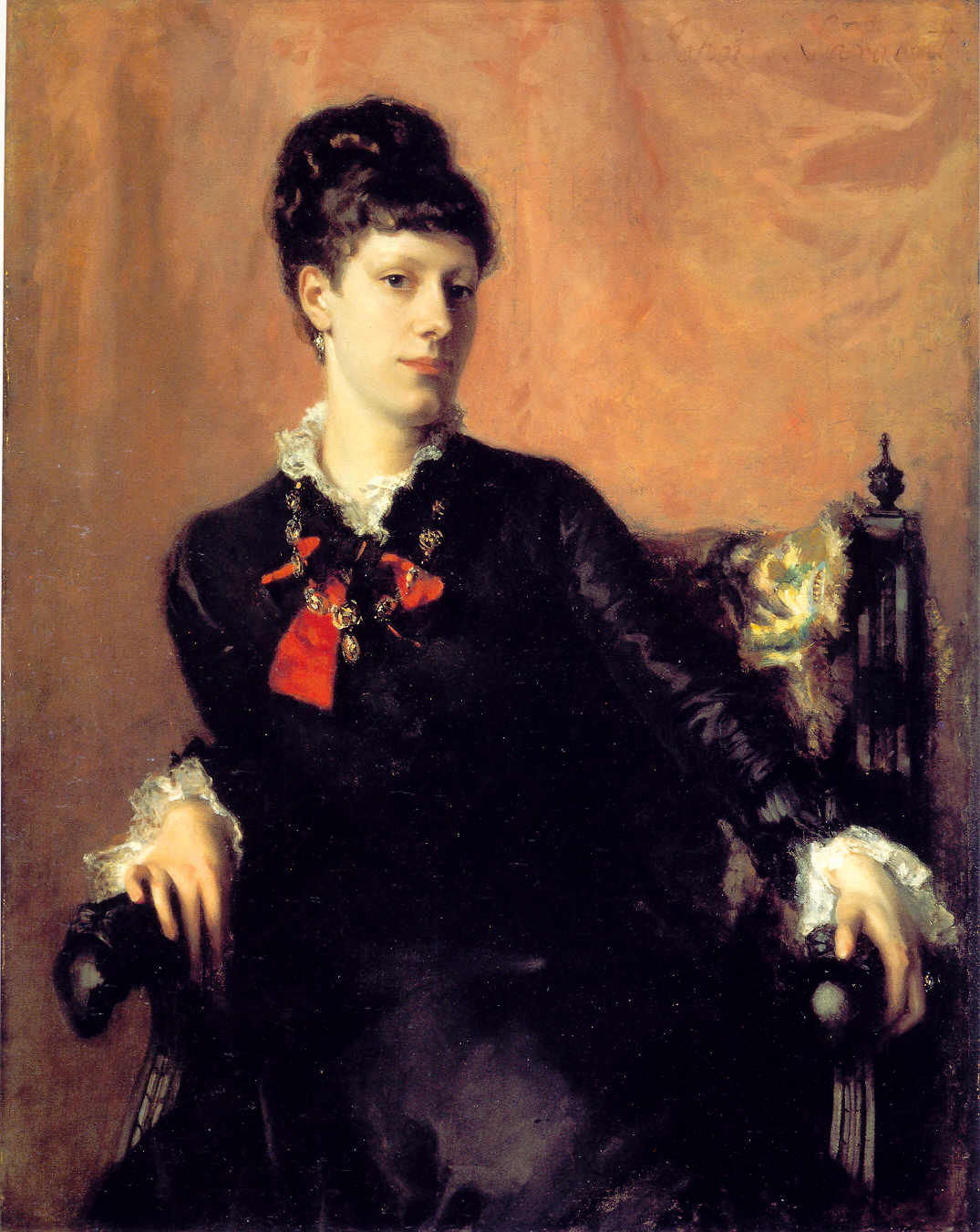
Portrait of "Fanny" Watts

John Singer Sargent, Portrait of Frances Sherbourne Ridley Watts, 1877

Sargent painted this portrait of Frances Watts, affectionately called Fanny, in 1877. She was a childhood friend, perhaps even a romantic interest; however more so than that, she was his ticket into the art world. At only 21 years old, Sargent and his portrait were accepted into the Salon and thrown into a world of fame and recognition. Judges and critics loved the portrait, calling it “charming” and “promising.”

The portrait embodied France’s aesthetic and stylistic values of the time. Fanny Watts’ ivory skin and coiffed hair appealed to French taste while distinguishing her as a lady of affluence. She looks in the direction of the viewer – or perhaps Sargent – with a coy gaze that French women have somehow perfected. Her position on the chair is telling of the modernity of the portrait. Unlike traditional portraits, where the subject is seated, straight-backed, and rigid, Sargent paints Fanny in the midst of raising herself up. Sargent often paid attention to the pose of his models. He often positioned them in unconventional ways, drawing attention to different aspects of the body. Her twisted torso and extended arm, paired with that coquettish gaze, evoke a sense of 
vivification. Although this portrait is conservative, that splash of red and shadow of knee hints at Sargent’s boldness that would soon surface in later paintings.

  • 7:00 AM

The Daughters of Edward Darley Boit


John Singer Sargent, The Daughters of Edward Darley Boit, 1882
Edward Darley Boit approached Sargent before the Madame X scandal to commission a portrait of his young daughters.  Not only was Sargent one of the most sought-after portraitists of the time, but he, like Boit, was also an American expatriate artist living in Paris.  Perhaps his realization of the Boits' and his common experience led him to commit his own feelings to the canvas, turning a simple commission into something intensely psychological.  In the Boit daughters's portrait, Sargent sees himself and expresses his own uncertainties about the future.

Diego Velázquez, Las Meninas, 1656
The painting draws inspiration directly from Velázquez's Las Meninas.  Both paintings share similar dimensions (but Daughters is almost exactly square) and use of depth, casting shadows across their subjects.  Each of Boit's daughters poses uniquely, the two youngest in front and the eldest further back.  Two Japanese vases roughly frame the painting, the possessions larger than the girls themselves.  The Boit family donated them along with the painting to the Boston Museum of Fine Arts, allowing the viewer to be completely immersed in the scene.

The Daughters maintains a prevailing sense of isolation and unease.  The unconventional composition could be playful in a different execution, but the subdued hues and poses seem to rob the painting of the quiet contentment.  Even the little girl in the foreground looks preoccupied, ignoring her pink doll.  The larger-than-life setting dwarfs the girls, from the strange vases and the tall red divider to the fireplace in the background.  The brushwork is quite good -- look at the light on the leftmost girl's skirt, or the youngest's fine hair -- but the picture seems somehow unsettling.  Perhaps Singer incorporated his own feelings into his art -- uprooted from one's country, the future was too mysterious to contemplate, a dark uncertainty infiltrating the backdrops of his work.

Sargent  entered the painting for the Paris Salon d'Automne in 1883.  Despite some critics accusations that it consisted of "four corners and a void" for its unusual shape and composition, it was well-received.  Would that the Boit daughters had fared so well.  Whatever vague shadows haunted the portrait consumed the sisters later in life.  The younger two remained close, but the older two both developed isolating mental and emotional disturbances.  None of the four ever married.  After a short trip to Madrid to hang alongside its 1656 inspiration in El Prado, the prescient painting was committed to its current museum in Boston, a source of eerie wonder.  The portrait only proves Sargent's deep understanding of his subject and mastery in describing their emotions on the canvas.

  • 7:00 AM

Atlas And The Hesperides

John Singer Sargent, Atlas And The Hesperides, 1922

We enter a scene of rest and serenity, complimented by the blue floor the nymphs lie on. That is of course before we see the sun, the rays bursting from behind this man’s sculpted form. A perfect match of colors, blue and orange, separated by the horizon. Atlas kneels with all his strength and immortality, bearing the weight of his suffering. For what he holds is a punishment. The way he holds the universe above him, preventing the sky from crushing the home we populate, shows a man trapped from either side. Confined by the sky that rests upon his back, as well as the soil that holds his weight, pushes back against him. If this wasn’t enough, the columns border him on either side, placing Atlas within a square. He was given this task for his siding with the Titans in Greek mythology.

This painting was one of Sargent’s later works, completed in between 1922 to 1925. John Singer Sargent died at age 69 in April of 1925. Age has no bearing on the beauty one can capture on canvas. What Sargent does so well with this painting is the colors, the proportions, and the composition with its geometrical aspects. First off, the colors Sargent captures, with the shadows, is modern and creates depth. He has taken a classical myth and painted the scene in an Art Deco style. He captures the cleanliness of straight lines and order. Next, Sargent captures the human form. The bottom half consists of nymphs laced with a sense of sexuality in their positioning while they slumber away. Finally, Sargent creates a well-balanced work through shape. The painting possesses strong linear lines that divide the painting in half; other lines push in towards Atlas, further emphasizing his prison. Beyond the lines, Sargent uses circles to stress the weight Atlas supports. The heaviness of it all, each side pushing in, contorts Atlas' body into a sphere. The Celestial sphere invades the canvas, which is also a circle, creating the sense of importance in Atlas’ job.

What makes this piece so great is how Sargent displays his understanding of his profession, as well as his skill. He accurately paints the pain and beauty of Atlas’ story. This is the work of a master.


  • 7:00 AM

Art for the Private Viewer - Man with Red Drapery

Art for the Private Viewer
The Broad Usage of Sexual Figures in Art
Curated by Sree Balusu

Man with Red Drapery, John Singer Sargent, After 1900

"Once I pass'd through a populous city imprinting my brain for future use with its shows, architecture, customs, tradition,
Yet now of all that city I remember only a man I casually met there who detained me for love of me,
Day by day and night by night we were together - all else has long been forgotten by me,
I remember I saw only that man who passionately clung to me,
Again we wander, we love, we separate again,
Again he holds me by the hand, I must not go,
I see him close beside me with silent lips sad and tremulous."
-- Once I pass'd through a populous city
, Walt Whitman

Many who argue that John Singer Sargent was gay, point to a series of paintings (which includes this painting) depicting men in sexual poses as clear evidence.

The naked man has only his dark red drape covering him as he poses erotically. The man expresses longing (possibly for a lover), as his arm is thrown upward while his head is tilted far back. The subject may remind viewers of a stage actor. Looking closely at the man's posture, we can see how it is poetic and even theatrical in its depiction of the sadness in being separated from a lover.


Sargent did say "Cultivate an ever-continuous power of observation. Wherever you are, be always ready to make slight notes of postures, groups and incidents. Store up in the mind... a continuous stream of observations from which to make selections later. Above all things get abroad, see the sunlight and everything that is to be seen." He thoroughly follows this idea in Man with Red Drapery, as he creates a very specific figure that shows unhappiness.

This painting is an excellent example of the way that sexual figures in art can be used to create an aura of grief and nostalgia.

  • 10:31 PM

The Misses Vickers

John Singer Sargent, The Misses Vickers, 1884
John Singer Sargent focuses once more on the fantasy of the femme fatale in his 1884 painting The Misses Vickers commemorating the eldest sister’s 21st birthday. In this pseudo-Velazquez work, Sargent brings the dark palette, depth, and eeriness used in The Daughters of Edward Darley Boit to the canvas.

Even though the dark background screens out the detail of the room the three sisters are posing in, the viewer can tell by the hint of light in the upper right corner that the room extends quite far back. Yet Sargent does nothing with this space he has created, randomly placing a few reflective objects here and there. But such is the mystery of a Sargent painting—three sisters, huddled together in a pitch-black room with eyes of innocence and lips concealing sin. The eyes immediately converge on Evelyn, the sister to the far left.

The only young lady dressed in a light, pastel dress, seems to illuminate against the stark background. The middle sister looks villainous in black with a hint of pink emerging from her bosom. And finally, Mildred, the sister to the far right, has a beige tint to her skin and wears a brown dress to match the cushion of the chair she awkwardly sits in. This cacophony of colors, fabrics, and positions certainly makes the foreground appear disjointed, but also succeeds in highlighting the individuality of each sister. Yes, they are painted as a group, but this is as much a solo portraiture as it is a trio snapshot.

We cannot know everything about this painting—which secrets have not been told, what lies behind the spot-lit women—but we do know that Sargent’s technique is one to be admired and not one to be imitated, for he truly demonstrates his mastery of conveying mystery and seduction in The Misses Vickers. 

  • 12:00 AM

Portrait of Carolus-Duran

John Singer Sargent, Portrait of Carolus-Duran, 1879
By age 13, John Singer Sargent spent much time studying paintings in museums. Everywhere he went, he took his notebook to sketch and paint what he saw. Mrs. Sargent (John's mother) had friends who encouraged her to arrange professional training for her son. It was a result of this early interest that Sargent met Carolus-Duran.

Sargent first met Carolus-Duran in 1874, when his parents enrolled him in Ã‰cole des Beaux-Arts, an art school in Paris. Carolus-Duran, after assessing Sargent's portfolio, decided to let him study art as his pupil. According to Carolus-Duran, Sargent was to unlearn certain methods he had acquired, but expressed optimism at the young boy's natural talent.

He quickly became one of Carolus-Duran's best students and gained the respect of his peers through his sheer innate ability. The school emphasized the importance of drawing as the foundation of visual art, while Carolus-Duran had his own ideas. He focused on manipulating the paint sensuously. Carolus-Duran held that artists should paint in a fluid way.

Originally, Sargent was interested mainly in landscapes (which explains his numerous sketches of mountains and seas). However, after studying under Carolus-Duran, he developed an interest in creating art out of the people he met. It was with Carolus-Duran's guidance that Sargent started his career in portraiture and gave him an interest in the subject.


  • 12:00 AM

Dr. Pozzi at Home

John Singer Sargent, Dr. Pozzi at Home, 1881
“But everybody wants some,
I want some too.
Everybody wants
Baby, how ‘bout you?”
-Van Halen, “Everybody Wants Some”
            
Dr. Samuel Jean Pozzi, Ph.D. in love, became interested in more things than gynecology in his career. Innovative doctor, socialite, and all around ladies man, the good doctor pleasured his guests with his dazzling good looks and friendly mannerisms. All of the ladies wanted him, and he obliged them. Inspiring such nicknames as the Siren, Doctor of the Stars, Dr. Love, and even Dr. God, Dr. Pozzi ruled the world of Parisian socialites.

Dr. Pozzi’s suave aura and wealth attracted many women and even a few men. John Singer Sargent came to one of Dr. Pozzi’s parties trying to find an established patron, but instead heard the enticing call of the siren. When talking to Dr. Pozzi about a portrait of Pozzi’s indifferent wife, Sargent suggested that he paint Dr. Pozzi. The doctor instantly fell head over heels for this idea. Sargent soon started on what would become Dr. Pozzi at Home, but found himself drinking Dr. Love’s love potion.


Sargent may have developed a crush on Dr. Pozzi. Pozzi’s hand unlacing his bathrobe certainly makes the painting scandalous, along with the scarlet background and robe. Sargent came from an American family, despite being born and raised in Europe, and often appeared proud of it. In the famous American novel The Scarlet Letter by Nathaniel Hawthorne, the Puritan courts force an adulterous, Hester Prynne, to wear an embroidered scarlet A as punishment for her crime so everyone immediately recognizes her as a sinner. Unsurprisingly, Dr. Pozzi appears all right with being drenched in scarlet paint. He even seems to revel in it, which seems natural since he would later found a social club named the Cercles des Amis de la Rose (basically a place where rich men could live out sexual fantasies). Sargent had also been known to have crushes on his subjects, like Madame Amélia Gautreau, Albert de Belleroche, and Judith Gautier.
Dr. Pozzi, with his Ph.D. and dashing good looks, enticed the wealthy of Paris while also making ground breaking discoveries in the field of gynecology. Sargent’s portrait cemented Dr. Love into the world of art history. Now, no one can ever forget why everyone in Paris, even Sargent himself, wanted some. 

  • 12:00 AM

The Daughters Of Edward Darley Boit and The Virgin Suicides


John Singer Sargent, Daughters of Edward Darley Boit, 1882
You’ve just stepped into a place were you are not welcome. Their gaze meets yours and you immediately go to turn away. You’ve locked eyes with the Boit daughters. They are mesmerizing, and utterly untouchable. These sisters are the focus of John Singer Sargent’s The Daughters of Edward Darley Boit. The girls in the painting are just as mysterious as the Lisbon sisters in Jeffrey Eugenides’ 1993 novel The Virgin Suicides.

Julia Boit, the youngest, resembles the spirit and joys of youth. While Florence and Jane, hide in the dark ashamed of the adolescence. None of the daughters in the painting ever married, and they all turned to each other for support. They were a cult in and of themselves. The Lisbon sisters of suburban Detroit allowed no one in either, and remained aloof to the outside community. Eugenides writes, “It didn't matter in the end how old they had been, or that they were girls, but only that we had loved them, and that they hadn't heard us calling, still do not hear us, up here in the tree house, with our thinning hair and soft bellies, calling them out of those rooms where they went to be alone for all time, alone in suicide, which is deeper than death, and where we will never find the pieces to put them back together.”

As you try to piece the Boit sisters’ stories together, you find your self faced with an impossible task. They are connected, yet eerily separated from each other. These nineteenth-century sisters’are cold and they beckon you to drop your gaze. The Lisbon sisters hold the same mystery, the closer you get to these girls you realized how far they are from reality. They are beautifully haunting, and hard to shake.

  • 12:00 AM