The First Days of Spring

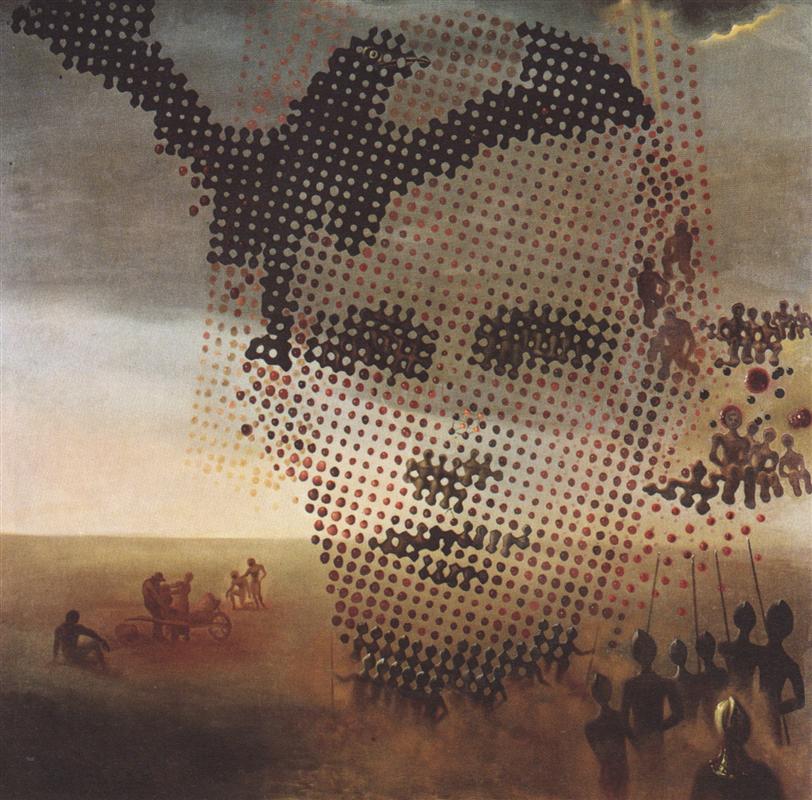
Salvador Dali,  The First Days of Spring, 1929
By SARAH XU

Salvador Dali is, in general, a strange and random artist. Many of his surrealist paintings can not be fully interpreted. The First Days of Spring was painted a couple of months before Dali joined the Surrealist movement. He called this painting “veritable erotic delirium,” which means he wanted to create shocking, detailed images. The various images seen in The First Days of Spring reappear many times in Dali’s other paintings.

Similar to many of his other paintings during his Surrealist period, Sigmund Freud’s theories were the main influence. Freud’s Interpretation of Dreams suggested a person’s childhood experiences were the source of someone’s fears, desires, and neuroses. As a tribute to his inspiration, the old man with the little girl on the right of the painting is thought to be a representation of Freud.

In the center of The First Days of Spring, there is a photo of Dali as a child, which further indicates the scattered and seemingly random images relate to his childhood. This painting was painted in 1929, a time when Dali and his father’s relationship was unstable. Dali’s father was becoming more and more disappointed in his son’s occupation and behavior, which caused their relationship to be strained. Figures of a man and a boy appear many times in Dali’s other paintings, while the seated man on the left is said to be Dali’s father in The First Days of Spring, signifying Dali’s desire to mend their broken relationship. The distressed man leaning on a woman in the front of the painting shows Dali’s sorrow towards his father while the contrasting happy artwork directly behind the two figures symbolizes Dali’s hope to be happy once again. Furthermore, the two fighting men in the back could be seen as a representation of Dali’s suffering. Although viewers see Dali as a peculiar man, each portion of his eccentric paintings represents something meaningful in his life.
  • 7:00 AM

Portrait of My Dead Brother

Salvador Dali, Portrait of My Dead Brother, 1963
By LISA MAEDA

There's a certain Slant of Light
By Emily Dickinson

There’s a certain Slant of light,
Winter Afternoons –
That oppresses, like the Heft
Of Cathedral Tunes –

Heavenly Hurt, it gives us –
We can find no scar,
But internal difference,
Where the Meanings, are –

None may teach it – Any –
‘Tis the Seal Despair –
An imperial affliction
Sent us of the Air –

When it comes, the Landscape listens –
Shadows – hold their breath –
When it goes, ‘tis like the Distance
On the look of Death –

Editor's Note: Students were asked to match a poem of their choice with a painting of their choice. The relationship between the two shall be determined by the viewer/reader.
  • 7:00 AM

Woman at the Window

Salvador Dalí, Woman at the Window, 1925
By SARAH XU

Ode on Solitude
By Alexander Pope

Happy the man, whose wish and care
A few paternal acres bound,
Content to breathe his native air,
In his own ground.

Whose herds with milk, whose fields with bread,
Whose flocks supply him with attire,
Whose trees in summer yield him shade,
In winter fire.

Blest, who can unconcernedly find
Hours, days, and years slide soft away,
In health of body, peace of mind,
Quiet by day,

Sound sleep by night; study and ease,
Together mixed; sweet recreation;
And innocence, which most does please,
With meditation.

Thus let me live, unseen, unknown;
Thus unlamented let me die;
Steal from the world, and not a stone
Tell where I lie.

Editor's Note: Students were asked to match a poem of their choice with a painting of their choice. The relationship between the two shall be determined by the viewer/reader.
  • 7:00 AM

Les Elephant

Salvador Dali, Les Elephants, 1948
By SARAH XU

My dear ginger friend Kennedy,

Alas my times on Earth are over, so I will you Les Elephant by my favorite artist, Salvador Dali. The red fades as your time by my side slowly comes to an end. I have thoroughly enjoyed your stories of journey to Thailand, and for this reason, my good friend Salvy Dali has painted elephants specifically for you. The sunset is the fire in your heart that refuses to die and color of your infinitely burning hair. The never ending legs of the elephants remind of your lengthy life. You are a year older than the rest of our class, after all. May you ride off into the sunset atop your elephant with your infinite amount of pets by your side and prosper wherever your elephant takes you.

“I am painting pictures which make me die for joy, I am creating with an absolute naturalness, without the slightest aesthetic concern, I am making things that inspire me with a profound emotion and I am trying to paint them honestly." -Salvador Dali

By willing this painting to you, I am dying of joy. Salvy's lack of aesthetic concern should be a mantra in your life, as you are as perfect as the most beautiful sunset. Elephants are a recurring theme in Dali's paintings, just as elephants are common in your Instagram posts. The pillars on the elephants' backs are the problems that weigh you down, but as the elephants are continuing their journey, I believe you can overcome any difficulties you may encounter. Your mission, shall you choose to accept it, is to live your life to the fullest. Home is at the end of the tunnel, or in this case the middle of the painting. Find the place you feel the most happy, and never give up. 

Keep on trekking, old chap.
Sarah Xu
  • 7:00 AM

Visions of Eternity

Salvador Dali, Visions of Eternity, 1936

By MADELINE VASQUEZ 

Salvador Dali, a Spanish surrealist painter, was known for his iconic style of incorporating cubism, impressionism, pointillism, futurism, and neo-cubism into his artwork. His use of historical, scientific, and religious themes helped create a new vision of the aspects of life through one single painting. When looking at his work, it appears  imaginative and dream-like, as if being within another universe - a universe that no one knew existed. The exploration of different dimensions is clearly displayed and has sparked an interest in people to learn more about his thoughts that built the perception of the material he used. Salvador Dali went out of his way to create art that was way before his time. A form of art where imagination became reality. He allowed people to see beyond the norm of artistry. 

In Visions of Eternity, Dali creates a painting of darkness and sadness that either reflects upon deeper problems within his personal life or the fathomless journey of the place people have in the world. This painting includes almost a silhouette figure sitting on top of an archway. In his paintings, a silhouette or shadow figure represents either something good, a supernatural entity, or strength, but also something wicked, influenced by struggles in life or self consciousness. Its face is blurred, as if it doesn't know its identity or feels loss of who they are or have become. Although the face isn't present,  the posture gives away the feeling of heartache. The core of the figure's body is beginning to fade away and deteriorate, as if the individual has lost all hope and is falling into deep depression. Pieces of its body are on the ground in front of the figure as it stares down at them, realizing now that there is nothing that can be done. In the distance, there is another figure that almost appears skeleton-like caring a net type bag. He is being followed by blobs that appear as apparitions. The significance of this figure is that even though it is thin and empty, it's still not fully gone and is trying to find its way in life the best it can. 

This work of art gives off a distressing view of life and how an individual can feel so empty inside. It displays as if death or giving up on life is better than living an eternity feeling lost and of no importance. When this painting was finished in 1936, the Spanish Civil War was happening. His sense of sadness could have been a reflection of the time of war and how corrupt the world was becoming. War was not only destroying its surrounding, but also the people involved in it.

Although Visions of Eternity is not on the joyous spectrum compared to other paintings, I chose it because it captured my attention and allowed me to relate it to my own life. I've decided to gift this painting to my father. I made the decision to give it to him because I've felt like the figure in the painting and my father has always been there to lift me up and make sure that I didn't fall apart and feel empty.  There have been obstacles in life where I've had to be strong and stay positive. Without the help of my father, it would have been much harder to make it through. So, I give this painting to my father, thanking him for helping me through the hardships life throws at us all. 


  • 7:00 AM

Spectre of Sex Appeal and Howl

Spectre of Sex Appeal, Salvador Dali, 1934

Howl, Part II

By Allen Ginsburg

What sphinx of cement and aluminum bashed open their skulls and ate up their brains and imagination?
Moloch! Solitude! Filth! Ugliness! Ashcans and unobtainable dollars! Children screaming under the stairways! Boys sobbing in armies! Old men weeping in the parks!

Moloch! Moloch! Nightmare of Moloch! Moloch the loveless! Mental Moloch! Moloch the heavy judger of men!

Moloch the incomprehensible prison! Moloch the crossbone soulless jailhouse and Congress of sorrows! Moloch whose buildings are judgment! Moloch the vast stone of war! Moloch the stunned governments!

Moloch whose mind is pure machinery! Moloch whose blood is running money! Moloch whose fingers are ten armies! Moloch whose breast is a cannibal dynamo! Moloch whose ear is a smoking tomb! Moloch whose eyes are a thousand blind windows! Moloch whose skyscrapers stand in the long streets like endless Jehovahs! Moloch whose factories dream and croak in the fog! Moloch whose smokestacks and antennae crown the cities!

Moloch whose love is endless oil and stone! Moloch whose soul is electricity and banks! Moloch whose poverty is the specter of genius! Moloch whose fate is a cloud of sexless hydrogen! Moloch whose name is the Mind!

Moloch in whom I sit lonely! Moloch in whom I dream Angels! Crazy in Moloch! Cocksucker in Moloch! Lacklove and manless in Moloch!

Moloch who entered my soul early! Moloch in whom I am a consciousness without a body! Moloch who frightened me out of my natural ecstasy! Moloch whom I abandon! Wake up in Moloch! Light streaming out of the sky!

Moloch! Moloch! Robot apartments! invisible suburbs! skeleton treasuries! blind capitals! demonic industries! spectral nations! invincible mad houses granite cocks! monstrous bombs!

They broke their backs lifting Moloch to Heaven! Pavements, trees, radios, tons! lifting the city to Heaven which exists and is everywhere about us!

Visions! omens! hallucinations! miracles! ecstasies! gone down the American river!

Dreams! adorations! illuminations! religions! the whole boatload of sensitive bullshit! Breakthroughs! over the river! flips and crucifixions! gone down the flood! Highs! Epiphanies! Despairs! Ten years' animal screams and suicides! Minds! New loves! Mad generation! down on the rocks of Time!

Real holy laughter in the river! They saw it all! the wild eyes! the holy yells! They bade farewell! They jumped off the roof to solitude! waving! carrying flowers! Down to the river! into the street!

Editor's Note: Students were asked to match a poem to a picture. They could do so with or without comment; they could be serious or playful, profound or goofy. We will leave it to our dear readers to make their own connections.
  • 7:00 AM

The Dream and "King Worm"

Salvador Dali, The Dream, 1931


Salvador Dali’s intense, bizarre imagery makes his work instantly recognizable. He captures perfectly the surreal feelings of disassociation, helplessness, and sensory deprivation that accompany dreams. The central figure of The Dream is a pale woman with her hair flowing strangely into almost baroque contortions, with her eyes swollen and sealed shut. Ants crawl over where her mouth should be. Tiny, naked figures in the background pose in strange contortions or embrace. By combining his contemporary Freud’s theories of psychology with his own flair for the surreal and discomforting, Dali has created an intensely vivid and personal piece.

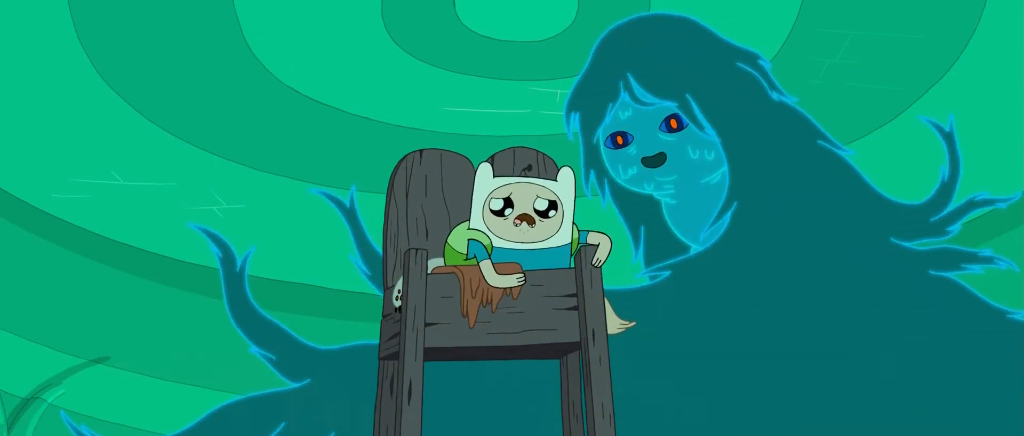
The cartoon Adventure Time’s loose and simplistic style of animation and the bizarre nature of the land of Ooo have the potential for plenty of surreal horror. In “King Worm,” hero Finn the Human finds himself trapped in a Dali-esque dream world, forced to confront his subconscious fears in order to escape. The logic of his dreams is surreal and inconsistent, full of strange images and foreshadowing of later episodes. In particular, a ghostly woman seen momentarily during the fear sequence reminds me of the central figure here in The Dream, with her billowing hair and greenish hue. Finn's dreams include confrontations with his love interest and his close friends; eventually, he learns to control the dreamscape to some extent, but locations still change unpredictably, melt, and change in very Dali-esque ways.
Adventure Time, "King Worm"


Dali experiments with trying to capture the helplessness and muted sensations of dreams, using the dark palette, crawling ants, and sealed facial features. The seated man in the background holding his bloody face may be Oedipus, a strong Freudian symbol, and the bust growing out of his back represents the father. Two men embrace each other, one holding what might be a golden key, and a third attempts to push his way into a red wall, symbolizing a search for meaning or escape. The strange, nonsensical actions reinforce the theme of dreaming. Dali considered this painting a strong enough representative of his work that he insisted it represent him at the First International Surrealist Exhibition in 1936.
  • 7:00 AM

Revelations: The Horsemen of the Apocalypse

Revelations
Curated by Arsam Yazdani

Salvador Dali, The Horseman of the Apocalypse, 1970

It's rough, this sketch of the horsemen. But it makes its own message by being so harsh, with every color slicing through the others instead of blending in. Dali's interpretation of the horseman differs from the usual. He doesn't focus on them as a group, more focusing on each individual horseman.

Traditionally, the four horsemen come as one and signify the apocalypse. The color palette Dali uses here perpetuates the hellish aspect, but the unfinished appeal of it changes things. As opposed to the horsemen interpretations of Durer or the like, this piece has less emphasis on their overwhelming presence and more on their entrance. Dali's piece is more frightening for this because the bodies and details are clearly unnecessary. The entrance of the horsemen is the truly scary part - the horsemen are a means to an end.

There are also only three horsemen here. In the Book of Revelations, each horseman represents something different. First is the White Horse, the figure of military prowess, usually referred to as Conquest. Red Horse, or War, signifies mass slaughter, his color specifically being a fiery red. Third: the Black Horse, or Famine. Then comes Pale Horse, the only horse whose rider is explicitly given a name: Death. Out of what is seen of Dali's piece, it seems that Red Horse, Black Horse, and Pale Horse are depicted. Which is fitting for the terrifying scene. Dali seems to focus more upon the terrifying aspects of the horsemen, leaving out White Horse - in many theories, conquest is thought of as a benevolent being, sometimes even as Jesus Christ himself. Dali would have left him out for a reason, then.

  • 7:00 AM

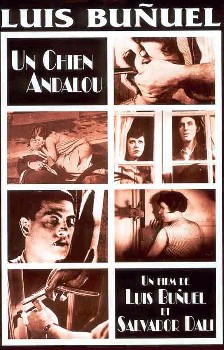
Un Chien Andalou


              Un Chien Andalou (1929), Luis Bunuel & Salvador Dali
Watching Un Chien Andalou (An Andalusian Dog), a silent surrealist short film by Luis Buñuel and Salvador Dalí will unquestionably leave you feeling disgusted, bewildered, and with a newfound understanding of surrealism. The film begins eerily with a man sharpening a straight razor on his balcony. The camera quickly cuts to a scene of the night sky with a bright full moon and ominous, singular, thin cloud. When the camera shifts back to the man, he is seen stretching a woman’s eyelids similar to when using eye drops. Another quick cut back to the night sky and the razor-thin cloud moves closer toward the moon. Suddenly the imagery clicks.

You brace yourself and pray you are wrong. It’s too late; the man slowly drags the razor blade across her iris, spilling the inner stuffing from inside the eyeball. Your stomach drops and you realize that only thirty seconds have passed. What an inconceivable way to begin a film, leaving the viewer horrified and repulsively intrigued! The scene ends abruptly and the text reads, “Eight years later.” The film promptly dives into another unrelated bizarre scene. This trend continues and the scenes following each other grow increasingly nonsensical over the course of fifteen minutes.

You try to make sense of the random scenes and search for some semblance of a plot, but alas, nothing. There is neither enough time nor context to comprehend the assumed symbolism embedded in each scene of the production. The film emerges as a compilation of several arbitrary scenes that cannot be understood through comparison or reason. Dalí and Buñuel, in fact, agreed that “no idea or image that might lend itself to a rational explanation of any kind would be accepted” when writing the script. Similar ideology influenced the Beatles in the creation of “I am the Walrus.” These artists reject notions of inherent symbolism that often diminish the significance of art and instead favor impulse reactions to their work. Un Chien Andalou suggests that surrealist works are perhaps not to be understood, only felt.
  • 12:00 AM