Two Girls With Parasols

John Singer Sargent, Two Girls with Parasols, 1889. 

In John Singer Sargent's career he painted over 900 oil paintings and 2,000 watercolors, which doesn't even include the endless sketches and charcoal drawings. After the scandal of Madame X, Sargent's portrait career ended in Paris but eventually grew in Britain and America. Sargent painted Two Girls with Parasols five years after his strapless gal got him in hot water. The tree and the woman in the center create a barrier from the lush green on the right and the rough browns on the left. The contrast of the colors is not harsh, instead it flows.

Sargent's brushstrokes smoothly sweep across the canvas, which allows the colors to not only stand on their own, but look like they belong. These strokes allow the painting to move, not just because the women are facing left. The brushstrokes start in the top right and slide down to the bottom left, aiding the woman in pushing the viewer's eye. 

The most interesting feature of this painting is the faceless women. Is he allowing the identity to be anyone, or is he hiding the true identity from the scandal of Madame X? Is Sargent's reputation still harmed five years later, that he wouldn't paint the faces of his models? The unrevealing dresses, shade from the tree, and shade from the parasol seems to put the women in the dark; they even seem constrained. Even though there is space for the action to move, the shadows and the clothing make the women timid. Their gaze does not meet the viewer (the lack of eyes help), and it seems to be a passing moment of hiding.
  • 7:00 AM

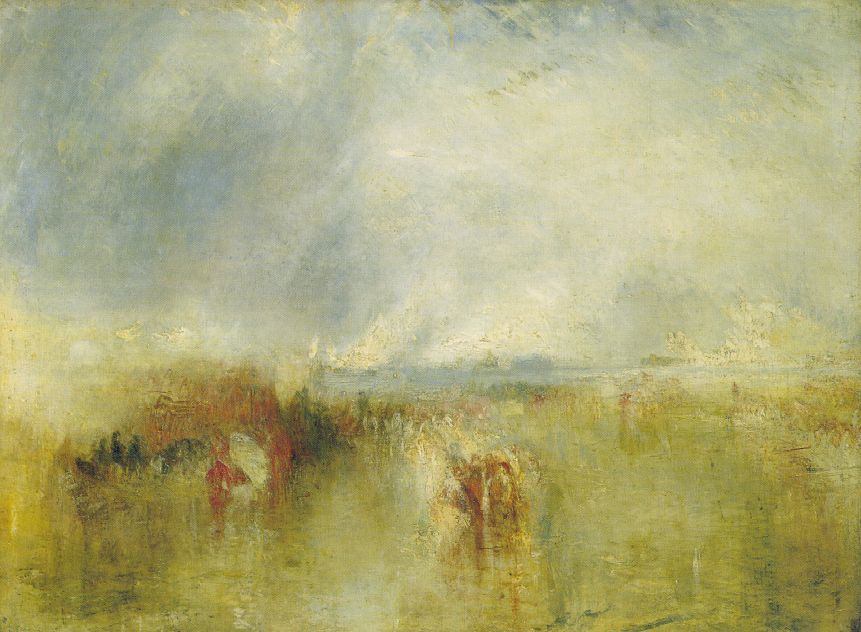
Procession of Boats with Distant Smoke and Waves

J.M.W. Turner, Procession of Boats with Distant Smoke, Venice, 1845.

Waves 

By Robin Robertson

I have swum too far
out of my depth
and the sun has gone;

the hung weight of my legs
a plumb-line,
my fingers raw, my arms lead;

the currents pull like weed
and I am very tired
and cold, and moving out to sea.

The beach is still bright.
The children I never had
run to the edge

and back to their beautiful mother
who smiles at them, looks up
from her magazine, and waves.

Editor's Note: Students were asked to match a poem to a picture. They could do so with or without comment; they could be serious or playful, profound or goofy. We will leave it to our dear readers to make their own connections.

  • 7:00 AM

The Ballet from "Robert le Diable"

Edgar Degas, The Ballet from 'Robert le Diable, 1871

Edgar Degas was born in Paris into a moderately wealthy family. When old enough, his father wanted Edger to pursue a life in the courtroom. So they compromised, Degas went into the Faculty of Law of the University of Paris in November 1853. Since he did not enjoy the world of the lawyers, he decided to not apply himself. He soon met Ingres who told him, "draw lines, young man, many lines."Shortly after Degas received admission to the Ecole des Beaux-Arts, where he found his way through the school developing a style similar of Ingres.


Degas is known for his graceful paintings of ballerinas from an angle that is off to one side of the stage.  The Ballet from "Robert le Diable" comes from an angle in the audience. In this scene Degas depicts the third act of Giacomo Meyerbeer's opera Robert le Diable. The ghosts of dead nuns have been resurrected and greet one another amid the ruins of a moonlit monastery. While analyzing this painting, it reminds me of the ballet Dracula (preformed by the Kansas City Ballet) where Dracula resides in an abandoned abbey and frequently dances under the cover of moonlight (classic vampire stuff). 

Degas featured himself in this painting, right in the center of the audience. He is completely oblivious to the performance on the stage and his eyes wander off - much like the other students whom were seeing the inside of the Kauffman center for the first time. Degas paints  The Ballet from "Robert le Diable" with three harsh verticals; the edge of the audience, the arms of the dancers, and then the rail coming off from the archways in the monastery. There is not a good indication of a center, the column splits the painting just to the left, Degas' head just to the right, and the dancers are awkwardly sliced through the center of those two. 


The Ballet from "Robert le Diable" hangs in the Metropolitan Museum of Art. I have walked through the halls of the Met, however I did not get to see this painting. I saw other pieces by Degas, which is where my appreciation of his works started. 

  • 7:00 AM

Portraits in an Office: The Cotton Exchange, New Orleans

Edgar Degas, Portraits in an Office: The Cotton Exchange, New Orleans, 1873. 

Edgar Degas visited family in New Orleans in 1872. His brother, René, coerced Degas to stay for a longer time then Degas imagined. During his long stay, Degas created The Cotton Exchange where he included his family within the painting. This painting was popular back in France where it was the only painting of Degas' that was purchased in the Pau Museum. 

Although it does not look like it, Degas encapsulates a moment of devastation. This scene is the exact moment when his uncle Michel Musson's cotton brokerage business went bankrupt in an economic crash. Musson is depicted in the painting near the pile of cotton, examining the cotton.  Degas' brother René is rather lazy, so it is fitting that Degas painted him just sitting and reading the paper. 

Finding out that Degas painted his family members in this piece, it became more interesting. First I thought it was boring and that Degas should stick to horses or dancers. But this painting proves that Degas has talent to spare even in the face of losing his eye sight. 

Compositionally, the painting is okay. I think the perspective is a little off, as the room does not look exact. The painting is split into thirds vertically - cut by the bookshelf in the back and Uncle Musson. The pillar on the left could be left out but I find it nice to balance the man on the right at the desk. It also serves as a painted frame to encase the people on the left more into the painting. The movement is cutting through the painting diagonally starting at the door in the back and ends at the older man sitting in the front. 

I enjoy how Degas has created a serene painting at the time of chaos. Edgar Degas has painted this in the earlier part of his career, and it shows the promise of many great works to come.

  • 7:00 AM

The Crowd


Wyndham Lewis, The Crowd, 1914-1915. 

With an unstable family life Wyndham Lewis, found his balance in painting. His parents were born from different countries and later divorced. Having to deal with switching houses a few times a week, with understandable complaints of not seeing a parent too much, try divorced parents in different countries. Lewis lived with his mother in England where he went to school and learned how to play rugby and paint. There are no recollections if he had a relationship with his father. Once out of school Lewis traveled around Europe for the most of his career.

Before World War I, Lewis found a balance through geometric designs of cityscapes. He and his fellow Vorticism painters denounced cubism because they could not feel movement. With their take, it does create movement. The Crowd gives a sense of falling, like in Alice in Wonderland, falling through different levels and seeing different shapes. 

In class we read through Brettell's bool on modern art. In that this piece was in black in white with gave it more of a balance between structure and chaos. With this color palate all the different shades of brown and orange remind me of a stereotypical 1970s home. I can see the bright orange carpet, the dark brown furniture and the weird yellow-ish curtains. While the white pieces - through all the muddy shades of brown - fight for attention. 

  • 7:00 AM

Can You Hear It and Gossip Girl

James Nares, Can You Hear it, 2010.
                              

Gossip Girl here, your one and only source into the scandalous lives of Manhattan's elite.

James Nares is a contemporary artist, creating his works since the late 1990s. Nares has an infatuation with movement, and creating movement within a short passage of time. He shows more of a creative mind as he passes through busy New York streets as he films his artistic videos.

What is more interesting than his works is how Nares creates his paintings. Nares first custom makes his own paint brushes that range from a paint brush fit for painting a wall to brushes that are larger than life. Once the perfect-sized brush has been chosen, James Nares straps into a harness and repels over his canvas, Mission Impossible-style. Nares craves to identify his movement by creating a finished work in a single stroke.

One of Nares’ pieces was featured in episodes of Gossip Girl, where his artwork hangs in the apartment building of the Van Der Woodsen's. James Nares captures moments in a manner similar to ever-present Gossip Girl.

The bouncing lines of Can You Hear It reflects the highs and lows of Manhattan’s upper elite. When following the love stories of Blair and Chuck, or Dan and Serena there are obvious (and sometimes redundant) ups and downs flows the same as this painting. In the series finale the viewers are given a sigh of relief when the show presents what happens five years later. Not surprisingly, Gossip Girl is perpetuated into the future of outsiders that crave acceptance. Nares’s piece flows like a river, sustaining the viewer’s eye to ebb and flow. Whereas Dan’s yearning to be accepted and eventually loved by Serena by hiding behind a mask, Gossip Girl encourages future high school students to do whatever they can to get mentioned by GG. XO XO.

  • 7:00 AM

Greece on the Ruins of Missolonghi and C'est si bon

 Eugène Delacroix, Greece on the Ruins of Missolonghi, 1826.


Eartha Kitt, a former Katherine Dunham Company troupe member,  is remembered for her distinctive singing style. Her most famous song is "C'est si bon." Kitt was born into a dysfunctional family, not knowing who her birth parents were and her guardian leaving her with a friend to go live with a man who did not accept Eartha.

"My Discarded Men" creates another take on Delecroix's Greece on the Ruins of Missolonghi. Instead of the woman's sadness, while listening to Eartha Kitt she becomes more sinister. It turns the victim of another crime into her victim. 

  • 7:00 AM

The Milkmaid of Bordeaux

Francisco Goya, The Milkmaid of Bordeaux, 1825-1827

After Francisco Goya's death, his reputation skyrocketed. Curators from France and England were buying all of his pieces. They even purchased paintings that were given to Goya's son. People from other countries knew that he was a eccentric sketch artist, and they thought his paintings were not held to the same standard.

During a short period after his death, some of his friends searched through his home in Bordeaux to find that Goya was a hoarder.  Whereas some artists would keep some unfinished sketches and paintings, Goya kept many of finished pieces that critics deemed as masterpieces. The Milkmaid of Bordeaux was one of these pieces that Goya hid from the world. He spent a long time perfecting the details of this image. 

The curve of the woman's back, along with her content facial expression, bring harmony to the painting. This is a typical Goya painting, due to the background and source of light hovering around the milkmaid's body. Pulsating like an aura, creating a heavenly layer to the painting. The amount of time that Goya spent on this painting, stands out from the rest of the portraits of other females. There is more dimension and poise of this woman than in other works such as The Duchess of Alba I

The Milkmaid of Bordeaux, exemplifies the artistic ability of Francisco Goya. He creates pieces that make people think, and have personal affiliations behind. But this piece is more serene and enjoyable than some pieces because of the tones of blues and light sources. Goya can do dark and creepy like no other, but it shows his talent that show us something so beautiful.

  • 7:00 AM

Christ

Jean Auguste Dominique Ingres, Christ, 1834

Oh. My. Dad. I am done. 

Jean Auguste Dominique Ingres, wildly known for his neo-classical portraits, also considers himself to be a historical painter. In this particular painting, he set Jesus in a totally sassy manor. His holy sassiness lets a high school art history student to apply their own modern Youtube jokes.

Ingres mainly painted religious figures when he was commissioned to paint for the Neo-Gothic chapel of Neuilly. During this period he painted other religious paintings like Jesus Among the Doctors. He painted a similar portrait of The Virgin Mary, where it is encased in the same oval frame. The difference is that The Virgin Mary has more background within the painting. Compositionally, the painting has a lot of merit. For a rather modest painting (80 x 60 cm) Jesus takes up the majority of the canvas without getting disproportionate.  

Jesus ain't got time for that. 


  • 7:00 AM

Belisarius Asking for Alms

Jacques-Louis David, Belisarius Asking for Alms, 1781

While David traveled to Rome, he was infatuated with historical paintings. This particular one shows a wide range of David's abilities. The detail of of the columns in this painting provide a design necessity. The columns do push down on the figures and split the painting in half. They also create a harsh diagonal, starting from the top left and passing through their arms and slashing into the bottom right. With the flow of the painting, the columns force the work our of balance. The right side is more packed and dark than the right.

The people in the foreground, feel merciful. The man and the child are begging for help, showing weakness that is in need of rescuing. While the woman gives another layer of compassion, understanding, and a maternal hand. The older man is not looking at the woman but is looking up past her face praising God; however, the young boy is communicating more compassion towards the woman.  But the soldier in the background seems to be protesting this offering.

  • 7:00 AM

Surprise! and Life of Pi

Henri Rousseau,  Surprise!, 1891


Either on a shipwreck or prowling across a field, tigers are dangerous.  In Surprise! by Henri Rousseau, we can see the darkness of the tiger's face. Contradictory to the movie's portrayal of tigers. Once Richard Parker, the tiger, and Pi Patel are on the life raft floating away we see the tiger's natural instinct: either kill or be killed. Richard Parker cannot fight these natural instincts and becomes violent. Rousseau's portrayal of a tiger, resembles that of Richard Parker in the beginning of the movie. Relying on his natural instincts to thrive. The tiger is in its natural habitat, and looks terrifying for a pedestrian who may encounter this tiger on his pursuit. I know I wouldn't want to interact with Rousseau's tiger.

However, Richard Parker seems more nice, like Raja from Aladdin. I just want to be sitting in a menagerie stroking its multicolored fur, and discussing life issues with him.  Or you want to be on a boat with hundreds of zoo animals in hope that one has a nonviolent attachment to you. Now  Life of Pi is only rated PG, so there couldn't possibly be a freakishly vicious tiger waiting to seek revenge, it needs to be a more humanistic with its facial features.  

These portrayals of tigers show both sides, their dark and predator side, and their nicer side. Each art form brings different feelings along.  Rousseau's is more scary than Life of Pi's (even though Richard Parker tries to consume Pi Patel). They bring awareness of how to react to these creatures as well. So if anyone is ever stuck on a boat with a hungry tiger, Pi Patel has guidelines for you.

  • 7:00 AM

Marriage A-La-Mode, part II

William Hogarth, Marriage A-La-Mode: 2, 1743

William Hogarth, an English painter, is known for his '"modern" and 'moral' subjects. Hogarth interned with a goldsmith. Later on his career he started to work with painting. Hogarth was continually claiming that his work was plagiarized and lobbied vociferously for the Copyright Act of 1735 to protect writers and artists.

In Marriage A-La-Mode presents a scene of higher class citizens. There are three hard diagonals. The first starting on the far left side, the corner of the frames down through the man in the blue coat. The second starts at the window down through the man in the red coat. The last one the man on the far right, beginning at his head going through all the way down through his toe.

Hogarth balances the painting with inception paintings (the paintings within the painting) above all of the people on the bottom. Also, the paintings are used as harsh verticals to split the painting in to thirds. The use of the clusters of people adds to this effect. Within the thirds there is a different object on the floor, left: a dog; middle: the handkerchief; and right the family tree. He uses the men on the far sides, on the left the man in the blue coat and on the right the man in the red coat to balance the painting as well.

The man standing facing the window holds blueprints for a building. One could assume that the building is the one that is being built outside the window. The men in the center, are holding money and papers that are talking about the marriage of the woman and the man to the left. The man in the red coat is pointing to the family tree on the floor. Possibly showing that they will be added to the family tree. If you look at the woman she does not look happy to be betrothed. While the man leaning into her looks more than delighted that she is going to be married.

  • 7:00 AM

The Dance Class

Degas, The Dance Class, 1873

"The image of Time brought thoughts of mortality: of human beings, facing outwards like the Seasons, moving hand in hand in intricate measure: stepping slowly, methodically, sometimes a trifle awkwardly, in evolutions that take recognizable shape: or breaking into seemingly meaningless gyrations, while partners disappear only to reappear again, once more giving pattern to the spectacle: unable to control the melody, unable, perhaps, to control the steps of the dance."- Anthony Powell

Edgar Degas, a French painter, was known for his dance subjects. He is also considered a founder of impressionism. However Degas disregarded the term "Impressionism" and called his work "Realist". He was taught in painting historical and classical art. But he soon switched to more modern subject matter and used his classical technique in his work, becoming a "classical painter of modern life."

The Dance Class was created in the middle of Degas' career. The diagonal of people pushing towards the dancer by the music stand is the major flow in this scene. Also the touches of red, the man wearing the coat in the background, the other man in the middle-ground, and finally the red carnation in the dancer's hair, pushes the eye foreword.

The viewer obtains a sense of stress and hurriedness from the dancers in the background and in the foreground. If you draw your attention to the dancer in the middle, the gracefulness of her arabesque calms the viewer. As your eyes progress to her hands, you can feel her reach. Her head leaning back, you can breathe in with her, making the painting feel strong, and composed in the middle of chaos.

  • 7:00 AM

Mary Magdalene

Donatello, Mary Magdalene, 1454-55
Mary Magdalene depicts a story of a woman who was a strong disciple of Christ. According to the Bible, Magdalene was a "woman of sin." In which her story dictates of her being saved from seven demons. After becoming a passionate follower of Christ, she became a role model for other female followers. At one point Magdalene refused to eat, she intended to rely on "heavenly nourishment" alone, which is why Donatello captured her with sunken, corpse-like eyes.

Donatello's attention to detail in this wood carving is astonishing, with every single drape of her dress and twist in her hair looks like it is dripping right off her. Magdalene's rugged body, brings back the idea of her only consuming heavenly nourishment. If one were to look at her face, she expresses a need for one last bite of heavenly nourishment which instills her loyalty to Christ.

Through Donatello's attention to detail comes along the striking humanistic qualities. Donatello goes as far as to carve her broken teeth poking out through dehydrated lips. What my eyes were drawn to were her eyes. The eyes are carved with an iris. Her head is pointing down, but her eyes remain looking up.

This portrait of Mary Magdalene is unlike any other done. Other works show her as a beautiful woman, with long blonde hair and fit. However, in other renditions, her eyes are all looking up, or at Christ himself. Donatello's version shows a different side of her, one that exemplifies her true passion for Christ.

  • 7:00 AM

The Journey of the Magi

Bennozzo Gozzoli, Journey of the Magi, Kelsey Thorp

In this period many artists were trained by goldsmiths, including Gozzoli. He was an apprentice to Fra Angelico for six to seven years. He worked on in the Dominion monastery of San Marco. This take on the journey of the Magi was displayed on the walls of the Medici household.

From this piece, the march is leaving the castle and heading toward the valley. Gozzoli exercises great detail in the piece. The vegetation looks soft in contrast of the harshness of the rocks. In many renditions of this idea, the artist chooses to only paint the magi, however Gozzoli depicts the Magi with a massive crowd that is never ending.

The use of the gold in this painting brings attention to the more important characters. Gozzoli utilizes the gold to highlight important sayings as well. As seen on the white horse to the slight left of the center. The martingale says "Semper" which means always, a common saying of the Medici family.
  • 7:00 AM

Racehorses

Edgar Degas, Racehorses, 1885
I am thankful for the opportunity to ride and the lessons I have learned from it. Since the first time I was on a horse I learned a lot. My first pony ride was at a local petting zoo when I was in pre-kindergarten. There I learned just how massive these animals are - and how much fun they can be. After this, I only saw horses in pastures outside the car door, or even in books.

The next time I rode a horse was at a family friend's farm. They let me walk the horse by myself, brush him. But they had to tack him up- I was too short. Once I mounted the horse I was free from the confining circle of the petting zoo. This experience taught me to enjoy this freedom and the time I have with horses.

A week later was my birthday. For my birthday I received a helmet which was a ticket for horseback riding lessons. From this point on riding horses has been an influential in my life. Because of riding I learned how to be graceful when under stress. I am thankful for my horses for teaching me to be organized and how to communicate without talking. Also many of my horses have instructed me not to fear failure, but to grow from it.

  • 7:00 AM

Figure and Boats

Thomas Hart Benton, Figure and Boats, 1920
I came into a place mute of all light,
Which bellows as the sea does in a tempest,
If by opposing winds 't is combated.

The infernal hurricane that never rests
Hurtles the spirits onward in its rapine;
Whirling them round, and smiting, it molests them.
-Inferno, Dante, Canto VII

As a local painter from a town outside of Kansas City, Missouri, Thomas Hart Benton grew up in the 1880s. His father did not approve of his painting, so he sent him off to military school. Benton's mother, on the other hand, was artistically inclined. He ended up devoting the majority of his life to art, obviously not taking his father's side. His work caused much controversy. Many people praised him for creating pieces that were realistic to the time period. Others thought of him as a drunk hillbilly or even an "okie baroque."

Benton regularly paints scenes of small town mayhem, which could be a product of his parents' relationship, or his own dealings with his parents. His father wanted Benton to follow in his footsteps and become a politician. Benton's mother supported him 100 percent She was totally invested in his life, emotionally and economically, at least until the day he married at the age of 33. Benton studied art at the Chicago Art Institute, and eventually moved to New York. Even as he established himself as an artist, Benton was still considered a drunken hillbilly.

In this piece, everything pulls and flows to the center. The circular patterns of the waves moves the eye in circles, like a whirlpool. Ending up at the person in the left hand corner. As one looks further into the piece, there is a house, standing on what seems to be a cliff. In Canto VII, Dante talks about a tower. In comparing the two works, the tower and house match up. This composition correlates with Dante's Inferno a great deal. With the winding river and the canoe at the base of the cliff, along with the figure depicting one of the many shades that are described in the text. Figure and Boats adds to the mystery and eeriness of Dante's Inferno.

  • 7:00 AM

Feast of Herod

Donatello, Feast of Herod, 1427

Donatello has significantly distributed the characters vertically as well as horizontally in this piece. There are four distinct lines that pulls the eye upward. If one looks at it in vertical halves it seems to be more unbalanced. There is more weight and darker hues on the right than the left. But the commotion on the left balances the right.

This scene is chaotic. The figure’s bodies are all pointing to the figure on the far left. The three characters surrounding the man on the left seem to be presenting him food. The group on the left appears to cringe, creating a deeper story within the piece. 

Donatello has manifested such detail and dimension, it feels that one could see the so much further than what is actually there. He pulls the viewer into the middle of all this chaos, which is what drew me into this piece.

  • 7:00 AM

Noli me Tangre

Giotto, Noli me Tangre, 1305

I want to know Christ and the power of his resurrection and the fellowship of sharing in his sufferings, becoming like him in his death, and so, somehow, to attain to the resurrection from the dead. Not that I have already obtained all this, or have already been made perfect, but I press on to take hold of that for which Christ Jesus took hold of me. -- Philippians 3:10-12 

The border and the actual painting seem to coincide with each other. Like the animal scolding her cubs, Jesus is not reprimanding,  but almost telling the awakened disciple to stay.  The disciple that is reaching towards Jesus resembles the cubs in the frame by reaching out to the bigger animal. Giotto carries on the same color scheme from the painting into the frame. Even into the smaller image, it does not seem to stand out. However, it does add a sense of comparison to the painting.

The horizon is pretty bleak in terms of vegetation. The trees are not blooming, nor have any sort of branches. As the eye travels forward there is more life. Especially surrounding Jesus, who is the only sense of life besides the actual people. Also, the sky is a darker shade, which creates a more somber mood. There is a harsh diagonal line that points to Jesus, as do the angel's wing, and the blue encasing the right side of the painting.

Notice how the two angels, the awakened disciple and Jesus are the only figures with a halo. It really depicts a believer sort of mentality. In this case seeing is believing, which shows through the certain halos.

  • 7:00 AM

The Blue House and We Have Always Lived in the Castle

Marc Chagall, The Blue House, 1917
"After a very long time I stood up again because I knew where I was going. I was going to the summerhouse. I had not been near the summerhouse for six years, but Charles has blackened the world and only the summerhouse would do... when he saw me turning onto the overgrown path which led there he went another way as though he has something important to do and would meet me somewhere later."- Shirley Jackson, We Have Always Lived in the Castle

Chagall was one of the first painters to use such vibrant and pure colors. In this scene, the house on the right is painted blue, which gives the feeling of isolation. The person-like figure in the open door way seems to be all alone. The house itself is run down, evident from the mismatched pieces on the roof and siding. The red brick on the left side of the structure, gives the sense of stability; however, it cuts through the house at more geometrical angles against the roundness of the logs.

The city in the background, looks grand and locked compared to the blue house. The feeling of being trapped in the city comes across through the river, the green and yellow cliff, and by the blue and red wall. The wall of the city and the roofs, complement the house. The reflection of the city in the river gives the impression of seeing the true city which looks darker, and gloomy. That feeling of being away from the city matches Mary Katherine's desire for isolation from the dangerous mob.

  • 8:00 AM