Know Your Chapeau: David

Donatello, David, 1440?

Donatello's David, renowned as the first free-standing bronze sculpture of the Renaissance, was quite controversial at time of release. While heralded as a great modern (at the time) work by some patrons, others considered it risque, especially in its nude and effeminate depiction of David. But one thing about the statue that has drawn considerable attention is David's hat. Being the only real article of clothing on the statue, it was bound to be imbued with speculative myths and hackneyed meaning.

But the actual hat itself is also quite enigmatic. The design of the hat is anachronistic of the time, it being more of an Italian mercenary's hat than anything that could have come out of the Biblical Era. And while the rest of the sculpture screams masculinity ...not, the hat at least conjures up the image of the violent Goliath and his supposed indomitable nature. But then there're the flowers.

While the hat itself seems out of place, what's weirder still is the presence of laurels and other flora. Taking an anachronistic hat and putting laurels (which are native to the Mediterranean region) on as accents seems like a bold move. But, this may make the sculpture better, at least historically. Unlike the Davids of other artists (read: Michelangelo), this David may indeed be more adherent to the Bible, depicting David as a somewhat weaker-looking person. In the narrative, David's weakness is extolled as a virtue, making its symbolic depiction here seem intentional.

  • 7:00 AM

Know Your Chapeau: Femme Au Chapeau

Henri Matisse, Femme Au Chapeau, 1905

Henri Matisse depicts his wife Amelie Matisse in his 1905 Femme Au Chapeau or Woman with Hat. She poses with a fantastic fan and honestly a fabulous hat that I wish was a part of my wardrobe. Amelie Matisse sayid in a 1906 interview that her outfit was completely black when her husband painted her. She always wore black, but her husbands eclectic mind put this painting to a new level of excellence.

Little did I know while researching crazy hats that this painting that I loved was a transition point in Matisse's career. This painting is typical of a Matisse, the brush strokes and the colors make it unmistakable. This painting is different because it was the star of his 1905 show that started a modern art movement called fauvism. Fauvism is French for "wild beasts." This art movement was an avant-garde style that used color to emphasize certain qualities of the subject. Another famous artist of this time was Andre Derain. The subject was simple but had a certain amount of abstract to set it apart from other works of modern art. 


  • 7:00 AM

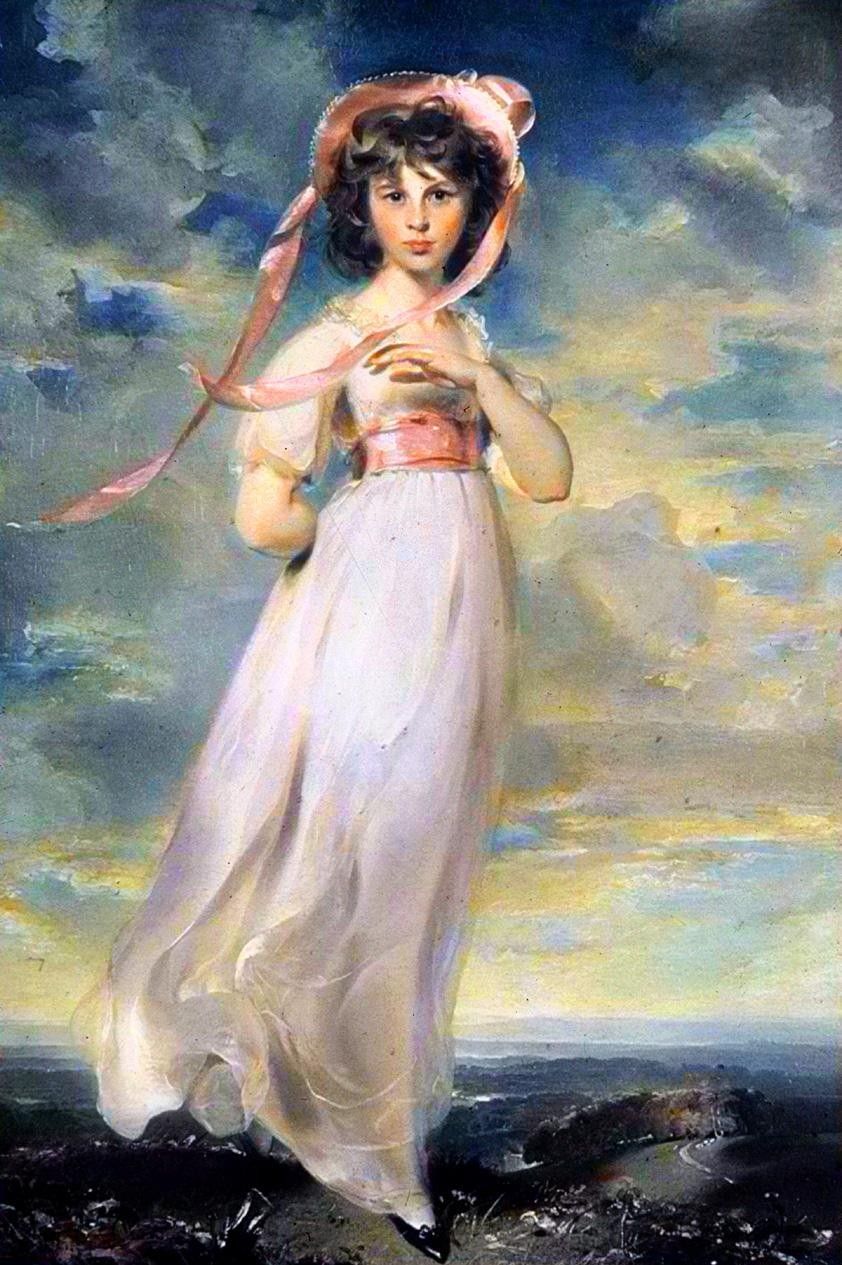
Know Your Chapeau: Pinkie

Sir Thomas Lawrence, Pinkie, 1794

Sir Thomas Lawrence, an accomplished portraitist, painted Sarah Goodin Barrett Moulton in 1794 when Sarah was eleven years old. Given the nickname Pinkie by her family (which I think is up there alongside Keith, Myrtle, and Bing on the list of horrible things to call your children), Lawrence played off of the nickname, giving his subject a soft, rosy complexion. Dressed in pink, young Sarah stands on the rocks poised, looking off among to the distance.

Pinkie and Thomas Gainsborough's more famous Blue Boy have been seen as a package deal before. In the 1960s, the two paintings were sold together as cheap home decor. Today, the two portraits hang beside one another at the Huntington Library in California. Although I’m not particularly fond of either painting, that feeling changes when you put them together. They complete each other. Lawrence clearly intended to juxtapose his painting with Blue Boy, seeing as how they were painted only fourteen years apart. Dubbed the “Romeo and Juliet of Rocco portraiture,” Pinkie and Blue Boy thrive together, but wilt when apart.

  • 7:00 AM

Know Your Chapeau: The Cardsharps

Caravaggio, The Cardsharps,  1594

Why did hats ever go out of style? They're great for everything. Balding? Hat. Sunburnt? Hat. Bad hair day? Hat. Want to advertise the fact that You Only Live Once? Stick on a stylish hat and you're good! Everyone cool, ever, wore a hat. My personal favorite is the Italian Hunters hat, also called the Archer's hat or the "Robin Hood," shown here in Caravaggio's The Cardsharps. There is no better hat for your cheating in card game needs! The stylish band goes great with your dagger, and is perfectly sized for an ace of spades!

While the this hat goes great with the striped jerkin, it wasn't as fashionable as you might think. This hat was mainly reserved for Italy's middle class. This suggests that while the wearer seems to be wealthy enough, as the jerkin and dagger would have been fairly expensive, he was not a part of Italian high society. The older gentleman stealing a look at the other boy's cards suggests that this isn't the first time he's made money this way.

I love this painting. All of the paintings from this time period seem to be either religious scenes, or stuffy upper class gentleman and women frowning in portraits. This one shows a lower-class cheater stealing money and rocking a hat. Caravaggio doesn't need your conventions, he paints what he wants...thank you very much.

  • 7:00 AM

Know Your Chapeau: Woman with Flowered Hat

Jean Dupas, Woman with Flowered Hat, 1940

Jean Dupas, an artist of many trades, achieved fame through his success two stylistic movements: Art Noveau and Art Deco. By fusing these two concepts, Dupas created paintings depicting elegant women in abstraction.

The woman below the absurdity of her flowery chapeau wears an absent smile that speaks levels about the probable discomfort she feels. Perhaps it’s the heaviness of the hat, or perhaps it’s the sheer ridiculous nature that weighs on her mind as she stares off into the distance. Her beautiful, yet giraffe-like features compete with the hat’s elevation in an attempt to not be completely dwarfed. Yet, the blossom-covered headwear remains proudly undefeated. Zero points for giraffe neck. No, not even her soulless alien eyes may distract from the hat’s magnificence.

In a way, the hat resembles a layered cake. At the top, white anthurium flowers (or something which resembles them – I’m no botanist) bloom healthily at the top. If we proceed with the cake metaphor, the anthurium flowers would be the icing. Below, a yellow rose and a pale camellia rest together. Camellias and roses aren’t too similar, but they’re similar enough in petals and color that the two together are rather jarring. Color contrast is a wonderful concept, and Dupas may have dropped the ball here. Thankfully, the scarlet flowers beneath provides enough pop to save the arrangement, despite their gaudiness. Admittedly, I have no idea what they’re called. My impaired knowledge of flora terminology aside, even I know that this leaning tower of flowers makes for a mediocre bouquet at best.

In a sense, perhaps the giraffe alien lady makes the perfect match for this oddity. Hats off to you, Dupas.
  • 7:00 AM

Know Your Chapeau: Bust of a Woman in a Striped Hat

Pablo Picasso, Bust of a Woman in a Striped Hat, 1939

Picasso’s cubist paintings are dissections of form. Something natural, like the female form, becomes geometric. Woman becomes a mass of shapes and lines and edges. She loses her identity, her flesh. Picasso has deconstructed her, and we put her back together like a puzzle. But the image in front of us, though we know it is a woman, does not register any of the female qualities usually expressed in painting – softness, femininity, beauty. It is strange and interesting, but I do not see a woman. I see shapes.

But I also see purple. The vibrant color reminds me of the 1932 poem by Jenny Joseph: “When I am an old woman I shall wear purple...” In the poem, the old woman wears a red hat, so it’s a stretch, but I consider the type of woman that wears purple. The Queen gets to wear purple because she is royalty, and baby girls wear purple when they run out of pink. In Joseph’s poem, the old woman wears purple to escape conformity and dullness. She wears purple because society tells her not to. In Picasso’s painting, perhaps this woman wears purple for the same reason. Her clothes (if she is wearing any) are grey and drab. Her expression is blank and her hair is neat. We do not know whether she is young or old – does it matter? She does not dance in the streets or scream at the top of her lungs or pick flowers from others’ gardens.

She certainly does not spit.

But she wears purple, so maybe she could.


  • 7:00 AM

Know Your Chapeau: Minecraft hats

George Stubbs, Turf with Jockey Up, 1765

The setting sun disappears over the horizon as I light the lanterns around the house. I go out to check on Jesus' stable to ensure that the zombies or skeleton archers will not disturb him during the night. Every night zombies just pound on the door and try to get in. After checking on Jesus, I walk back to my simple wooden plank shack before the nightly assaults, whether they be skeleton archer or zombie. The fire crackles in the furnace as the raw meat slowly transforms into my dinner to keep my hunger meter filled. Before I learned that raw meat could be cooked to restore my energy, I would venture out into the wilderness and slay herds of cow everyday just to sate my appetite. I hang my favorite baseball hat beside the collection of zombie heads, diamond pickaxes, and diamond swords and settle down for the night.
|
During the night, I hear "THWAP" against the house repeatedly from skeleton archers futilely trying to break in. The zombies pounding on the doors prevents me from fully replenishing all my hearts each night, so in the morning my health bar is not filled to the brim as it should be. But as the sun rises, the noises recede back with the darkness and all is serene. Unfortunately daytime is the only opportunity available to work the fields without disturbance from the nightly hordes, and so I work it tirelessly so that I may finish each day's work before the sun sets.

I have recently developed this backpack that allows me to carry up to nine different items at once. With it, I have become a walking armory even while working the fields. I hold my diamond swords, pickaxes, hoes, shovels, and my bow and arrow. A short time ago I stumbled upon an enchanted bow that only requires me to carry one arrow at a time and yet can fire limitless arrows. I have thus named the bow: "The Infinity Bow" but am ignorant of its durability. Zombies beware.

  • 7:00 AM

Know Your Chapeau: Three Cornered Hat

Walt Kuhn, Three-Cornered Hat, 1943

Kuhn's Three Cornered Hat, achieves a look of complete power. The woman depicted maintains a constant stern face and and piercing blue eyes (as if she needed any of this). The hat alone contains the capability to take control of an empire. Do not make the mistake of misinterpreting the flowers on the hat, the hat is more than just decoration, more than just an accessory.

The thing's mere size could be used as a weapon, even the hat's edges stretch further than the woman's own shoulders. The red streaks that outline the head wear might as well be stains of blood, as this woman means business with the symbol of power resting upon her head. Generally,  throughout history, people should know to never mess with a massive hat. This is more than a simple top hat or cap, the hat embodies the word "elite." The hat is more than just fashion (although it very much is so), it is power.


  • 7:00 AM

Know Your Chapeau: Picnic in the Mountains

Fernando Botero, Picnic in the Moutains, 1966

Picnic in the Mountains is a striking painting. All I can say is, "Hats off" to Francisco Botero for catching my attentions so quickly in my art history career. His painting style is… interesting to say the least. He always satirizes people into these strange pudgy beings who never fail to haunt my dreams. This painting in particular takes a bolder view in that as he sketched the two abnormally large beings who take up more space than the mountains. What is even more mind boggling is that the size of the man’s hat. It is just as big as the mountains.

Some could argue that Senor Botero’s perspective is way off, but after examining his paintings, you realize this man actually doesn’t care about what other people think (you can look at some notable works on artstor.org). Botero uses a vast color range in this painting as he uses many warm colors and wide variety of fruit

Fernando Botero changed my life. After looking at his obese renditions of some of art's most iconic paintings (like the Mona Lisa), my eyes have been opened. As an aficionado of art history, any kind of art intrigues me, but Fernando Botero almost immediately grabbed my attention.


  • 7:00 AM