The Sickness Unto Death Pt. VII: Bust of Costanza Bonarelli

The Sickness Unto Death 
A Musically Guided Exploration of Artist's Struggle with Mortality
Curated by Aaron Dupuis

Gian Lorenzo Bernini, Bust of Costanza Bonarelli, 1636-37

"And when I have my childhood back
I'll tear every page out of my bookPlace them in an urn
And strike a match and watch them burn
And then i'll hold the front cover
Against the back cover and look
You see
Eternity will smile on me"
"The Sickness Unto Death," Typhoon


Leave it to Gian Lorenzo Bernini to stand out from the crowd. While the other artists in my gallery accepted death as the inevitable fact of life - the only sure thing about existing - Bernini rejects the notion. Perhaps, it was not his intention. Perhaps, I am giving the piece more meaning than the sculptor intended. However, this is largely what art history is about: applying meaning where they may be none. Indeed, that is what the reception of any art form is about. And so I posit that by creating the Bust of Costanza Bonarelli, Bernini not only paid homage to his mistress, but conquered death itself in the name of love.

Costanza Bonarelli was the wife of one of Bernini's assistants, and a participant in a heated affair behind said assistant's back. Bernini and Bonarelli's affair never came to the attention of her husband, but it did come to the attention of his younger brother, Luigi, who quickly made the love triangle a square. In response, Bernini beat his little brother near to death, and had Costanza's face cut up by an assassin. Yes, these events are horrific. Yes, they are based deeply in obsession. Yes, this is a story of love gone wrong. But it makes the Bust of Costanza Bonarelli all the more beautiful.

Bernini must have known that his affair must eventually come to and end. Either the husband would find out, or Costanza would lose interest. These things never worked. More over, beauty is fleeting. Costanza's looks would wilt with the passage of time, and the youthful face that Bernini so loved would be no more. And so, he sculpted her a love song, freezing her in time, forever young, forever beautiful. Age could not take her beauty away. Her mutilation could not either. Not even death could rob her of her looks now.


  • 7:00 AM

The Sickness Unto Death Pt. VI: Isenheim Altarpiece

The Sickness Unto Death 
A Musically Guided Exploration of Artist's Struggle with Mortality
Curated by Aaron Dupuis


Matthias Grünewald, Isenheim Altarpiece, 1512

"Every bitter night into an empty room I plead my caseEvery night I pray that in the morning when I wake
I'll be in a familiar place and find that I'm recovered and I'm sane
and I'll remember everything
I'll remember what I was like before that bug bit me"
"The Sickness Unto Death," Typhoon 

Of all of the paintings of the crucifixion, this one hits me the hardest. Critics can talk all they want about the strides that Caravaggio made in making Christ accessible to the public at large. I won't disagree with them. However, this is the only work I have ever seen that fully reduces Christ to a human form. There is no grace. There is no dignity. There is no beauty. Instead Grünewald gives us a hanging corpse, skinny and ragged. He gives us ugliness. The true ugliness of death.

Though this particular panel depicts no sense of holiness - not even the faint halo of Mantegna's Lamentation over the Dead Christ - the other panels hidden from view in the above photo depict a scene of glorious resurrection and ascension into the blinding lights of heaven. By portraying Christ's as a deformed corpse and later as a risen angel, Grünewald conquers the fear of death, not for his own sake, but for the sake of the wretched masses who would have seen the altarpiece in the Monastery of St. Anthony. The Monastery, you see, served primarily as a hospital, and served the lepers and cripples of Isenheim, helping to alleviate their suffering and make their final days on earth as comfortable as possible.

And so the Isenheim Altarpiece's ugliness is only surface level. Beneath the grime and gore lies the beauty of compassion and human empathy. And there too lies the belief that our time on earth is what we should dread most. Death is nothing at all.

  • 7:00 AM

The Sickness Unto Death Pt. V: Head of a Man on a Rod

The Sickness Unto Death 
A Musically Guided Exploration of Artist's Struggle with Mortality
Curated by Aaron Dupuis


Alberto Giacometti, Head of a Man on a Rod, 1947


"I read somewhere that when you face eternity
 You face it alone
No matter what you thought
Or what you had or you had not
Unless you put yourself in God
But tell me God oh where did you go?"
"The Sickness Unto Death," Typhoon 

Alberto Giacometti's sculptures and portraits exhibit a twisted pride in the reduction of the human form to its most basic and fragile states. The Walking Man series, City Square, and Three Men Walking all feature thin, frail figures, lost in the void of empty space around them. The inclusion of several figures upon a single surface - City Square and Three Men Walking for instance - serves to increase the sense of loneliness rather than detract from it. These shades are lost and self-absorbed, worn down to skeletons by the slow steady passage of time. In the aftermath of WWII, Giacometti's works were a statement about the human condition, that is to say, that humans were broken, selfish, helpless things. Not one of these works, however, seems quite as lonely or hopeless or concerned with eternity as Head of a Man on a Rod. 

A man's cry to the cruel, unfeeling heavens captured in cold, rough bronze, Head of a Man uses negative space to its fullest extent. The man's body has blown away, gone like so much dust in so many gusts of wind, leaving only a rod to support the head. Empty space surrounds the silhouette, engulfing the figure in nothingness. The man is crying into a vacuum, the vacuum. He hopes for a reply. A sign. For purpose. For hope. But he receives nothing in return. Instead his head hovers there for eternity, gazing into the abyss, praying at the top of his lungs that something stares back.

  • 7:00 AM

The Sickness Unto Death Pt. IV: The Dog

The Sickness Unto Death 
A Musically Guided Exploration of Artist's Struggle with Mortality
Curated by Aaron Dupuis

Francisco Goya, The Dog, 1819-23

"Now I've only got one organ left in this old bag of bones
It is failing me
And I try to tell people that I'm dying 
Only they don't believe me
They say we're all dying
That we're all dying
But if you are dying, why aren't you scared?
Why aren't you scared, like I'm scared?"
"The Sickness Unto Death," Typhoon


In 1819 Francisco Goya holed himself up in the the "Quinta del Sordo" - "The Villa of the Deaf Man" - near Madrid, Spain. In the preceding years he had been racked by illness and mental decline, just as his country had been racked by war. During his stay at the Villa, Goya completed a series of fourteen paintings commonly referred to as The Black Paintings. These dark and brooding pieces were painted directly onto the walls of his home, like hieroglyphics in an Egyptian tomb. But while the Egyptians used their art to capture the promise of a happy afterlife, the murals of Goya's mausoleum speak of the inescapable horror of the void beyond life.

Among these Black Paintings, The Dog stands out, not as the most macabre work, but rather, the most hopeless and tragic. The titular canine gazes up at the sky, into the heavens, as he is tossed about in a sea of darkness. For now his head pokes up above the surface, but soon the swelling wave on the right side will break over him, tossing him down, down, down, into its black empty depths. The helpless creature has no chance to live, only to survive. To paddle and paddle until its strength gives out, or the darkness consumes it once and for all.

Goya must have felt that he was the dog. Lost, alone, and afraid. The Black Paintings were never truly intended for public exhibition. Goya had chosen to paint on the walls of his home for his own sake, never mentioning the paintings in writing or in conversation with his contemporaries. The paintings acted as a sort of therapy in this, the final dark chapter of his life. The dog's plight is his own. But while it will forever be frozen in time, just on the cusp of drowning, Goya's story would have to end, and no series of paintings, no matter how moving was going to change that.

  • 8:40 PM

The Sickness Unto Death Pt. III: Foreshortened Christ

The Sickness Unto Death 
A Musically Guided Exploration of the Artist's Struggle with Mortality
Curated by Aaron Dupuis


Andrea Mantegna, The Lamentation over the Dead Christ, 1480

"Life is for the living
I've heard tell that it is while we are young
In the morning sun
You take every year as it comes,
But when your life is over
All those years fold up like an accordion
They collapse just like a broken lung"
"The Sickness Unto Death," Typhoon

Most paintings of Jesus' death focus on his resurrection, ascension, or divine heritage. They seem weightless, light, and joyous. After all, he alone succeeded in conquering death. Yet Andrea Mantegna's The Lamentation over the Dead Christ paints a strikingly different picture of the death of Christ.

His green and yellow skin drapes itself over his insides, much like the blanket that covers his body. The stigmata on his hands and feet are a deep, festering red. The flesh at the edges of the wounds hangs in hideous folds. His large torso - accentuated by the foreshortened perspective - seems heavier than the stone slab upon which he lays. Upon his face he wears an expression of pain and weariness. This is not the rest of the Messiah before his ascension. This is the body of a human being, unceremoniously taken down from his place of execution. The only indication of divine presence is the faint halo that crowns his head. However, even its inclusion cannot save the work from feeling like a struggle, not only with death, but with faith.

The two mourners that attend Christ's deathbed give the death a sense of finality. Until he rises again, if he rises again, all that the mourners know with a certainty is that the human form is a frail thing, even when inhabited by the Son of God. While this notion certainly makes the viewer more apt to relate to Christ, it also suggests that Mantegna may have been wrestling with his belief in Christ's divinity, and the promise of an afterlife. Neither the mourners nor Mantegna can comprehend what awaits their savior beyond the grave. Indeed, they cannot be sure that anything awaits them, nor that he is their savior at all. All this must be taken on faith, and in the face of death, faith can be a weak crutch to lean on.


  • 7:00 AM

The Sickness Unto Death Pt. II: David with the Head of Goliath

The Sickness Unto Death 
A Musically Guided Exploration of Artist's Struggle with Mortality
Curated by Aaron Dupuis


Michelangelo Merisi da Caravaggio, David with the Head of Goliath, 1609

"You tried so hard to make people remember you for something
you were not,

And if they so remember you then something else will certainly
get forgotten" 
"The Sickness Unto Death" Typhoon 


Michelangelo Merisi da Caravaggio was a man all too fond of going against the grain. Drunken brawls and late night prowls through the streets of Rome were his primary pasttimes before (and during) his rise to fame. It was this rebellious past that allowed him to tell the stories of the gospels as never before: through the eyes and experiences of sinners. It also led, however, to his ultimate downfall. In the summer of 1606 Caravaggio challenged Ranuccio Tomassoni to a duel in the streets of Rome, less than a year since an attempted homicide and a libel suit. Caravaggio, who had grown more and more violent since his rise to fame, won the duel and took Tomassoni's life, a decision which would change Caravaggio's forever.

For years Caravaggio had been creating works for the Catholic Church in order to reach the worst of the sinners of Rome. His down-to-earth depictions of the Saints, Disciples, and Christ promise that salvation was waiting for all people,  no matter how wretched the life, no matter how wicked the sin. "Gamblers, prostitutes, drunks, beggars: It matters not what you were," his works say, "Because now you are saved." And yet, with Tomassoni's blood on his hands and a price on his head, Caravaggio began to fear that he may not receive the same treatment. 

Wracked with guilt, but hopeful for a way out, Caravaggio fled to Naples and then Malta, painting more scenes from the gospel. Scenes of redemption. Scenes of forgiveness. It was in Malta that Caravaggio first sought to clear his name by joining the Order of St. John in return for the painting, The Beheading of St. John the Baptist. Shortly thereafter, he assaulted one of his fellow knights, and was thrown back in prison, his life once again in jeopardy. Somehow, he escaped from the jail and made his way back to Naples where he caught word that the pope's nephew, Scipione Borghese, was willing to pardon him. In order to save his life and repay Borghese, Caravaggio painted David with the Head of Goliath.

The work is a self-portrait unlike any other. Caravaggio paints himself as Goliath, the wicked giant that is struck down with a slingshot. Mouth agape, right eye filled with blood and lolling to the side, the stump of his neck dripping with blood and hanging gore, Caravaggio is truly monstrous. He has become a villain, not only in the context of his life, but in the context of Catholic belief. The man who promised sinners a sure way out is beyond redemption. Except, that he isn't. At least, not on earth. By killing himself metaphorically, Caravaggio hopes to save himself in the real world. The state had asked for his head in a basket, and he was giving it to them on canvas instead. 

The intention is sound, but the implications are horrific. It is, in effect, a suicide of the soul in exchange for the safety of the vessel, and suicide - like murder - is a mortal sin. And this must have been what Caravaggio feared, for if he so believed in the saving grace of Christ, why then his fear of death? Perhaps a deep-rooted dread that he might be swallowed whole by the jaws of non-existence, of the pitch darkness that surrounds the characters of his works, the utter blackness that finally closed over him as he struggled through the swamps of Italy, hoping to catch up with his ticket out. 

You see, things didn't quite go as planned. On his way home to Rome, he was arrested by a guard who hadn't been informed of his pardon. By the time he got out of jail, his ship had left without him, taking his works with it. Lost, alone, and hopeless he chased after the boat by way of land, and collapsed on a beach in a fever. He died before he could receive his pardon, having killed himself on canvas for naught. 


  • 7:00 AM

The Sickness Unto Death Pt. I: At Eternity's Gate

The Sickness Unto Death 
A Musically Guided Exploration of Artist's Struggle with Mortality
Curated by Aaron Dupuis

Vincent van Gogh, Worn Out: At Eternity's Gate, 1890

"Old man in your rocking chair
You wake up, you've been living alone

After all these years
Surrounded by these shards of mirrors
How'd it get so quiet here
You wonder where did everyone go?"
"The Sickness Unto Death," Typhoon


A couple weeks back, as I  was driving beneath the emerald canopy of Blue Ridge Boulevard and tossing project ideas about in my head, "The Sickness Unto Death" by the Portland0based indie group Typhoon began to spill from my speakers. It had been some time since I'd heard the song, but just as the cold makes the old cut on my finger ache, it brought back the ache of buried memories. Teenage heartbreaks. Long drives in the dead of night. Relatives that I'd lost. But most of all, as is always the case, it brought back the fear that lurks in the back of my head, of many heads around the world. The fear that reduced me to tears time and time again as a child. The fear of forever. Of experiencing forever, whether I continued to exist or not.

And it was from this well of fear - beautiful, terrible fear - that I drew the inspiration for my gallery. I present to you The Sickness Unto Death. Through a synthesis of contemporary lyrics, personal experience, and the paintings of the masters, I will explore the efforts of the Artist to reconcile himself with human mortality. In doing so, I hope to capture the beauty of life and expression, rather than the triumph of death. Though the lyrics themselves will not play a great part in the body of the text, I felt it necessary to include them, not only to give the gallery a proper narrative structure, but also to illustrate the timelessness of the Artist's struggle with death. That being said, I would encourage readers to give the song a listen. It's a favorite of mine.

And so it goes:

Van Gogh first took down the image of the old man in the chair in 1882, using an aged war veteran he encountered in an alehouse as his model. He wrote extensively about the drawing, which he called Worn Out, and its eventual transformation into a lithograph. The writings in question detailed his thoughts about the emotional power of the human form, and the greater implications that it seemed to hold. "It seems to me that one of the strongest pieces of evidence for the existence of 'something on high' in which Millet believed, namely in the existence of a God and an eternity," he wrote, "is the unutterably moving quality that there can be in the expression of an old man like that, without his being aware of it." Fascinated and moved by his discovery, van Gogh began a long series of lithographs and drawings of the veteran, women, and hospital patients, all in the same pose.

Vincent van Gogh, Worn Out, 1882
For eight long years, van Gogh did not return to the drawings and lithographs he had made in that formative time of his career. And in those eight long years his life had drastically changed. He had found his artistic style, collaborated with artists like Gauguin, created what would be his most famous painting, Starry Night, begun frequenting brothels, cut off his left ear, and had started to lose touch with reality. By 1890, the hallucinations and periods of madness had grown so strong that van Gogh could no longer keep their effects from affecting his work. During this time there passed entire months of inactivity, months that took their toll on the artist's outlook and work. It was directly following a mental relapse that van Gogh finally revisited the old man in the chair. This time he forsook pencil and lithograph, and went straight for his paint.

Blues, greys, whites, orange. They play off one another, but they do not dance the way that the colors of van Gogh's landscapes do. Instead they seem to tremble. The man in the painting seems smaller, weaker, than his predecessor. And where the subject of Worn Out seems to be resting his eyes, the fists in Eternity's Gate look like weary guardians of tear-filled eyes. The men are not the same. At Eternity's Gate is more than a final play on an early artistic motif, it is a mirror of van Gogh's life. He has replaced the old war veteran. He is a veteran in his own right. A veteran of art. A veteran of life.

Two short months after painting At Eternity's Gate Vincent van Gogh shot himself in the chest while out on a walk in the wheat fields of Auvers. He lived a night and the better part of the next day, managing to make his way back to his room in the local inn, where his brother Theo comforted him and recorded his final words:

"The sadness will last forever."


  • 7:00 AM

Bird in Space

Constantin Brâncuși, Bird in Space, 1923
I already dug art when I joined art history my junior year. I had seen contemporary shows at First Fridays, Town Center, the Country Club Plaza, etc. I was fully aware that despite my love for art, I knew absolutely nothing about the masters of the past, save for their names. As I expected, these once unfamiliar masters became beloved friends. Their works brought my life beauty, intrigue, even encouragement in difficult times. By the end of my junior year I believed that I had come to understand art better. I was wrong.

You see, I had created a very narrow definition of art for myself. That is to say I only sought out paintings and drawings. I thought that sculpture was neat, sure, but I never thought that it could move me like paintings did. After all, nearly all sculpture consists of handsome youths traipsing around in the nude, modeling themselves as Greco-Roman deities. That's what I thought at least, until I saw Bird in Space.

When I first lay eyes on Bird in Space my breath caught in my throat. I felt a rush of joy and excitement rush over me as I gazed upon its bronze curvature. Nothing I had learned could account for this feeling. It was just a shape. Just a perfectly sculpted, beautiful, electrifying shape on a base of wood. Nothing more. And yet, I could not ignore the emotions it instilled in me. In that moment, it became my favorite work, for nothing before or since has evoked the same reaction in me. Bird in Space taught me more than the worth of sculpture. It taught me the meaning of art.


  • 7:00 AM

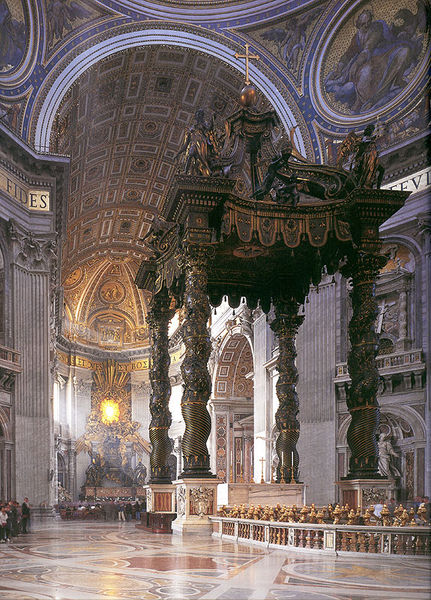
St. Peter's Baldachin

Gian Lorenzo Bernini, St. Peter's Baldachin, 1623-34
In 1623 the Basilica of St. Peter was vastly under-decorated. The golden ceilings, tapestries, paintings, murals, sculptures, altars, and carvings were nice to look at, sure, but they didn't give the church the class that the Papacy was looking for. And so it came to pass that Pope Urban VIII, sick of worshipping in such a destitute chapel, ordered Gian Lorenzo Bernini to begin work on a marker for St. Peter's resting place. Something nice and flashy that would pull the room together, like a favorite rug might. So began the plans for St. Peter's Baldachin. 


Detail of St. Peter's Baldachin: columns and canopy 
The first problem that faced Bernini was creating a structure large enough to fill the space under the giant dome of the Basilica. He responded by fighting fire with fire, and built the canopy 95 feet high. In order to build the structure to such a massive height, Bernini and his benefactors were forced to borrow materials - especially bronze - from older, less interesting creations like the Pantheon. So much bronze was scavenged from the city's architecture that the people of Rome began to whisper quod non fecerunt barbari, fecerunt Barberini, or "what the barbarians did not do, the Barberini did." Truly, a reputation worth all the bronze in Europe. But at least the beautiful, twisted, Solomonic columns that called for all of the material were one of Bernini's finer ideas, right? Alas, even the idea was pillaged from an architect by the name of Carlo Maderno, who had drawn up a design of his own not long before Bernini was put on the job.


Detail of St. Peter's Baldachin: coat of arms
While some of what went into the construction of the Baldachin suggested that Bernini and his bosses were devoid of moral fibre, some of it showed a severe deficiency. The Baldachin is credited entirely to Bernini, scholars aren't entirely certain which parts of the structure he actually contributed to. The project marked the first time that Bernini acted as an administrative figure, rather than primary artist, giving way to an age of uncertainty regarding his works and their true authorship. Of course, artists have always had their assistants and apprentices, but its a practice rooted in a brand of ego found only in the department store of fame. And though the Baldachin bears St. Peter's name and marks his grave, Bernini made sure to cover it with the sigil of his very own patron saint, Urban VIII. The base of each of the columns has a carved Barberini coat of arms. What better way to ensure future employment than to memorialize your employer in stone?


And yet, despite all of my griping about the politics surrounding the piece, I cannot bring myself to dismiss it. How could I? Its soaring columns, dramatic statuary, and massive scale command the eye in a building already filled to the brim with beautiful decorum. And whatever kissing up Bernini may have done pales in comparison to the masterful planning and execution that went into the coats of arms. Each represents a stage in childbirth - from conception through delivery - in a tasteful, yet daring show of talent. Sure, the methods may have been questionable, but what the Barberini built, barbaric or not, no one else could have.

  • 7:00 AM

Fray Hortensio Felix Paravicino

El Greco, Fray Hortensio Felix Paravicino, 1609

Most of El Greco's portraits lack discernable features in the background. It is not unusual that he limits his color palette in Fray Hortensio Felix Paravicino to white, black, and brown. And though that left wrist looks mighty odd as it seems not to have an arm attached, it still is not what makes the painting stand apart. The strange thing about Fray Hortensio, a portrait of Hortensio Felix - a poet, friar, and friend of El Greco's - is the way in which Hortensio is portrayed within the context of his chair and robe.

With the exception of his Portrait of a Cardinal and Fray Hortensio, El Greco seems to rely on the face to reveal the personality of his subjects, ignoring or simply excluding the rest of the body. His subjects are poised, proper, and still. Even Portrait of a Cardinal depicts the Cardinal in a pose that reflects his high standing in the church. Hortensio, however, seems on the verge of slouching in his seat, casually lounging as his portrait comes to life, stroke by stroke. His body looks frail and lost in the great sea of his friar's habit. His pose does not suggest his fame or importance.

Yet still he sits, smugly gazing back at the viewer with dark, piercing eyes. His strength lies not in his stature. Rather, he makes himself a giant in the intellectual arena. At his side he clutches two books, likely the Bible and a book of poetry. The larger of the two dwarfs what the viewer can see of Hortensio's physique, but also reflects the power of his mind.

Interestingly enough, Hortensio's powerful mind, though it made him a staunch supporter of most arts, also led him to decry all nudes. He once went so far as to demand that the best of these should be burned for the good of society. The best of these would no doubt have included many of El Greco's most famous works. That's a poor way to repay a friend for painting you.

  • 7:00 AM

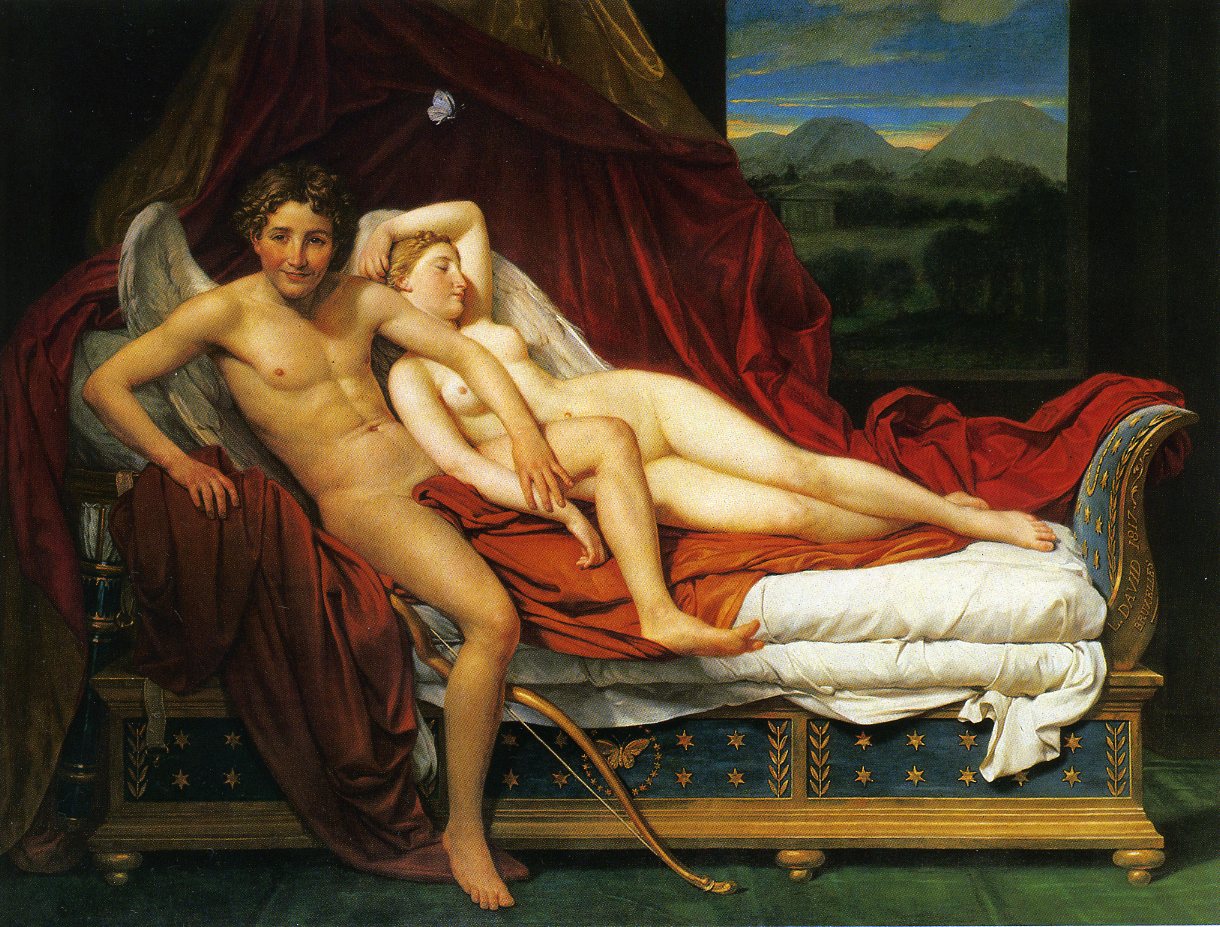
Cupid and Psyche

Jacques Louis David,  Cupid and Psyche, 1817

Girl, would you look at that body? Perhaps Jacques Louis David's funniest painting, Cupid and Psyche depicts the beginning of the couple's tumultuous relationship. "Tumultuous?" you may well ask. "How is this tumultuous? A handsome young man and his fair skinned maiden just waking up from a light night 'tumble,' all seems right to me." And that it should. David has gone out of his way to spice up the allegory from Metamorphoses, and has done so brilliantly. It's nothing too glaring: Just a smug grin on cupid's face, a gentle moving of the lover's arm, an open window and a winged rogue to escape through it. These details are what first made me love this painting.

The story behind the work is a wonder in and of itself: Once, a king and queen raised had three daughters, the youngest by the name of Psyche. Psyche was so beautiful that the people of the kingdom gave offerings to her instead of Venus, the goddess of love and beauty. Of course, this made Venus pretty upset, and so she asked Cupid to enact some sort of punishment upon the young girl. Cupid, like any good henchman, falls in love with the young girl instead.

 Basically, time goes on, Cupid doesn't do his job, doesn't claim Psyche for himself, and eventually people start to wonder why Psyche hasn't been married. An oracle cries wolf - or rather unholy dragon offspring - and Psyche is whisked away to a mansion in the middle of nowhere where an invisible Cupid seduces her and makes her his wife. All right, all right, let's get to the good parts by doing this middle bit quick: Cupid leaves every morning before sunset (again, note the pleased grin), all goes well until Psyche's sister comes to visit and insists that Psyche look upon her lover. Cupid is so hot that she spills hot lamp oil all over him and he runs away. Smooth.

So while Cupid runs home and sobs into his manicured hands, Psyche wanders the earth looking for him. She tries in vain to call on the help of the goddesses Ceres and Juno, and finally offers her service to Venus herself. Venus gives her three tasks of increasing difficulty, and Psyche finds herself constantly wishing for death, but each time she is saved by an animal or talking object that encourages her to keep going. Finally, after completing these first three trials, Psyche is tasked with traveling to the underworld to borrow some of the queen of the underworld's beauty. She performs her task beautifully until she opens the box and falls into a deep cursed sleep.

"Oh no!" you may say, but fear not! True love wins out in the end as always. Cupid finally nurses his "wounds" and comes to wake Psyche with ambrosia, the drink of immortality. The two are married and give birth to a beautiful daughter. Note: Daughter. Not a scary dragon.

  • 7:00 AM

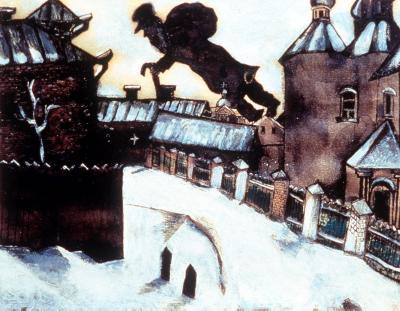
Over Vitebsk

Marc Chagall, Over Vitebsk, 1915

Marc Chagall's Over Vitebsk is a modernist masterpiece that evokes the powers of simple geometry and complex composition all at once. Its plays on color are stunning, the yellow and blue amongst a world of white and grey. The faceless wanderer floating above the city, sack in hand, not only stands in for Chagall's departure from his home town, but also for the escape of Jews from the oppression of Russian  prejudice. However, all of these things have been said, and said, and said again. Instead of harping on the artistic merit of this particular painting, I believe we'll all have a much better time exploring the theft of the painting that came before it. 

Marc Chagall, Study for Over Vitebsk, 1914
Study for Over Vitebsk, a dark painting no bigger than a sheet of printer paper with an estimated value of $1 million, hung in a temporary collection of Chagall's entitled "Marc Chagall: Early Works from Russian Collections" on June 7th, 2001 when it was stolen straight off the wall. For several days, no clues came up as to the whereabouts of the painting. Finally, a letter was delivered to the museum from an organization calling itself the International Committee for Art and Peace.

 It was a ransom note like no other. The thieves had no intention of profiting from the work. Instead they asked for something straight out of a Miss America pageant: Peace. The thieves promised the Jewish Museum of New York City that the painting would be returned when the Israelis and Palestinians could achieve peace between their nations. A noble cause, to be sure, however, the thieves' plans were not well laid. As it turns out - and this may come as little surprise - museums don't have much sway in international relations, and the Jewish Museum was forced to give up what little hope they had left of ever seeing its painting again. 

That is until it showed up in a post office in Topeka, Kansas, where its packaging was opened after being deemed undeliverable. Following a series of calls to the F.B.I. in my hometown of Kansas City, the painting was promptly returned to its owners in St. Petersburg. Though the painting and its owners had their happy ending, the thieves never got theirs. Theft may not be the most morally sound method of encouraging world peace, but it begs the question: If lives and art are equally threatened by a world at war, what is safe?

  • 7:00 AM

The Tempest

Giorgione, The Tempest, 1508

I sat in my friend's kitchen, restlessly glancing about the room from a dining room chair. I felt uncomfortable and restless as this was my first visit to this particular acquaintance's home, and I now found myself left to my own devices as he talked to his parents about family matters. Not the show, mind you, as I would gladly have joined in on that conversation. I had already occupied myself with admiring from afar the various collections of pottery, fine china, and contemporary paintings about the room, and nothing seemed to take my mind away from the inherent awkwardness of my situation.

With few options left, I turned to a nearby collection of pocket-sized books - the kind that line the check-out lines of Barnes & Noble - and stumbled upon a volume frankly titled The Art Book. I promptly began flipping through the pages, nodding at this painting or that in approval until I came upon one that caught me in a way that others hadn't. It held my attention in a way I was not yet accustomed to, and I couldn't put my finger on why.

The painting that so captivated me was Giorgione's The Tempest, a work that has divided art historians, educators, and uppity bloggers in regards to its interpretation for decades. Some insist that the painting depicts Adam and Eve with a newborn Cain shortly following their banishment from Eden. Others evoke the story of Mary and Joseph and their escape to Egypt. These interpretations rely on the presence of the male figure to hold under scrutiny, however, scrutiny reveals that the male figure did not exist early in the painting's development.

This X-ray of The Tempest taken in the 1930s reveals that a nude woman was originally in the place of the soldier that graces the final painting. The discovery of the image beneath the surface may have shattered all attempts to crack the symbolism of the piece, but that wouldn't do the determination of art critics justice at all. Instead, the discovery only added to the mystery of the piece already present in its dissident symbols of the broken column, the bridge that spans the stream, and the suckling baby cradled in the woman's arms. But the mystery of the piece is what keeps me coming back after all, the fun of a puzzle is in the challenge, not the solution.

Besides, the painting has a kind of quiet majesty to it. Though a storm looms in the background, alive with lightning and roaring thunder, the characters seem not to care. They do not look back, they do not look worried. They simply look at one another, and at the viewer. In their gaze lies all the peace of the landscape: The soft glow of the stormy skies, the calm water of the stream, the majestic bird atop the tower. It grabs you, and holds you there firmly. So firmly, that you may not notice a friend in the doorway, motioning that he's ready to go.

  • 7:00 AM

Hunters in the Snow

Pieter Bruegel the Elder, Hunters in the Snow, 1565

A day and a half come and past. A night spent among the towering skeletons of trees. A night spent in the silent vacuum of winter. A scrawny fox carcass - more fur than food - is all the men have to show for their trouble. 

Not one of the three has spoken since the group turned back. Even the dogs, they notice, don't dare to wimper. The winter has been long. Cold. Deep. Deeper than the snow drifts that now swallow their boots to the brim. The elemental intrusion means little. Their feet are long forgotten. The rise and fall of the earth is all they know. 

Finally they fall no more. The next rise is the last. The sounds of the village drift over the crest of the hill. They forfeit footing for their final flight to the top. Lungs aflame and muscles screaming, the men lift their weary eyes and take in the majesty before them. The valley greets them as it always has. The village below them slips away, voices fade, and for a moment nothing exists. Nothing but the unfeeling spires of the great mountains that line the tiny village. No depth. Only death. 

A raven slices through the frigid air, and lets forth its shrill caw. A sudden gust of wind breaks the still of day. It falters momentarily before diving into the valley.

The man carrying the fox watches as the bird makes its way through the village, winding in and out of buildings, until finally disappearing into the trees. He glances to his left as the aroma of fresh firewood reaches him. A woman scolds her children as they prepare a fire for the feast. To hear her tell it they don't have a brain in their head, nor muscle in their bodies. Slowly a smile makes its way across his face. Her words hide love. 

The feast. It was intended to be the game his party had caught. However, that amounted to the single fox that now swung to and fro from his back with each step he took. The village had expected more than this. He had as well. No matter. They would put something together. Neighbors would provide for one another. More a feast than ever. A communion. 

He makes his way down the slope and through the village past the frozen lakes where friends and family spin and twirl. Again, a smile. Maybe he would skate tomorrow. His first time this year. But first he must go home. Waving, nodding, calling out, he makes his way through the town, past the church, and onto the wooded road to his home by the stream. Through the trees he sees his son playing on the ice. The boys laughter floats gently to his ears. A gentle plume of smoke rises from the chimney. Warmth washes over him. 

High above the birds have retaken the sky, but the ravens will not rest here tonight.


  • 7:00 AM

The Third of May

Francisco Goya, The Third of May, 1814
Yeah, yeah, yeah, I get it. Goya's Third of May is a masterpiece. It's his best known work. The way he tackles the subject matter is brilliant. A print of the work hangs in the classroom. My kid certainly couldn't paint it. But you know what, I still don't like it. It's dark, depressing, and unpleasant to look at. I understand that mass murder isn't usually aesthetically pleasing, but I count Turner's The Slave Ship as one of my all time favorite works. It is brutal and horrifying, yet vibrant and beautiful. The Third of May on the other hand is an ugly amalgamation of brown, black, and gray.

Though I have many gripes with the work I ultimately have to admit that it deserves the praise given it by other admirers of art. Goya's talent as an artist shows in his mastery of human expression. Where Turner's nautical horrorshow leans upon his talent for grandiose landscapes, Goya evokes sorrow through the faces of the victims, especially those of the men directly in the line of gunfire. And though we can clearly see the faces of the victims, those of the soldiers are purposefully hidden from view. They appear as a mass of anonymous shadowy beasts, beings less than human.

Remember those ugly browns, blacks, and grays that I mentioned earlier? I may hate them, but in all honesty the use of these earthy colors makes the piece work. Rather, it's how these pigments are used that makes it work. The dirt and darkness truly bring out the horror of the massacre as they envelop the figures. The blood and earth blend together, the soldiers disappear into the black of night, citizens are bathed in light just as they meet their end. The burst of yellow and white in the center of the painting contrasts the darkness all about in a explosion of light so great you can almost hear the gunfire that rang out on the third of May.


  • 7:00 AM

St. Michael Vanquishing Satan

Raphael, St. Michael Vanquishing Satan, 1518
Raphael, St. Michael
Overwhelming the Demon,
 1505
Nothing says "I'm a big deal now" like being asked to revisit a painting by the Pope. Such is the position that Raphael found himself in in 1518, when Leo X commissioned the painter to do a second rendition of St. Michael slaying Satan. The first rendition - completed in 1505 - had been commissioned by the head honcho of Raphael's hometown, Guidobaldo da Montefeltro, the Duke of Urbino. The original painting showcased a Northern European influence in its surreal presentation and apocalyptic preoccupations, and bore a striking resemblance to the style that would later define the work of Hieronymous Bosch. 

The transformation of Raphael's style in the course of a decade is shocking. By the time of the Pope's commission, the dramatic gloom and doom of this early work had been replaced by a fascination with the human form and the warmer palette of the classicist movement. Where St. Michael Overwhelming the Demon seemed primarily concerned with relaying the story of the archangel slaying Lucifer, St. Michael Vanquishing Satan displays a much keener interest in the painting itself. 

By the time of Leo X's request, Raphael had matured enough in his craft that his piece could stand alone and spend less time teaching a bible passage and more time celebrating the process of art itself.

  • 7:00 AM

Man of Sorrows

Fra Angelico, Man of Sorrows, 1443
Now, I'm no expert on Jesus paintings, but Man of Sorrows by Fra Angelico has got to be one of the cooler ones out there. For once it wasn't the content or message of the work that drew my attention, but rather the boldfaced weirdness of it all. The use of black in the background is startling, especially given the ambiguity that surrounds its context. Is that the night sky, or a metaphorical space in which the scenes of the Passion of Christ may be displayed?

The scenes themselves borrow elements from Fra Angelico's other works that line the walls of the San Marco. Incredibly detailed and surreally arranged in the negative space, the scenes do not seem to adhere to any particular pattern or linear story. Rather they seek to evoke an emotion. They tell the story of Christ's betrayal and crucifixion in fragments: The Judas kiss, the nails used to crucify Jesus, the payment of 30 silver pieces to Judas Iscariot, the taunting of Christ. It is also notable that the work depicts an empty cross, with two streaks of blood running from the nails, still stuck fast into the wood.

In portraying the resurrection of Christ in this way, Fra Angelico seeks to portray a triumphant portrait, praising the Man of Sorrow for the trials he faced. As modern viewers, whether we buy the biblical story or not, at the very least we should find a sense of victory in the piece: an ultimate sacrifice for a cause outside of the self.

  • 7:00 AM

The Swallows

Edouard Manet, The Swallows, 1873
I'm thankful for the countryside. For any day that I can lie lazily lounging in the open air, as the wind rushes through fields of Kansas blue stem. I am thankful for the rusty-palette and quiet splendor of autumn, the biting chill of winter on my cheeks, the budding beauty of spring, the sweat of summer nights. I am thankful for the hot July night, two years back, when I saw thousands of fireflies flicker between the trees, like the willow-the-wisps of folklore, so that the night sky and the woods around became as one. For the afternoon I spent at the pumpkin patch on Holmes with my sister, laughing and racing through the corn maze, willingly losing ourselves in the winding aisles of crop. For the days before my license, when Michael, Adam, Will, Deko, Chris, and I would trek for an hour just to waste the day at the park or wander the aisles of Price Chopper. The nights that we would steal out of our homes to play Manhunt.

And with these last two, I've touched upon something that I had not considered when I set out writing this post: That these moments stand out because they are shared. I've enjoyed my share of lonely days wandering the hills and creek beds near my grandparents' home, and I cherish those evenings of self discovery. But those shared moments of glory - whether the wonder was lost on my company or not - are those that truly shine.

Just two weeks ago, Max and I fixed up bikes in the driveway of his new home, desperate to set off in search of adventure in the last hours of sunlight. Our repairs made, we mounted up and raced through his neighborhood, up sidewalks and down asphalt roads, past joggers and couples and children playing in yards. In that moment we were free. We smiled like we hadn't since the year began.

  • 7:00 AM

The Process of Dance(s) (The Invitation)

Fragonard, The Progress of Love (The Pursuit), 1771
The dance is almost here and there's no time to dilly-Dali, so I guess it's time to step up and be a Manet? I spent a good long while trying to come up with the Wright way to ask you to the dance because it's Fragonard to come up with something creative, and all too easy to Bosch the job. So I hope I've proven myself to be "Duchamp of Invitations," and that you'll accept my humble pe-Titian. 

Gabbi Fenaroli,  would you make this Cézanne truly jolly 
van Gogh with me to Winter Formal?


  • 1:32 PM

Puberty

Munch, Puberty, 1893
Midway on our life's journey, I found myself
In dark woods, the right road lost. To tell 
About these woods is hard - so tangled and rough
And savage that thinking of it now, I feel
The old fear stirring: death is hardly more bitter.
 - Inferno, Dante, Canto I

I don't envy Dante for going through his mid-life crisis in 14th century Italy. Carrying the weight of depression, regret, and doubt before the invention of motorcycles, hair restoration, and dating services sounds like Hell on earth. The poor guy's true love died, and he'd only ever seen her twice. His political party had lost power, and his wife nagged him nightly about leaving the chamber pot lid up. A modern poet would have taken to the bottle, but whiskey hadn't hit the shelves in Italy just yet. Instead, Dante put pen to parchment and scrawled out one of the greatest poetry epics known to man, The Divine Comedy. His cantos cast his enemies into hell, placed his beloved Beatrice in heaven, gave him Virgil as a spiritual guide, and secured his place in history as il Somma Poeta.

Admittedly, I have no experience on which to base my feelings on Dante's situation. I'm a seventeen year old kid cracking jokes about people of an age more than twice my own. In some way, I am in no position to muse about the pains of growing old, but I have wandered through dark woods of my own. I suppose I'm lost in some right now. 

Each night when my head hits the pillow I sigh, and reflect, and many nights I reach the same conclusions: I am happy, but not fulfilled. I am busy, but not productive. I care deeply, but do not act. I can't decide whether I'm waiting for things to fix themselves, or for Cormac McCarthy to float through my window and show me the right road (preferably not the one he wrote about). The only thing I'm certain of is that the latter won't happen. And it shouldn't. I'm not alone in these woods. Though the brush and bramble may block my view, I know that there are others, and that many deserve their guide's attention more. 

  • 11:14 PM