Water Graves - Raft of Medusa

Water Graves 
Reflections on the Illusions of Drowning in Art
Curated by Taylor Schwartz


Théodore Géricault, The Raft of Medusa, 1818-1819
Gericault’s figures in The Raft of Medusa are drowning. Not in their subconscious or any other metaphorical substance as discussed in prior analyses, but physically drowning. I have examined many illusions of this type of death in my previous posts, but none have dealt with the tremulous fear of an actual drowning. Confronted with cannibalism, rotting flesh, and fading hope on a life-sized canvas, the viewer himself feels as if he is struggling to stay alive on the condemned Méduse. This canvas is not an illustration of a piece of literature, a mythological interpretation, or a projection of the creator’s fantastical mind. Gericault, after months of intense research, recreated the historic wreck of the frigate Méduse. All of a sudden, the viewer is forced to grasp that Gericault’s shipwreck hanging on a red wall in the Louvre, a monstrous amalgamation of rotting flesh and salty water, happened. Drowning, and in a more general sense, death, becomes instantly palpable, as the eye moves across dismembered limbs and green bodies up to a wind blown piece of fabric floating in a dark and shadowed sky.

I have seen many disturbing paintings as an Art History student, but for me, Gericault’s Raft of Medusa is perhaps the most unsettling. I assume my fear of it comes from my own diluted aquaphobia. Who else would focus an entire collection around drowning? This collection has allowed me to investigate the cruel, yet at times forgiving, nature of the sea, and how artists and fictitious characters entrap themselves in illusions of drowning. The ocean can be a marvelous place, but with beauty always comes sadness.

The arms of the ocean, so sweet and so cold. All this devotion I never knew at all. And the crashes are heaven, for a sinner released, let the arms of the ocean deliver me.

Never Let Me Go, Florence and the Machine
  • 12:00 AM

Water Graves - What the Water Gave Me

Water Graves 
Reflections on the Illusions of Drowning in Art
Curated by Taylor Schwartz

Frida Kahlo, What the Water Gave Me, 1938
"I am what the water gave me, a smoke-ring in a jar, the braided rope, my ladder-to-the-light, my shivering bird heartcaught." Pascale Petit, What the Water Gave Me: Poems After Frida Kahlo 

Frida Kahlo’s What the Water Gave Me renders simple child’s play in a bathtub into a grotesque scene with Bosch-esque miniature characters. Kahlo replaces toy boats and rubber ducks with skewered birds and nude women. The water supports floating memories of life and death, of love and loss, unable to stay permanently under the water. Images representing various periods of Kahlo’s past breech the surface and trap Kahlo in the tub. Every object appears solid and heavy, yet they all stay afloat—a volcano, a skyscraper, various flora and fauna. A miniature figure of Kahlo bobs in the middle of the tub, strangled by a tightrope connected to the other objects in the composition. Kahlo has become entrapped in the web of her subconscious, drowning under the weight of her own memories. This concept becomes more complex when we bring the Kahlo submerged in the bathtub back into the picture. These miniature bathtub scenes are projections of Kahlo’s mind. In this context, the image of Kahlo being strangled by her past becomes even more disturbing, as she is the one imagining this. This painting is ultimately an exorcism for the artist, a hope to escape from a haunting past by confining it to the canvas. Unlike Landscape with the Fall of Icarus, the undesirable experiences and memories once forced under the water have resurfaced, and the subject must encounter them again.

  • 12:00 AM

Water Graves - Landscape with the Fall of Icarus

Water Graves 
Reflections on the Illusions of Drowning in Art
Curated by Taylor Schwartz

Pieter Bruegel the Elder, Landscape with the Fall of Icarus,  1558
“Proud of his success, the foolish Icarus forsook his guide, rising upon his wings to touch the skies; but as he neared the scorching sun, its heat softened the fragrant wax that held his plumes; and heat increasing melted the soft wax—he waved his naked arms instead of wings, with no more feathers to sustain his flight. And as he called upon his father's name his voice was smothered in the dark blue sea, now called Icarian from the dead boy's name.” Metamorphoses, Ovid
In another of Ovid’s myths, Icarus, son of the craftsman Daedalus, is given a pair of wings made out of feathers, wax, and leather, given to him by his father as a method of escape from the island Crete. Ignoring the warning from his father, Icarus flew too close to the sun, eventually melting the wax and leading him to his death.

In Bruegel’s Landscape with the Fall of Icarus, the farmer and plough seen in the foreground dominate the composition, a strange but effective choice on Bruegel’s part. The yellow-tinted light highlights the banks of the bay, drawing the eye away from the title character. It is only after the eye moves toward the right of the composition that the viewer sees Icarus. Well, part of Icarus. His flailing legs are the last to plummet into the cold green sea. Icarus will inevitably drown, a consequence brought about by his ignorance. But in a way, Icarus, in this depiction, has already drowned. He has drowned in the landscape of this chaotic composition, his existence forgotten. Such is the nature of the cruel sea.

His suffering will forever be ignored as the peasants of the foreground continue to wade through long days and short nights. In his poem, “Musee des Beaux-Arts,” W. H. Auden writes “In Breughel’s Icarus, for instance: how everything turns away/Quite leisurely from the disaster; the ploughman may have heard the splash, the forsaken cry,/But for him it was not an important failure” (14-17). It is a tendency for man to bury things he cannot withstand or cannot worry himself with. He buries them in work, play, and love. We all have memories, regrets, and losses condemned to the benthos of our subconscious. We just pray that they don’t resurface.

  • 12:00 AM

Water Graves - Eurydice

Water Graves 
Reflections on the Illusions of Drowning in Art
Curated by Taylor Schwartz

Eurydice, Valerie Morignat, 2009
“So Orpheus then received his wife; and Pluto told him he might now ascend from these Avernian vales up to the light, with his Eurydice; but, if he turned his eyes to look at her, the gift of her delivery would be lost. They picked their way in silence up a steep and gloomy path of darkness. There remained but little more to climb till they would touch earth's surface, when in fear he might again lose her, and anxious for another look at her, he turned his eyes so he could gaze upon her. Instantly she slipped away. He stretched out to her his despairing arms, eager to rescue her, or feel her form, but could hold nothing save the yielding air.” Metamorphoses, Ovid
Perhaps the most tragic of Ovid’s myth, the tale of Orpheus and Eurydice encapsulates the strength, devotion, and misfortune of young love. Determined to resurrect Eurydice from Hades, Orpheus played his most cathartic music to gain access to the underworld. Even the bloodless ghosts themselves wept. He was allowed to take his wife from the underworld under one condition—he could not turn around to look at her. Inevitably he did, and she died a second death.

In Valerie Morignat’s photograph, water is the medium by which Eurydice reenters Hades. The disturbed surface of the water shows that the photograph has captured Eurydice mere moments after Orpheus looked back. Morignat interprets the young bride’s second death as a drowning. Not only does the water engulf Eurydice’s body, but it also consumes any memory Orpheus had of his bride. In stage productions that include the retelling of this myth, such as Mary Zimmerman’s Metamorphoses and Sarah Ruhl’s Eurydice, on-stage water is used as a symbol of forgetfulness. In both productions, Orpheus is doused in water as memories of his beloved Eurydice gradually wash away—a baptism. In essence, this is what Morignat captures in her photograph. Orpheus, unseen, reaches for Eurydice as she sinks deeper and deeper into the water, her reflective porcelain flesh the only visible semblance of her existence.
 
  • 12:00 AM

Water Graves - Girl Drowning

Water Graves 
Reflections on the Illusions of Drowning in Art
Curated by Taylor Schwartz

Roy Lichtenstein, Drowning Girl, 1963

Roy Lichtenstein’s Drowning Girl is a tidal wave of clichés. Literally. Lichtenstein’s mastery comes from his ability to make an emotional scene feel impersonal and distant. In Lichtenstein’s panel, the subject seems to be drowning in her own tears, shouting “I’d rather sink than call Brad for help!” above the crashing waves. The death of the character is meant to be taken lightly, a mere vehicle for Lichtenstein’s dark humor. The clichés of heartbreak, young love, and old Hollywood damsels-in-distress are specialties of Lichtenstein’s, as one can deduce from this hyperemotional frame.

But in this scene, Lichtenstein subverts the conventional ‘victimized female’ complex and projects a feminist message. For the forlorn girl, enabling drowning declares her independence from her hurtful ex-lover, and in extension, from any semblance of male aid. What does this say about the ability of women to free themselves from their male counterparts? Must they resort to a premature death in order to escape? Well for Hamlet’s Ophelia (see previous post), it was the only option. Death meant escape, and drowning in a substance associated with femininity sends a message that is too clear. These women have drowned in their own stereotypes and stigmas, unable to livingly free themselves from their respective patriarchal cultures—sixteenth century England and mid-twentieth century suburbia. Lichtenstein’s usage of Ben-Day dots, typical in mass-produced images such as comic strips, gives the female character a certain universal quality. Anyone can be the Drowning Girl. So step back and ask yourself, “Doneed Brad?”

  • 12:00 AM

Water Graves - Ophelia

Water Graves 
Reflections on the Illusions of Drowning in Art
Curated by Taylor Schwartz

John Everett Millais, Ophelia, 1851
"There on the pendant boughs her coronet weeds
Clamb'ring to hang, an envious sliver broke,
When down her weedy trophies and herself
Fell in the weeping brook. Her clothes spread wide,
And mermaid-like awhile they bore her up,
Which time she chanted snatches of old lauds,
As one incapable of her own distress
Or like a creature native and endued
Unto that element. But long it could not be
Till that her garments, heavy with their drink,
Pulled the poor wretch from her melodious lay
To muddy death." 
HamletWilliam Shakespeare

Similar to Lemoyne’s Narcissus, Millais’ Ophelia depicts a subject haunted by demons of the mind. While Narcissus suffered from an insatiable love, Ophelia suffered from a fantastical love. It has been argued that Ophelia was not melancholic, but was afflicted with erotomania, a type of delusion in which the person affected truly believes that another person is in love with him or her. In Millais’ painting, Ophelia rests on the brink of drowning, mouth agape in the pleasure of the release that accompanies death. Millais’ Ophelia evokes comparison with Bernini’s St. Theresa in Ecstasy. In addition to her erotic facial expression, Ophelia lies in a position that is almost saint-like: arms elongated, palms upward toward the heavens. For Ophelia, the water is an escape—an escape from her inner demons and her harsh reality. She moans in pleasure for she has become unbound from her mortal body and the water is her source of delivery. She sinks into a garden of foliage, a free woman embracing purely feminine scenery. Drowning, in this work, is not a death. It is a rebirth, a passage from the waking world to one that is entirely Ophelia’s own.

  • 12:00 AM

Water Graves - Narcissus Contemplating His Image Mirrored in the Water

Editor's Note: For their final project, the students in Modern Art History held an art fantasy draft of seven works. These works then become an exhibit based around a subject. Enjoy, as the posts should delight all through the summer. 


Water Graves 
Reflections on the Illusions of Drowning in Art
Curated by Taylor Schwartz

Narcissus Contemplating His Image Mirrored in the Water, Francois Lemoyne, 1725-1728
“Here Narcissus, tired of hunting and the heated noon, lay down, attracted by the peaceful solitudes and by the glassy spring. There as he stooped to quench his thirst another thirst increased. While he is drinking he beholds himself reflected in the mirrored pool—and loves; loves an imagined body which contains no substance, for he deems the mirrored shade a thing of life to love. He cannot move, for so he marvels at himself, and lies with countenance unchanged, as if indeed a statue carved of Parian marble.” Metamorphoses, Ovid 
In Narcissus Contemplating His Image Mirrored in the Water, Francois Lemoyne recounts one of Ovid’s most popular myths: that of Narcissus, his reflection, and the nymph Echo. We encounter Narcissus perched on a riverbank, lost in the reflection of his eyes. So moved by his own image, Narcissus becomes paralyzed like a statue, transfixed by the handsome specter in the water. His reflection is almost a siren, drawing the man closer and closer to the water with a sense-pleasing vision. In Lemoyne’s work, and in Ovid’s myth, Narcissus does not drown, but dies of the sadness that accompanies falling in impossible love.

As this collection is entitled Illusions of Drowning, we must clear the image of man plunging to the bottom of the ocean floor. Instead, let’s look at how Narcissus drowns in his own psyche. When he encounters his reflection, he loses all sense of reality. The world falls away as he falls deeper and deeper into his self-absorption—a metaphorical drowning. Lemoyne paints Narcissus’ gestures and fabric as to flow to the left of the composition, his downward glance at the mirrored river the only stationary and straight aspect of the painting. The background—moving trees, flowing fabrics, a swirling sky—resembles waves of water, yet the actual water in the painting is still and calm. This draws further attention to center of the composition, where Narcissus is rendered statuesque in the presence of his unwavering reflection. Forever doomed to an afterlife of insatiable desire, Narcissus still stares at his reflection in the waters of the river Styx.

  • 12:00 AM

The Henry Ford Hospital

Frida Kahlo, Henry Ford Hospital, 1932
  "I never painted dreams. I painted my own reality." At times, it seems that we have seen her reality in our own dreams. Floating fetuses, angelic monkeys, a passion as overpowering as the thick, textured colors used in her retablo-esque works. Frida Kahlo is by no means one-dimensional. Her experiences and ancestry inspire complex, multi-dimensional compositions. At times these pieces deter those who merely focus on her bizarre persona. But as we delve into her life and love, the line we see between Kahlo’s reality and fantasy blurs.

In one of her most touching works, Kahlo places her internal struggles and pain on display. Henry Ford Hospital, painted in 1932 after a residency in Detroit with Diego Rivera, is a comment on the mechanical nature of medicine, the fragility of the female form, and the pain that accompanies the loss of life. Trying to rein in six escaping, floating images, Kahlo rests on a hospital bed in the Henry Ford Hospital of Detroit. With bleak metal factory contraptions lining the horizon, Kahlo paints herself terminating her second attempt at conception in an unfamiliar land. The floating fetus represents her unborn, now dead, son.

Anchored by the heavy machinery in the bottom left and upper right corners, the fetus has undergone an unnatural, man-made process. The two anatomical images in the upper left and bottom right corners allude to Kahlo’s past. As a teenager, Kahlo was injured in a car accident, breaking her pelvis and puncturing her uterus, inhibiting her reproductive capability. The pelvis and uterus in Henry Ford Hospital represent the inescapable memories that Kahlo must carry. Finally, Kahlo paints the orchid given to her by Rivera in the lower half of the composition. However, she paints what was a fresh, turgid flower as flaccid and pale—perhaps a reference to her less-than-perfect marriage to the flower’s donor.

These images-within-an-image certainly mystify the painting and add a bizarre aurora, but in the context of the life and struggles of their creator, they seem as commonplace as red in a Rothko.

  • 12:00 AM

The Misses Vickers

John Singer Sargent, The Misses Vickers, 1884
John Singer Sargent focuses once more on the fantasy of the femme fatale in his 1884 painting The Misses Vickers commemorating the eldest sister’s 21st birthday. In this pseudo-Velazquez work, Sargent brings the dark palette, depth, and eeriness used in The Daughters of Edward Darley Boit to the canvas.

Even though the dark background screens out the detail of the room the three sisters are posing in, the viewer can tell by the hint of light in the upper right corner that the room extends quite far back. Yet Sargent does nothing with this space he has created, randomly placing a few reflective objects here and there. But such is the mystery of a Sargent painting—three sisters, huddled together in a pitch-black room with eyes of innocence and lips concealing sin. The eyes immediately converge on Evelyn, the sister to the far left.

The only young lady dressed in a light, pastel dress, seems to illuminate against the stark background. The middle sister looks villainous in black with a hint of pink emerging from her bosom. And finally, Mildred, the sister to the far right, has a beige tint to her skin and wears a brown dress to match the cushion of the chair she awkwardly sits in. This cacophony of colors, fabrics, and positions certainly makes the foreground appear disjointed, but also succeeds in highlighting the individuality of each sister. Yes, they are painted as a group, but this is as much a solo portraiture as it is a trio snapshot.

We cannot know everything about this painting—which secrets have not been told, what lies behind the spot-lit women—but we do know that Sargent’s technique is one to be admired and not one to be imitated, for he truly demonstrates his mastery of conveying mystery and seduction in The Misses Vickers. 

  • 12:00 AM

Saturn Devouring His Son and Mrs. Dalloway


Perhaps the most startling and disturbing piece of his collection, Goya’s Saturn Devouring His Son depicts the god Saturn carnivorously eating his son, fearing that his children would one day overthrow him. One would argue that such grotesque imagery does not and cannot mesh with Virginia Woolf’s 1925 portrait of Clarissa Dalloway—an overly-reminiscent semi-socialite preparing for a soiree.
Francisco Goya, Saturn Devouring His Son,
1819-1823
In comparing the two works, I have found it crucial to interpret Goya’s piece in an alternative fashion than most would. I see less of a monstrous god tearing at the flesh of a human and more of a deranged old man feasting on his youth. Saturn, painted as if on the verge of tears, desperately crams the body of a youthful, fit man into his mouth. Grey-haired and weathered, it is almost as if the man hopes to find the Fountain of Youth in his poor son’s body—wishing to taste the hazy memories of juvenescence.

Clarissa Dalloway, “who [feels] very young, but at the same time unspeakably aged," constantly dwells on the past. When venturing into the city to prepare for her party, Dalloway reflects on her youth in Bourton, questioning her choices in life and love. Attempting to fill the gaps torn by her aging self, Dalloway constantly seeks company, feeding off the energy of those around her. She finds herself longingly gawking at those younger than her, remarking “They looked so clean and sound…she in an apricot bloom of powder…she loved Lords; she loved youth…” In a way, Dalloway is the human embodiment of Goya’s creation. Starving from the turmoil of old age, both characters wish to reclaim a sense of power, control, and vitality—cannibalistically sucking from the youth of those closest to them. 
  • 12:00 AM

The Death of Marat


Edvard Munch, The Death of Marat, 1907
Jean-Paul Marat has been immortalized on canvas by the likes of Jacques-Louis David, Pablo Picasso, and Edvard Munch. Depicting Marat on his deathbed, these artists see the event with unique perspectives, each bringing inimitable technique, experience, and emotion to the work of art. Munch, in his 1907 painting The Death of Marat, violently depicts the politician’s death, bringing his signature, horrific elements to a hackneyed subject.

At first glance, the blunt nudity of the two subjects is shocking. Never before have Corday and Marat been painted nude. Perhaps adding the infamous knife or sickly skin to Marat would allow the viewer to infer what is occurring in the painting. But without these tell-tale signs or class-defining garments to shroud the subjects, the viewer only sees two naked figures—one female, standing in the center of a room, one male, bleeding on a sheeted bed.

At closer inspection, one feels entrapped in a room of violent chaos. Long, hurried brushstrokes blur the composition. Each stroke escapes basic geometric boundaries, the muted reds and pinks of the coffee table extending past the round edge and into the space of the room. As the colors attempt to fill the entire composition, they are halted by a stark, ghost-like Corday. She halts all movement and pierces the viewer with her stoic gaze. To her left lies the ded Marat—a bleeding corpse tossed on a filthy bed. His arms and legs are fully extended as his head rests on his right shoulder, imitating Christ’s position at the Crucifixion. Munch’s decision to place him in this position further solidifies Marat’s “martyrdom.”

In an unusual yet intriguing depiction of the death of Marat, Munch plays with psychological aspects of art, conscientiously making the viewer feel trapped in a scene of violent bloodshed. And I wouldn’t have it any other way.

  • 12:00 AM

Parade de Cirque


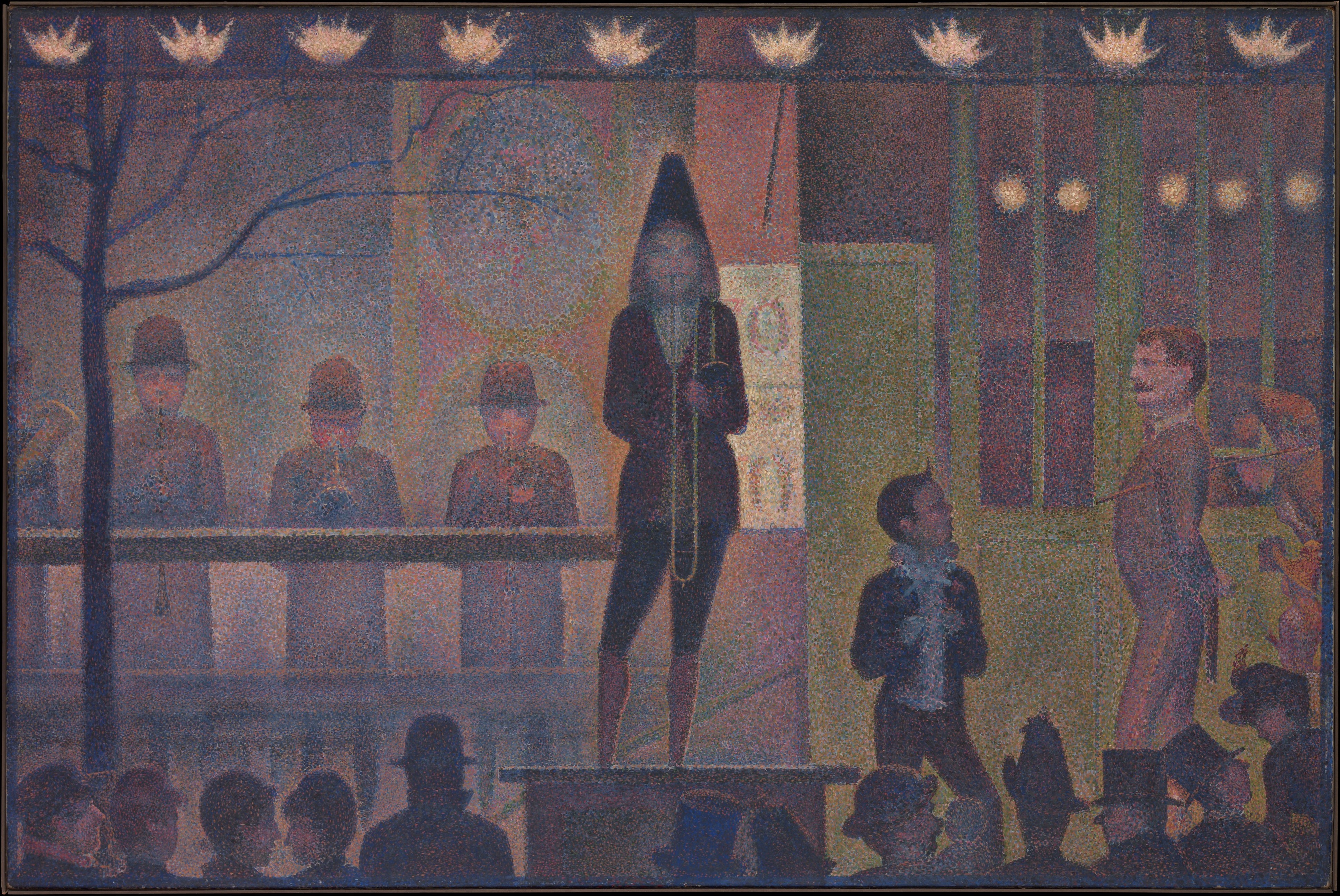
Georges Seurat, Parade de Cirque, 1887-88

Seurat’s Parade de Cirque (1888) is the third to last canvas in his short career. Inspired by sketches he made when visiting Fernand Corvi’s traveling circus in the spring of 1887, Parade de Cirque stunningly depicts a circus tableau at night.

Seurat uses pointillism as a way to cast a thin mist over the scene, giving it a show like, perhaps sleazy, quality. Under the glow of the stage gaslights, a performance unfolds. In his first nocturnal painting, Seurat does a fantastic job using light, or the lack thereof, to his advantage. The facial details of the stage performers are indistinguishable in the light of dusk. The highlighted characters are the spectators, each with a gentle angelic glow around their heads. The hats of the audience give the foreground a buoyant feel, the eye bopping along from one bowler hat to the next. A parallel effect is exhibited by the gaslights above, light exploding in small, powerful bursts. This joyful feeling in the top and bottom of the composition is balanced by the somber and faded colors of the center backdrop.
          
The painting itself appears to have been stolen from an actual circus, the colors and texture mirroring a late nineteenth century canvas circus advertisement. Seurat’s Parade de Cirque is the first of his series on scenes of popular entertainment. Each painting in the series feels vibrant and alive as each character feeds off the energy of his surroundings. In this sense, Parade de Cirque ultimately allowed Seurat to solidify the technique of capturing of live entertainment and led to the magnificent Le Chahut of 1890. 
  • 12:50 PM

Ophelia


John Everett Millais, Ophelia, 1851-52

Millais’ Ophelia depicts Hamlet’s Ophelia at the brink of her poetic death. Painted singing afloat on the Denmark River, Ophelia is the embodiment of the “tortured female.”  As Shakespeare’s tragedy progresses, Ophelia begins losing her mind, haunted by inner demons. At the time Hamlet was written, medical professionals believed that melancholy was a disability of the intellect expressed in males. Women with similar symptoms were assumed to be afflicted by not melancholy, but erotomania, a type of delusion in which the person affected truly believes that another person is in love with him or her. Millais might be alluding to this presumption in the facial expression of Ophelia.

Mouth agape in the release that accompanies death, Millais’ Ophelia evokes comparison with Bernini’s St. Theresa in Ecstasy. In addition to her erotic facial expression, Ophelia lies in a position that is almost saint-like: arms elongated, palms upward toward the heavens. She sinks into a garden of foliage, immaculately painted by Millais. Each flower adds to the meaning of the painting—the poppies signal the coming of death, the white flowers possibly referring to the song Ophelia sings to Hamlet about a maiden loosing her virginity. Influenced by the foliage on the riverbanks of London and Shakespeare’s words, Millais’ Ophelia has inspired many other works following its creation, such as the song “What the Water Gave Me” by Florence and the Machine and the cinema poster for Lars von Trier’s Melancholia, featuring Kirsten Dunst in a similar Opheliaesque pose. 
  • 12:00 AM

The Cross in the Mountains (The Tetschen Altarpiece)

Casper David Friedrich, The Cross in the Mountains, 1807
Perhaps the first Where’s Waldo of the nineteenth century, Casper David Friedrich’s first majorly publicized work left viewers agape at the relative insignificance of Christ’s figure in a depiction of the Crucifixion.

The Cross in the Mountains, painted by Friedrich at the age of 34, was originally intended to be an altarpiece for the Swedish King, Gustav IV. Confined to a frame made by Friedrich himself, the work was coldly received by the public when it was exhibited on Christmas Day of 1808. Friedrich perches the cross on a mountain surrounded by grand firs. When looking at the painting from afar, the cross almost appears to blend in with the landscape as just another fir. Upon inspection, we discover the cross to be in the center of the composition, reaching higher than the surrounding firs. Hanging on the cross is Jesus in the traditional crucifixion pose. But the savior does not face out toward the viewer. Instead, Friedrich positions Him to mirror the setting sun.

The luminescent sun rays carry great significance in the work. The earth can no longer hold onto the light of Christ. The rays seem to fade as the sun descends and the flesh of Christ grows closer to death. The mountain, immovable, demonstrates the unyielding power of faith, even if the visible rays no longer shine. Faith endures the test of time, as do the firs surrounding the ultimate symbol of Christianity.
  • 12:00 AM