The Third Class Carriage

Honoré Daumier, The Third Class Carriage, 1864
BY CARLY HOFMANN


One recurrent themes of  Honoré Daumier's work, was the impact of industrialization and urbanization on the working class people of Paris. Here, in The Third Class Carriage, his societal commentary turns his attention to new forms of public transport, namely, trains. His interest was not in the vehicles themselves, but instead in the ways in which they reinforced social hierarchy within such modern and allegedly democratic conveyances.

The invention and widespread use of the railroad was but one of the many changes heralded by the Industrial Revolution. The Industrial Revolution shattered societal norms throughout Europe by dramatically redefining the socio-economic standings of many working class citizens. As the factory system and mechanization of tools took over, many working class citizens found themselves forced out of the country-side and into the cities. This may be exact situation of the women in Daumier’s work here. It is quite possible that the subjects of his painting have been forced to abandon their previous jobs as artisans or farmers in the wake of industrialization.

The women in the foreground of the painting represent three generations, almost as if it were the full spectrum of life.  The figures who occupy the wooden bench in the painting's foreground are clearly of the lower class, as indicated by their disheveled and worn appearance. These third class travelers are physically separated from the more affluent passengers behind them, representing their social and economic separation. The third class family also faces away from the rest of the passengers, further emphasizing their isolation and rejection from Parisian society.

The feeling of compression that dominates the background is dispelled by the spaciousness surrounding the figures nearest the picture plane. In contrast to the irritable expressions of the wealthier passengers in the background, the nursing mother, the grandmother, and the sleeping child, who are all bathed in a golden light, seem quite serene. These features may allude to Daumier’s critique of the upper class being emotionally unfulfilled despite their apparent economic success. Daumier may be saying that it is be better to remain impoverished and content than wealthy and miserable. Though the painting is unfinished, it is still obvious that Daumier seeks to capture the plight of the working class by capturing the quiet moments of their everyday lives.
  • 7:00 AM

White Cross

Wassily Kandinsky, White Cross, 1922
BY CARLY HOFMANN

In his book Modern Art Richard Brettell claims White Cross serves as a primary example in Brettell's analysis of nationalism in abstract artwork through through the early twentieth century. Brettell argues that "nationalism is among the most powerful forces in modern society" as it can be seen at the root of most substantial political events. Yet in spite of ever growing globalixation, the history of modern art remains largely a sequence of national histories written in national languages by historians who viw art as belonging to a specific set of national values. Brettell believes that this is the box Kandinsky's work has been placed in, thus limiting its value. 

Kandinsky was truly an innovator in his time. His background as an economist and a lawer provided him with a unique perspective as he painted his experiences as a participant in the "Great Utopia." The "Great Utopia" was a revolutionary period of artistic transformation in Russia that foreshadowed the impeding political upheavals of the early twentieth century.

In this painting, Kandinsky evokes, rather than describes war, and elicits a more musical expression of his understanding of conflict. On this large canvas, Kandinsky compiled a catalogue of elements observed and invented by himself during his years in Russia. This piece would eventually become emblematic of his style. Though Kandinsky left for Berlin to escape political turmoil when he created this painting, art historians have classified it as a "uniquely Russian artwork."

It is in this classification that Brettell believes the potential of this painting is limited. Brettell notes that "every modern art museum teaches us that place is as important to art as time" and it serves as the primary mode or organization. Modern art museums are segregated by geopolitical fences through which time flows. As viewers, we see pieces produced in the same place at vastly different times, but never work produced at the same time in different places.  

However, as the world became more cosmopolitan, art historians began to understand the value in classifying artwork beyond the physical place in which it was created. This, Brettell argues, opens the door for more thoughtful consideration of artwork such as Kandinsky's. Now, the ability to succeed in a multilingual artistic society is seen as essential for a modern artist, and those who were able to cross such boundaries remain successful today.  In this way, Kandinsky was ahead of his time. Through his use of abstraction, he appealed to all viewers, regardless of language or nationality. The feelings prompted by his compositional an color choices are universal. 
  • 7:00 AM

Saturn Devouring One of His Sons

Francisco de Goya, Saturn Devouring One of His Sons, 1819-1823
By CARLY HOFMANN

Francisco de Goya's work defies any standard stylistic classification. His art cannot be separated from the conflicting social and political upheavals of late eighteenth century Spain. Goya assumed the role of a moralist and believed that his art could censure society's vices even more forcefully than any form of eloquence or poetry. He understood art as an opportunity to expose the eye of the viewer to thoughts and attitudes previously hidden within impassioned and unenlightened minds. He shared the enlightenment opposition to religious fanaticism, social injustice, and senseless cruelty. However, as with many others, his faith in the power of reason to solve human and artistic problems ended in disillusionment.

In January of 1890, Goya witnessed a liberal victory in Spain that forced Ferdinand VII to accept the constitution. Goya's response to constitutional freedom is demonstrated in the fourteen "Black Paintings" that he executed on the walls of his country home. In the paintings of his so-called black period, he explored the dark and terrifying world of the subconscious. It was understood that evil could no longer to be attributed to the devil, but to humanity itself.

In Saturn Devouring One of His Sons, Goya accentuates the blood and gore of ancient Roman myths as a cure for the glamor and opulence of neoclassicist idealism. Goya depicts Saturn feasting upon one of his sons, with the head and the right arm already consumed. As the titan looms from the darkness, the only brightness in the painting comes from the bulging eyes of Saturn, the sickly flesh and red blood on the child, and the white knuckles of Saturn as he clutches the body. There is evidence that this painting may have originally portrayed the titan with an erect penis. The feminine curvature of the corpse combined with this possibility denotes a disturbing sexuality. 

Various interpretations of the painting exist among critics. Some point to the conflict between youth and age, time as a devourer of all things, or the wrath of God. However, the most likely explanation of Goya's imagery is the painting as an allegory for the situation in Spain, where the fatherland has consumed its own children in wars and revolution.

Goya moved to France when the Spanish monarchy was reinstated and critics began to understand his works as projecting evils of a past when truth and reason ruled alone. This interpretation provided further evidence that if not formally a liberal, Goya believed in constitutional government and the freedoms it ensured. Goya famously said, "Imagination abandoned by reason produces impossible monsters, but united with her, she is the mother of the arts and source of their wonders."
  • 7:00 AM

When I Have Fears That I May Cease to Be

Caspar David Friedrick, The Abbey in the Oakwood, 1810
When I Have Fears That I May Cease to Be
By John Keats

When I have fears that I may cease to be 
   Before my pen has gleaned my teeming brain, 
Before high-pilèd books, in charactery, 
   Hold like rich garners the full ripened grain; 
When I behold, upon the night’s starred face, 
   Huge cloudy symbols of a high romance, 
And think that I may never live to trace 
   Their shadows with the magic hand of chance; 
And when I feel, fair creature of an hour, 
   That I shall never look upon thee more, 
Never have relish in the faery power 
   Of unreflecting love—then on the shore 
Of the wide world I stand alone, and think 
Till love and fame to nothingness do sink.

Editor's Note: Students were asked to pair a poem and painting with no explanation of the connection. 
  • 7:00 AM

The Nightmare

The Nightmare, Henry Fuseli, 1782
By CARLY HOFMANN

Despite working during the height of the Enlightenment and the so-called "Age of Reason," Swiss-English painter, Henry Fuseli, instead chose to depict darker, irrational forces in this masterpiece. The Nightmare became an icon of Romanticism and a defining image of Gothic horror.  The painting has yielded many interpretations and is seen as a precursor to late nineteenth-century psychoanalytic theories regarding dreams and the unconscious. The father of psychoanalysis himself, Sigmund Freud, studied this painting and kept a print in his office.

The figure that sits atop the woman's chest is often described as an "imp" or an "incubus." This type of malevolent spirit from germanic legend was believes to lie upon people in their sleep or even have sexual intercourse with sleeping women. The presence of the imp may be understood as a mythic representation of the physical experience of chest pressure during sleep paralysis. Although it is tempting to understand the painting's title as a reference to the horse in the background, the term "nightmare" does not refer to the equine figure. Instead, the name refers to the antiquated term "mara," which refers to an evil spirit that tortured humans by suffocating them in their sleep. It is possible that the milky eyed horse is the evil steed of the mischievous incubus.

Fuseli's painting is suggestive, but not explicit, leaving open the possibility that the woman is simply dreaming. This dream has taken form in a frightening and physical manifestation of the demonic figures. However, the violent slash marks on the drapery suggests that she may have succumbed to the terrors and died. The table top on the left side of the painting holds some mysterious bottles. Perhaps they are perfumes or medicinal concoctions. More than likely, the glasses contain laudanum, a narcotic mixture of alcohol and opium that was popular during Fuseli's time.

Through his use of composition and chiaroscuro the strategic contrasting of light and shadow– Fuseli heightens the drama and uncertainty of his scene. Traditionally, chiaroscuro was used to symbolize the literal enlightening power of rational observation, However, Fuseli's work instead reveals the futility of such light to penetrate and explain the darker realms of the unconscious. The single light source coming from the right, the curtains and tassels in the background, and the shorted foreground all contribute to the theatricality of the work. The red drapery falling off the edge of the bed suggests a river of blood as it might be enacted on stage in the operatic performances of the time.


On the back of the canvas, Fuseli painted an unfinished portrait of a woman. This woman is said to be Anna Landolt, the object of Fuseli's unrequited love during his visit to Switzerland in 1779. After her rejection of Fuseli, his depression and anger manifested itself in his subsequent paintings. This painting has thus been interpreted as an expression of the painter's sexual revenge and frustration. Even the imp's facial features have been seen as resembling Fuseli's own.
  • 7:00 AM

First Station

Barnett Newman, First Station, 1958

By CARLY HOFMANN
Momma,

I chose to thank you with this painting because I know it’s something that you’d hate at first. I can hear you now, “There is no way that could mean anything. That’s a line. Seriously.” And you’d be right, as always. It is a line. But it’s not just any line, because it’s one of Barnett Newman’s emblematic zip paintings and it happens to be titled, First Station

After years of you teaching me, it’s my turn to teach you a little something. 

Newman created a series of fourteen paintings that represented the Fourteen Stations of the Cross. The Stations of the Cross outline the horrific events of Jesus’ last day on Earth. Historically, artistic depictions of the stations were meant to reanimate the trauma of His crucifixion so that they become newly raw and searingly real regardless of the viewer’s familiarity with art or even the church. 

As we’ve grown together, I’ve seen you step away from your Southern Baptist roots in favor of a faith still traditional in its beliefs yet more modern in its applications. I think that’s exactly what Newman was trying to get at with these paintings. Newman himself said, “We do not need the obsolete props of an outmoded and antiquated legend.” Instead he insisted that modern artists and believers ought to make cathedrals “out of ourselves, out of our own feelings.” 

Newman’s abstract development of the Stations of the Cross recognizes the evils of idolatry. It was never his intention for his viewers to see a literal representation of Christ that could then be worshiped. He encouraged his viewers to draw their own conclusions and make their own emotional connections unhindered by the blatant portrayals of violence or sorrow so often seen in renderings of the crucifixion.

Newman’s work resisted idle religious generalization in favor of the visceral and instinctual. The austerity of Newman’s series accomplishes just that. The violent zips on the canvas reflected the woundedness and brokenness of Jesus’ physical body. His work reminds me of the way we can know something is there without fully being able to describe it. To me, that’s what faith is. That’s what you’ve taught me faith is. 

So. I hope that after that explanation, you understand why I love this painting. I hope you love it too. I encourage you to look at all of these painting in succession. I encourage you to momentarily trade your world of logic and rationality for a world of the vague and emotional. 

Thank you for your faith in Christ and your faith in me. I love you.

Carly

Editor's Note: Students were asked to give a painting to someone they cared for. These are their moving responses.
  • 7:00 AM

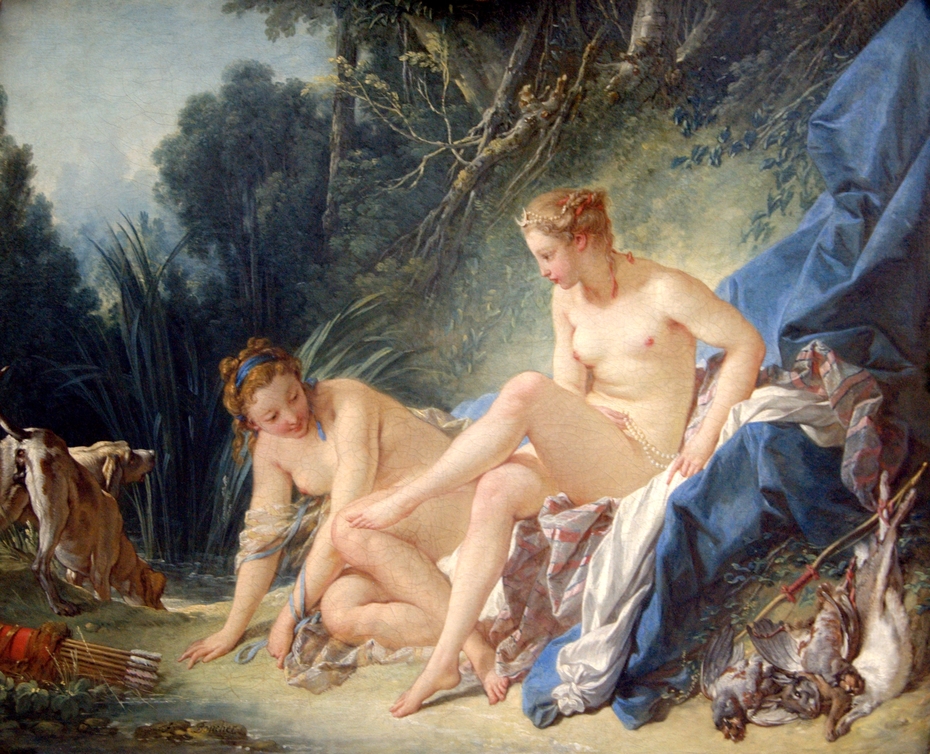
Diana Leaving Her Bath

Francois Boucher, Diana Leaving Her Bath, 1742
BY CARLY HOFMANN

In Diana Leaving Her Bath, Boucher demonstrates his expert manipulation of color, lighting, and form to create an idyllic and erotic portrayal of the innocent goddess, Diana. His subject matter is mythical in nature, but also takes on a sensual connotation. Boucher intentionally contrasts the dark blues and greens around the periphery of the painting with the bright golden tones in the center to emphasis his subject matter. In regards to perspective, the manipulation of color also brings the center of the painting forward, while pushing away elements such as the hunting dogs and forest. The lighting works in conjunction with this structure. The pseudo-natural lighting, possibly a beam of sunlight through the trees, emphasizes Diana and her hand maiden. 

A series of lines run through the painting, creating structure and visual focus. The main linear structure runs from the arms of the assistant, through Diana's legs and up through the infamously reoccurring blue curtain. The painting is very well balanced along this diagonal line and provides an untraditional sense of symmetry. Again, Boucher sticks with his trademark circular composition. In regards to form, the bodies of Diana and her aid are very proportional and anatomically accurate. They are crafted in a delicate and sensual manner that is aided by the texture of the brushstrokes. The soft, feathery, and well blended strokes around the skin add to the ethereal effect of the painting. 


Beyond the formal elements of the painting, Boucher has crafted a very specific narrative. Diana is identified by her signature attributes: the golden crescent settled in her hair and the bow and game lying next to her. However, most prominent here are the traits in fashion under the reign of Louis XV. Her the milky complexion, small full face, and curvaceous figure are emblematic of beauty standards at the time. 

Her virginal state distances her from any ill intent and she reveals her nudity only out of the necessity of her bath. She does so with total frankness and lack of prudery, like a novice to the world of romance. Diana is presented as a ravishingly pretty and demure girl. Many critics describe Diana as having “a voluptuous vacancy on her face” and argue that the lack of animation in her expression increases her charm. Her features reveal nothing of the hard-hearted goddess of the hunt. Though Diana is so desirable, she seems without desires, in a state of innocence that borders on ignorance. She is almost aloof in her routine. 

Boucher is above all interested in the relationship between the body and nature. The intense blue of the drapery is offset by the rosy freshness of skin and the subtle green of the landscape. The treatment of the nude female body is particularly delicate here and the modeling of the body is sensual, yet realistic. Boucher’s depiction of Diana reflects a totally human woman. His idealizing touches are restricted to the refining of the ankles and wrists, the arc of the brows, and the deeper red tinting of the lips. 

The most famous story relating to a bath of Diana is that in which the hunter Actaeon, coming across the bathing goddess, spies on her. Diana in her anger at Actaeon, who once boasted that he was her equal in hunting, causes her to turn the man into a stag. His own hunting hounds devour him. Is this painting a recreation of the pose of a goddess only recently having dealt with an affront to her glory? A goddess who calmly returns to her routine as her servants serve and her subjects reel in terror? 

  • 7:00 AM

Art History Hotties: Nino

Paul Hoecker, Nino, 1904
BY CARLY HOFMANN

The jawline, the pectoral muscles, the tasteful peek at the down below, and the precarious placement of the luxurious golden sheet all contribute to the deliciousness of this historical hunk. His casual sideways glance is enough to make any young girl swoon. However, it wasn't girls that our handsome model was after, and the true intrigue of this portrait lies in the history of the artist and his relationship with the model.

The artist, Paul Hoecker, had his fair share of sexual scandals. In 1897, word broke that Hoecker had used a male prostitute as a model for a painting of the Madonna. Eventually, this scandal forced him to resign from his elite position at the Munich Academy. He was socially rejected by his peers and retreated to Capri where he met the poet Jacques d'Adelsward-Ferson, who had fled Paris after his own scandal. There, Hoecker painted several portraits, including this one, of Fersen's lover, Nino Cesarini.

Nino Cesarini met Jacques d'Adelsward-Fersen in Rome on July 9th, 1904 at the tender age of fourteen. He found work as a construction worker and a newspaper salesman. Fersen conned Nino's parents into allowing Nino to work as a "secretary" with him in Capri. Their secret relationship blossomed, and Fersen commissioned several artists to immortalize Nino's beauty.  Fersen also commissioned famous sculptor, Francesco Jeraceto to cast a bronze statute of Nino. He also had Nino photographed as a Roman emperor and a Christian saint. He eventually sold these photographs commercially and faced radical criticism.

Nino, whose sexuality was not bound by gender constraints, also attracted women. When Nino and Fersen traveled to Venice, Nino flirted with Ricoy Antokolsky who eventually managed to seduce him. Fersen was enraged and produced a volume of poems that praised Nino's physical beauty in fear of being abandoned by his lover.

In 1923, Italian author and poet, Ada Negri, described the home of Nino and Fersen as "a place where everything was very beautiful, including Nino, the secretary, with the intense gaze of deep black eyes, crowned by well shaped eyebrows." He also noted that Fersen, who he considered "Nino's protector and lover" was greatly dependent on opium and smoked over thirty pipes a day.

In the same year, Fersen died of an overdose of cocaine dissolved in a glass of champagne. There were suspicions of suicide, but no evidence to substantiate the claim. Nino was named as the sole recipient of Fersen's estate in his will. In an attempt to preserve the family estate, Fersen's family spread a rumor that Nino had poisoned him in a jealous rage. Though the claim was taken seriously by the authorities in Naples, the accusation was dismissed.

Forbidden love, secret trysts, bisexual models, and alleged murder. What more could you want from an Art History Hottie? 

  • 7:00 AM

Mugshot Study

Kehinde Wiley, Mugshot Study, 2006
By CARLY HOFMANN

Kehinde Wiley refuses to be pigeonholed as any one thing. As a black, gay, Yale-educated, California -born, Brooklyn-based portrait artist, Kehinde Wiley finds his identity in this eclectic compilation of attributes. Wiley creates portraits to celebrate the equally complex identities of his African-American peers. 

As Wiley walked down the streets of Harlem, a crumpled piece of paper blew across the sidewalk. Wiley picked it up and discovered the mugshot of the unnamed man in this painting. The dichotomy of the traditional African necklaces and the wife beater stand out against his dark skin. The beautifully crafted highlights on the young man's face are representative of Wiley's classic style. In Mugshot Study, Wiley proposes a critique of the mugshot and its impact on members of the black community. With this painting, Wiley rebukes the mugshot with the ability to say, "I will be seen the way I choose to be seen." 

In his other, more iconic paintings, Wiley pulls subjects off the street in his effort to represent the common black man. When new subjects arrive at his studio, Wiley encourages them to look through various art history books and review classical works. When they've found a painting that resonates with them, he paints them in that pose. His paintings are not depictions of the wealthy, powerful, or influential. Wiley describes his paintings as "chance encounters with those too often prevented from filling those roles." By placing young blacks in the midst of classical portraits, he calls attention to the lack of representation for minorities in the historically great works of art. Wiley creates tension between traditional art history and its neglect of black subjects. His portraits symbolically reassign value to the sitter. 

The surfaces of Wiley's paintings are intentionally flat and thinly painted. This choice calls attention to the subject matter as art, instead of the paint itself. He disliked the visible brushstrokes of the expressionist era. Wiley's work is not about the paint, but the paint at the service of something else. He said, "It is not about gooey, chest-beating, mach '50s abstraction that allows paint to sit up on the surface as subject matter about paint."

Furthermore, Wiley was heavily focused on the idea of "remix culture." His paintings, replicas of various classical compositions, are "remixed" with the insertion of his black subject matter. Wiley is not concerned with being entirely original, nor is he concerned with the idea of cultural appropriation. He contends that, "Nothing is original anymore. Everything comes from something else. Every idea is inspired by something outside of itself." 

Wiley, almost hypocritically, also warned of the danger that art can tell us universal, cultural, or autobiographical truths. He warned against politicizing artwork in a way that limits the viewers perception of the painting. Wiley often points out the limitations created when the viewer expects art to be a political statement, social commentary, or a catalyst for change. However, this notion seems highly hypocritical because Wiley clearly pushes social commentary upon his viewer by transplanting disenfranchised blacks in the place historically powerful whites. 


  • 7:00 AM

The Artist and His Mother

Arshile Gorky, The Artist and His Mother, 1926-1936
By CARLY HOFMANN

When Arshile Gorky began painting, many defined him as a flagrant plagiarist. He spent the beginning of his career trying on and disposing of painting styles as casually as one would with assorted pairs of shoes. Even in his personal letters, Gorky was notorious for plagiarizing various authors and artists. However, this piece represents the most painstaking expression of his unique artistic style. The personal subject matter lends itself to such a presentation.

Gorky spent ten years perfecting this portrait of himself with his mother. He was inspired to recreate this childhood photo after his mother died in his arms following the Armenian genocide in 1919. The intention behind Gorky's work is most apparent when the painting is place next to the photo which inspired it.

Gorky's portrait represented his first experiment with flatness and incompleteness. After each layer of paint was added, he used a straight edged razor to scrape off any semblance of texture on the canvas. Gorky did not wish to accurately recreate a memory with this portrait. Instead he intended to immortalize his mother as a work of art with this venture into flatness and abstract expressionism. This style is highly reminiscent of Pablo Picasso's Blue Period.

The painfully negative space and the intentional angling of the artist's feet away from his mother highlights the separation in their relationship. The stark emphasis on the eyes also accentuates the emotional turmoil of this painting. The extension of the rectangle behind his mother's head serves as a sort of cloth of honor that presents her as a Madonna figure.

Though Gorky would later depart from this pseudo-realistic style, he would continue to push his early abstract tendencies that reveal themselves in this painting.  His abstract approach would soon evolve into a self-described combination of nature and reality filtered through memory and feeling.
  • 7:00 AM