A Room with a View - Untitled Film Still #15


A Room with a View
Examining the Film through an Art Historian's Lens
Curated by Melissa Martin

Cindy Sherman, Untitled Film Still #15, 1978 
"Don't you agree that, on one's first visit to Florence, one must have a room with a view?" - Lucy Emerson As we approach the end of our journey, you may notice a slight change (spoil alert). Yes, Lucy's surname has changed to Emerson. Not only has her identity changed slightly, but her attitude has developed into one of easygoing grace. As she and George honeymoon in the pensione they first met, a young girl and her chaperon complain of the situation that Lucy herself once faced: a room without a true Florentine view. The newlyweds offer up their own room, complete with a vista of the Arno, bringing Lucy's experience to a full circle. Thus, this once stubborn teenager has now transformed into a generous young lady. Along the same lines lies Cindy Sherman's Untitled Film Still #15, a self-portrait of "the tough girl with a heart of gold," according to the Guggenheim. Sherman creates an intimate moment of a model (herself) appreciating the scene outside while the audience relishes their own view. Her melodramatic photograph of feminine stereotypes serves as a critique of society, much like A Room with a View. With this underlying sentiment in mind, my collection comes to a close. If society ever gets you down, I would highly recommend contemplating life while admiring a view or getting lost in the wonderful world of art. Then again, you could just curl up with a fluffy blanket and watch A Room with a View on Netflix...
  • 12:00 AM

A Room with a View - Garden at Sainte-Adresse


A Room with a View
Examining the Film through an Art Historian's Lens
Curated by Melissa Martin

Claude Monet, Garden at Sainte-Adresse, 1867
"He doesn't know what a woman is. He wants you for a possession, something to look at, like a painting or an ivory box. Something to own and to display." - George Emerson In A Room with a View, Lucy Honeychurch must decide between the pompous Cecil Vyse and the philosophical George Emerson. Cecil's intellectual prowess and dainty nature aren't exactly turn-ons when compared to George's romantic gestures. Will Lucy conform to societal expectations or follow her rebellious heart? This turmoil dictates the majority of the film, which highlights the rather superficial values of the Edwardian upper class. Just 40 years before A Room with a View takes place, Monet painted the lovely Garden at Sainte-Adresse. The pre-Giverny portrait of his family summering in northern France illustrates the lives of the affluent. Although Monet portrays the delightful garden and its sea-view, he uses them primarily as a stage for a domestic scene. His subjects do not interact so much as they sit on display. This is the portrait of Lucy's possible future with Cecil.
  • 12:00 AM

A Room with a View - Girl at Sewing Machine


A Room with a View
Examining the Film through an Art Historian's Lens
Curated by Melissa Martin

Edward Hopper, Girl at Sewing Machine1921
"I don't care what I see outside. My vision is within! Here is where the birds sing! Here is where the sky is blue!" - Mr. Emerson Yet again, Mr. Emerson provides dramatic insight while dealing with a delicate situation. His passion and conviction give a reality check to the decorum-obsessed characters in the Edwardian era film. While his peers remain focused on the outward appearance of things (i.e. the view outside a hotel room), Mr. Emerson chooses to develop his own self, his very soul. Perhaps Edward Hopper incorporates this sentiment in his works, especially those like Girl at Sewing Machine. A vast number of Hopper's paintings feature empty rooms in the city with lonely subjects washed in the bright light of a window. In the harsh world of a bustling metropolis, Hopper's characters must turn inwards to preserve their personal oases. Girl at Sewing Machine epitomizes this attitudethat one should rely on their vision within when stuck in the middle of a concrete jungle.
  • 12:00 AM

A Room with a View - Eugene Manet on the Isle of Wight

A Room with a View
Examining the Film through an Art Historian's Lens
Curated by Melissa Martin

Berthe Morisot, Eugene Manet on the Isle of Wight, 1875 
"My father says there is only one perfect view, and that's the view of the sky over our heads." - George Emerson Much of A Room with a View takes place outside, whether the characters are exploring the sights of Florence, bathing al fresco in the English countryside, or playing an intense game of badminton. The Emersons' love of nature contrasts the societal expectation for women to stay indoors, which further emphasizes their free-spirited approach to Edwardian standards. Interestingly enough, Edouard Manet, a key leader of the Impressionist movement, did not share this same affection for the outdoors...at first. Natural light drives Impressionism, infiltrating every piece and dictating each artist's style. Berthe Morisot embraced this idea by practicing plein air painting, or painting "in the open air." She eventually convinced her colleague and friend, Manet, to take up the technique and enter the outdoors. However, it appears that Manet prefers the comfort of the indoors in Morisot's Eugene Manet on the Isle of Wight. At least he can discreetly stalk the lovely ladies passing by, which might be the view he prefers.
  • 12:00 AM

A Room with a View - Woman at a Window


A Room with a View
Examining the Film through an Art Historian's Lens
Curated by Melissa Martin

Caspar David Friedrich, Woman at a Window, 1822


"Women like looking at a view. Men don't." - Mr. Emerson Wise words from Mr. Emerson, the film's wacky yet astute patriarch. He utters them at the very beginning, while Charlotte Bartlett, Lucy Honeychurch's cousin and chaperon, complains about their room's lack of a view. For the reason stated above, Mr. Emerson offers up his and his son George's suite, thereby solving the horrendous problem and triggering a romance between Lucy and George. In the time of both Caspar David Friedrich's paintings and the Edwardian era of A Room with a View, this kind gesture would have held special significance. As evidenced by Friedrich's other works, men spent much more time out of doors than their female counterparts. While they experienced nature firsthand, women were often confined to the comfort of their domiciles, meaning much of their interaction with the outdoors was through glass panes. Windows in paintings such as Girl Reading a Letter at an Open Window or Woman at a Window offer unique perspective from women viewing the outside world through comparatively tiny peepholes, much like Lucy Honeychurch's attempt to step out of her sheltered lifestyle.

  • 12:00 AM

A Room with a View - Girl Reading a Letter at an Open Window


A Room with a View
Examining the Film through an Art Historian's Lens
Curated by Melissa Martin

Girl Reading a Letter at an Open Window, Johannes Vermeer, 1657-1658
"Afar off, the towers of Florence. And she wandered as though in a dream through the wavering sea of barley, touched with crimson stains of poppies. All unobserved, he came to her. Isn't it immortal? There came from his lips no wordy protestations such as formal lovers use. No eloquence was his, nor did he need it. He simply enfolded her in his manly arms..." - Eleanor Lavish Love at first sight is no myth. It happens rarely, but when it strikes, life changes drastically. That's how I feel about Johannes Vermeer. As my junior self sat wide-eyed in the bewildering Renaissance Art History class, I found solace in the delicate portraits from Vermeer. The soft lighting calmed me, the subject matter engaged me, and the perfectly organized composition intrigued me. I couldn't get enough of his classic Dutch genre paintings, and I still can't. An unhealthy obsession with Vermeer's works planted a seed in my mind to craft a collection around. My favorite works of his often feature windows that illuminate the setting and character, so why not use that as a jumping-off point? Thus, "A Room with a View" was born. The title that developed in my subconscious eventually prompted me to re-watch A Room with a View, a boring and lengthy movie I hadn't seen for years. Goodness, was I wrong. Though slow at times, I thoroughly enjoyed giving it a second chance. Now, I could relate the film with Girl Reading a Letter at an Open Window on content alone (suppressed females aching to escape the restrictions of society, but that would be too obvious). For me, these two works share an abstract commonality: the ability to fall in love so effortlessly. Much like Lucy Honeychurch and George Emerson adore each other, I very much fancy Mr. Vermeer.
  • 12:00 AM

A Room with a View - View of the Jardin du Luxembourg, Paris

A Room with a View
Examining the Film through an Art Historian's Lens
Curated by Melissa Martin

To preface: I did not intend for the title of my collection to relate directly to the 1986 film. However, after re-watching A Room with a View, I thought it might provide a nice story to weave into the paintings. Please join me for a journey through the Academy-Award winning masterpiece and accompanying artwork.

Jacques-Louis David, View of the Jardin du Luxembourg, 1794

"Smell! A true Florentine smell. Inhale, my dear. Deeper! Every city, let me tell you, has its own smell." - Eleanor Lavish
Not only does each city have its own scent, its own character, but it has its own unique history. Though David's historical paintings formed his reputation, he occasionally ventured outside of his typical style, one prime example of this being
View of the Jardin du Luxembourg. The main aspect that sets this work apart from the rest is the bird's-eye view that David employs. Maybe he imagined himself as a pigeon soaring over the park's winding paths, or perhaps he envisioned the viewer as a nobleman overlooking the visitors from the palace's balconies.

So what exactly does this work have to do with
A Room with a View? Well, after some careful research, I discovered that the settings share much in common. The backdrop for the film, beautiful Florence, actually inspired the park's design. King Henri IV's widow, Marie de Medicis, created the park in the 17th century as an homage to her childhood home. This little slice of Florence may have cured the queen's homesickness, but I'm sure Ms. Lavish would attest that nothing holds a candle to the authenticity of Firenze, Italia.

  • 9:52 PM

Gas


Edward Hopper, Gas, 1940
Wanderlust. It's a contagious disease that develops in the subconscious and spreads to your very soul. A few major symptoms include desperate yearning for adventure and heightened awareness of your surroundings. But how do you cure it? Only one solution remains apparent: trek from the redwood forest to the Gulf Stream water until you stumble across self-discovery.

It is this sentiment that Edward Hopper conveys in his iconic masterpiece, Gas. This composition from 1940 offers a glimpse into the Route 66 culture, which emerged around the same time that Hopper’s career gained traction in the art world. Everyday American life inspired the quiet artist immensely, as evidenced by his seemingly endless depictions of New England architecture and mundane city life. Considering his track record, Hopper’s choice to paint America’s burgeoning highway system seems odd at first, but then the work speaks for itself.

Among the happy-go-lucky families on vacation and the rushed business travelers hide sufferers of inherent loneliness: those who traverse the nation looking for answers, Jack Kerouac-style, or those who get lost in the shuffle. Hopper decidedly focuses on the latter. He identifies with the sole attendant who tends the three Mobilgas pumps. Empty pavement stretches out behind him, while a forest of ominous pines traps him in his little corner of the world. The attendant, much like Hopper, must remain a lonely witness to the never-ending stream of passersby, unsympathetic to the victims of wanderlust.
  • 12:00 AM

Madame Pierre Gautreau

Antonio de la Gandara, Madame Pierre Gautreau, 1879 
I walked up the steps to the small museum, my feet tired from a day of exploring yet my eyes eager for visual delight. Charleston, South Carolina is a beautiful city for outdoor enjoyment, but I was able to drag my family into the seemingly solitary art museum in the state. We entered through the gift shop (Banksy reference intended), not quite sure what to expect of the stately Gibbes Museum, sparsely filled with elderly tourists. I kept an open mind and urged my parents and sister to be patient.

They were featuring Alfred Hutty in their "Artist Spotlight" collection, paying tribute to the local artist through his various watercolors, sketches, and oil paintings. Another part of the museum focused on local modern artists, such as Jasper Johns. We walked some more and stumbled upon more classic paintings, especially portraiture. I yawned and pressed onward. Then, my mother beckoned me. "Isn't this Amelie Gautreau?" she asked me excitedly. I commended her for her temporary art history buff status and attempted to plop myself down in front of Gautreau's stunning figure.

But alas, sit and stare I could not. There were no benches to be had. In fact, I had missed the painting in the first place because of its awful corner location. This larger-than-life portrait with its impressive contrast and notable subject wasn't even the focal point of the exhibit. Antonio de la Gandara had painted it in 1897, years after the Madame X ordeal. He made great effort to flatter the then 38-year-old social butterfly by placing emphasis on her distinct facial features and graceful being, rather than her aging body. For this reason, Antonio de la Gandara's Madame Pierre Gautreau became Amelie's favorite that she hung in her room. Ironically enough, this socialite who had once been the center of the Parisian universe has been reduced to a corner of a small museum in South Carolina. Madame X must be rolling in her grave about that horrific faux pas.
  • 12:00 AM

Garden at Vaucresson and The Beautiful and Damned

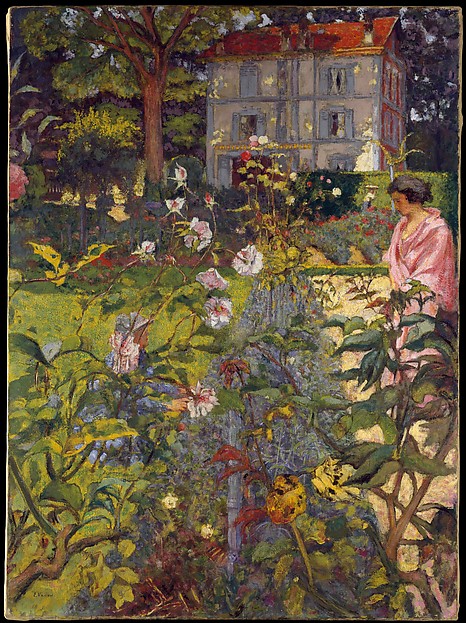
Edouard Vuillard, Garden at Vaucresson, 1920
Edouard Vuillard's obvious nod to Monet depicts a mademoiselle enshrouded in carnation pink touring her gardens. Barely visible through the foliage lies a gardener bowing beneath the flowers and to her noble employer. The soft brushstrokes and pastel shades give the work a certain level of daintiness, but is there a more interesting story behind this pretty spring scene?

Take, for example, F. Scott Fitzgerald's 1922 novel The Beautiful and Damned. Cast in the light of the sparkling Jazz Age, Anthony Patch and his wife Gloria float through New York atop champagne bubbles, committed to no vocations other than waiting around for inheritance and improved societal standing. Gloria eschews traditional roles in favor of cherishing her days as a flirtatious flapper, even after her nuptials. Fitzgerald best sums up Gloria's perspective in the following passage:

"The reality, the earthiness, the intolerable sentiment of child-bearing, the menace to her beauty--had appalled her. She wanted to exist only as a conscious flower, prolonging and preserving itself. Her sentimentality could cling fiercely to her own illusions, but her ironic soul whispered that motherhood was also the privilege of the female baboon." 

This preservation of beauty that occupied the minds of Jazz Age women not only appeared in Fitzgerald's characters, but also in pieces by artists such as Vuillard. As females sought independence within society, they championed new ideals of youth and physical appearance. The subject of The Garden at Vaucresson chooses the path that leads to elegant aging and a charmed life, rather than the route of the laborer. Perhaps this era of luxury and sophistication appear most evident in such refined works as The Garden at Vaucresson and The Beautiful and Damned, embodiments of Fitzgerald’s 1920s.

  • 5:00 PM

La Goulue Arriving at the Moulin Rouge

Henri Toulouse-Lautrec,
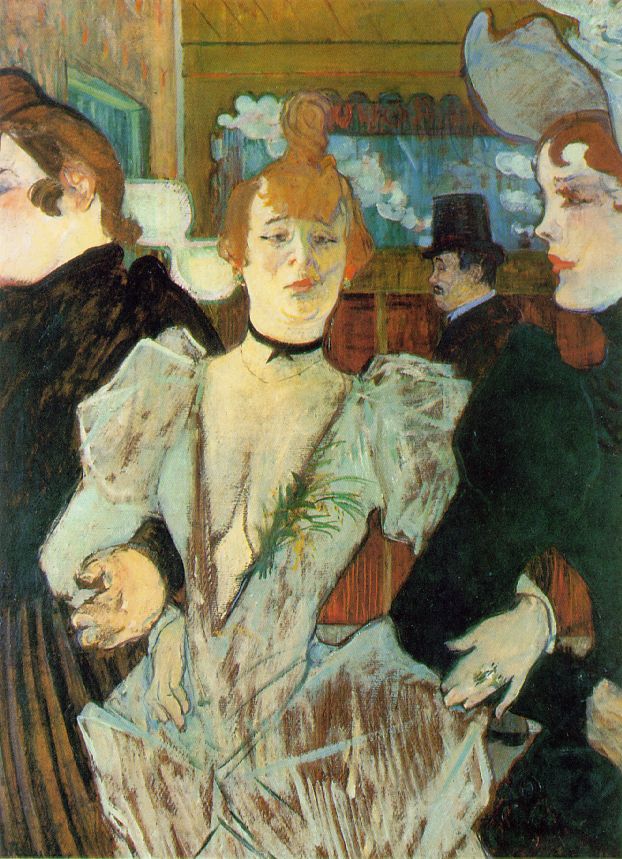
La Goulue Arriving at the Moulin Rouge, 1892 
She walks into the room. Everyone turns their heads. The sound of her swishing skirts seem to drown out the music of the band, the loud salon music that reverberates off of the Moulin Rouge's crowded interior. The Belle Epoque is in full swing, and La Goulue reigns over Paris as its high-kicking queen.

Louise Weber would not have achieved such celebrity without some help from her artistic friends, especially Henri Toulouse-Lautrec. He adopted La Goulue ("the glutton") as his muse, immortalizing her image in paintings that lined gallery walls and posters that littered the streets of Paris, advertising her as the forward dancer with free-flowing skirts. Lautrec glorifies the movement that La Goulue embodies in her dance. This mastery of subject is the product of years spent together, considering he followed the starlet from her debut to the end of her fame. Even when La Goulue isn't dancing in his depictions, Lautrec manages to evoke a sense of lively movement and a certain unrestrained spirit.

Lautrec combines the sense of grand entrance with a spirited personality in La Goulue Arriving at the Moulin Rouge. The lady occupies most of the portrait's space, framed by her gentleman dance partner to the left and her sister to the right. The viewer can admire both her wily red hair and unmissable decolletage from beyond the painting. However, if the viewer dares to stare too long, s/he may encounter the gaze of the subject. Her eyes appear tired, but once combined with the pursed lips, an appearance of a smirk begins to emerge on her famed countenance. In regards to movement, Lautrec achieves a sense of chaos ready for release by painting furiously brushstrokes across the fabric of her dress, criss-crossing every which way. Obviously, La Goulue cannot be contained. Let the entertainment begin.
  • 12:00 AM

At the Races in the Countryside


Edgar Degas, At the Races in the Countryside, 1869
Back in the 1870s day, Cassatt and Degas were a dynamic duo. The American full of spitfire and creative urges fell in love with his paintings and later wrote, “The first sight of Degas’ pictures was the turning point in my artistic life.” The two maintained a lasting friendship that provided artistic and mental support, despite their often clashing personalities.

Degas inspired Cassatt, who continued to venerate his work throughout her own artistic career. This becomes evident in Driving (1881), a painting that draws heavily upon Degas’ At the Races in the Countryside (1869). Cassatt’s interpretation focuses on the family within the carriage, carrying her maternal motif, while Degas incorporates more of the surroundings.

The key difference between the two pieces is color. Cassatt creates a dark background, keeping her figures light and rosy, while Degas paints a light and airy background contrasted by the dark horse and carriage. Degas’s light blue and pea green are superior to Cassatt’s dark tones. Additionally, Degas expands the painting and including more than just the main subjects, creating a more interesting composition. Unfortunately for Cassatt, the grasshopper has not surpassed the master.
  • 12:00 AM

Rain, Steam and Speed – The Great Western Railway


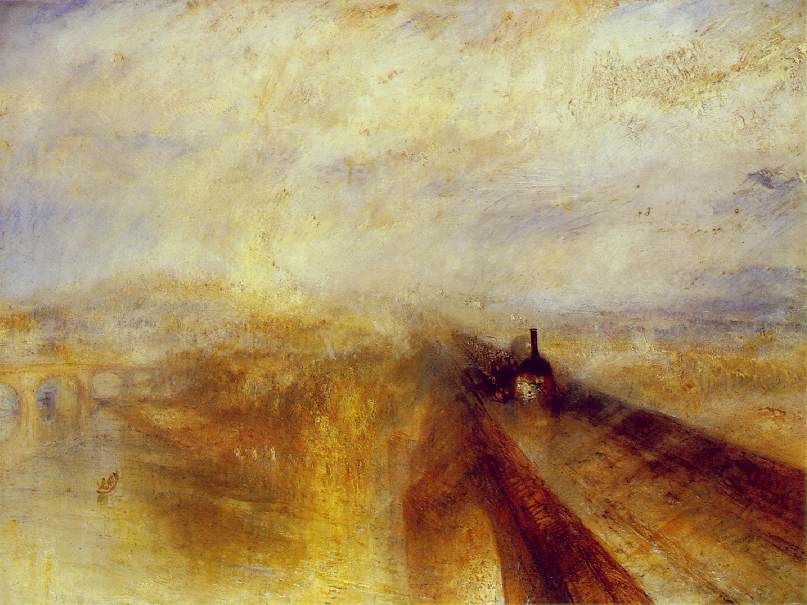
J.M.W. Turner, Rain, Steam & Speed, 1844
Art and invention battled it out in the industrial revolution, fighting for their opposing positions in modern society. But what if someone could reconcile these two seemingly contradictory concepts?

Enter J. M. W. Turner, landscape painter extraordinaire. Those familiar with Mr. Turner might imagine breathtaking watercolors of natural wonders upon hearing the artist’s name. Indeed, most of Turner’s renowned works feature stunning seas and golden waters, highlighting nature’s prowess. Despite his fascination with nature, Turner did not eschew the inventions of the industrial revolution. One in particular caught his eye: the steam engine.

Seven years after retiring from his professorship, Turner toured Switzerland for the last time. In 1844, he was 69 years old, seven years away from his death. The railway business remained at its peak during Turner’s latter years. This boded well for the wandering artist, an elderly man who relished the comfort and speed trains offered. Turner enjoyed a leisurely lifestyle, despite the rapidity of the machine. Rain, Steam and Speed is just that—a marriage between relaxed landscape and impressive innovation. To look at the painting is to share an experience with Turner. Stick your head out of the window and savor the wind of speed.
  • 12:00 AM