Naked Man with his Friend

Lucian Freud, Naked Man with his Friend, 1980
By ROSIE PASQUALINI

Just as one forgets their coat until the cold rolls in, clothing has a redemptive effect on the human form which we often take for granted. Lucian Freud, who preferred the term "naked" over "nude," manipulated ideas of human dignity and intimacy in a manner reminiscent of his grandfather, the infamous psychoanalyst Sigmund Freud. Both men, it seems, were plagued by a constant awareness of the body's frailties and shortcomings. Lucian's work reveals a self-contradictory love of, and distaste for, the human form. His subjects are uncannily vivid, glowing with the sickening brightness of rot. Their facial expressions straddle the line between peacefulness and death. Their flaws -- the veiny hands, the wrinkles, even those blackened toenails -- are as endearing as they are disgusting, and the man's nudity is unbearably striking when juxtaposed with his friend's pajamas. At first glance one turns from this painting. But if, as I did, you look for long enough, you cannot stop looking. The nudity gradually becomes less shocking until the clothed man seems like the odd one out. There is a strange and ferocious pride here, an unabashed affection. Ugly love is the purest.

It is difficult to exist in a human vessel. For many years I believed my body did not function or look the way it was supposed to. I respect Lucian Freud because he painted people as he saw them, not as they wanted to be seen. The result is deeply comforting. Though few of his subjects look pretty or even healthy, there is warmth in the way they relate to each other on the canvas. I do not wish to suggest that their flaws make them beautiful. This is simply false. But their interactions are a little bit beautiful. I read several articles about Freud's artistic process, all of which elicited entirely negative reactions in the comments. They were not intelligent reactions. Someone complained about his 2005 painting of Kate Moss, claiming she had a distasteful amount of pubic hair. Someone else responded with the YOU-CALL-THIS-ART!!!!! snobbishness usually accorded to abstract works. I have a suggestion for these people. I think they should go find a mirror. Freud's work is certainly grotesque, but it is important. If it  horrifies us to see the reality of the human body on a canvas, we probably do not look around enough in real life. Let's all take a break from our Instagram accounts and our overproduced pornography to check out some Freud.

You're really screwed up, aren't you? Your body is a transient wreck.

It's ok. I love you anyway.

  • 7:00 AM

Eyes in the Heat

Jackson Pollock, Eyes in the Heat, 1946
By ROSIE PASQUALINI

When I was in the fourth grade and still believed in magic, my friend Emma and I decided God had given us special powers -- a certain clairvoyance, a capacity for truth -- which would enable us to save the world. We did not know what, exactly, we were to save the world from, but this seemed irrelevant at the time. We felt important, and thus we were happy. The evidence was everywhere. First there was the large stick from the playground -- creatively dubbed "The Stick" -- which appeared to be covered with ancient hieroglyphs. I still remember those meaningless squiggles. They were uncommonly beautiful. Next there was the wind in the grass, which I thought nothing of until Emma convinced me each ripple was really the footstep of an angel. Her mother had told her this, and Emma's mom was my English teacher, so of course I trusted them both. But I would not have believed as strongly in our game as I did if it hadn't been for the eyes. One Wednesday afternoon when we were looking for God, Emma pointed at the sky and said, "It's Him! He's watching us!"

I had no idea what she was talking about, so she pulled me closer and aligned my gaze with her finger. One of the clouds was not a cloud. It was a gigantic eye made of cloud-bits. Thus began the strangest and most glorious phase of our self-aggrandizing fanaticism. We saw eyes everywhere. I especially recall how we scoured the bricks on the back of the school with the palms of our hands, feeling for little craters, which we always found. We were ecstatic, waiting for a message that never came; we said that God was "everywhere and nowhere at all," our first foray into philosophy. Then it ended. I do not know when, or even if, I stopped believing in God, but a creeping sense of shame told me the game itself was fake, like the feeling you get when you first contemplate the impossibility of Santa Claus. Emma and I grew apart. We turned to books and love for answers, with varying degrees of success. (My first crush is now-- horrifyingly-- a senior at Pembroke.) Even the allure of our favorite stories and hopeless romances paled in comparison to our self-imposed holiness. This is why I have chosen Jackson Pollock's Eyes in the Heat-- because it brings back all the mystery and excitement of when Emma and I went looking for God on the playground.

Pollock toys with the mind's tendency to seek out facial features. We naturally detect faces on the fronts of cars and in outlets for three-pronged plugs; here, we find eyes in vague, loping ellipses.
Hehehehehehehehehe!
Is it Prozac, or is the world a really happy place right now?
Some shapes in Eyes in the Heat are clearly more eye-like that others, and once the mind is primed, we find new eyes in the slightest indications of roundness. Even knowing the title changes what the viewer finds; I would like to have two people look at this painting for twenty seconds-- telling only one person the title-- and then ask them what they saw. Eyes in the Heat shows how truly arbitrary artistic meaning can be and emphasizes the importance of the subconscious and the power of belief in our everyday quest for truth.
  • 7:00 AM

Mrs. Henry Marquand

John Singer Sargent, Mrs. Henry Marquand, 1887
BY ROSIE PASQUALINI

If she weren't extremely dead, I would be friends with Mrs. Henry Marquand. She looks kind without seeming naive, dignified but unpretentious, and elderly yet healthy. Also, she and I have matching hair. In this portrait Mr. Sargent presents, without excess coyness, several pairs of characteristics that we often assume to be mutually exclusive, especially within the context of high society. For all her regal flair, Mrs. Marquand exudes an undeniable warmth. The goal of portraiture, perhaps, is to bring out certain half-hidden attributes from a subject without negating what is apparent at first glance, and Sargent accomplishes this perfectly.

Mrs. Marquand is the center of gravity and light. She is a beacon of clarity and order compared to the glowy haze above her and the shadows hugging her chair. The first time I saw this piece I thought there was a bird on her chest, with its wings gliding up her shoulders. The lace carries this same delicate allure. She holds a fan in her right hand. I find this inane detail a bit disturbing, because the fan matches the walls far too well, which forces us to acknowledge that portraiture is a contrived theatre of light, similar in many way to today's Photoshop. Yet the facade has been put to good use here. Equally off-putting is the prominence of Mrs. Marquand's wedding ring in conjunction with the painting's title-- essentially her husband's name. Loss of self, it seems, was a prerogative of marriage. Henry Gurdon Marquand was a prominent businessman whom Sargent wanted to impress. Mr. Marquand helped found the Metropolitan Museum of Art with the intent of "humanizing" the "practical" lower classes, and had an impressive private collection-- he donated fifty Old Master paintings to the MoMA and had several left over. Daaaaamn, Daniel! I have found little about Mrs. Marquand herself in Deborah Davis's Strapless, but we do learn, as the painting suggests, that Sargent liked her personally. Her first name was Elizabeth.

  • 7:00 AM

Fêtes and Folly: The Tea Party

Andrei Ryabushkin, The Tea Party, 1903
Me, circa 2013.
By ROSIE PASQUALINI

A tea party? Count me in! It's all fun and games until someone sees the severed human heads in the background. Actually, wait. They probably haven't even noticed. By "they," of course, I mean the fearsome foursome lined up at the table, looking like clowns in their obscenely pretty clothes. The brightness is nauseating, like the guests' frostbite, which brings out the dullness of their eyes. The table is laden with simple yet sacred food: Fish and bread. Nobody is eating. (When I discovered this painting, I was overcome first by a sort of thrill at the perfidy of it all, followed by an uncanny familiarity. Lunch on the eating disorder unit had a similar vibe.) Many paintings are conducive to laughter. Others inspire the urge to vomit. But few can produce these two effects in tandem. What's going on here?

Here's how I see it. This posse of relatively moneyed hooligans is rolling through a poor neighborhood when some emergency-- perhaps an ambush, considering the heads-- forces them to take cover in a local eatery. They both ignore and are actively disgusted by the wealth discrepancy, which terrifies them even more than the commotion outside. In avoiding the food they are served, our guests assert their perceived superiority while simultaneously resisting the "truths" of excess and poverty, including that undeniable wholesomeness-- here, a holiness-- which accompanies subsistence at its most basic level. Every member of our fearsome foursome deals with their discomfort in a unique way. The man on the far left is pretending that nothing is wrong. His face exudes an expert blend of self-assurance and exhaustion. To his right sits a man with splendiferous hair, who wears a curiously bashful expression. Perhaps he envies the first man's composure. Personally, I think he is smitten with the man in blue. (After all, while a smidge of anxiety helps us disguise ourselves, fear is self-revealing.) The woman on the right is peeved not only by her spectacular out-of-place-ness but also by her husband's homoerotic tendencies. The crease in tablecloth accentuates their divide. And just look at that glare. Only the man on the far right responds sensibly to the whole predicament. He is drinking his troubles away.

Beside the individuality of each facial expression, my favorite aspect of this composition is that it has no true center. After escaping the woman's death-stare, my gaze tumbles down her shoulder and gradually descents the line of the tablecloth, where it must then find a new face to keep from falling off the painting. The constant motion inherent in this arrangement mimics the discomfort Ryabushkin creates in his depiction of a wealth which seems absurd, nearly laughable, when juxtaposed with a lack thereof. We humans like to associate with those similar to us in order to feel normal. Ryabushkin's Tea Party pushes back against this tendency, revealing a truth, or at least a difference, that can't not be noticed.

*** Editor's Note: Students developed the topic of Fêtes and Folly to chronicle elegant celebrations, bad dates, late nights, or other things related to that time in Spring where barbaric yawps can be heard from backyards, beaches, or the more familiar rooftop. Enjoy their revelry, cheeky overstatement, and occasional tales of ribaldry over the next couple of weeks.

  • 7:00 AM

Psychological Abstract Portrait of Ted Shawn

Katherine Dreier, Psychological Abstract Portrait of Ted Shawn, 1929
By ROSIE PASQUALINI

1. Wealth is defined as the sum of any and all resources owned by a community or by an individual which exceed those required to reasonably ensure survival.

2. Wealth is a means of control. Those in its possession gain power, via necessity, over those less fortunate. Furthermore, wealth is conducive to the sense of self-sublimation that accompanies a perceived increase in control over one's physical state. Once basic needs are met, a society or class shifts toward the pursuit of security in a deeper sense; e.g. intellectual "immortality," which includes the development of social systems whose values are meant to outlast its members.

3. Wealth is always used as a means for control, though this may not be apparent in every case. This makes sense from an evolutionary standpoint.

4. The performance of wealth has two mechanisms, both of which suggest a "mind over body" ideal. -

--Note: Wealth is not necessary for the pursuit of conceptual security, but it makes this endeavor feasible on a social scale.

--The first mechanism is alteration. This includes modification and restriction of the human body, its appearance, and its environment. Fashion is a form of alteration; so are sexual permissions or limitations (e.g. chastity) which are socially sanctioned. In general, the performance of wealth via alteration targets those physical states which are most difficult to attain in a particular time and place. For example, thinness is glorified in Western culture because foods with low nutritional value are easily accessible and relatively inexpensive. Alteration of the human body at the class level reinforces a system's values as well as the wealth-- and, therefore, security-- of the individual.

--In addition to direct manipulation of the body, alteration includes the modification of its surroundings. Any anthropogenic change in the environment that facilitates human activity counts as alteration-- housing, transport, et cetera. This form of alteration is required at the sub-wealth level to ensure survival but becomes amplified when wealth is achieved. It contributes to the pursuit of ideological security because physical control is part of what keeps a society-- and its values-- alive.

--The second mechanism of wealth performance in relation to the human body is abstraction. Instead of, or in addition to, changing the body and its environment, the growth of wealth in a social stratum may entail the institutionalization of "abstract" thought and an emphasis on intellectual progress. Advances in the arts and sciences likely come to mind. However, the definition of progress changes in accordance with social values; the concept of leisure, which we have discussed at length in class, is an equally fitting example because the luxuries of play, rest, and socialization manifest as the "sublimated" ideal of wealth in leisure-driven societies. Leisure illustrates the convergence of alteration and abstraction, or physical control and mental elevation.

--In staying faithful to this model we may postulate that the institutions of education and religion are also abstract performances of wealth; God or no God, our desire for intellectual and spiritual permanence that exceed the human lifespan form the basis of how we use wealth.

5. Art is a form of alteration, abstraction, or both.

--Art is a performance of wealth. 

6. There are two kinds of art: Reflective and reflexive. Reflective art drives conscious social change.  What distinguishes reflective art from other forms of innovation is its ability (or, rather, the artist's ability) to critique the relationship between wealth and control despite the fact that artistry is, in and of itself, a performance of wealth. Reflexive art, on the other hand, makes no intentional statement about the relationship between wealth and control-- which, by default, reinforces the values and practices of the social system from whence it comes.

--Note: I will not try to define "art" here-- but I believe that reflective creation is always art, while reflexive creation is sometimes art, depending on whom you ask.

7. NOW I'M GOING TO TALK ABOUT THE PAINTING.

--Note: You thought it would never happen.

--In Chapter 6 of Modern Art, Brettell discusses the peculiar and seemingly paradoxical role of the portrait in modern societies. He explores how "portraiture represent(s) the comfort and anxieties of the urban-based class" (Brettell 165), and adds that "many of the most famous modern portraits seem critical both of their class and of the social structures of class representation" (167). This last bit is especially interesting, given that portraiture, almost always done on commission, was the epitome of wealth performance. It combined alteration and abstraction by creating a favorable representation of the subject's physical likeness, thus separating their "psychological essence" from their body while simultaneously acknowledging the subject's ability to manipulate his or her own physicality in accordance with the rules of their class (165).

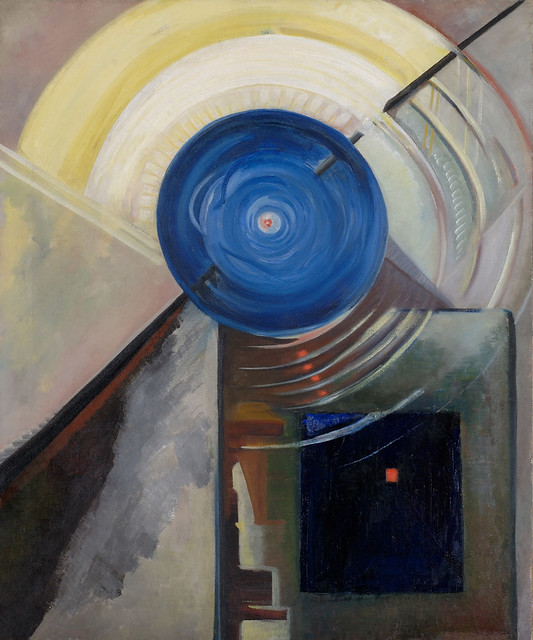
Katherine Dreier's Psychological Abstract Portrait of Ted Shawn is even more unusual. It is a holistic conceptualization of someone who devoted his entire career to the transformation of the human body and its movement. Shawn was a pioneer of modern American dance, and this abstract portrait complements his choice of career, as wealth is performed (and art created) through abstraction and alteration. 
  • 7:00 AM

Where Do We Come From? What Are We? Where Are We Going?

Paul Gauguin, Where Do We Come From? What Are We? Where Are We Going?, 1897
By ROSIE PASQUALINI

*FACT*

True Emotion is teenage angst dressed up in fancy shoes and a tuxedo.

*A DESCRIPTION OF MY CURRENT STATE*

It is called Missouri. That’s pronounced Misery if you are a hater (read: from Kansas). It is sort of big and full of interesting things.

*A DESCRIPTION OF MY CURRENT STATE OF MIND*

I am seventeen years old. I am an elderly child, or an extremely young adult. I am about to enter what some call The Real World and what others call Another Phase of Your Life From Which You Will Emerge with the Stark Realization that You Still Don’t Know Anything About Anything. I have been taught to learn what I can, to arm myself with truth, to let my id drown in the deep end of my mind where the unspeakable flows edgelessly through itself, making waves, held back by the tidal pull of rational thought.

It is difficult.

We all know this. It is difficult to be the Earth and the moon and the architect of both their orbits. I have been told that there are answers. Progress. I have believed; I still believe. There is no other way to be. But why learn? Why try to be good? (Because that is the crux of knowledge: Practicing right and wrong. Not knowing the difference; you already know the difference. Seeing each time that there is a choice.)

I remember the first time I hurt someone. I made the wrong choice on purpose and it was kind of exciting, like a child’s first taste of the ocean. Waddling through slimy seaweed, cringing with tiny toes, and fwoosh there’s a wave. It fills the mouth with happy spluttering. We say sin is subjective. It’s not. Sin is that saline twinge that grows in the back of your throat when you mess up. Pecado in Spanish; pescado is fish; the nourishing s removed. (Works in French too. Péché means sin. pêcher means “to fish.” There’s something fishy going on here.) The first time I was consciously an asshole, my mind started powerhigh, then grew lukewarm with the first curdles of guilt. You know how it goes. There is no singular me or you; there are parts. Always fighting each other. All of me trying to win. And it’s not like I can get away. Not even for an instant. Wherever I go, I’m still there, with this or that part waiting to take over.

It is difficult. But I’m glad that I love people or whatever. I’m glad that I want to do the right thing. It’s worth it-- about 99% of the time.

*A DESCRIPTION OF HOW I INTERACT WITH THOSE WHO HAVE WITNESSED THE OTHER ONE PERCENT, OR WHOSE ONE PERCENT I HAVE WITNESSED*

An instantly regrettable and very hovery hug, like holding a ghost. That moment of reckoning when you realize that nobody really knows anybody. An insoluble loneliness. Strangers again. Ab aeterno, ad infinitum. Look, blink, smile. Repeat after me:

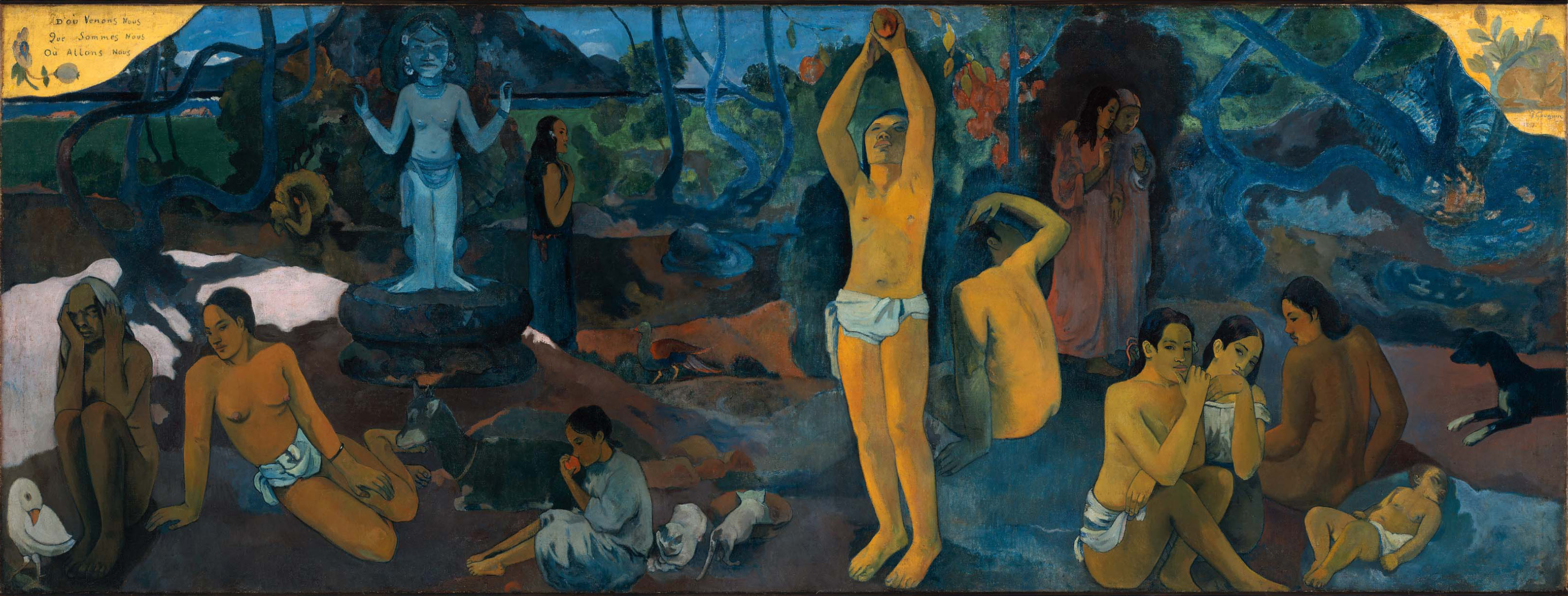
“Where do we come from? What are we? Where are we going?”

*FACT*

True Emotion is teenage angst dressed up in fancy shoes and a tuxedo.

...Or, in Gauguin’s case, clothed in fearless but clean-edged spats of color.

*WHERE DO WE COME FROM?*

Paul Gauguin learned to paint and think at a school called Le Petit Séminaire, which he attended from the ages of eleven through sixteen. His favorite teacher, a Monsieur Dupanloup (literal translation: Mister of the Wolf Bread), had young Paul consider three ideas as the basis of his education: Where does humanity come from? Where is it going? How does humanity proceed?

In case you’re thinking your formative years won’t matter that much in the long run, consider this: Mr. Wolfbread’s questions became the philosophical guts of what Gauguin called his “most important work in the history of ever-- like seriously, y’all, I’m delaying my suicide to finish this, so you’d better pay attention.” That is an actual Gauguin quote, obviously. And his magnum opus-- D’où venons-nous? Que sommes-nous? Où allons-nous?-- must have exceeded even Gauguin’s own expectations, because he chose to keep living (and then died of syphilis).

If you ever start to worry whether art is important, just remember: Your creative instincts may one day save your life. Or perhaps they already have. The next time you walk around in your own head, note the safety net of possibility between You and The Abyss. Then keep walking right along before that stuff starts staring back.

*WHAT ARE WE?*

The piece itself is hard to interpret creatively because Gauguin made its meaning clear from the get-go. It is intended to be read from right to left. As its figures age, we progress through Gauguin’s questions. No answers appear forthcoming save the slow decay of aging. The blue idol in the background represents what Gauguin called the Beyond. The white bird in the left-hand corner symbolizes the futility of words in the description of certain thoughts, an idea I yearn to reject but simultaneously sympathize with. Unsurprisingly, this painting was and is critiqued for being too obscure. But Gauguin didn’t expect people to “get it,” just as he didn’t expect people to “get” his so-called madness. All symbolism aside, one cannot help but feel shivery at this smorgasbord of resplendent colors. And before reading the painter’s alleged explanation, the combination of his work’s in-your-face title and its models, young and old, all female, made me consider all the different me’s tramping through my mind.

In a Conradian turn of events, Gauguin left European society and went to live in Tahiti to explore the “primitive” parts of his own morality. Gauguin is a highly controversial figure (read: potential pedophile, pretty damn racist) and the value of his art is often contested for this very reason. However, I sympathize with his quest to mine his personal heart of darkness; it takes a certain nerve to delve into that one percent, to face the parts of yourself you ought to be afraid of.

*WHERE ARE WE GOING?*

Growing up, then, means finding the right shoes and tux for your angst to wear.

Is this progress? Maybe.

Is it important? Yes.

Look. Blink. Smile.

Repeat after me.
  • 7:00 AM