El Jaleo, Sargent

El Jaleo, John Singer Sargent, 1882

There are only a handful of words able to describe the feeling of watching a well-trained dancer, nimble, graceful even cunning, and Sargent finds a way to extract life from paint- an ability to create a moment. Born into an era where art was “great” made finding a particular facet of the discipline very difficult and somewhat daunting. Should one take the naturalist approach of those in the Rococo? Or stray towards the realism of Courbet.

Sargent like many artists before had established a close partnership and rivalry with his dearest friend Belleroche. His emotionally-charged relationship guided the work he created, ensuring that no piece would be left unable to stand on its own. The sensuality and intensity of their relationship transcended into arguably one of Sargent's best works El Jaleo. Nowhere is it more evident than in this piece the strength of his approach to realism, the eleven-foot wide canvas clearly represents the grandeur and scale of his sentiments.Inspired by his trip to Spain in 1879 and in the throes of his romantic crush, he paints a Spanish dancer being swept away by the rhythm of the music, her form effortlessly gliding about the space. Sargent's love for Gypsy music and elaborate garb could not have meshed in a more perfect manner. The illuminated form tumbles through the painting, her disheveled appearance only adding to the intensity of her movement.

Entered into the Salon in 1882 Sargent demonstrated a new level of involvement with his figures, a parallel from his brush stroke to his inner emotions. Sadly being an American he never received the recognition he deserved from the Parisian upper class. Far worse than his lack of social acceptance was his dear friend Belleroche becoming a cocaine addict and shortly thereafter dying.

  • 7:00 AM

Saint Serapion and "Invictus"

Francisco De Zurbaran, Saint Serapion,1628
Invictus
William Ernest Henley


Out of the night that covers me,
Black as the Pit from pole to pole,
I thank whatever gods may be
For my unconquerable soul.

In the fell clutch of circumstance
I have not winced nor cried aloud.
Under the bludgeonings of chance
My head is bloody, but unbowed.

Beyond this place of wrath and tears
Looms but the Horror of the shade,
And yet the menace of the years
Finds, and shall find, me unafraid.

It matters not how strait the gate,
How charged with punishments the scroll.
I am the master of my fate:
I am the captain of my soul. 

Editor's Note: Students were asked to match a poem to a picture. They could do so with or without comment; they could be serious or playful. We will leave it to our dear readers to make the connection.

  • 7:00 AM

9 Rue de la Condamine

Frederic Bazille, 9 Rue de la Condamine,1870
   
A failed doctor, Frederic Bazille joined the Impressionists as their token rich boy, befriending each of his fellow artists on quite intimate levels. Exemplified by bright colors, nudity, and lots of men, Bazille’s work is distinct from his friends’ work. Here, he pays homage to their pieces in The Artist’s Studio, 9 Rue de la Condamine.

In the middle stands Bazille, Manet, and Monet chatting in front of a window while Émile Zola stands on the stairs chatting with Renoir while Edmond Maitre, a prominent journalist, plays the piano. On the walls rest many of these artists’ pieces, enlarged so that the space stretches much farther than it really would in person. Bazille does this as a sort of optical illusion to mimic the favorite Impressionist way to paint: en plein air. Doing this, he invokes nature and light into what really may have been a small, stuffy room, instead making it a grand space for artists of many mediums to rendezvous.

This piece is a great compilation of his and his friends’ works. Bazille created this after only starting painting three years prior, so his technique is even more admirable. Having learned bits and pieces of the trade from his friends, especially Monet and Renoir, Bazille has been widely praised as the “Lost Impressionist.” I enjoy this piece because of the massive attention to detail he presents in his own works hanging on the walls. Discipline and practice really show in a manner where he is able to stretch the walls and transform the room while still maintaining natural proportions. Not very far after this piece was finished, the Franco-Prussian war broke out and Bazille was killed in the very first battle, shot in the stomach. It’s a shame to wonder what other great works may have come from him if he had lived past the war.

  • 7:00 AM

Young Boy With Cat

Young Boy With Cat, Pierre-Auguste Renoir, 1868

After browsing through many of Renoir’s works, I originally thought this piece had been attributed to him by mistake. By far the strangest looking piece I have seen, especially by him, it resembles none of his previous works, yet tells the most about the artist. It is striking, glowing with purity and beauty while the highly sexualized scene is diffused by the presence of the lone feline.

The sexuality of this piece reaches out and grabs your attention, his posture and gaze almost trap the viewer. It’s refreshingly intense. In the Baroque style, the similarities between Young Boy with Cat and Caravaggio's Boy with a Basket of Fruit are striking. The highly-eroticised figure bears a basket of fruit while fixating on the viewer with the same mischievous stare. The tension in the stance, the lighting on the body, so similar to the provocative nature of Caravaggio’s boy displaying his bare shoulders. For an “Impressionist” painting, this piece is painted in great detail, especially the pattern of the sheet is incredibly fine and skillful, demonstrating a disciplined stroke.

The lewd tension in this piece is inescapable, but what does the cat in his arms suggest? Looking to other pieces, cats are symbolic of piety and cleanliness, often times the presence of nature and mystery. The pale, stylistic affectation of the boy comes from Renoir sharing a studio with Frederic Bazille, and his obsession with Edouard Manet. The diverse masculinity found in Renoir’s other works is absent here, giving a glimpse into Renoir’s private life with Bazille, that privacy embodied by the cat. Shortly after this piece emerged, Renoir was forced to become a more serious artist after the birth of his first child, leaving this piece - and its meaning - in his past.

  • 7:00 AM

Seascape

August Strindberg, Seascape, 1894

The harsh brushstrokes of Strindberg feel static, unmoving in the middle of what should be a tumultuous scene. After looking at the piece and taking it all in, I feel the current of these static waves pulling me upwards into the sky, carrying me through the waves. The piece itself is quite fluid even though it’s made up of such solid brushstrokes. Even the sky, horizon, and sea all blend together as one. Similar to Rothko’s work, each segment of the painting fights for its space on the canvas, drowning out the light and devouring any space left on the canvas.

Seascape reminds me of a certain scene in Being Dead, where Crace describes “a bay… subject - famously - to the wind. There was a constant drift of the air that ran along the coast, west - east, so that the dunes were sculpted and aligned like resting seals. Most days the dunes would hum as the wind hugged the scarp and dip across the bay.”

This type of motion presents itself in this piece, the movement of such solid lines making it all come to life. The darkness contrasted with the amber of the sun is striking, drawing the viewer in to such a chaotic scene. When I look at this piece I don't see a rough sea, but rather union, natural forces working together. This piece is fused together even by the methods used to burn the canvas. The corners blacken and deepen the contours, mimicking nature's power. For me, this is what makes this piece beautiful: the preparation, diligence and dedication to “ the creative forces in nature that we must all adhere to."

  • 7:00 AM

The Harvesters and The Wire

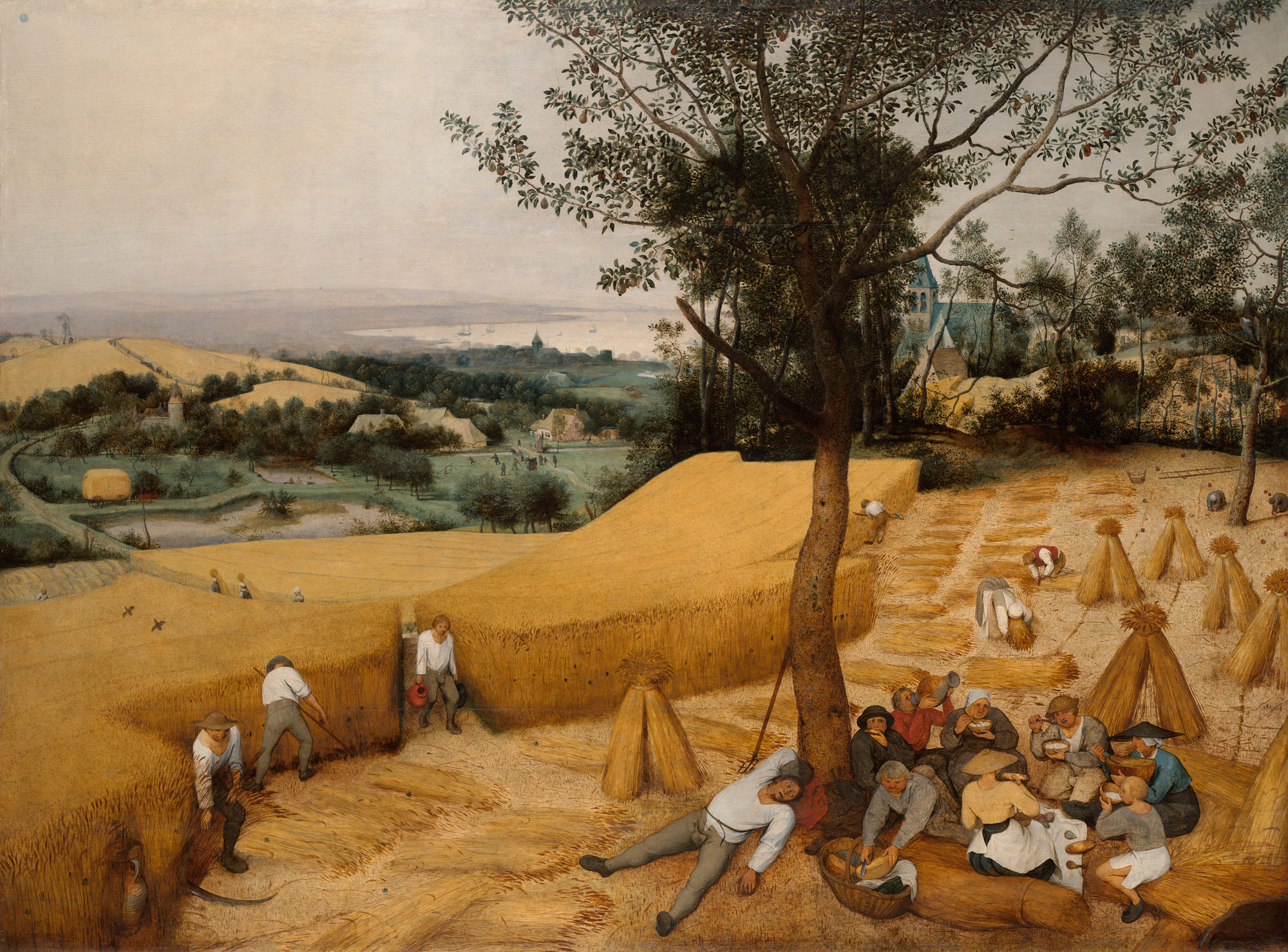
Peter Bruegel the Elder, The Harvesters, 1565

The Wire is a modern-day incarnation of Pieter Bruegel’s Harvesters, with each piecestaking low aspects of life and lifting them into the public eye to create something truly dynamic. Bruegel, an aristocrat by birth, spent more time with peasants than nobility. Most of his work, other than the absolutely crazy pieces, focus upon the day-to-day monotony of life in a normal village instead of making peasant life seem more grand than it truly is. His honesty in this effect actually works to his advantage, because his focus on the peasants in what was considered high art elevates them enough so that he doesn’t have to exaggerate them.

The show does something similar, taking life in broken Baltimore and observing each and every aspect of how its characters live. Praised as one of the best TV shows ever on television, the show is described as a literary work, drawing connections and creating characters with far more depth than what most shows on television ever offered. Bruegel and the writers of The Wire share this innovation in common, taking underrepresented societal groups and bringing them to the forefront, giving them the chance to shine for what they are and not for anything more or less. They allow honesty, which is a rarity for both the arts of painting and television.

Editor's Note: While we love The Wire, we also all like our jobs. We searched high and low for a clip that did not contain explicit language. We had no luck.

  • 7:00 AM

Ossian Receiving the Ghosts of the French Heroes

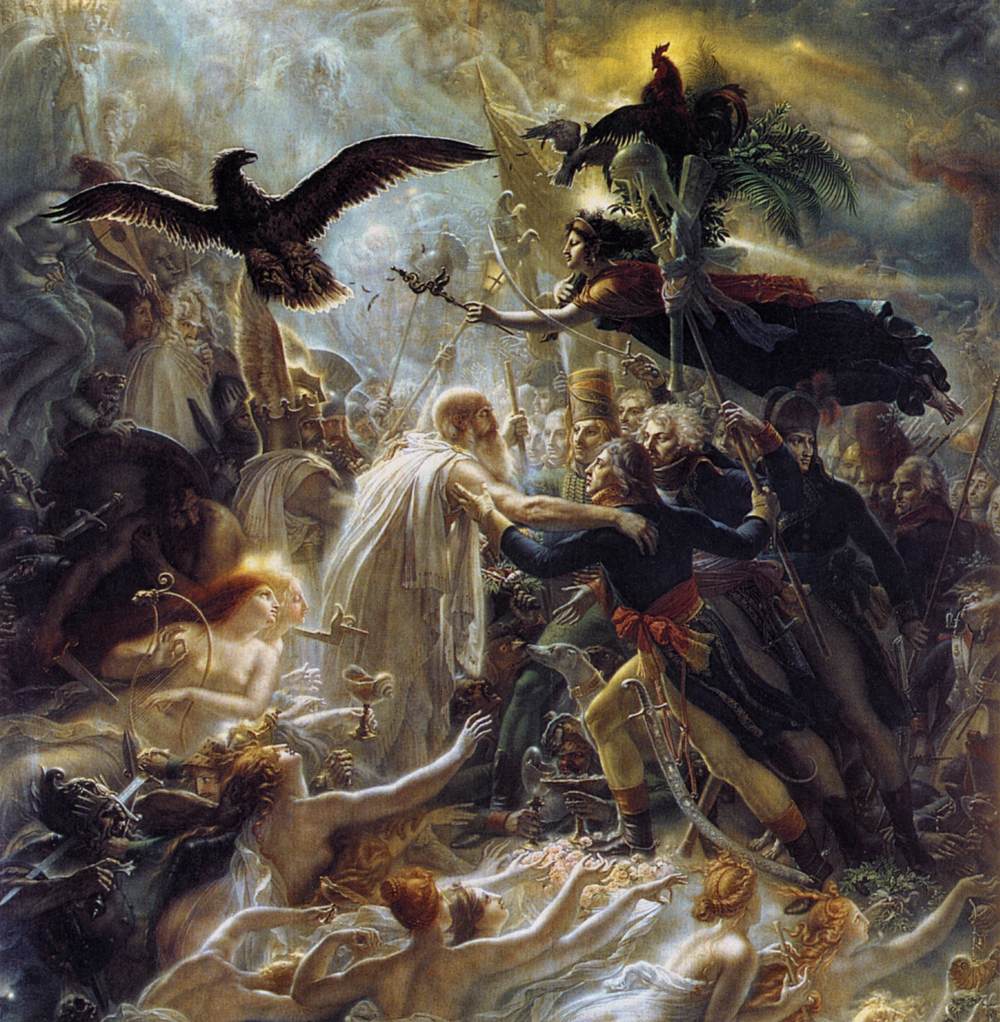
Anne Louis Girodet,Ossian Receiving the Ghosts of the French Heroes,1802

Originally crafted for a small palace intended for Napoleon, this piece by Anne-Louis Girodet and its counterpart, Ossian Evoking Ghosts on the Edge of the Lora, by Francois Gerard were the only pieces in the entire palace Napoleon praised. There was something rare and unique surrounding these works. Both of the pieces focus on the work of the Gaelic poet Ossian, who Napoleon adored at the time. Ossian’s epics caused a sensation, not only because its subject matter fueled the new Romantic movement, but because of the ambiguity surrounding its origins - even its existence.

This particular piece shows brave soldiers prepared for battle and surrounding the poet Ossian; a piece perfect for Napoleon, who was in the middle of a revolution of his own. This snapshot from the battle is told by the narrator Fingal at the edge of battle. In the valley of Valhalla, these men are ready for battle and they look beyond the poet, seeing the inner radiance of their slain brethren. The entire piece feels almost sacred, with the left side clustered with floating maidens promising glory in death.

This piece is busy, crowded, almost ready to spill onto the floor. Despite its compositional weight, I can’t help but love it. Peering into the emotion of these men, observing the earth beneath them wash away, this ominous cloud perpetuates the spirituality and warmth of the piece. The only real disappointment with this piece lies with the backstory of the poet it glorifies. Turns out, the great tales Ossian wrote, that towns were named after and that Napoleon himself carried into battle, were actually forgeries. The originator of the tales, James Macpherson, actually wrote these from fragments sliced from sagas. Even though the context of the piece is a letdown, Girodet’s work is surely not. It glows just as brightly as the people within it.

  • 7:00 AM

Le Jockey Perdu III and Wild Horses.

Rene Magritte, Le Jockey Perdu III, Unknown


"I conceive of the art of painting as the science of juxtaposing colours in such a way that their actual appearance disappears and lets a poetic image emerge. . . . There are no 'subjects,' no 'themes' in my painting. It is a matter of imagining images whose poetry restores to what is known that which is absolutely unknown and unknowable." - Rene Magritte

Rene Magritte, influenced greatly by the works of Giorgio Chirico, sought to incorporate seemingly unrelated items into groups. The combination of items not only pleased the viewer, but challenged their perception and thought. Magritte’s Le Jockey Perdu III embodies the passion of his mentor: providing a subject an unrelated setting. Le Jockey Perdu III depicts a lone racer withdrawn from the track, where he should be, and placed in the desert.

While on the road, the Rolling Stones wanted nothing more at times than to just be where they needed to be, instead of constantly in flux. The lyrics, "wild horses couldn't drag me away" give the listener a sense of futility, as if no matter how hard they try to stay, they have to go. "Wild Horses" was written to cope with the stress of touring across the nation, to pay homage to what was thought to be an easily grasped theme. Instead, the song remained a mystery. The fluidity and movement within the lyric and rhythm give so much freedom to the listener, both in how they listen to the song and how they interpret it.

The element of movement is masked within Magritte’s work, the viewer taking a stagnant position from within a rocky outcrop observing a misplaced racer. As I viewed this piece I could not help but compare it to a Rothko. Mark Rothko exercised a visual tension in his artwork, a constant imbalance and movement. Le Jockey Perdu III for me is very much the same, the viewer forced to grapple with the speed and ferocity of the horse slicing through the environment - leaving dust in his wake. This piece is not merely pleasurable to view, but also to contemplate. The contrast and tension in this piece makes it seem almost simple, something it is proves not to be at all.
  • 7:00 AM

The Death of Sardanapulus

Eugene Delacroix, The Death Of Sardanapalus, 1827

I have never seen such a piece of both great chaos and pointed apathy. The last of the Assyrian rulers, Sardanapalus, sits atop his cushy, luxurious bed and orders the destruction of his material goods and servants. Having heard that he was soon to fall and be humiliated publicly, Sardanapalus decided to destroy everything rather than face his public.

The warm color palette contrasts the darkness of spilled blood from his harem of faithful concubines. But the real beauty and movement in the piece lies in the emotion and vignette style. Pioneering this technique, the dramatic lighting heightens the sense of urgency and chaos within the painting. The viewer is forced to look above at these god like figures killing and destroying the kings possessions in a hostile manner. Delacroix’s subject matter is not only foreign, but his style and means of delivering feeling in the piece is unmatched.

This piece truly exhibits Delacroix's passion for the oriental - an atypical but growingly popular style of the time. Greatly inspired by Napoleon's conquest of Egypt, the lavish clothing and exorbitant amount of wealth in the piece contrast daily life in France. Delacroix found Lord Byron's play Sardanapalus to be the great inspiration for the painting. Selected because Delacroix believed that people must not grant any sympathy to the ruling class because their losses are not limited to themselves. This painting resembles the reign of Napoleon, with a high-class lifestyle hurting all others below. This piece has two sides of emotion to it. At first, the chaos makes the viewer feel all the terror and pain, but then they see Sardanapalus on his bed, calm as can be, and the viewer is confused. For me, even disturbed. What kind of person can watch everything they have, everything they love, be destroyed and just lay there?

  • 7:00 AM

Monsieur Seriziat

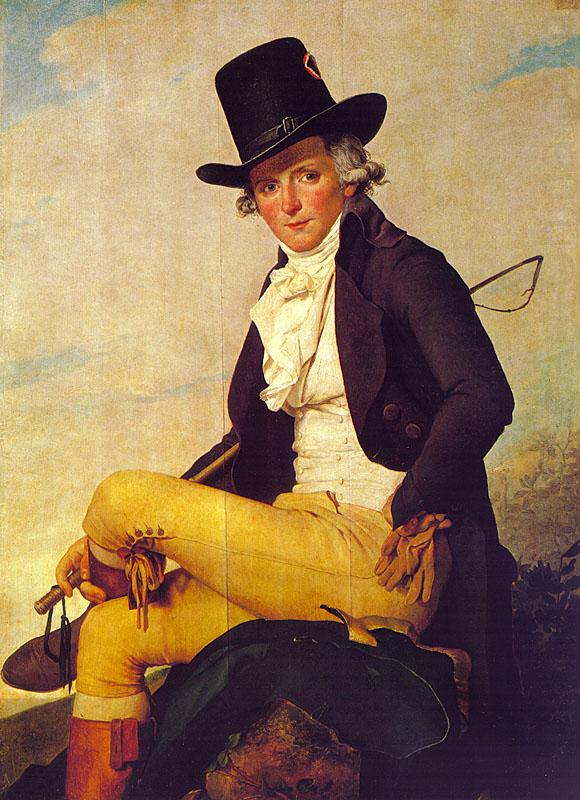
Jaques Louis David, Portrait of Monsieur Seriziat,1795

If you have ever been to a wax museum you can't help but feel watched. Now of course you know that none of these figures are alive, but they have an aura and a certain presence. David is a master at making the viewer feel him through each and every one of his strokes, gently tugging for the viewer's involvement. Expert propagandist and patron of the noblemen and gentry, David knew his place, making it very clear as he painted prominent figures of society leeching off the government for protection. Serving on the Committee for Public Safety, David sanctioned the death of hundreds, and was later imprisoned for his involvement with and support of Robespierre. While waiting out his sentence, David managed to acquire some basic materials and did what he did best: paint.

Shortly after his release in 1795 he left for the countryside where he spent his time with his sister-in-law Madame Seriziat. After meeting her husband, David painted his portrait of Monsieur Seriziat. Seated rigidly in his riding attire, he clearly resembles the nobility. David, knowing that the upper echelon of society welcomed him, reminded them all of what he was capable of. The master artist was back to manipulative tactics, seducing the less fortunate with images of what their lives could be after the revolution. I can't help but escape the eyes of Monsieur Seriziat, it both attracts me and reminds me that I can never be close to him. This capturing of such great feeling and motion is what makes David an incredible artist and a painter.

David’s return to the realm of French revolutionary politics could not have been achieved without these subtle works. Monsieur Seriziat represents a stage in society as the nobility must kneel to the rise of the classes below. David, as a master of propaganda, managed to survive as each succeeding conqueror stepped in and with each a new persona - ever the social chameleon.

  • 7:00 AM

Van Gogh Self Portrait and Anna Karenina

Vincent van Gogh, Self-Portrait with Bandaged Ear, 1889


I know when I get into a heated argument, my first urge is to cut off my ear and give it to a prostitute. But I hold back.Van Gogh, on the other hand, found that perfectly appropriate and really went with that urge. Gauguin exclaimed, “You crazy bastard! You have sliced off your ear!” and finished the argument with Van Gogh on top, one ear less than where he started. This self-destructive act to spite his competition and himself deeply moved his audience and shocked those around him. Looking at his Self-Portrait With Bandaged Ear, the pain in his eyes is evident and unyielding. The cool, chaotic palate depicts Van Gogh’s inner turmoil as he stares blankly forward, colors spinning all around him.

The horse scene in Anna Karenina evokes these same chaotic emotions, from the tension of the race and the heartbreaking crash to Anna standing up and screaming for Vronsky, her wounded lover, in front of her husband and all of Russian high society. You want to scream with her, to stand and help her get to the man she risked everything for, but as a viewer you understand how self-destructive Anna is. She may not cut off her ear to spite anyone, but her entire life with Vronsky is in spite of her socially-acceptable life. Her end itself is self-destruction in its purest form, throwing herself under a train - the very thing that brought her to Vronsky in the first place.

Both of these examples show the peak of these real and fictional characters’ self-destructive tendencies, outside of their tragic ends. They may be destructive for different reasons, but both of their desperate acts in the heat of the moment are far too similar to the other. Anna’s terrified scream for the one she truly loves is the vocalized version of Van Gogh’s slicing off his ear to prove to Gauguin how much he meant to him in a desperate effort to get him not to go back to Paris. The piece shows the static aftermath of this act, while the scene from Anna Karenina is the exact tipping point into her downward spiral. Both are equally tense and foreboding. It makes me not want to know what happens to them, makes me want to save them from themselves… but I can’t.
  • 7:00 AM

Embarkation for Cythera

Antoine Watteau, Embarkation for Cythera, 1710

The Rococo style emerged right in the middle of the Enlightenment, an era where religion was questioned and science took its place. Philosophers and scientists garnered respect and fame, entering the global stage as figures of authority. For once, religion fell to the wayside in favor of humanity and its comforts - specifically the lavish lifestyles of the wealthy. In all aspects of art, ranging from architecture to painting, the Rococo style celebrated glamour and was the first art style to so highly elevate nobility in such flamboyant manners.

Watteau paints these rich nobles in their expensive attire enjoying the beauty of nature and the beauty of their possessions. All around them the landscape is "blooming," filling the canvas entirely. In signature Rococo style, Watteau's Embarkation to Cythera was thought to be the re-discovery of sense of self and humanity. Sense of self was very important during this period, specifically through scientific humanism. Descartes describes this idea, declaring, "I resolve to seek no other knowledge than that which I find within myself, or perhaps in the great book of nature.” The Enlightenment was a time of great prosperity and decadence as the noblemen of France became able to show off their lives in art, gaining celebrity along the way. This piece is adorned with gold, soaked in color revealing the desire for human intimacy with one another and with nature. The figures in the scene prance around and enjoy each other’s company, in their own fairytale world that they made sure to have painted so that others can look on in envy.

  • 7:00 AM

La Boudeuse

Antoine Watteau,  La Boudeuse, 1718

Looking at this painting I find myself wanting more from it, I want to be lured into it, captured by its beauty and emotion. But all I really get are a couple of misplaced figures in a well-painted meadow. Watteau paints theatrical scenes and sometimes he takes those figures and places them into a colorful backdrop. Clearly these amorous lovers are having a moment, but I feel like I can't connect with it. The woman stares back at you not with passion but rather melancholy and subtle boredom. Even Watteau's technique is nothing stunning - a flat painting at eye level, no real characterized depth and no embracing feeling as you look.

Despite the subject matter this painting is unique and done with great skill. The shadowing on their clothing is some of the most accurate and makes the colors pop. Movement and color were two of Watteau's best allies when it came to painting these scenes. During the Rococo painters figured out that not only did subject matter, but color also really added to the beauty. Mocked up by looking at Venetian furniture and art,Watteau received great praise from critics and common people alike for his luminous palette.

The thing that strikes me is the precision he is able to produce from such large brush strokes. It's as if he can envision not only the shapes, but also the color in such massive steps. I also enjoy how I get more emotion out of those harsh strokes than I do looking at this rosy-cheeked man court this woman. 

  • 7:00 AM

Black On Dark Sienna on Purple and Being Dead

Mark Rothko,Black on Dark Sienna on Purple, 1960


"He didn't carry with him any of that burden which makes the human animal so cumbersome,the certainty that death was fast approaching and could arrive at any time, with its plunging snout, blindly to break the surface of the pool. its only those who glimpse the awful, endless corridor of death, too gross to contemplate, that need to lose themselves in love and art" - Jim Crace, Being Dead.

Joseph and Celice’s corpses lie on the beach, decomposing and becoming part of nature once more. Their battered, blood-covered bodies decompose while sandhoppers surround them, reclaiming their bodies. The text tells their story, the story of the two lovers' bodies as time captures them washing away slowly. The two bodies lie there frozen, the heat of their blood gone, the movement run out, their vision gone black, their minds left blank. Jim Crace brutally throws their harsh and painful deaths at the reader, all too similarly to Rothko. The struggle between their lives and their deaths ends in this text, the slithering black consuming everything once more. As the beauty of the world fades, the red of life and passion fades away, leaving nothing behind but two carcasses. 
 
Mark Rothko depicts this everlasting tension between life and death in his piece Black On Dark Sienna on Purple. The red and black battle with each other, uneven lines bleeding into the other in final attempts to beat the other. Eventually, the black overwhelms the red, eating away the color just as death inevitably does to life. In this piece especially, the color disparity is violent and desperate. The black void consumes the flesh of the red. Both float in an open space, the depth not understood unless stared into without distraction, a disrupted pool of color. Rothko’s pieces have a way of washing over the viewer. This piece especially does that to me. The colors are dark, their struggle is unsettling. I know which color will win in the end. Rothko’s own fear of death is evident in every stroke of this painful piece. I now feel it, too.

  • 7:00 AM

Revelations: The Apparition

Revelations
The Apparition
Curated by Arsam Yazdani

Gustave Moreau, The Apparition, 1876

This piece shows Salome, a woman who, with her dancing, bewitched her mother's husband Herod Antipas. As a reward, she was given the head of John the Baptist. What the hell? This is the idea: "Let me just get naked and dance for my father-in-law so he can give me a saint's head real quick". 

Moreau could be showing a few different parts of the scene. It could be after Salome's dance, with the apparition being her terrifying wish not yet coming to fruition. Or it could be a scene after the beheading, where she feels remorse for her sexy-dance for her father in law... This is just weird.

John the Baptist's head is the clear focal point, though it honestly resembles Jesus' head. Salome is the only completely visible other character, this scene clearly between just the two of them. No other character is important here, only their interaction. 

The detailing on the piece is incredibly delicate, most of it looking as if it was sketched onto the piece as an afterthought - or as if it was unimportant as well, fading away like everything else in the room.

  • 7:00 AM

Revelations: The Horsemen of the Apocalypse

Revelations
Curated by Arsam Yazdani

Salvador Dali, The Horseman of the Apocalypse, 1970

It's rough, this sketch of the horsemen. But it makes its own message by being so harsh, with every color slicing through the others instead of blending in. Dali's interpretation of the horseman differs from the usual. He doesn't focus on them as a group, more focusing on each individual horseman.

Traditionally, the four horsemen come as one and signify the apocalypse. The color palette Dali uses here perpetuates the hellish aspect, but the unfinished appeal of it changes things. As opposed to the horsemen interpretations of Durer or the like, this piece has less emphasis on their overwhelming presence and more on their entrance. Dali's piece is more frightening for this because the bodies and details are clearly unnecessary. The entrance of the horsemen is the truly scary part - the horsemen are a means to an end.

There are also only three horsemen here. In the Book of Revelations, each horseman represents something different. First is the White Horse, the figure of military prowess, usually referred to as Conquest. Red Horse, or War, signifies mass slaughter, his color specifically being a fiery red. Third: the Black Horse, or Famine. Then comes Pale Horse, the only horse whose rider is explicitly given a name: Death. Out of what is seen of Dali's piece, it seems that Red Horse, Black Horse, and Pale Horse are depicted. Which is fitting for the terrifying scene. Dali seems to focus more upon the terrifying aspects of the horsemen, leaving out White Horse - in many theories, conquest is thought of as a benevolent being, sometimes even as Jesus Christ himself. Dali would have left him out for a reason, then.

  • 7:00 AM

Revelations: The Fisherman, Early Morning

Revelations
The Fisherman, Early Morning
Curated by Arsam Yazdani

Pierre-Étienne-Théodore Rousseau, The Fisherman, Early Morning, 1865

He's alone, making his journey to do as he pleases in the early morning. This isn't your stereotypical apocalypse painting, with fire and brimstone and all that. But it struck me, the lonely figure venturing out into the wilderness.

The figure practically fades into the lush wilderness around him. Under him seems a jungle, above him sparks images of a big, green swamp. He knows exactly what he's doing, where he's going, and how to do it when he gets there. That's something I envy with every ounce of my body. 

Rousseau's color palette is warm, the light of this early morning just peeking through the dense trees. The green is so deep and so complex that it, by itself, gives off the lushness I think Rousseau was aiming for. Honestly, the figure is the subject of the painting, but Rousseau doesn't take huge efforts to accentuate him. He allows him to just be a part of his environment, therefore allowing the viewer to make their own journey through the piece. Kind of funny how much I like this piece, but when I think about it, it all makes sense. He knows what he needs to do and immerses himself in it.  

  • 7:00 PM

Revelations: Triumph of Death

Revelations
Curated by Arsam Yazdani

Pieter Bruegel I, Triumph of Death, 1562

Can't get much more apocalyptic than skeletons battling it out with the living. This scene gives the viewer a disturbing, yet funny, glimpse into the mind of Bruegel. The entire battle is set in a sickly yellow-green hue, emphasizing the awful scene.

Of course, all of Bruegel's pieces have political context and represent the political climate of his period. Here, he represents a crazy scene with all life being taken off of Earth indiscriminately. The high-set horizon allows the scene to take over the canvas, with chaos everywhere. There are two points of view in the piece, which I found fascinating in their integration. Firstly comes Death, obviously, on his white horse on the left side of the painting, leading his troops to destroy life. But secondly comes the political message. On the bottom of the piece, Bruegel depicts individuals in different stations in life. No one is safe from Death, no matter how wealthy. He shows a king, a cardinal, chess players, a couple, and a knight - and all are slaughtered.

This piece is all too similar to the events occurring in Antwerp during this period and Bruegel's message is clear: death cares not about social class nor status.

  • 7:00 AM

Revelations: The Seven Works of Mercy

Revelations
Curated by Arsam Yazdani

Caravaggio, The Seven Works of Mercy, 1607

The seven corporal works of mercy are as follows: feed the hungry, give drink to the thirsty, clothe the naked, harbour the harbourless, visit the sick, visit the imprisoned, and bury the dead. Caravaggio shows each here in his definitive chiaroscuro style.

Caravaggio developed his style through many hardships and expressed his suffering through his art. This piece captures a tone that makes all of the figures meld together in one snake-like, upward movement. The setting of the painting is an interesting choice as well, as he could have painted seven different scenes rather than one containing them all. By doing this, he makes the works meld into one grand act, one true moment of true benevolence. 

These poor beggars in the piece were clearly cast out and left at the mercy of those who could do something to end their suffering. This really struck me as an odd thing to paint, so much pain and suffering in their faces when the man who painted them was living so large. Caravaggio shows his discipline and his humble upbringing, perhaps even his own inner suffering, to remind those around him that he is one of them. 

  • 7:00 AM

Revelations: Agony in the Garden

Revelations
Curated by Arsam Yazdani

El Greco, The Agony in the Garden, 1597

With intensely contrasting colors, El Greco creates forced perspective and a strong focus upon Jesus' conversation with God. In the Bible, he is described as discovering the true meaning of agony, pleading with God and saying, "My Father, if it is possible, let this cup pass me by. Nevertheless, let it be as you, not I, would have it." 

Overwhelmed with sadness and pain, Jesus sheds his tears which, in the Gospels, are said to fall as drops of his blood onto ground beneath him. The three apostles are seen sleeping in the cave, oblivious to his agony. El Greco frees the scene from structure and forms a fluid background instead of showing division, all the shapes further accentuating Jesus in dead center. It's incredible how he puts in every important part of the scene but manipulates their shapes so that Jesus is the sole focal point, the colors around him showing his inner turmoil and fear. The harsh diagonal colors and light contrast the curves of the figures and the rocks. The bleak background and lack of folliage really place Jesus in total environment of sorrow and anguish. All others in the piece are sickly in appearance, throwing the viewer in as an onlooker of Jesus' private battle. 

  • 7:00 AM