LGBT Artwork: Sleep: Deux Femmes Noires

LGBT Artwork
From Lesbos to New York
Curated by Camille O'Leary


Mickalene Thomas, Sleep: Deux Femmes Noires, 2012

Mickalene Thomas, a contemporary New York artist, explores black female celebrity and sexuality in her work. Her exhibition "Origin of the Universe" takes its title from one of Gustave Courbet's erotic works, a view of a woman's torso and genitalia. In her exhibition, Thomas re-imagines classical works and replaces the original figures with powerful, extravagant black women who challenge traditional ideals of beauty. Studded with rhinestones and bursting with rich color, her portraits, landscapes, and collages draw heavily from the history of art but take on a life and originality of their own in her hands.

Sleep: Deux Femmes Noires takes another erotic Courbet piece, Le Sommeil, which was originally a painting of two nude white women sleeping, limbs intertwined. This depiction of lesbianism was strictly for male gratification, in an indoor space. Thomas transforms the blonde and brunette of Courbet's fantasy into voluptuous yellow and black women, plucking them out of the domestic indoor scene and placing them into a brightly colored outdoor landscape. The collage-like effect, punctuated by the searing orange that shows through the cracks, is deliberately fragmented and jarring, revealing the process behind the work. The bold colors challenge Courbet's original work and reclaim it as a statement of feminine power.
  • 7:00 AM

LGBT Artwork: The Swimming Hole

LGBT Artwork
From Lesbos to New York
Curated by Camille O'Leary

Thomas Eakins, The Swimming Hole, 1884-1885

The nude body has been used as the most direct way to teach anatomy and train artists since the Renaissance. Nudes were Thomas Eakins's discipline when he taught at the Pensylvania Academy of the Fine Arts, and he used this painting, The Swimming Hole, to demonstrate his mastery of the subject. Six men pose, frozen, on an outcropping of rock, caught motionless in the act of bathing together. Eakins himself can be seen in the lower right, in the place where an artist might normally sign their name.

Unknown, Dying Gaul, 220-230 BCE
Eakins photographed and sketched the young men, his students, in preparation for this masterwork, but also drew poses from classical statuary like the Dying Gaul. Eakins transferred the classical subject of the nude to the contemporary outdoors, shedding clothing, shoes, and other marks of civilization. Unnatural lighting emphasizes the lines of their poses, which suggest a smooth arc of movement from reclining to standing to diving into the water. Their poses are idealized and beautiful, reminiscent of Greek nudes, and all six face away from the viewer, further obscuring their identities to focus attention on their bodies, including that magnificent butt.

Eakins himself was dismissed from the academy in 1886, two years later. The popular story says he was dismissed for removing the loincloth from a male model in front of women students. He was involved in many more incidents that strained the boundaries of Victorian propriety, such as "demonstrating" the movements of the pelvis to a female student, pressuring both male and female students to pose nude, and offering himself as a nude model. Rumors said that he participated in sodomy and bestiality; certainly, Eakins seemed to prefer his young protege Samuel Murray to his wife. His voyeuristic tendencies were scandalous under the tight guidelines of Victorian society, and still highly questionable today, but his fascination with the nude meant that he pioneered techniques in the new field of motion photography, capturing the human body in action more precisely than ever before.

  • 7:00 AM

LGBT Artwork:Sappho and Erinna in a Garden at Mytilene


LGBT Artwork
From Lesbos to New York
Curated by Camille O'Leary

Simeon Solomon, Sappho and Erinna in a Garden at Mytilene, 1864

Sappho, a famous Greek poet, was well known and lauded in her time as a poet, but only fragments of her work remain. Her masterful poetry deals with the love that men and women have for both sexes, but she is most famously associated with female homosexuality - to the point that her name and her birthplace (the isle of Lesbos) both became adjectives to describe it. Sapphic, lesbian love, is Sappho's legacy, seen in this painting of Sapphos and one of her lovers, Erinna. Erinna was also a poet, although not as proflic as Sappho, and very few fragments of her poetry survive. She died young, at the age of 19.

Here, Sappho and Erinna embrace tenderly. Sappho, the figure on the right, is the stronger and more androgynous of the two, while Erinna provides a more feminine foil, with her breasts exposed. On the right, a musical instrument and a scroll are visible, symbolizing Sappho's achievements as a poet. Above them are two doves mimicking their pose, symbolic of love, to further emphasize their relationship. The painting's slightly blurry lines, strict pyramidal composition, and riot of greenery are typical of the Pre-Raphaelite style.

The painter, Simeon Solomon, was a Jewish Englishman who was associated with the Pre-Raphaelite brotherhood, an attempt by a core group of seven painters to reform the artistic world and make painting more precise. He was one of the few British painters who depicted Sappho; he was homosexual himself, and he explored that taboo subject in his work, including nude depictions of the god Eros. After he was arrested in 1873 on a charge of attempting to commit sodomy, his artistic career was abruptly cut short. In 1905, he finally succumbed to alcoholism.

  • 7:00 AM

LGBT Artwork: Just a Couple of Girls

LGBT Artwork
From Lesbos to New York
Curated by Camille O'Leary

Harry Wilson Watrous, Just a Couple of Girls, 1915

Harry Wilson Watrous, a New York painter from the turn of the century, painted a number of simple, clean genre paintings early in his career. Around 1905, he began to lose his eyesight, and turned almost exclusively to painting women: seductive women, modern women, and independent women. He created a very smooth, polished painting surface, seeking a classical simplicity, and often included symbolic elements like insects and flowers. Most of his women are dressed in dark colors and facing in profile, accentuating their silhouettes against his light backgrounds.

His works, which have mostly been ignored since his death, are not well documented. I could find very little information about Just a Couple of Girls, except that most sources seemed to agree that the two women are lesbians. The pastel background, a muted riot of fish, plants, and water, possibly takes some inspiration from Japanese designs.  The two of them share an intimate, private moment together, one woman resting her head on the other's lap, and neither one acknowledges the viewer. Other portraits from Watrous depict seductive, attractive women, clearly under the gaze of an unseen man, but these two ladies exist only for each other.

  • 7:00 AM

LGBT Artwork: The Improvised Field Hospital

LGBT Artwork
From Lesbos to New York
Curated by Camille O'Leary

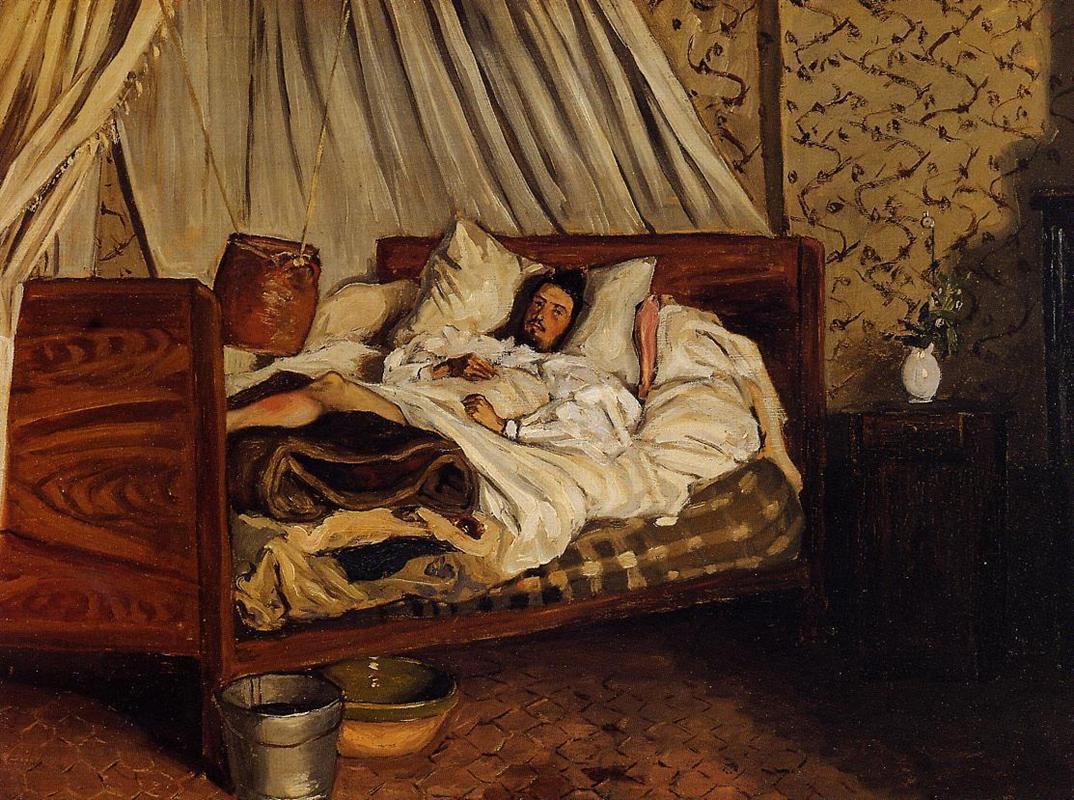
Frederic Bazille, The Improvised Field Hospital, 1865

Frederic Bazille had an unusual relationship with his much more famous contemporary Claude Monet. Bazille - also an Impressionist painter - was much more well off than his friend, and supported him financially, buying his paintings and providing canvases, paint, and other resources. However, Monet was undoubtedly the more skilled painter of the two, and generally took a dominant role as Bazille's mentor. At his suggestion, the two men took a trip to the small village of Chailly-en-Biere to hike and paint landscapes. Soon after Bazille arrived, though, Manet injured his leg. Bazille, a former medical student, rigged up a makeshift hospital bed for him in a local inn, with a counterweight to raise his leg and make him more comfortable. Bazille then painted this portrait of his mentor while he healed, an intimate work that documented their relationship.

Manet, domineering and confident in his own skills, can be seen here reduced to a position of dependence, chafing under the restriction of his freedom. After looking forward to the masculine pursuits of hiking and painting en plein air, he has been unceremoniously reduced to weakness. He stares at the viewer with a frustrated expression, looking curiously lost under the tangled bedsheets. The lines of the room bear down on him and trap him, crushingly heavy.

It's likely that this painting was far too personal to sell, especially since Monet was a well-known, recognizable figure. Monet painted many portraits of Bazille, and the Impressionists all often posed for each other when they couldn't afford models. However, this portrait is different; while we don't know exactly what the relationship between the two men was, they lived together for many years and had a close relationship. One detail in particular seems to sum up their relationship. The two sent a lengthy correspondence back and forth, and Bazille saved many, possibly all, of Monet's letters. And Monet? Monet saved none.

  • 7:00 AM

LGBT Artwork: Leonidas at Thermopylae

LGBT Artwork
From Lesbos to New York
Curated by Camille O'Leary

Jacques-Louis David, Leonidas at Thermopylae, 1814

When Neoclassical art emerged in the eighteenth century, it styled itself as a contrast to the "feminine" Rococo style, reframing classical myths in a modern context and looking to ancient art for inspiration. The male body was idealized and glorified, often in the nude. Jacques-Louis David was a pioneer of the style, as part of his efforts to create propaganda and glorify the republic. He drew inspiration from Roman history, especially hyper-masculine, male-oriented stories of glory and fanatic loyalty. The end result - while it is debatable whether homosexual desire was the intent - is a strikingly muscular guy wearing nothing but a helmet and a scabbard over his bits.

This painting depicts Leonidas at the battle of Thermopylae (yes, the battle popularized by the movie 300). Rather than depict the fighting itself, David shows a frozen, suspended moment of preparation. Trumpeters sound, men race for their weapons, and Leonidas, the seated central figure, prepares himself for battle, contemplating the fate of himself and the soldiers who volunteered to hold off the attacking Persian army. On either side of him, two very young men can be seen; one is tying on his sandal, and the other says a last goodbye to his father (with an extremely phallic sword, which perhaps slightly mars the gesture). Leonidas attempted to send these two boys away, under the pretext of carrying a message, but they refused to go. The camaraderie of the men is unmistakable, as is their fantastic physique.


  • 7:00 AM

LGBT Artwork: Sleeping Hermaphroditus

LGBT Artwork
From Lesbos to New York
Curated by Camille O'Leary

Unknown/Gian Lorenzo Bernini, Sleeping Hermaphroditus, unknown/1620

A Hellenistic bronze, copied by a Roman sculptor in marble, now reclining on a seventeenth-century mattress: the Sleeping Hermaphroditus has a long history. From behind, the sensuous, shapely pose of the sleeping figure resembles a traditional female nude, but the frontal view reveals the male genitalia of Hermaphroditus. The son of Hermes and Aphrodite in myth, Hermaphroditus was originally a handsome man, who attracted the unwelcome attentions of the nymph Salmacis. Salmacis begged the gods for the chance to be with her love forever; they obliged by merging Hermaphroditus and Salmacis into one being who was a perfect blend between two genders.

This statue was discovered in Rome in 1608 and made part of the Borghese collection. The Borghese family, particularly Cardinal Scipione Borghese, collected a wide range of sculptures and paintings both modern and ancient. In 1619, the famous sculptor Bernini was commissioned to create a mattress for Hermaphroditus, which, though marble, seems appealingly soft and yielding. With this new bed, Hermaphroditus could recline in flirtatious comfort for many years. In 1807, the sculpture was sold to the Louvre, where it now resides.

Here, Hermaphroditus's dual nature is a theatrical gesture typical of Hellenistic sculpture. The contrast of his feminine and masculine anatomies gives the viewer a crude shock, which doesn't lessen the playfully erotic pose. The original sculptor, Polycles, probably drew inspiration from older female nudes, and particularly from contemporary depictions of Dionysus, who often took more feminine attitudes. Hermaphroditus was associated with the union of men and women in a figurative as well as literal sense, presiding over weddings, effeminacy, and androgyny. Artists have depicted or suggested homosexuality in their works for centuries, often as a reflection of their own preferences. "Alternative" genders and sexualities are not a twenty-first century invention; they have existed and been acknowledged since antiquity.

  • 7:00 AM

Loplop Introduces Loplop

Max Ernst, Loplop Introduces Loplop, 1930

When Max Ernst was fifteen years old, his younger sister was born on the same day that his pet cockatoo died. He blamed the newborn Loni for stealing the life force of his pet, and even in his later life continued to conflate bird and human, life and death. As the other Surrealists did, Ernst took Freud’s admonition to “analyze the symbolism in his dreams and other unguarded thoughts” to heart, and he used his art as a way to explore his subconscious, including his childhood fears and the hallucinations he suffered after a bout of measles. A “menacing nightingale” figured prominently in these hallucinations, and even after his recovery he purposely tried to bring back his visions. He saw birds as symbolic of freedom, while humans sought control and represented the Freudian concept of the superego.

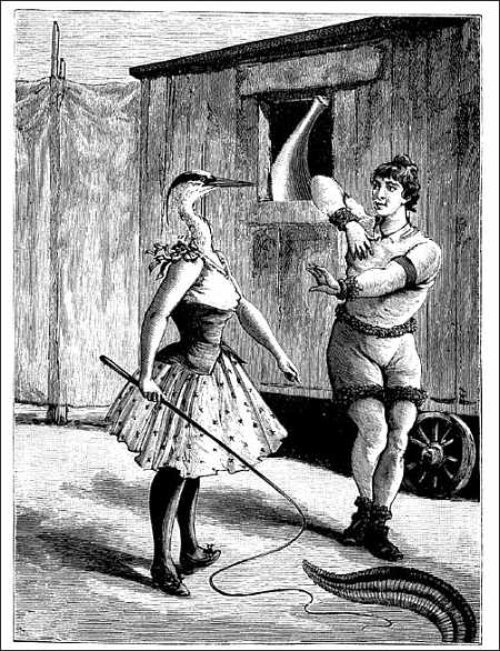
Page from Une Semaine de Bonté, Max Ernst, 1934
Page from Une Semaine de Bonté,
Max Ernst, 1934
The character of Loplop, Superior of Birds, came out of this combination of symbols, and appeared in many of his works. Serving the role of narrator and presenter in Ernst’s “collage novels,” Loplop was both a reflection of Ernst’s own personality and a spirit animal or totem of sorts. Loplop takes many forms, both male and female, and displays the heads of many different birds. The aspect of the hybrid creature varies wildly from endearingly goofy to erotic to grotesque and intimidating.
Loplop Introduces Loplop features the titular figure with a fanciful head resembling a chicken and painted in a primitive, tribal style, with multiple arms, displaying a framed collage a la Vanna White. Other images of Loplop were created directly with collage, pasting bird’s heads over the bodies of men and women in formalwear. Loplop is the central figure of Une Semaine de Bonté, a work entirely in collage and a predecessor of sorts to graphic novels. The surreal, deeply personal imagery of this and other Ernst novels is, even today, poorly understood.

  • 7:00 AM

Carnation, Lily, Lily, Rose

Carnation, Lily, Lily, Rose, John Singer Sargent, 1886

“Shepherds, have you seen, / tell me have you seen my Flora pass this way? / A wreath around her head, around her head she wore, / Carnation, lily, lily, rose…”

After the debacle of his controversial portrait of Madame X at the Paris salon, John Singer Sargent retreated to Britain. There, in 1885, he began work on another painting, one which he hoped would overshadow his earlier failure. The title Carnation, Lily, Lily, Rose is a line from a popular contemporary music-hall song, called “The Wreath,” or “Ye Shepherds Tell Me.” Sargent, a talented pianist, probably could have played it for his hosts, the Millets.

Sargent painstakingly constructed a scene of peaceful, idyllic contentment, where two young girls in white dresses light Chinese lanterns in the evening sky. At first, he planned to use the young Kate Millet as his model; however, Polly and Dorothy Barnard, the older children of his artist friend Frederick Barnard, proved more tractable and more capable of standing still. In the picture, they use long tapers to light paper lanterns, the slim candles echoing the paintbrushes used in gardening to pollinate flowers and by artists to create portraits.

An admirer of Impressionist methods, Sargent worked diligently to get the outdoor lighting effects absolutely right. Usually, he worked in a studio, not Impressionist fashion en plain air. Every evening, he set up his easel and paints in advance, wanting to take advantage of the few precious minutes of perfect lighting. He worked on the painting all summer, often scraping off the previous night’s progress in the morning; when the flowers wilted, he had them replaced with artificial ones. Each aspect of the painting was carefully staged to give the illusion of spontaneity, capturing a single, magical moment on canvas. He even sent the Millets fifty lily bulbs, twenty to plant in pots and the rest for the garden, in order to properly set the scene. Sargent used the unfinished painting as an excuse to return the next summer, and it was finished by October of 1886. The virginal innocence of the work, as well as its lushness and beauty, stood in contrast to the scandalous Madame X, and went a long way toward repairing his tarnished reputation.

  • 7:00 AM

Spectre of Sex Appeal and Howl

Spectre of Sex Appeal, Salvador Dali, 1934

Howl, Part II

By Allen Ginsburg

What sphinx of cement and aluminum bashed open their skulls and ate up their brains and imagination?
Moloch! Solitude! Filth! Ugliness! Ashcans and unobtainable dollars! Children screaming under the stairways! Boys sobbing in armies! Old men weeping in the parks!

Moloch! Moloch! Nightmare of Moloch! Moloch the loveless! Mental Moloch! Moloch the heavy judger of men!

Moloch the incomprehensible prison! Moloch the crossbone soulless jailhouse and Congress of sorrows! Moloch whose buildings are judgment! Moloch the vast stone of war! Moloch the stunned governments!

Moloch whose mind is pure machinery! Moloch whose blood is running money! Moloch whose fingers are ten armies! Moloch whose breast is a cannibal dynamo! Moloch whose ear is a smoking tomb! Moloch whose eyes are a thousand blind windows! Moloch whose skyscrapers stand in the long streets like endless Jehovahs! Moloch whose factories dream and croak in the fog! Moloch whose smokestacks and antennae crown the cities!

Moloch whose love is endless oil and stone! Moloch whose soul is electricity and banks! Moloch whose poverty is the specter of genius! Moloch whose fate is a cloud of sexless hydrogen! Moloch whose name is the Mind!

Moloch in whom I sit lonely! Moloch in whom I dream Angels! Crazy in Moloch! Cocksucker in Moloch! Lacklove and manless in Moloch!

Moloch who entered my soul early! Moloch in whom I am a consciousness without a body! Moloch who frightened me out of my natural ecstasy! Moloch whom I abandon! Wake up in Moloch! Light streaming out of the sky!

Moloch! Moloch! Robot apartments! invisible suburbs! skeleton treasuries! blind capitals! demonic industries! spectral nations! invincible mad houses granite cocks! monstrous bombs!

They broke their backs lifting Moloch to Heaven! Pavements, trees, radios, tons! lifting the city to Heaven which exists and is everywhere about us!

Visions! omens! hallucinations! miracles! ecstasies! gone down the American river!

Dreams! adorations! illuminations! religions! the whole boatload of sensitive bullshit! Breakthroughs! over the river! flips and crucifixions! gone down the flood! Highs! Epiphanies! Despairs! Ten years' animal screams and suicides! Minds! New loves! Mad generation! down on the rocks of Time!

Real holy laughter in the river! They saw it all! the wild eyes! the holy yells! They bade farewell! They jumped off the roof to solitude! waving! carrying flowers! Down to the river! into the street!

Editor's Note: Students were asked to match a poem to a picture. They could do so with or without comment; they could be serious or playful, profound or goofy. We will leave it to our dear readers to make their own connections.
  • 7:00 AM

The Floor Scrapers

Gustave Caillebotte, The Floor Scrapers, 1875

At the 1875 Salon, The Floor-Scrapers was rejected as too vulgar - a semi-nude painting of the urban lower class at work. Gustave Caillebotte was criticized for his choice of subject matter and his frank interpretation of the male figures. Critics claimed the shirtless men were too thin, their chests too narrow, and their proportions simply not idealized enough. Louis Enault proclaimed, “Do the nude, gentlemen, if the nude suits you…. But either make your nude beautiful or leave it alone.” Caillebotte, a wealthy lawyer and engineer with an inheritance from his parents (who sold blankets to the French army), could afford to ignore the whims of the Salon judges and take up the philosophy of Impressionism.

The unusual perspective of Caillebotte’s painting traps the workers, weighing down on them, but the men themselves appear unconcerned. Two of them have casually turned their heads to converse with each other, and a bottle of alchohol sits off to the side. The long, sinewy arms of the workers are better suited to labor than the impressive physique of classical statuary. They are scraping a layer of older varnish off the floor in order to clean and prepare it for a new coat, in long, regular strokes. The discarded shavings curl and twist in a manner that echoes the metalwork of the door in the upper-right corner. The tilted floor, with its horizon line almost at the top of the painting, is characteristic of Caillebotte’s style, an affectation borrowed from the newly developing art of photography. 

Caillebotte’s engineering training may have contributed to his precise treatment of perspective and architecture. In addition, he worked together with his brother, Martial Caillebotte, who was a photographer. Although no concrete evidence has been found, art historians speculate that some of Caillebotte’s tracing paper sketches, done on paper the same size as a photograph, may be studies traced from his brother’s photographs. The strangely detached paintings his methods produced, which imitated photographic depth of field and looked from unusual angles, were different from the main body of Impressionist work, but nevertheless valuable.

  • 7:00 AM

Paris Street, Rainy Day

Gustave Caillebotte, Paris Street; Rainy Day, 1877

Caillebotte was an outsider among the Impressionists; a lawyer from a wealthy family who espoused the ideals of the Impressionist movement, but whose flat, exacting style of painting had more to do with Realism. Living off a large inheritance from his parents, he pursued painting and gardening as hobbies while buying artwork from his colleagues, amassing a sizable collection of Impressionist work. His own paintings were influenced by the growing art of photography, using tricks like cropping, tilted floors, and high vantage points to create unusual and precise perspectives.

Paris Street, Rainy Day prominently showcases the new boulevards and changes to the cityscape taking place during this period. The “Haussmanization” of Paris meant great leaps forward in urban planning, bringing new public parks, monuments, facilities, and more. The sharp, geometric buildings of this intersection near the Gare St-Lazare tower over the disproportionately small people in the streets. As the scene extends back into the distance, it blurs, mimicking the limited depth of field of a photograph. The flatness of the shading evokes, more than anything, more modern artists like Edward Hopper, not Impressionism. The unusually detached crowd move like sleepwalkers, none of them making eye contact. In fact, the three people in the right foreground are about to unwittingly collide. The overall effect comes off as carefully planned, but still amazingly spontaneous; the viewer feels as though they have stepped outside on a rainy day in Paris to marvel at the grand façades of their modern city.
  • 7:00 AM

Metropolis

Paul Citroën, Metropolis, 1923

What will the future look like?

The spread and dissemination of images across the globe seems normal to us now, even commonplace. Photographs and artwork bombard us constantly in the modern age, in advertising, media, and every facet of our everyday life. But when photography was just beginning to establish itself as an art form, it changed the consumption of media drastically. Images of cities, of artworks, of nature, and yes, of naked ladies could be taken, reproduced, and spread over vast distances. This meant that it was easier for artists to obtain reference material, but also that new art could be created by combining and collaging the old.

Paul Citroën, along with a small group of colleagues, worked to synthesize images of the modern world into a vision of the potential future. In Metropolis, he fills the entire space with photographs of the city of Paris. The dizzying repetition of shapes, rigid lines, and the contradictory angles (some buildings are viewed from above, others head-on) draws the viewer into an imagined cityscape completely divested from reality or nature. In an interview, he explained, “if you would paste pictures of buildings on a large sheet, it should give an impression of the way many cities looked like. It was a view into the future. It was certainly not just a silly idea." He lived and worked nearly a hundred years ago. I’ll leave it to you to judge - does his work still capture the spirit of a modern, even futuristic city?
Editor's Note: To answer Camille's question: Yes.

  • 7:00 AM

The Dream and "King Worm"

Salvador Dali, The Dream, 1931


Salvador Dali’s intense, bizarre imagery makes his work instantly recognizable. He captures perfectly the surreal feelings of disassociation, helplessness, and sensory deprivation that accompany dreams. The central figure of The Dream is a pale woman with her hair flowing strangely into almost baroque contortions, with her eyes swollen and sealed shut. Ants crawl over where her mouth should be. Tiny, naked figures in the background pose in strange contortions or embrace. By combining his contemporary Freud’s theories of psychology with his own flair for the surreal and discomforting, Dali has created an intensely vivid and personal piece.

The cartoon Adventure Time’s loose and simplistic style of animation and the bizarre nature of the land of Ooo have the potential for plenty of surreal horror. In “King Worm,” hero Finn the Human finds himself trapped in a Dali-esque dream world, forced to confront his subconscious fears in order to escape. The logic of his dreams is surreal and inconsistent, full of strange images and foreshadowing of later episodes. In particular, a ghostly woman seen momentarily during the fear sequence reminds me of the central figure here in The Dream, with her billowing hair and greenish hue. Finn's dreams include confrontations with his love interest and his close friends; eventually, he learns to control the dreamscape to some extent, but locations still change unpredictably, melt, and change in very Dali-esque ways.
Adventure Time, "King Worm"


Dali experiments with trying to capture the helplessness and muted sensations of dreams, using the dark palette, crawling ants, and sealed facial features. The seated man in the background holding his bloody face may be Oedipus, a strong Freudian symbol, and the bust growing out of his back represents the father. Two men embrace each other, one holding what might be a golden key, and a third attempts to push his way into a red wall, symbolizing a search for meaning or escape. The strange, nonsensical actions reinforce the theme of dreaming. Dali considered this painting a strong enough representative of his work that he insisted it represent him at the First International Surrealist Exhibition in 1936.
  • 7:00 AM

The Raft of the Medusa and One Of Our Submarines

Théodore Géricault, The Raft of the Medusa, 1818


Bye-bye empire, empire bye-bye
Shallow water, channel and tide
Bye-bye empire, empire bye-bye
Tired illusion drown in the night... 

"One Of Our Submarines" - Thomas Dolby


In 1816, a ship set out on a disastrously ill-fated voyage. Traveling from France to Senegal and captained by Hugues Duroy de Chaumerys (who had never commanded a ship before), the Medusa stuck close to the African shoreline in an attempt to make good time. Eventually, the ship ran aground on a sandbar. Whoops! The wealthy and important people onboard grabbed all the lifeboats for themselves, leaving over 100 people drifting on a makeshift raft. Over the next two weeks, cannibalism, insanity, and rough waters claimed all but fifteen of the survivors. In other words, the Medusa only needed Leonardo DiCaprio and a haunting soundtrack to become a major theatrical masterpiece. 


Théodore Géricault did the next best thing and used the tragedy as the subject of a painting, The Raft of the Medusa. The starving mariners are depicted as heavily muscled, idealized figures, barely clothed and sprawling over the deck of their ersatz craft. The pile of (white) sailors culminates with the upright figure of a black man, waving a frantic signal to the distant ship, a not-terribly-subtle statement about race. The tension and desperation of the tragedy come across loud and clear, reflecting the scandal that broke out in France after news got out. 

A century and a half later, musician Thomas Dolby (best known for "She Blinded Me With Science") released "One of Our Submarines," a work of art about a completely different nautical disaster. The haunting, echoing synth-pop was inspired by the story of Dolby’s late uncle, who was part of a submarine crew fighting in World War II. He drowned not during a military engagement, but while performing routine maneuvers. The futility and pettiness of his death stuck with Dolby over the years, eventually taking shape in this song. The Raft of the Medusa takes advantage of the same feeling of despair. Shipwrecked men are at the mercy of an uncaring sea, and not even the timeless love between Rose and Jack can save them.

  • 7:00 AM

Esto es peor (This is worse)

Francisco de Goya, Esto es peor, 1812-15
This,” Goya sardonically proclaims, “is worse.” 


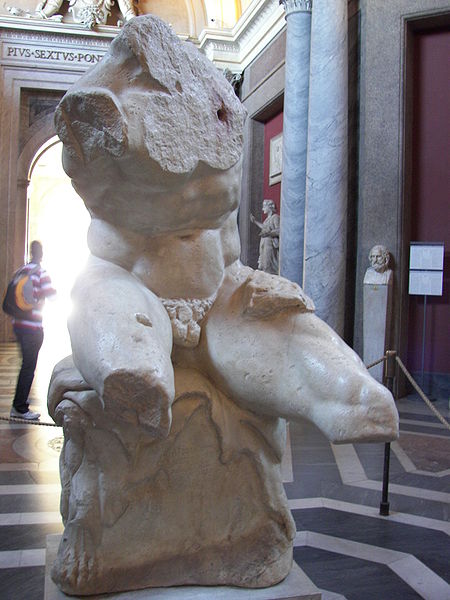
The Belvedere Torso
It certainly is. The body of a Spanish rebel, naked and mutilated, has been grotesquely impaled on the stump of a tree. Depending on who you ask, that’s either two branches, one through his anus and one through his shoulder, or one branch going all the way through. Yikes. In the background, another Spaniard is being dragged away by a mustached, uniformed soldier, utterly indifferent to the corpse in the foreground. Francisco de Goya based this particular etching, part of his Disasters of War series, on a real incident which occurred in Chinchón, the town where his brother lived. Two French soldiers were killed by rebels, and their fellows took revenge on the townspeople.

The jarring cruelty depicted in Goya’s work is enough to unsettle and disturb just from the surface, but let’s look deeper. Neo-classicism was still an active movement in the early 19th century, and it was still fashionable for neophyte artists to travel to Rome and study from early sculpture. Goya was one of those who did, and he apparently kept those early sketches and referred to them later. The pose of the corpse seems to be based on the Belvedere Torso, a heavily damaged sculpture missing a head, both arms, and both legs below the knees (presumably why it’s called the Belvedere Torso and not the Belvedere Elbow). Knowing this, we see that Goya gets a jab in at the Neo-classicists and the ancient sculptures they venerate. Damaged sculptures, missing arms, heads, and legs, are praised as beautiful art, while the same damage inflicted on a living body is horrifying. The slack-jawed head of the corpse turns toward the viewer, inviting them to share in the macabre joke.

  • 7:00 AM

The Source

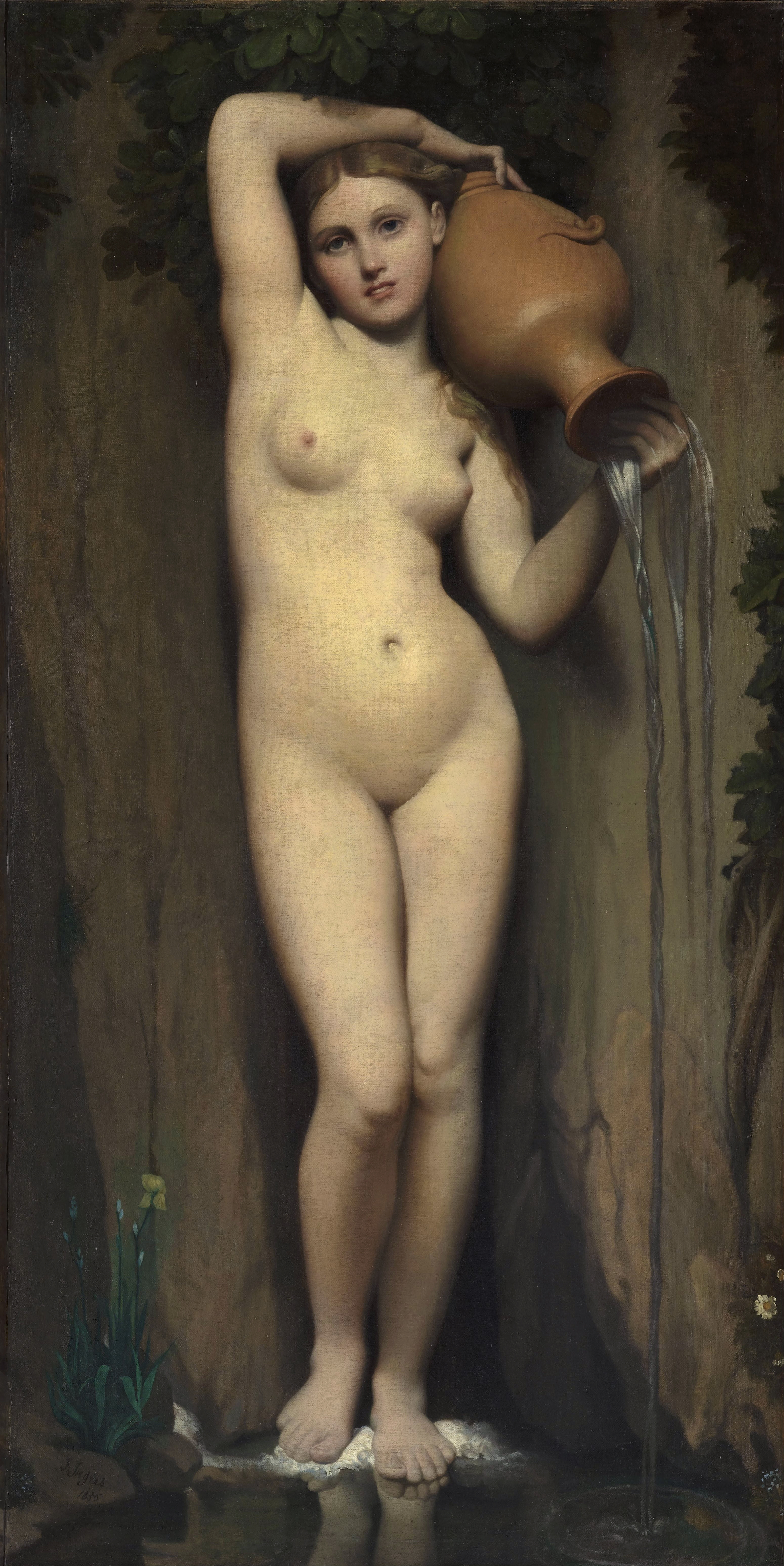
Jean Auguste Dominique Ingres, The Source, 1856

Ingres searched for perfection in his nude female figures by exaggerating and elongating their forms, creating sensual curves and strangely attenuated poses. However, The Source, which he left unfinished for more than 30 years, depicts a woman with more realistic proportions and sculptural smoothness, pouring a silvery stream of water into the pool at her feet. The water is just beginning to ripple, not yet disturbing the reflection of her feet, leaving her image frozen in time. Her undeniable sexuality is tempered by the body of water separating her from the viewer and her cold expression. The smooth, simplified curves of her body and the matte texture of the paint make her resemble a sculpture more than a living woman. She represents a natural spring, as well as a Muse and a source of poetic inspiration.

The painting was first exhibited in 1856, when Ingres was seventy-six and well advanced in his career. The first owner displayed it surrounded by flowers and aquatic plants, emphasizing its connection to the earth:  the delicate flowers on either side of the figure suggest an image of purity, while ivy was sacred to Dionysus, god of wine and totally sick parties. The effect of the surrounding greenery supposedly emphasized the painting’s realism even more. The Source has often been praised as one of Ingres’ best works, or even “the most beautiful figure in French painting.” The smooth, sculptural treatment and allusions to Greek myth place it firmly in the realm of superb Neoclassical paintings.
  • 7:00 AM

Mars Being Disarmed by Venus

Jacques-Louis David, Mars Being Disarmed by Venus, 1824

At the end of his life, exiled to Brussels, the 73-year-old Jacques-Louis David painted his enigmatic final masterpiece, Mars Being Disarmed by Venus. Although the god of war has divested himself of helmet and shield and his modesty is protected only by a conveniently placed dove, the final outcome of Venus’s courtship is still in doubt. Mars holds back, with a diffident expression, from the proffered crown of roses (a symbol of submission), and Cupid has set aside his bow, having shot neither the gold arrow of love or the less famous lead arrow of disgust. The three Graces, Venus’s attendants, fuss about performing meaningless tasks in the background, looking frankly less than graceful. The overall effect is confusing and highly unusual, leaving scholars to puzzle out the meaning of the work.

David sent Mars Being Disarmed by Venus to a Parisian exhibition from his exile, as a response to the newly ascendant style of Romanticism. In that case, perhaps the aging David felt the grip of his Neoclassical style fading, and that the public was being seduced away from what he considered right and proper. Perhaps his detatchment from France and the feeling that he was cut off from the newest trends in art informed the coldly dispassionate affair in this painting. An early sketch for this painting shows Venus’s voluptuous body facing forward, so that the viewer could see her from the front. In the final work, she is much thinner, and turned away, showing not even a hint of chest. One dove clumsily censors Mars’s crotch, while the other drives a wedge between the two gods. They do not even touch, except for one thin hand on Mars’s thigh, which Venus is using to support herself more than anything else.

The story goes that Vulcan, Venus’s crippled husband and the blacksmith of the gods, found out about this affair and wove a fine mesh net to catch Venus and Mars in the act, then brought all the other Roman gods to point and laugh at them. Perhaps this explains the incongrouous touches of comedy in the painting. The Graces certainly seem to be laughing at something (maybe each other), and Cupid peers straight at the viewer with a cocky smile, inviting them to share in the joke.

Little has been written in analysis of this painting; scholarship focuses on his earlier, revolutionary works. In the end, really, the viewer must ask themselves a question: just what is that Grace doing with Mars’s helmet? Does she think there’s a shelf there for her to put it on, or is she just holding it up strangely? Surely that grip wouldn’t actually support anything?

  • 7:00 AM

The Sleepwalking Lady Macbeth

Henry Fusili, The Sleepwalking Lady Macbeth, 1781-1784

One of the most pervasive theater superstitions is that a curse was placed on the name of one of Shakespeare's plays. If you ever say the name backstage, you're doomed to be mobbed by angry, shrill-voiced actors who will insist on dragging you out of the building to dispel the hex. Oh yeah, and something bad will happen during the performance. Actors have suffered everything from minor inconveniences to severe injuries, like when Charleton Heston's pants apparently caught on fire during a 1953 production. How you "accidentally" soak someone's tights in kerosene, I'll never know. The play is, of course, Macbeth, semi-affectionately referred to as "The Scottish Play" by many superstitious actors. (This might be stretching the assignment a bit, but, darn it, there are at least a dozen movie versions.)

The eerie, sinister qualities of the play make it a perfect fit for Henry Fuseli's work. Fuseli, born in Switzerland, is most famous for his creepy erotic revenge fantasy The Nightmare, and he frequently painted and sketched scenes from Shakespeare's works. His painting style was described as slapdash at best; one former student wrote that since he was "very nearsighted, and too vain to wear glasses… sometimes… he would put a hideous smear of Prussian blue in his flesh, and then, perhaps, discovering his mistake, take a bit of red to deaden it…then turn round to me, and say, 'By Gode, dat's a fine purple! it's vary like Corregio, by Gode!'" The Sleepwalking Lady Macbeth depicts Macbeth's wife as she wanders through the halls of the castle, tormented by the phantom smell of blood on her hands. Her face, starkly lit by the candle in her hand, reveals anguish and horror, complimented by the billowing of her dress and hair. The two figures cowering in the back, a doctor and an unnamed noblewoman, rear back in uncomprehending fear. Macbeth deals with the occult, with the price of ambition, and with the darkest parts of human nature. Fuseli, who, frankly, was a conceited and petty man, captures this shadowy, sinister atmosphere perfectly.

  • 7:00 AM

Maximilien Robespierre

 Pierre Roch Vigernon, Maximilien Robespierre, d'après Adélaïde Labille-Guiard, 1786

Adélaïde Labille-Guiard was a female painter and miniaturist, who was constantly in bitter competition with her contemporary, Madame Vigée-Lebrun, a female rival in the field of Rococo portraiture. She was involved in a number of scandals and ethically and sexually… oh wait, I got the legitimate historical accounts mixed up with slander from her male rivals and enemies, who didn’t consider a woman able to properly participate in the world of high art. Sorry about that.

Seriously though. Labille-Guiard was not as considerate as Lebrun, who wrote a detailed memoir of her life, training, and experiences. Many details of Labille-Guiard's life have been lost, as well as several of her works, including the miniature she painted for her entry into the Académie de Saint-Luc. Her early education remains a mystery; she would not have fit into the normal male-dominated structure of mentors and pupils, but we know she did receive some tutoring from a family friend, François-Élie Vincent (whose son she would marry, then later divorce), and from Quentin de la Tour. Although Enlightenment philosophy, as summarized by Emmanuel Kant’s dictum “Sapere aude! (Dare to know!) Have the courage to use your own intelligence!” was coming to the fore at this time, rejecting old beliefs in favor of new rational, logical conclusions, a good deal of prejudice towards women still existed. Labille-Guiard nevertheless championed women’s rights and took on female students, as well as building up patrons and connections among the nobility and eventually getting one of her pieces into the Salon, Self-portrait with Two Pupils. She was eventually given the title Peintre de Mesdames (painter to the king’s aunts, believe it or not) and a cushy government pension.

After the French Revolution, her connections to the nobility made her suspect in the eyes of the new order. However, she adapted, and managed to obtain sittings with Maximilien de Robespierre, a famously influential member of the National Assembly. The painting shown above is a reproduction of the original - like many of her other works, it has been lost or destroyed. Robespierre exchanged correspondence with Labille-Guiard and even flirted with her. He smiles confidently in his portrait, a smartly dressed man with his hat tucked under one arm. The waist-up format with a simple background is Labille-Guiard’s standard for portraiture. His simple but elegant clothing is richly detailed, in all its folds and frills. Although some protested her use of pastels to immortalize l’Incorruptible, with criticisms like “Ah ! peignez un Robespierre à l’huile, (Paint a Robespierre in oils!)," her delicate touch and diligent eye for detail creates a warm and charismatic image of an influential young man, painted with a woman’s hand.

  • 7:00 AM