Member Dismemberment - Apollo and Daphne


Member Dismemberment
A Look at Limbs 
Curated by Kate Sims

Bernini, Apollo and Daphne, 1622-25
"Yet what he sung in his immortal strain,
All but the nymph that should redress his wrong,
Though unsuccessful, was not sung in vain.
Attend his passion and approve his song.
Like Phoebus thus, acquiring unsought praise,
He caught at love and filled his arms with bays."
- Waller, The Story of Phoebus and Daphne

Apollo, god of light and unmarried men, was found irresistible by most for his charm and bravery. After Eros shot him with an arrow of love, Apollo fell for a nymph, Daphne, who uncharacteristically rejected him. Bernini, the master of marble, depicts the moment where Apollo reaches to grab Daphne and she turns into a Laurel tree.

Apollo’s arms illustrate his impatience and desire to reach Daphne with his right arm stretched back and fingers widespread. His left hand reaches out and caresses Daphne’s fragile frame. It is from that touch that Daphne roots her feet in the ground as the trunk wraps around her knees and legs. Her arms reach upward and widespread fingers transform into leaves. The limbs create movement within the sculpture. It begins with Apollo’s foot and creates a diagonal line up through Daphne’s arms. Bernini succeeded in capturing the delicate moment in time as Daphne transforms into a tree, running away from Apollo’s love.

  • 8:00 AM

Member Dismemberment - Floor Scrapers

Member Dismemberment
A Look at Limbs 
Curated by Kate Sims

Gustave Caillebotte, Floor Scrapers, 1875
“...It is only when a person has visited the slums of this great city that it dawns upon him that the inhabitants of modern London have had to sacrifice so much that is best in human nature in order to create those wonders of civilization... Every great town has one or more slum areas into which the working classes are packed. Sometimes,  poverty is to be found hidden away in alleys close to the stately homes of the wealthy. Generally, the workers are segregated in separate districts where they struggle through life as best they can out of sight of the more fortunate classes of society.” EngelsThe Conditions of the Working Class in England in 1844.

Caillebotte’s depiction of lower class laborers explores a new genre of workers. Peasants and country workers had often been shown, but in a harmonious state with nature. There is little to glorify within the Industrial Revolution where death rates skyrocketed and only a small percentage reaped the benefits of lower classes. Caillebotte’s Floor Scrapers takes a straightforward and academic approach of the work. A high-angle perspective, has the viewer tower over the workers, transforming the viewer into the supervisor of the operation. This uncomfortable angle does not allow sympathy toward the workers, but distances the viewer from them.

The slanted angle of perspective and geometric structure of the room draw attention to the workers’ arms, which stand out as curved nonconforming shapes. The lengthening of arms along the floorboards intensifies the labor. Understandably, their faces are shamefully downturned focusing on the task at hand. The light shining in from the window, and only connection to the outside world, glistens on the floorboards and backs of workers. They have digressed into an animalistic state, which further dehumanizes them with no positive end in sight. These may not be the exact working conditions that Engels was referring to, but they seem pretty darn close.

  • 8:00 AM

Member Dismemberment - Third of May


Member Dismemberment
A Look at Limbs 
Curated by Kate Sims


Goya, Third of May, 1814
It is not often that a Christ-like figure appears in front of a bale of hay with a half-dozen bayonets shoved down his throat. As a commission for the provisional government of Spain, Goya’s Third of May explores the tragedy of Spanish slaughter by Napoleon’s armies coupled with commemoration for their strong resistance. The Christ figure, a nameless man holding his arms and stigmatised hands open as if he were nailed to the cross, willingly faces his murderers. As the only subject facing outward, this man shows a mournful compassion toward his killers while standing up and taking the blame for his companions. These efforts prove fruitless as his inevitable death looms as corpses stack up around him. His un-heroic positioning, an unheard of technique, overturns conventional “beauty of hero” stereotypes, and strengthens the overall impact of the piece.

The executioners, by contrast, have lost all human qualities as their arms transform into gun barrels. Their extension of arms, close shooting proximity, and anonymity represent the corruption and metamorphosis from human to beast. Their careless slaughter and lack of proper disposal undercut the humanity of the victims. Goya strove to and captured the horrific nature of war with a lone christ figure, standing up to take the blame for his community. The arm in Goya’s Third of May serve two roles, to depict a man as a Christ figure and transform men into machines of war.


  • 10:00 AM

Member Dismemberment - Oath of the Horatii


Member Dismemberment
A Look at Limbs 
Curated by Kate Sims

David, Oath of the Horatii, 1784
“[The arts] should help to spread the progress of the human spirit, and to propagate and transmit to posterity the striking examples of the efforts of a tremendous people who, guided by reason and philosophy, are bringing back to earth the reign of liberty, equality, and law. The arts must therefore contribute forcefully to the education of the public... The arts are the imitation of nature in her most beautiful and perfect form... Those marks of heroism and civic virtue offered the eyes of the people [will] electrify the soul, and plant the seeds of glory and devotion into the fatherland.” Goldwater, Artists on Art

David’s Oath of the Horatii illustrates a scene from Roman Legend where two competing cities go to war with each other. Three brothers from the Alba-Longa family plan to fight three brothers from the Horatti family. Each of the brothers is willing to give up his life as the last male standing wins the war for his city. The painting can be divided into three sections. The males do not show emotion with their faces, but rather with their arms. The brothers, who eagerly ask for their father’s blessing, jut their arms forward, mimicking the swords and cascading upward, revealing complete confidence in the situation. Their father, raises the swords with arms spread toward the heavens. He is asking God to look over his sons as they go to war, as well as offering his sons as a sacrifice to the city.

On the other hand, the sisters and mother are holding their heads in their hands or dropping their arms to their sides. Greif has overtaken their bodies and literally immobilized them. The women are the only ones allowed to feel emotion because they do not have heroic responsibilities. The stillness of these characters against a plain dull setting elevate the importance of the situation. The limbs in Oath of the Horatii display the mental and physical differences between men as the tragic heroes and women as the weaker sex.

  • 10:00 AM

Member Dismemberment - The Creation of Adam


Member Dismemberment
A Look at Limbs 
Curated by Kate Sims


Michelangelo, The Creation of Adam, 1511
"So God created man in His Own Image, in The Image of God He created him; male and female He created them. God blessed them and said to them, "Be fruitful and increase in number; fill the earth and subdue it. Rule over the fish of the sea and the birds of the air and over every living creature that moves on the ground." Then God said, "I give you every seed-bearing plant on the face of the whole earth and every tree that has fruit with seed in it. They will be yours for food. And to all the beasts of the earth and all the birds of the air and all the creatures that move on the ground - everything that has the breath of life in it - I give every green plant for food." And it was so. God saw all that he had made, and it was very good. And there was evening, and there was morning - the sixth day." Genesis 1:27-31

Step inside the Sistine Chapel and try to look down, left, right, anywhere but up. It is impossible. You don’t notice the hundreds of other tourists, packed in like sardines. Their incessant murmurs become white noise along with the docents gentle “shhhhing.” You become enthralled by Michelangelo’s massive ceiling works. Their size, color, and raw passion capture both your attention and emotion. Nine scenes from the Book of Genesis dominate the ceiling, but one particularly breathtaking scene, The Creation of Adam, captures the attention of onlookers as well as its own spot in the Art History Hall of Fame.

In this collection, titled Member Dismemberment, I will explore the importance of limbs, specifically arms, and their contributions to the art world. Limbs display a specific emotion that viewers unknowingly relate to. I will begin, as seems fitting, with the beginning, or creation of humans. Viewing The Creation of Adam begins at the center of the painting, where God reaches out and Adam meets him halfway. This mirroring of arms represents the image of man created in God’s likeness. The hands are purposely not touching as God imparts the spark of life into Adam. Now, in regards to his arms, God’s right arm and hand of power is actively extended. While Adam, rather nonchalantly, slouches back, not seeking after God, and rests. His arm only extends to his knee where it rests. Adam’s drooping arm and limp wrist displays his reliance on God. The strength of one arm and weakness in another shows the relationship between God and man, and foreshadows the expulsion from the garden.

  • 9:00 PM

The Evil Genius of a King


Giorgio de Chirico, The Evil Genius of a King, 1915
SURREALISM, noun, masc. Pure psychic automatism by which it is intended to express either verbally or in writing, the true function of though. Thought dictated in the absence of all control exerted by reason, and outside all aesthetic or more preoccupations. (Encyclopedia) 

Andre Breton, the father of Surrealism, defined the movement as stated above. This was a break from the Dada movement, which didn’t contain art, but revolted against the senseless killing and barbarities of war. At this stage in 1924, here was no mention of painting or artwork associated with the literary movement. The experimentation with language free from conscious control bled over to include photography, cinema, and ultimately, painting. 

Art inspiration came from the works of Giorgio De Chirico, acknowledged as the founder of the surrealist aesthetic. The role of consciousness was minimized as shapes simplified, saturation deepened, and common sense was replaced by unconsciousness. His work, The Evil Genius of a King, contrasts the depictions of harmless children’s toys as well as alludes to the organs assembled on sacrificial alters of augurs in ancient Rome and Etruria.* In these works there are no definite interpretations, but rather emotions that are meant to be taken from the works.

The first group exhibition was held in Paris in 1925. Art displayed included the techniques of frottage and collage used by Max Ernst, the automatic drawings made by Andre Masson, and Man Ray’s rayographs. Shortly after, Miro, Picasso, Magritte, and Dali broke through the scene producing iconic juxtapositions of object, emotion, and unconsciousness. The success of surrealism lies on its lasting impact and revolution of the art community. 

*Merjian, Ara H.(2010). ‘Il faut méditerraniser la peinture’: Giorgio de Chirico’s Metaphysical Painting, Nietzsche, and the Obscurity of Light. California Italian Studies Journal, 1(1).

  • 12:00 AM

Portrait of Mademoiselle de Lancey

Carolus-Duran, Portrait of Mademoiselle de Lancey, 1876 
Carolus-Duran was not only “sought after as a portraitist because he knew how to make his subjects look attractive and important but not at all boring or conventional,” (Davis 65) but he expressed their sexuality in an acceptable fashion. He chose that Mademoiselle de Lancey follow the lead of Titian’s Venus of Urbino and Manet’s Olympia. Her lounging position and direct eye contact lure the viewer inside the frame. Although there are two major alterations from the preceding masterpieces that boosted her reputation: clothing and isolation.

Paris was at the height of fashion in the later parts of the 19th Century. Mademoiselle de Lancey chose a flamboyant and risqué ensemble, exposing her enticing bust and slender crossed ankles, to illustrate both her financial stability and personal confidence with her place at the height of society. The white (or in her case dirty white) sheet of virginal beauty does not lie beneath her, but wraps around her tiny corseted frame. Similar fabric folds and bunching of the train lead viewers gaze toward her, ahem, mid-section. Her isolation commands all of the attention as she resumes responsibility for her actions. Without the watchful eye of a maid or family member, she is free to act as she pleases during afternoon visiting hours.

The alluring sexuality exudes from the hand gestures of the women. Mademoiselle de Lancey does not need to cover herself like Olympia and Venus of Urbino. Instead her right hand grasps a fan and places it suggestively ­­below her waist. The left does not rest at her side, which would create a barrier between her and the viewer, but rather supports her head with an enticing expression. One finger points up as a “come here” gesture, ensuring the command of her invitees.

Carolus-Duran accomplished portraying Madamemoiselle de Lancey with “an increased sense of life and personality” (Davis 79). His inspiration drew from Titian’s Venus of Urbino, and Manet’s Olympia where he succeeded in suppressing the naked sexuality and replacing it with sensual silks. A draping of red, which reveals the passion, appears in each of the four works. This beneath the innocent (or not so innocent) white fabric succeeds in making each woman alluring.

  • 12:00 AM

The Rehearsal and Tiny Dancer

Edgar Degas, The Rehearsal, 1878
"Blue jean baby, L.A. lady, seamstress for the band
Pretty eyed, pirate smile, you’ll marry a music man
Ballerina, you must have seen her dancing in the sand
And now she’s in me, always with me, tiny dancer in my hand."

- Elton John, “Tiny Dancer”

The tiny dancer in Degas’ hand was the paintbrush that wisped across the canvas, capturing the softness of the ballet with his color pallet and strength of their performance with his brushstrokes. Ballerinas took center stage as Degas became infatuated by their beauty and elegance. Degas not only enjoyed painting them, but also liked the company of the dancers, who would share gossip with him as they posed. But, Degas kept his boundaries, unlike his brother Achille, who had an affair with a ballerina. He viewed them as beautiful and inspirational characters that could be fashioned to fit the canvas.

Ballet and opera were fashionable parts of Parisian culture, and Degas more that likely was part of the audience before he began painting the ballerinas. His first works featured the audience and orchestra as much as the dancers on stage. Degas quickly grew out of that habit and developed a passion for portraying the entertainers not only in recitals, but also in life behind the scenes. The Rehearsal demonstrates Degas’ determination and ability to weasel his way backstage and experience a dancer’s life from a new point of view. Elton John’s Tiny Dancer also explores new perspectives. As the band traveled to the United States, Bernie Taupin, lyricist of the song, was inspired by the warmth and beauty of the women. California in the fall of 1970 was full of sunshine and free spirits. Taupin’s ballerinas were those lounging on the beaches and dancing in the sand, while Degas portrayed his ballerinas with the tiny dancer in his hand.

  • 12:00 AM

Melancholy


Edvard Munch, Melancholy, 1891
Melancholy by Edvard Munch does not refer to one particular work or medium. It began as a pastel drawing in 1891, in 1892 Munch painted several versions and added “Yellow Boat” to the title, and in 1896 he created a woodcarving. These works were set in AsgÃ¥rdstrand, Norway, where Munch spent most of his summers between 1889 and 1906. The main figure is said to represent writer Jappe Nielsen, who suffered for his hopeless love of Oda Krohg. She is pictured with her newly-married husband, Christian, on the pier. Ironically enough Christian Krohg, Norway’s leading artist at the time, published an article giving the painted version much praise and attention.

I enjoy the pastel sketch the most of the three mediums because I believe that Munch’s ability to portray desperation and melancholy feeling touches the surface of emotion, but both leaves freedom for and encouragingly accepts the honest passionate reaction of the viewer. Jappe’s figure is the most finished portion of the work. Behind him, his memories begin as the canvas unfolds into color and dimension. A darker line extending from the tip of his nose, across the bay and toward the figures seem to connect the two. The characters of his lost love and her new husband seem too painful to remember, thus are barely touched. As is the ocean, which opens up a plethora of opportunities for Oda to sail away and never return.

I enjoy this painting for its external simplicity as well as its complexity of line and movement. The seemingly unfinished canvas leaves a plethora of emotional opportunities for viewers that all revolve around the melancholy Jappe.
  • 12:00 AM

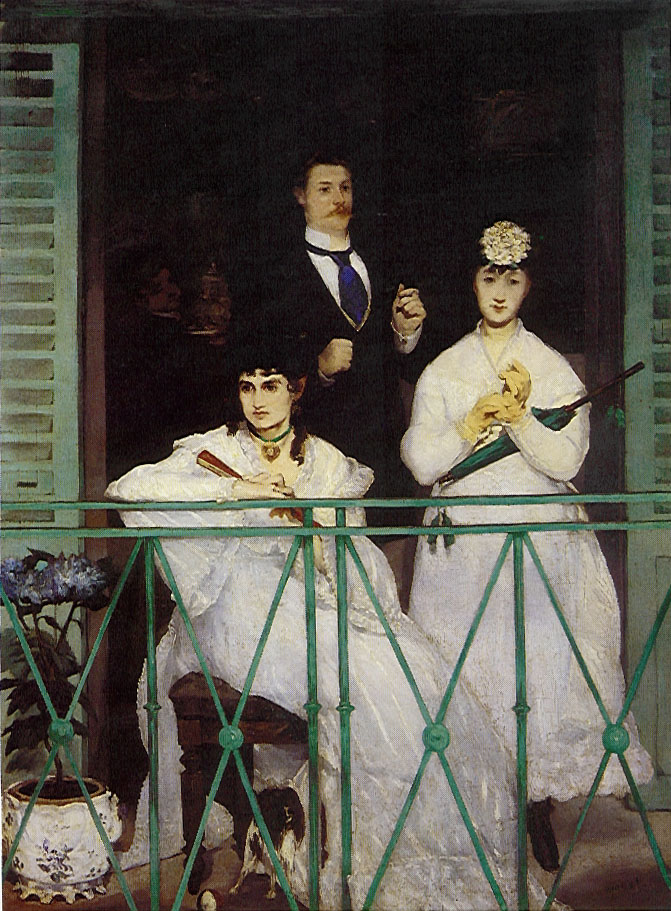
The Balcony


Edouard Manet, The Balcony, 1868-1869
Edward Manet’s 1868 oil painting, The Balcony, was first exhibited at the Paris Salon of 1869.  Obvious inspiration comes from Goya’s The Majas at the Balcony, which stems from the themes of class structure. Two intimidating male companions oversee two young and smiling upper-class women.  In The Balcony a stiff and awkward trio replaces the balanced quartette in The Majas at the Balcony. Manet also exchanges Goya’s sinister balcony setting for a spruced up minty green version. He seeks to express the life of the upper class, and succeeds in unveiling the rigidness beneath the poised façade.

The three polished subjects, who were all friends of Manet, seem disjointed, as if they were taken from other works and pasted together on the canvas. Berthe Morisot, on the left, sits like a romantic waiting for her suiter. Her piercing eyes are the most defined, but send gazes away from the viewer and off the painting. Antoine Gilement, a painter, displays a look of indifference and rigidity. Finally, a young violinist, Fanny Claus, seems completely uncomfortable with the entire situation. She stands holding her hand together and on her tiptoes as if she were to leave the scene at any moment. A small boy carrying a tray in the background is Manet’s son, Leon. Born out of wedlock to Suzanne Leenhoff, Leon, posed often for his father and was the subject in many of Monet’s paintings.

Adding Leon in the background of The Balcony slightly taints the sophisticated rigidity of the painting, but offers a connection to the artist that the viewer does not see within the subjects of the painting.

  • 12:00 AM

Madame Phillippe Desbassayns de Richemont and Her Son, Eugene

Marie-Guillemine Benoist, Madame Phillippe Desbassayns,
1802-1803 
Marie-Guillemine Benoist’s work Madame Phillippe Desbassayns de Richemont and Her Son, Eugene has a bit of a cloudy background. In 1897, the painting surfaced in an exhibition at the Ecole des Beaux-Arts in Paris. This was the first time that Jacques-Louis David scholars had seen the work, and they presumed (wrongly) that it was his.

A member of the de Richmont family gave the work to the Metropolitan Museum of Art in 1953. Family tradition stated that David painted Madame de Richemont and her daughter, Camille, shortly before the girl’s death in an accident. The family sold the painting because the painting alludes to memories of their daughter’s tragic death. Critics speculate that after Camille’s death, the painting was altered to replace the young girl’s portrait with that of her brother Eugene’s. However, the physique of the child in the portrait, as portrayed through its curls and rosy skin tone, does not indicate a particular gender.

While art critics attribute the painting to Benoist, the mannerisms of David, her mentor, shine through the work. The position of the character, short brushstrokes, and wisp-ish quality of the hair mimics David’s style. But, the shade of red in the shawl that adorns the chair contradicts David’s customary color. The orange tones of Benoist’s fabric almost seem too bright and florescent compared to the customary crimson used in David’s works, such Venus Disarming Mars. After studying David’s paintings, it can resolutely be stated that Madame Phillippe Desbassayns de Richemont and Her Son, Eugene was not painted by the late master, but by his studious disciple.


  • 1:00 AM