The Fight Between Carnival and Lent


Pieter Bruegel, The Fight Between Carnival and Lent, 1559

Bruegel's genius is subtle. Then again, it's really not. The chaos in this picture is evident. Like so many of Bruegel's other paintings, the viewer becomes distracted by the chaos, thus the subject is lost to them (i.e. The Fall of Icarus where a man peacefully plows in the foreground and Icarus, unnoticed, drowns in the bottom right corner). In this particular painting, the focus is just as unclear, despite Bruegel giving it to us in the title. The spectrum is broader; the subject busy and chaotic.

But Bruegel doesn't take sides. He sits behind his paint brush and his wit, observing the utter chaos in front of him. He depicts the convergence of a religious contrast. On the right side, there is a church, religion and order, representing Lent, a time of solemnity and purity. Hunched over nuns walk about the street looking sickly and forlorn. On the left, an inn where the drunk and foolish stumble out.

It kind of boggles my mind to think that Bruegel never got in trouble for this painting. He depicts two different religious days as a mockery, ridiculous through every aspect. Despite all this, he was considered a pious man, but this only impresses me. Throughout all of history, Bruegel is one of the brains I would look to pick the most (right behind Oscar Wilde). To me, he's that guy at the back of the party that's just there, watching and observing the comedy in every day life

  • 7:00 AM

Know Your Chapeau: Pinkie

Sir Thomas Lawrence, Pinkie, 1794

Sir Thomas Lawrence, an accomplished portraitist, painted Sarah Goodin Barrett Moulton in 1794 when Sarah was eleven years old. Given the nickname Pinkie by her family (which I think is up there alongside Keith, Myrtle, and Bing on the list of horrible things to call your children), Lawrence played off of the nickname, giving his subject a soft, rosy complexion. Dressed in pink, young Sarah stands on the rocks poised, looking off among to the distance.

Pinkie and Thomas Gainsborough's more famous Blue Boy have been seen as a package deal before. In the 1960s, the two paintings were sold together as cheap home decor. Today, the two portraits hang beside one another at the Huntington Library in California. Although I’m not particularly fond of either painting, that feeling changes when you put them together. They complete each other. Lawrence clearly intended to juxtapose his painting with Blue Boy, seeing as how they were painted only fourteen years apart. Dubbed the “Romeo and Juliet of Rocco portraiture,” Pinkie and Blue Boy thrive together, but wilt when apart.

  • 7:00 AM

Know Your School of Athens Military Boss: Alexander the Great

Raphael, School of Athens, 1511 (detail of Alexander the Great)

This could be either one of two people: Alcibiades or Alexander the Great.

Bust of Aclibiades as every Greek man
Although I don’t have any schools of thought to ramble about, I do have strategic geniuses who were actually pretty stupid in their free time. While history may try to glorify these two, let me assure you that I will expose them for the dudebros they are.

Alcibiades was basically anything but a philosopher. First, he worked for his native home of Athens, but evidently decided that Sparta looked so much cooler (that and he was charged with sacrilege). While in Sparta, he worked against his former ally of Athens, but he eventually made more powerful enemies in Sparta, and was forced to leave. He defected to Persia where he was the adviser for the satrap until his enemies demanded a recall. Yet, when he returned to Athens, he did not fall from power. On the contrary, Alcibiades became an Athenian General until (surprise, surprise) his enemies had him exiled. All in all, Alcibiades war tactician for not one, not two, but three different empires.

On the other hand, Alexander the Great spent his formative years in a pissing contest with his father that lasted for years after his death. For a brief time, 
Alexander was tutored by Aristotle beginning at the age of thirteen. In return, Alexander’s father Philip II, restored Aristotle's hometown, which he had formerly razed.

Super Alex: short, ginger, and angsty
What leads me to believe that Raphael stuck Alexander in there rather than Alcibiades was that, while Alexander may have been more jock than nerd, his contribution and intellectual legacy lives on through Alexandria. After Alexander founded the city, it became a wealth of knowledge. Of course, this didn't last for very long. It was soon destroyed by the growing Christian presence in the city.

At any rate, maybe Raphael should have just painted the city of Alexandria in there, but I digress.

  • 7:00 AM

Tobias and the Angel

Andrea Del Verrocchio's Workshop, Tobias and the Angel,  1470 - 1480

Although probably best known as a sculptor, Verrocchio, at one point in his life, turned to painting. His painting Tobias and the Angel, is taken from the Book of Tobit. Raphael, the angel Tobias walks with, tells Tobias about a remedy that will cure his father's blindness. He tells Tobias to take the liver, heart, and gall for the remedy. Raphael carries the completed concoction in his hand. 

This painting wasn't completed by just Verrocchio. A respected teacher, many of his students worked on this painting. If you look close enough, it becomes visible; some areas of paint application are stronger than others. For example, the background looks fairly weak in comparison to the smaller details like the fish. It seems almost impossible to talk about Verrocchio without talking about Leonardo, but it becomes one of, if not the only, controversial topic that involves my artist. And since I don't wish to bore anyone who may be reading this to death, I choose to once again defend my artist against those hated Leonardo fans (similar to those who act like Shakespeare is God). 

Rumor has it that Leonardo was the model for Tobias, also painting the fish and the dog. I maintain my opinion that the dog really isn't even that great since it falls into the background (most likely not well-preserved), but the model part is what irks me the most. Verrocchio is his own artist without Leonardo. Even if his apprentice did paint the best part of the painting (a dog and a fish, congrats), this is still Verrocchio's work. Yet, I sit here frustrated that while I attempt to defend Verrocchio from those that would label him outshined by Da Vinci, I can't stop talking about the apprentice, instead of the master. 

Unfortunately, the best part of Verrocchio is Leonardo and the rumor that surrounds them.

  • 7:00 AM

David

Andrea Del Verrocchio, David, c. 1475

Although my love for paintings seems vast and never ending, I have recently been turning to sculptures for some aesthetic pleasure. While I could probably stare at anything by Bernini for the rest of my life, I'm not writing my blog post about him.

Enter Andrea Del Verrocchio. When he was first assigned to me, I knew nothing about him, just that he was a sculptor. My first thought was, "This'll be a great way to appease my sculptor craving." Upon looking at his work, though, I was unimpressed. This will be great quickly changed into "He's no Bernini." Comparison can be tricky, especially when it comes to a statue like David. Verrocchio's rendition doesn't come close to Donatello's Pan-ish tribute or Michaelanglo's youth.

But to truly appreciate Verrocchio, you have to throw all of those comparisons out the window. He might not be great, but he is pretty darn good. Verrocchio creates soft beauty through the use of curls and drapery. His David may not be as slick or stunning as the others, but there is a boyish charm in the smirk he dons; Goliath's head thrown on the floor like it's dirty laundry.

He is an artist lost in the shadow of others, and I can connect to that.

  • 7:00 AM

The Milan Cathedral

Milan Cathedral, 1386-1965

Made in the Italian-Gothic image, construction on the Milan Cathedral began in 1386. Per the Gothic style, it was to originally be built with brick, but then brick was switched to marble. Hence what I said about the Italians having that need to make everything their own. Of course the unprecedented use of marble caused unprecedented difficulties, forcing the architects and builders to outsource. French and German architects poked and prodded at the new design, with the head architect switching from one to the next.

I'm not a huge architecture person. Besides the fact that I like my homes Tudor and my windows French, I have little to no knowledge of what an apse or a spire even is. Buildings don't speak to me the way paintings do, yet that didn't stop me from choosing this. Perhaps it was my deeply ingrained aversion to popularity that made me choose something other than a Duccio or Giotto that so many others in my class did, but I would like to believe it was a different and less stubborn reason.

My grandma always makes sure to tell me that people see the world in different way. She sees the world a certain, a very black and white way, because she is a doctor and that it just how she is. Conversely, she knows someone (an uncle, a distant friend... I forgot which) who is a gifted painter who sees the world in shades. When he looks at a tree he identifies all of the different shades of green in the leaves.  Now, I don't see the world in shades or numbers like the Matrix, but I try to see the beauty in everything. Cliche as it may sound, my eyes lock on anything that I identify as aesthetically beautiful. I find beauty in architecture. That's just my perspective.

So, while I may not be an expert or able to make Gothic architecture interesting and controversial, I can tell you that the Milan cathedral is beautiful and completely Italian. The Italians saw the world in a different way than the Germans who built the Ulm Cathedral or the English that built the Salisbury. The Milan Cathedral perfectly displays, what I believe to be, the Italian artists best quality: to make something entirely their own. Essentially, what makes this cathedral so unique boils down to a matter of perspective.
  • 7:00 AM

Rouen Cathedral Facade and Tour d'Albane

Claude Monet, Rouen Cathedral Facade and Tour d'Albane, 1894

Lately, I've been thinking a lot about repetition. Such as: what good is it? What does it do? What's it's purpose? Most of all I've been asking myself why I have this odd affinity towards it. This could be, simply, that I'm a creature of habit in the truest sense of the phrase, but recently I've found that that answer doesn't satisfy me. I am currently, as I write this, a week into my senior year at Barstow. This is also my fifteenth year at this school. In essence, I have gone and spent my entire life here. Willingly? Only sometimes, but I have found myself returning again and again, making my yearly Mecca-like pilgrimage to the overly air-conditioned building. Repeatedly, I have sat in the same classes and walked down the same halls thousands of times. So, why is it that I find myself coming back?

Claude Monet must have asked himself this question everyday as he went out to paint the Cathedral Rouen. He found himself obsessed with the way the light would rest on the cathedral, but was never quite happy with the way he painted it. Well, that may be an understatement. Monet eventually became so obsessed with the cathedral and its light that he could never pin down that he began to have nightmares about it. Eventually, Monet found himself in a rut, haunted by his subject, and had to leave Paris for a while. This is one of my favorite art history stories, and I had previously mentioned it in my post about Pissaro's obsession with the Boulevard Montmartre. Pissaro's experience with his subject was much better. In fact, I deduced that Pissaro, instead, had more of a love affair with the boulevard. Monet may have loved the cathedral - I've never been sure - but something about drew him towards it and made him want to come back after each failure.

In this instance, I so empathize with Monet. Even after all of the failures and disappointments, Basrtow has been a second home to me where I have been fortunate to meet some fantastic people. This year, I am one of only two returning students in my Art History class, and I remember how nerve wracking my first blog post was. Now, after writing one analysis after another, I feel rather seasoned and sure of myself. I repeated the same actions over and over, but I have never found it boring. Repetition is comfort. It means that you are comfortable with something or love it enough to return. For me, that's Barstow.

  • 8:10 AM

Symphony in Violet

Albert Gleizes, Symphony in Violet, 1931

Orphism, arguably a subsidiary of Cubism consisting of artists that would have been unfortunately forgotten otherwise, attempted to combine music and art into a singular experience. Prescribed by Guillame Apollinaire in 1913, Orphism's name stemmed from Orpheus, a legendary musician in the  Metamorphoses most known for attempting to retrieve his wife, Eurydice,  from the Underworld… and failing. A non-representational style of art, Orphism concentrated on color contrast and space. Many of the artists Apollinaire dubbed Orphists could better be catagorized as Cubists. In fact, Robert Delaunay, the most famous Orphist, would shy away from being labeled as such unless the connection to music was involved. Delaunay was heavily influenced by Michel-Eugene Chevreul's theory of simultaneous color contrasts. The theory tests the idea that, instead of seeing one color at a time, one is able to process multiple colors at one time. In correlation, Wassily Kandinsky, an expressionist, claimed to have synaesthesia: being able to see a color when listening to music. Apollinaire's direct definition of Orphism stated that it was, "an explanation of color and geometry that owed nothing to the actual forms of art."

Albert Gleizes, better known as a self-proclaimed founder of Cubism, painted Symphony in Violet in 1931, years after the Orphist movement had come and gone. Yet Gleizes' title links the core Orphist themes of music and color. His abstract shapes, primarily circular, are distinctly influenced by Delaunay. To really get the full effect, I'm listening to "Preludes, Les Filles Aux Cheveux" by Debussy. While I think that this painting is less of a Debussy and more of a Stravinsky, the only way to fully experience this painting is with music. This, I believe, is was that Orphists were trying to achieve: an experience. Often times paintings only use sight, you look at a painting, but do not touch, hear, smell, or taste it (disclaimer: please do not lick any paintings). Orphism demands that you use more. You have to hear the color and see the music, and owe nothing to the reality of art.

  • 7:00 AM

A Pardon in Brittany and Spring is like a perhaps hand

Gaston La Touche, A Pardon in Brittany, 1896

Spring is like a perhaps hand
by e. e. cummings

Spring is like a perhaps hand
(which comes carefully
out of Nowhere)arranging
a window,into which people look(while
people stare
arranging and changing placing
carefully there a strange
thing and a known thing here)and

changing everything carefully

spring is like a perhaps
Hand in a window
(carefully to
and fro moving New and
Old things,while
people stare carefully
moving a perhaps
fraction of flower here placing
an inch of air there)and

without breaking anything.

Editor's Note: Students were asked to match a poem to a picture. They could do so with or without comment; they could be serious or playful, profound or goofy. We will leave it to our dear readers to make their own connections.

  • 7:00 AM

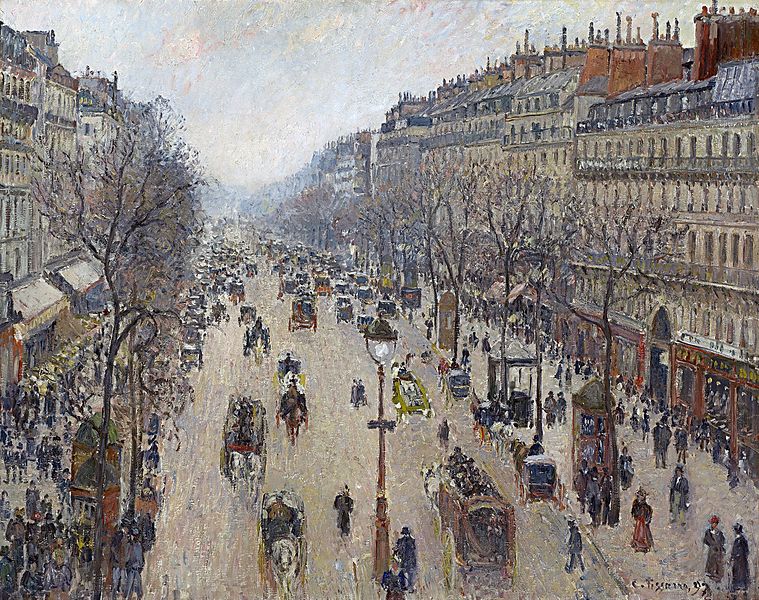
The Boulevard Montmartre at Night

File:Camille Pissarro, The Boulevard Montmartre at Night, 1897.jpg
Camille Pissarro, The Boulevard Montmartre at Night, 1897
Camille Pissarro, in the late 1880s, rented a room at the Grand Hôtel de Russie in Paris. This provided him with a view of the Boulevard Montmartre, which is one of the grand four boulevards in Paris. While the painting above depicts the street at night, Pissarro painted and painted this same view multiple times. In a series of works done in 1897, Pissarro painted the Boulevard Montmartre at four different times of day; morning, noon, evening, and night. Whether Pissarro marathoned all four of these paintings and finished them in one day or if they were all done separately, I don't know. Perhaps a bit of Monet's all-at-once painting technique had rubbed off on Pissarro. (If so, then I can understand why the brushstrokes on The Boulevard Montmartre at Night were more hurried than the rest. A man's gotta sleep, after all.)
File:Camille Pissarro - Boulevard Montmartre, morning, cloudy weather - Google Art Project.jpg
The Boulevard Montmartre, Morning, Grey Weather, 1897


In his later years, Pissarro suffered from a reoccurring eye infection that confined the previously en plein air painter indoors. Thus, Pissarro worked from the inside looking out -- or down, rather -- from hotel rooms in Paris, as well as London. This change in venue also made Pissarro change his subject matter from that of Millet-esque peasants and nature to city streets. A vast and difficult change for any painter, but that's what I appreciate about Pissarro. He has the innate ability to switch painting styles and subjects at the drop of a hat. I can't say that Pissarro has any set style, one that would uniquely define him as a painter. He switched from watercolors to Impressionist, to pointillism, to Impressionist again. Thus, the day begins with The Boulevard Montmartre, Morning, Grey Weather. I wish I could present this in the intended size (Wikipedia has a quality, zoom-in-able version of this painting. I would recommend looking it up). Although collectively grey, it's extremely colorful and lively. Overcast weather is usually portrayed as melancholy and dull, but the small flecks of color in the people and buildings bring vitality to the canvas. A hint of red, a blip of yellow; Pissarro manages to somehow breathe life into this painting with the small things.

The Boulevard Montmartre: Afternoon, in the Rain, 1897
The overcast skies have now given way to rain. The Parisians on the boulevard, made up of multicolored smudges and blobs, have their umbrellas out. This painting is slower than its predecessor. There's also a sort of buoyancy to this painting. The Boulevard Montmartre, Morning, Grey Weather is dense and heavy. The air seems thick and so does the paint. In The Boulevard Montmartre: Afternoon, in the Rain, it feels like a deep sigh, a weight has been lifted. The brushstrokes are smoother, blending together like water and dirt to make mud.

Part of me loves that fact that Pissarro painted the same boulevard fifteen times (that's not an exaggeration, it's an approximation), but it also drives me up the wall. The only difference to each painting is the the position of the people, the weather, and the trees. The man was obsessed. This always reminds me of Monet and his paintings of the Rouen Cathedral. He painted this same subject eight times (don't quote me on that), becoming obsessed with how the different times of day would light the cathedral walls. But he was never satisfied with his compositions, so much so that the cathedral haunted his dreams, giving him so many nightmares that he had to leave Paris. Did Pissarro ever dream of the Boulevard Montmartre? I'll come back to that thought.

Boulevard Montmartre, Sunset, 1897
So, now the clouds are mostly gone, and the sun shines golden light through Pissarro's boulevard. People pack the streets, a noticeable carriage traffic jam up ahead; everyone is heading home for the day. The crowded boulevard and noticeably shorter buildings make the Boulevard Montmartre, Sunset look weighted. It's not as smudgey as the afternoon, but not as detail oriented as the morning. Here, I think Pissarro struggles to find that balance, an equilibrium if you will, in his painting style. As I mentioned earlier, Pissarro's style often changed, and while that I see that as dexterity, I also see that as confusion. This caused many an "artistic crisis" for Pissarro, causing him to struggle to find his own signature style.

In The Boulevard Montmartre at Night, I believe he finds that. My favorite of the Boulevard series, The Boulevard Montmartre at Night is so different from the other three paintings that it hardly looks like the same artist. Returning to this idea, I believe Pissarro had to have dreamed about his boulevard. Looking at the painting, it's too dreamlike from him to not have. Except, unlike Monet, it wasn't a nightmare. The sky is dark and starless. Pissarro, instead, brings that celestial quality to the ground. The streetlights, previously lost in the commotion of the day, have their own star-like quality. It's no longer about the people or carriages that crowded the street, it's about the Boulevard Montmartre itself. He shows his love for the Boulevard Montmartre through these paintings, like a love affair (objectively, of course). And I have to admit, I'm obsessed.

  • 7:00 AM

Little Girl in a Blue Armchair

Mary Cassatt, Little Girl in a Blue Armchair, 1878

It's not your traditional children's portrait. Instead, Mary Cassatt's Little Girl in a Blue Armchair depicts a more realistic alternative to a traditional portrait. Sitting still for more than thirty minutes is a serious challenge for anyone, especially children, thus sitting as still as a statue for hours must have seemed ridiculous. This makes for a stiff portraiture, one that's boring for both the subject and the viewer. Cassatt, instead, decides to paint her subject as she really was: a normal kid.

Mary Cassatt was born into a upper-middle class American family in Pennsylvania. She traveled often, living in France for most of her life, and was a well-educated and well-rounded individual. It was more than likely that Cassatt herself knew exactly how her subject felt. Painting, for women, the upper class especially, was intended as nothing more than a hobby to make them appear more attractive to suitors. It was something to be flaunted, just as this portrait would have been something the little girl's parents could flaunt. She almost seems swallowed up by the large, blue armchair, her existence synonymous with that of the furniture.

  • 7:00 AM

Night Effect

Anders Zorn, Night Effect, 1895

I always think of Anders Zorn, a mostly unknown Swedish painter, as the weird uncle version of John Singer Sargent. His brushstrokes are looser, his lighting less pronounced, and his subjects more nude than not. Where Sargent paints beautiful, elegant women, Zorn chooses to paint an inebriated prostitute. Zorn's subject leans against a tree, as if she is incapable of standing on her own. Her face is flushed and set in an unattractive expression. Although some could see this as Zorn mocking the dignified women Sargent paints, I view this piece as comical. Her dress, bright red as an indication towards her profession, is not revealing. In fact, she's rather well covered for a prostitute (disclaimer: I'm no expert on prostitute fashion, they could wear parkas and long johns for all I know). The exposed lacey hem of her underskirt is, perhaps, the most provocative aspect of her outfit.

Zorn creates tension in the painting via the background lighting. The cafe's lights are bright and intense, illuminating our "lady of the night," but they suddenly break off and become inky black. It took me a while to actually notice that there's a man in that darkness. All that can be seen is a vague profile of his face and clothing. To me, the painting seems rushed, especially the background. It's as if Zorn added in the background as an afterthought. The dark and the light push against each other, separated only by the scarlet woman. Zorn's brush strokes are hurried and blurred, as if the viewers own vision is hazy. That always leads me to imagine that when I look at this painting I immediately step into the role of her drinking buddy, stumbling home after last call. Where Sargent takes the viewer into the lives of the bourgeoisie, Zorn takes you to the streets and out for a drink with some rather rough customers.

  • 7:00 AM

Game of Thrones and Pallas Athene

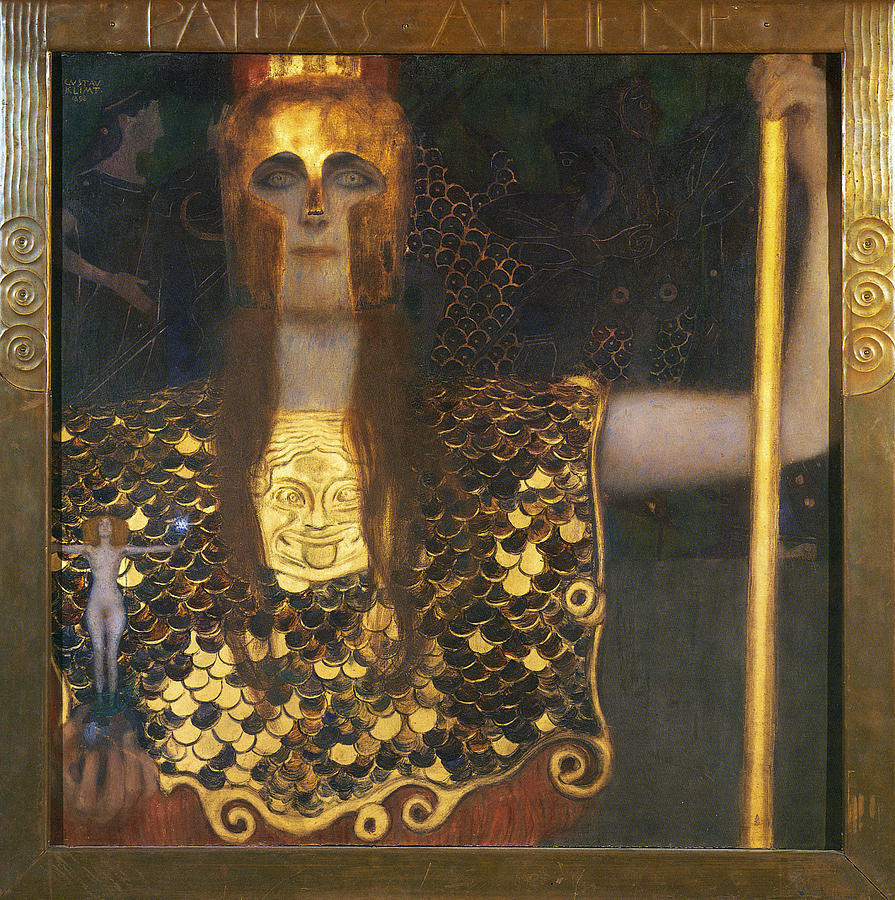
Gustav Klimt, Pallas Athene, 1898


She's so fabulous. 

Daenerys Targaryen is the last of her family, House Targaryen. In the first season, Daenerys is portrayed as a soft spoken and timid girl. Two seasons later, and look how far she's come. Daenerys, using her three pint sized dragons, has managed to conquer several slave cities in the continent of Essos. She searches for an army, one that will help her take the Iron Throne. 

For those who aren't as completely obsessed with Game of Thrones as I am, here's a brief synopsis. The House of Targaryen was the former royal family of Westeros. They had come from Valaryia, a once great city in Essos. The Valaryians were able to tame dragons and were masters of magic until the volcanoes that surrounded their civilization erupted in what was later called "The Doom." The Targaryen's were the only surviving Valaryians. They managed to save three dragons from the Doom, thus their house sigil: a three headed dragon. Aegon Targaryen and his sisters conquered Westeros with their dragons, eliminating the former warring kingdoms and uniting them, with Aegon as their king.

In order to "keep the bloodline pure," the Targaryen's would often marry relatives, even sisters to brothers if necessary. This caused, as can be expected, some incestuous consequences. "Every child knows that the Targaryens have always danced too close to madness." It is said that when a Targaryen is born, the gods flip a coin; on one side madness, on the other greatness. The last Targaryen king of Westeros, Aerys Targaryen was known as the Mad King, and, towards the end of his rule, became obsessed with burning his enemies alive. He was overthrown, killed by his own Kingsguard, and the rest of the Targaryen family was killed. Daenerys plans to take back her rightful throne with, "fire and blood."

That same madness mixed with greatness harbors in Pallas Athene. While both Daenerys and the goddess Athena evoke strength, they walk a fine line. Athena's golden eyes are terrifying; metallic like her armor. Her posture conveys a power beyond royalty, instead it's god-like, as it should be. But no matter how imperious Athena seems, her eyes still bother me, like a painting who watches you as you cross a room. I have no doubt that, at any moment, Athena could turn from greatness into madness. Daenerys holds the burden of her family's past on her shoulders, her closest of kin serving as a reminder of what power can do to those with fragile minds. But Daenerys is anything but fragile. These two women remind me that I am just as powerful, that I could lead great armies into battle. Or, more realistically, I can feel like I could as I listen to a really awesome song and walk down a hallway. In the words of Nicki Minaj (yes, I am quoting her), "You can be the king, but watch the queen conquer."

  • 7:00 AM

Slave Ship and The Mariner's Revenge Song

J.M.W. Turner, Slave Ship, 1840


Every time I hear this song, I burst into a one woman musical, singing as loudly as possible while everyone within a one mile radius cover their ears. I love this song, the creepy solo the mother has, the slightly concerning amount of detail The Decemberists went into while describing how the boy should avenge his mother. Lovely, isn't it? Then again, I've always had a soft spot in my heart for the dark and creepy. 

But really what I love most about this song is the story it tells. The story of a con man who takes advantage of a young boy's single mother, seducing her then taking all that they have. The son never forgave the man, especially when his mother later dies of illness. In her last moments, she beckons him to seek revenge, a raw and hate-filled revenge for what that man had done to them. He spends many years, looking and sulking, but eventually locates the man as the captain of a ship while overhearing a sailor giving confession at the church the boy works at. Immediately, he takes to sea with a privateer, his mother's voice whispering to him a reminder of what he must do in the wind. When the ship is finally located, a giant whale attacks, swallowing and demolishing both ships. Coincidentally, the boy and his target are the only two left alive, alone in the belly of a whale. Hence my favorite line, "But oh what providence! What divine intelligence! That you should survive as well as me!" Then, the lyrics stop, and you're only left with an increasing instrumental tempo, but you know exactly what's happening.

That same turbulent, treacherous noise can be found in Turner's Slave Ship. Rather than the story of a young man's revenge, Turner retells how the cruel captain of a slave ship  threw slaves he suspected of being diseased into the sea, chained and alive. His reason? Money. The captain would not have been paid if slaves showed up dead, but would be given something if his human cargo had been "lost at sea." Thus, when disease inevitably broke out, he decided that it would be more fiscally responsible to throw anyone with sniffles overboard. Turner added some more monsters to the painting. What I can only assume are piranhas gnaw at a chained leg, while fish-monsters like the ones in the song close in on the abandoned slaves. It's gut wrenching and horrible, but that was the point. To capture your attention and tie your stomach into a knot so that you would never forget what true evil looks like. Turner was an abolitionist later in his life, and painted Slave Ship as a protest to such a monstrous institution. No one was ever convicted for the crime, and while the ghosts of the slaves the captain had thrown over board never met him in dark alley or the belly of a whale, I like to think that this is Turner's own form of revenge. A dish best served cold and covered in paint.

  • 7:00 AM

The Death of General Wolfe at Quebec

Benjamin West, The Death of General Wolfe at Quebec, 1770

Get ready. This is going to be geeky. Not only am I going to get to talk about one of my favorite parts of history and culture, but I also get to discuss video games. What video game, you ask? My absolute favorite video game on this Earth: Assassins Creed III. I'm still not exactly sure how I convinced my teacher to let me do this, but don't worry it all ties together, albeit eventually.

General James Wolfe fought for the British army against the French and Indians in, you guessed it, the French and Indian War. He would later come to be known in history as the "Hero of Quebec" and the main reason the English won the war. Historically, he died from four musketball wounds at the height of the battle depicted above. Benjamin West paints the British hero's final moments Pieta style, where General Wolfe's death mirrors that of Christ when he is taken off the cross and held by Mary. Surrounding him are various British officers, a doctor attempting to stem the bleeding from his wounds, and, most interestingly, a Native American. Here is what I find so interesting about this painting. The Iroquois Confederacy was composed of the Mohawk, Oneida, Onondaga, Cayuga, and Seneca nations that populated the northeastern coast of America, even extending up into Canada. Originally warring nations, they eventually united under an oral constitution known as the Great Law of Peace some time in between 1450 and 1600, maybe even earlier. During the French and Indian War, the Iroquois Confederacy sided with the French. This was because the Iroquois Confederacy had a growing concern about the English and their consumption of Indian lands. The English colonists and neighboring tribes had never had an amicable relationship, whereas the French and Indians did. In contrast to the English, the French were not interested in colonizing nor settling the New World. Their main priority was fur trade, which made interaction and good relationships with native tribes a necessity. So, it strikes me as odd that an Indian would be kneeling, seemingly in thought, across from the British General. As far as I know, no Native Americans sided with the British, and I see no reason why they would. Maybe Benjamin West just got his facts confused.

Last year, Assassins Creed, a video game series very near and dear to my heart, revealed that the setting for their third (technically fifth, but whatever) game would be in Revolutionary War America, and that the main character would be half Native American, Mohawk to be exact. Many of the events that occur in the game are historically accurate, but the game takes on an entirely different perspective of the war that everyone in America thinks they know. It showed the Native American point of view; how they saw the war and how they also struggled for independence. The protagonist, Ratonhnhakéton (pronounced ra-don-han-ge-don), but assumes the name Connor, comes into contact with the stars of the Revolution: Samuel Adams, General Putnam, Marquis de Lafayette, and even George Washington Fun Fact: the Mohawk people don't have generically used first names like European cultures do (i.e. John or Mary), nor do they have last names. Instead, each first name is individualistic and has meaning. Connor's name, Ratonhnhakéton, means "life that is scratched." He believes in the colonists cry for freedom, helping them to win battles and change the tide of the war. But while doing this, Connor finds that helping the colonists win may compromise the safety of his people and their lands. "My enemy is a notion, not a nation," Connor states. The view this game offers of the Revolutionary War is one that a textbook will never tell. Given, the game is manipulated to revolve around the history of Assassins and Templars, two warring secret societies, but the historical commentary is raw and unforgiving. By the end of the game, the only founding father I came away liking was Lafayette. Washington, while serving under General Braddock in the French and Indian War actually burned Indian villages (which is, spoiler alert, how Connor's mother dies). Surprising, right?

Coincidentally I stumbled upon this painting while recently replaying Assassin's Creed III. The house that Connor lives in, called the Davenport Homestead, collects 18th century paintings of various historical figures and events every time a certain mission is completed. While walking around the house, checking out the awesome items I had collected, I saw this painting and yelled, "Hey! I know that one!" I have always found Native American culture to be interesting. When I was in Kindergarten, I remember being distraught over the fact that I had been cast as a Pilgrim instead of an Indian for the Thanksgiving musical. So, to look at history through a Native Americans point of view rather than an English one was not only refreshing, but enlightening. To be blunt, the core ideologies of the Revolution, even the Revolution itself, were flawed. Men claimed that they fought for the everyone's rights, but it was only for white, land-owning men. What of the rights of enslaved Africans, women, and Native Americans? Those would have to wait. I would argue that the listed groups still don't posses all of the rights endowed to them, "inalienable Rights" as described by the Declaration of Independence. The saying history is written by the victors could not be more relevant. Perhaps everything would have been different for the Native Americans had the French won the war, but they didn't and there's not much use in contemplating hypotheticals. Of course, none of this, the American Revolution, the birth of a nation, and the mistreatment of the Native American peoples, could have been possible without General Wolfe, "Hero of Quebec."

  • 7:00 AM

The Oath of the Horatii

Jacques-Louis David, The Oath of the Horatii, 1784

Jacques-Louis David, propagandist extraordinaire of the French Revolution, painted The Oath of the Horatii five years before the actual beginning of the French Revolution. So, why then, did it become such a huge symbol of the republic to come? A neoclassicist, David's paintings often depicted Roman scenes with an anti-frivolity that greatly contrasted to the Rocco movement that had occurred only a short time before. One of such scenes David emulated in The Oath of the Horatii. The Horatii were Roman warrior triplets (similar to that of The Powerpuff Girls) who pledged their lives to fight the enemy, the Curiatii from Alba Longa. Whoever wins the fight, wins the war. In the end the Horatii win, but only one out of the three survives, Publius. The victor with an unfortunate name and destiny, returns only to commit sororicide. His sister, one of the lamenting women in the background of David's painting, was engaged to one of the Curiatii. Publius was sentenced to death for his actions, but justified it by stating, "So perish any Roman...who mourns the enemy." In a way, couldn't that be said for the Reign of Terror as well?

"To arms, citizens," La Marseilles urges. "From your battalions, let's march, let's march! Let an impure blood water our furrows!" Written in 1792 and eventually adopted as the new Republic's national anthem in 1795, La Marseilles is a literal call to arms, which is everything this painting embodies and more. Although painted five years before the actual start of the French Revolution, The Oath of Horatii elicits a deep-set devotion to a cause. The Horatii reach for the swords as the French did for freedom, yet, at the time, were still unable to grasp them in their hands, nor hold them above their heads in victory. It's as if David paints both a warning to the aristocracy and a calling to the oppressed. In essence, that's what David did do. He would go on to become the painter for men such as Robespierre and Marat; a producer of propaganda. The Oath of the Horatii embodies the ideals of the French Revolution, a dissolution against monarchy and tyranny, but also demonstrates how flawed such ideologies were.

  • 7:00 AM

Lucifer and American Psycho


Jackson Pollock, Lucifer, 1947


I wanted to do American Psycho and a Jackson Pollock piece, because the two are tied together in my mind through the splatter, but they have very different meanings. That may seem and odd thing to say while talking about a painting entitled Lucifer, but I beg to differ. Jackson Pollock was an artist painting, per se, during the 1940s and 50s. He acted as a symbol for atomic anxiety after World War II, the very thing I see when I look at Lucifer. In essence, Pollock commended peace through his frenzied paintings rather than violence. It's supposed to be a juxtaposition when sitting next to a clip of Patrick Bateman smashing some jerk's brains in while listening to Huey Lewis and the News, but it isn't. There are more ties than I really want to acknowledge. The black, like cracks in a sidewalk, demand your attention. I can't stare at it for long without hyperventilating. By the way, not a fan of 80s pop. Everything about this, the painting, the scene, the music, is upbeat. Well, the painting and scene are more like an accelerating heartbeat rather than the song.

Patrick Bateman is the epitome of an 80s suit clad, business executive jerk. He even wears the stereotypical blue shirt with white collar, except the tie is red and not yellow. At least that's what I think of when someone says "80s Wall Street." Bateman struggles to stay alive in this back stabbing business, taking the pressure of business card showdowns off by attending spas and killing his coworkers. Let me play the devil's advocate for a minute and say that Paul Allen was a real...word-I-can't-say-in-this-blog. I constantly find myself on Bateman's side throughout the entire movie, even finding it painful to watch as others completely disregard and humiliate him. So, it's pretty satisfying when Bateman swings that hammer. But the question I keep asking myself about this movie is this: why make a serial killer so pitiable? I feel bad for him, but Bateman is a serial killer. Serial killers, in my mind, hold a certain kind of power in their work, and they must also hold power in the world around them. How else could they get away with killing more than one person? Also, the act of killing someone is a gain of power. I mean, you literally hold that persons life in your hands. That's power. At least, this is what I've learned from watching Silence of the Lambs and Hannibal religiously. Although the film was satirical the core truth emitted from Bateman's deterioration was depressing. Despite being an actual serial killer, in the end, Bateman was the most sane, morally correct person in the room.

  • 7:00 AM

Immaculate Conception

Placido Costanzi, Immaculate Conception, circa 1730

Although Costanzi's Immaculate Conception now sits at The Getty, you can tell that it was once destined for - you guessed it - a church. Costanzi, an Italian rococo painter, painted the sloping boughs as a modello of what would actually be built (personally, I like it better that way). The painting, as titled, depicts the moment of Mary's miraculous pregnancy - only here in high Rococo style. As opposed to Fra Angelico's painting of Gabriel's announcement, Costanzi's Mary rises from the clouds, surrounded by angels and almost enough cherubs to be dubbed Fragonard-esque. 

Two saints flank the emergin' virgin, and even more cherubs hanging off of them. Saint Luke, on the left, points towards Mary with one hand while holding a piece of paper that reads "Ecce Virgo" which translates to "Behold the Virgin." Saint Luke was the writer of Gospels and the Acts of the Apostles, and thus naturally holds a script in his hand. To the left of Mary, sits the Apostle St. John the Evangelist, dressed in his traditional red and green robes. He holds a pen and papers in his hand, documenting the miracle of Mary's pregnancy, like a really, really old fashioned pregnancy test of the Lord. Front and center Mary stands, with eyes turned upwards and arms open in acceptance. She wears blue, as always, and a halo of stars can faintly be seen encircling her head. Angels play music at her feet, while cherubs climb on her, around her, and even hide under her clothes, celebrating. Costanzi's career consisted of mainly religious paintings, but I think that his Immaculate Conception most accurately portrays the artistic influence that Rococo had on religious works 

  • 7:00 AM

The Blue Boy

Thomas Gainsborough, The Blue Boy, 1770

One of the many aspects I love about this Art History blog, is that I am able to freely express my thoughts, feelings, and opinions towards artwork. In the short time I have been a part of this group, I have learned not only how to identify what art period such and such is from, or what type of paint was used here, but to search for what a painting tries to convey, what it wants to tell me. Some opinions I have previously had about art have changed, giving me a new perspective on a time period, painter, or artwork. I am able to form opinions about which painting I believe to be the one of the greats or one of the worst. This painting, right here, is one of the latter. 

Thomas Gainsborough was an English painter and the artistic rival of Joshua Reynolds. A majority of his work consisted of landscapes depicting the British countryside and portraits. In about 1740, Gainsborough moved from Sudbury to London, where his clientele transitioned from middle class farming families to a more aristocratic crowd. After painting a portrait of both the king and the queen, his constituency became quite exclusive. The Blue Boy, Gainsborough's most famous work, portrays the son of a wealthy merchant. 

Besides the way that the clothing shines, I see little to appreciate in this painting. Something about The Blue Boy makes me irrationally angry. Maybe it's the 100% concentrated sass I am receiving just from just looking at him (Tyra Banks would be proud of that smile), or maybe it's those ridiculous bows on his shoes. It could even be the odd choice of venue. Why would a random rich kid be standing in the middle of a field, posing next to a rock? He's going to get those fancy little bows quite dirty.

Much of Gainsborough's often repeats itself, especially his landscapes. Thus, when trying to interpret a piece of his artwork and point out the feeling it gives me leads me to frustration and staring contests between the subject and myself. From this painting, and also from Gainsborough's other work, I can't help but feel that he was going after the money. 

  • 7:00 AM

The Unexpected Answer and Red

Rene Magritte, The Unexpected Answer, 1933

"You see the dark rectangle, like a doorway, an aperture, yes, but it's also a gaping mouth letting out a silent howl of something feral and foul and primal and REAL. Not nice. Not fine. Real. A moan of rapture. Something divine or damned." – John Logan, Red

That gaping hole in what may have once been a doorway can either be seen as an entry or an exit, or even a acidic silhouette that has eaten its way through. Or it can be infinitely more complex, if you so choose. Personally, every time I have viewed Magritte's The Unexpected Answer I've always felt that it was more of a mirror than a hole. It stares back at me, but I am lost in the darkness. Either that, or I'm a vampire.

As the floorboards recede away, dissolving into the black, I find myself asking where exactly do they go? Do they drop off into some crawl space abyss or do they lead on through some Nosferatu corridor? In fact, the longer I look, the more questions gurgle up like magma. What caused this? Would it be better to walk through the hole or turn the knob? Does the knob even work? And chiefly, where does the darkness lead? I think that's what makes Magritte's painting one of my favorites. Darkness has always been synonymous with fear, something to turn away from. The door itself reminds me a bit of something you would see in a horror movie, perhaps it's Norman Bates'.

But here, I find that shadow reaching towards me, beckoning me forward. I want to touch the darkness. I want to follow it. Perhaps if it were just a door, I would want to turn and run. The dark is what pulls you in, probes your curiosity. Like John Logan's depiction of Rothko states above, it's not nice. It's not pretty. The darkness reveals something, "feral and foul and primal and REAL," about oneself. A side of us that may not be as terrifying as we had previously imagined. In fact, it may be what we had been looking for after all. There, within the darkness, is your expected answer.

  • 7:00 AM