Beautiful Paintings of Terrible People: The Morning of Our Motherland


F.S. Shurpin, The Morning of Our Motherland, 1948

Beautiful Paintings of Terrible People
By LIBBY ROHR

This painting is by far the strangest of this whole collection. It’s not often we see Stalin associated with such love and serenity. It’s not often we see Stalin with anything other than absolute abhorrence. Of course the exception to this rule is obviously the late forties into the fifties in the Soviet Union, where paintings like The Morning of Our Motherland were critically acclaimed and coveted. Paintings like this follow a movement in Soviet culture called the Cult of Personality that idealizes Stalin and puts all the original intentions and feelings towards communism on him. He was at this time revered as a hero and pioneer of communism and humanity, foiled by outside influences beyond his control. When Shurpin first produced this painting, it was widely celebrated in the USSR and shortly thereafter became a recipient of the Stalin award, the greatest art honor possible in the Soviet Union at that time.

It’s easy to see why. If you were to look at this painting with no knowledge of Stalin and no context whatsoever, you would see a man, clothed in the white of purity, with a pensive, fatherly air about him, gazing out to the horizon. His figure is massive in comparison to the scene behind him. He looks almost godly in size and demeanor and statuesque in his poise. The sky behind him is soft and lovely, somewhere between white and blue cotton candy. The background frames him in a purple agrarian dream, dappled with tranquil tractors and the silhouettes of power lines, turned pink by the fading horizon. These images, though subtle, allude to some of Stalin’s perceived successes and the hope for an increasingly developed and industrialized Soviet Union. There is nothing about this gorgeous nature scene that would suggest gulags or mass starvation or incredible brutality. I don’t know a single person who would associate a lavender field with Stalin’s legacy. As a result, this painting is probably the most incredibly impressive piece of propaganda I discovered in all my research for this project. Clearly, Shurpin did not see Stalin in the way that we remember him in the West.

But it’s important to remember like all of these paintings, that someone who we would consider to be an indisputable cold-blooded killer is in some places revered as a national hero. It was this painting in fact that made me choose this topic. Whatever you consider to be the purpose and definition of art, it will always showcase the artist’s perspective. Great art will never fail to drop you straight into the mind of the person painting it. In this case, it’s the mind of someone inspired by communism and moved to reverence by someone like Joseph Stalin, who, like it or not, did change the nature of Russian history and government forever. As I depart from my little corner of the world at Barstow and head out into the great blue yonder, I’d do well to remember this power of perspective. If the humanities teach us anything, it’s that there is both light and darkness, beauty and ugliness, in all things. And to understand the world is to acknowledge the imperfection and pain and confusion of it all. The whole world is interpretation and everything you encounter is somewhere in the grey and in a world this confusing, it’s nice to have art to help us make sense of a world that is impossible to fully understand. While I encourage you not to be a lover of all things Stalin, I believe it’s a good thing to force ourselves to see these radical points of view from time to time to help us grow and change and challenge ourselves to be better more understanding people. 

So enjoy this gorgeous, hopeful sunrise over a brutal totalitarian dictator, and remember to think about the “wrong” side of history every once and awhile, because it’s always going to be someone’s hero story. It’s been a pleasure writing for you all.
  • 7:00 AM

Beautiful Paintings of Terrible People: Andrew Jackson

Ralph E.W. Earl, Andrew Jackson, 1836-1837
Beautiful Paintings of Terrible People
By LIBBY ROHR

For those of you keeping up with current events, you may know that our current President, Mr. Donald Trump, is quite the fan of President Andrew Jackson and recently hung this here portrait of our former President in the Oval Office. Jackson has had a mixed reputation through the years. He’s clearly a love-him-or-hate-him kind of guy. Certainly, Jackson ran as a war hero and a pioneer for the common man and won on the back of that goal, but if you dive a little deeper into this President’s history and legacy, you’ll begin to understand why Andrew Jackson is easily one of my least favorite Presidents of all time and a clear addition to this list of terrible people.

This portrait, by Ralph E. W. Earl, the closest the White House has ever come to a “court painter,” depicts the 7th president of the United States and a member of the early Democratic Party. This party was just about as far from the politically progressive, central government strengthening, anti-war Democrats of today as one can possibly be. The group Jackson ran for was a party of the working class and the rural, an avid supporter of state’s rights and the expansion of slavery out West. Born in Tennessee poverty, he rose up in early American society first as a young successful lawyer, plantation and slave owner, and politician as well as a war hero from the War of 1812. Looking at Jackson’s war record, it’s hard to argue he was anything other than an exceptional soldier and what my grandmother would call a “tough cookie,” receiving several scars on his face at the age of 14 for refusing to clean a British soldier’s boots after being captured. However, as political records go, Jackson’s wartime awesomeness did not translate into Presidential awesomeness. For his efforts, he was elected into the House as the first Tennessee rep and spent a short time in the Senate as well. Although he lost his first race for president against John Quincy Adams, largely due to a last minute rallying of support from Henry Clay, Jackson came back and won in 1928. Jackson was the first frontier president and represented not only a new faction of Americans but ushered in new trends in American politics, trends I would argue have not had the best effect on our history.

“Old Hickory” was strong and uncompromising in his values. His first real action in office was to establish a criminally nepotistic cabinet, filing all the seats he had control over with people from his family and his circle of close friends, despite their obvious lack of qualification for these crucial roles. In his personal life, Jackson began his term as president by throwing a massive non-exclusive party in his new home and allowing average citizens and his guests to get horrifically drunk and literally throw up all over one of our most cherished and respected symbols of our great nation, the White House. Despite being a member of and running on the ticket for the pro-states’ rights party of the time, Jackson quickly established himself as an exceptionally controlling President. Political cartoons at the time came out in droves proclaiming Jackson to be an American tyrant, nicknamed “King Andrew I,” throwing out executive orders left and right and exercising his veto to the greatest extent possible, often times for minor details in bills that he opposed. As a result, he undermined congress and maintained his own near absolute power and upsetting the balance of our democracy. During his term, the charter for the Bank of the United States, which Jackson hated, was set to expire. When congress voted fair and square to recharter the bank, Jackson immediately vetoed it, claiming the bank was supporting the “prostration of our Government to the advancement of the few at the expense of the many.” On a more fortunate note for this president, when South Carolina sat on the verge of civil war violence over a national tariff law they wanted not to follow, Jackson was able to insist (through threats) that they back down and preserved the union, a feat for which he received great credit. However for me, this accomplishment was quickly overshadowed by his ignoring a supreme court judicial review protecting Native American rights and subsequently ordering the mass move now deemed the “Trail of Tears” that led to the deaths of 4,000 Native American people.

So yeah. You could say I’m not a Jackson fan. Looking back at these past couple of posts in this series, you may notice a pattern, propaganda. This Earl painting is the same as any other, a beautiful, well-planned image of an unfortunate person. In Earl’s rendition of Jackson, his face in poised and stately, with a pensive positioning of his eyes and eyebrows, as if you’re just catching him deep in thought. The only sign of his legendary raging temper is in the flair of red in his coat draped over his shoulders. Looking at the man in this portrait, you’d never know who exactly he was. As President Trump continues on with his first year in office, he has a lot to learn. Though I have an obvious distaste for Jackson, he is a United States President and therefore someone I must embrace as a part of our country’s complicated history. Unlike “Old Hickory,” here, this is Trump’s first experience with a government position, and while I wish him all the best, I highly encourage he look a little farther into famed figures like Jackson before he jumps to put him on the wall of the highest office in the world. Earl’s exceptional skill as a portrait painter certainly made a regal image of Jackson, and one easy to see the best in. I understand the honorable values that Jackson is often made to represent such as strength, a refusal to give up on what one believes in, and the power of the people, but after more research, perhaps Jackson is not exactly the kind of man I would want our new President to be emulating. Either way, Earl’s portraiture genius has created this masterpiece of a highly complicated man, and that is a skill I can certainly respect.
  • 7:00 AM

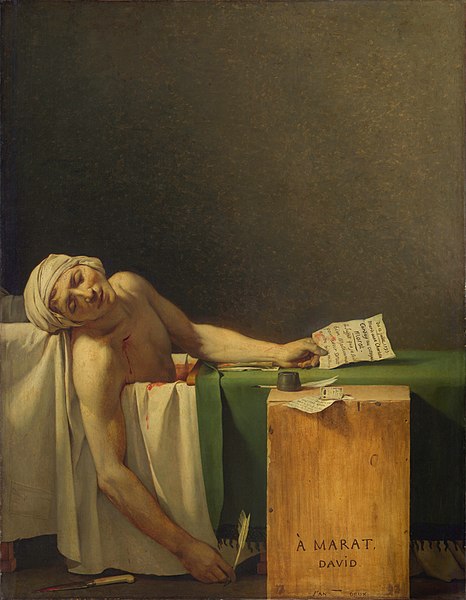
Beautiful Paintings of Terrible People: The Death of Marat

Jacques-Louis David, The Death of Marat, 1801-1805
Beautiful Paintings of Terrible People
By LIBBY ROHR

For this post, the terrible person is twofold. Both Jean-Paul Marat, as the revolutionary martyr pictured here, and Jacques-Louis David, the painter, were intelligent, talented people gone bad. Picture it, just a few years before the French Revolution, the tension is mounting in the wake of the shockingly successful American Revolution due to french support. In Paris, he was just coming into the light of success after a series of acclaimed essays on philosophy, science, and government. January of 1789, the year the revolution began in Paris, Marat was still under the impression the monarchy might still be able to solve their country’s problems. However, by September, Marat’s writing began took a sharp new turn, shifting towards the movement of the revolution that would soon sweep his city as he took on the new role as editor of L’Ami du Peuple, a revolutionary newspaper. Marat grew more and more radical, drifting towards the more dangerous side of the revolution and befriending Maximilien Robespierre along the way while supporting the Jacobin faction of the revolution. With his newspaper he became a leader in inciting propaganda, stirring up the people to a point where he was nearly arrested upwards of three separate times. However, his fame began to grow to the point that it overruled those arrest warrants and, though a rogue, he was able to continue to work and write in paris. He worked particularly hard to bring down the Girondin revolutionary faction and to fuel the fires of violence. He became one of the most dangerous men of the early revolution from his place in the bathtub (he had a skin condition soothed only by hot baths) scrawling out scathing articles. On July 13th, 1793, he agreed to meet with a beautiful young girl, Charlotte Corday, claiming she wished protection from the violence, but upon stepping into the room where he was bathing, Corday pulled out a knife from under her dress, revealed her continued support to the Girondins, and stabbed Marat to death. As blood filled his bathtub, she ran, and without meaning to, his posthumous image as a martyr became an even stronger tally on the side of the Jacobins, who, led by Robespierre, would take this momentum and begin the Reign of Terror, arguably Paris’ most unjust and dangerous time.

But as I said, Marat is not the only one to blame. David, the painter, had taken on a similarly vocal role in the revolution and was a close personal friend to Marat. He, like Marat, rose to success shortly before the revolution began, painting beautiful neoclassical scenes like his famous Oath of the Horatii, which were widely popular in the increasingly revolutionary climate in Paris. When the revolution did break out, David, always the hidden radical, was quick to jump to the side of the Jacobins, entranced by their vision of a utopian Paris. He, too, became a master of propaganda, painting, rather than writing, his incredibly convincing pleas to the people. David himself had visited Marat in that very bathing room the day before his murder, and upon hearing what had happened, knew exactly what had to be done. David immediately jumped in to paint his friend as the martyr for the cause. The Jacobin Christ figure. An image so emotional and haunting it practically fueled the Jacobin rise to power and the subsequent horrors. 

But how could one not be moved by this portrait. The Death of Marat is unquestionably stirring. A man in his most vulnerable state, sitting naked in a bath in his own home, lays draped over the edge, head lolling back, defeated. His pen remains in his right hand while the other clutches the introduction letter from Ms. Corday, now smeared with his blood. A shadow has been cast across that side of the painting, as if to show his final breaths have just left his body. Directly behind his gaunt, quickly paling face, is a crimson pool, giving a horrifying image to represent the violence of his brutal murder. The white linen of purity surrounds Marat, right to his turban-like hat, framing his face almost like a fabric halo. Marat’s round visage and slightly parted lips are childlike and innocent. If you didn’t understand the mechanics of the revolution, you’d see this and come away telling a story of slaughter of the pure and well meaning. Of senseless violence robbing a poor man of his precious life. Of renewed support for the Jacobin side of the revolution. 

That’s what qualifies Marat and David for my list of terrible people. They might not have been the literal hands to drop the guillotine, but the two of them are at least significantly responsible for putting Robespierre and his Committee of Public Safety in a position to do so. Their sheer ability to create such moving emotional propaganda through their arts made these two master manipulators. At the time they likely believed they were doing what was best for their country. Don’t we all? The difference is, with a few strongly worded articles and a violent tribute to a lost friend, these two became responsible for the paranoid executions of 1400 people. Clearly a stunning work, it’s easy to get lost in the glowing tenebrism of this painting, just make sure that when all’s said and done, it’s something you can pull yourself out of.
  • 7:00 AM

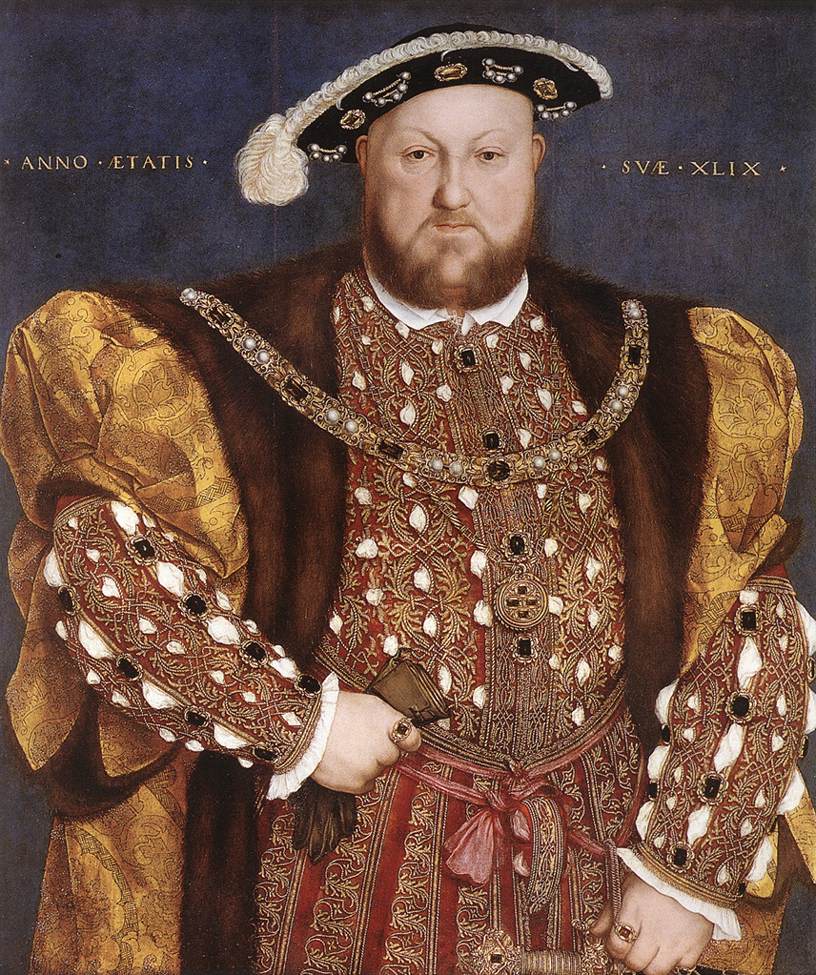
Beautiful Paintings of Terrible People: Henry VIII

Hans Holbein, Henry VIII, 1537
Beautiful Paintings of Terrible People
By LIBBY ROHR

It’s fair to say as paintings of Kings go, there are few more blatantly flattering than this famous portrait of King Henry VIII. Hans Holbein the Younger, a painter from a long line of German artists, is most famous for his etchings and portraits of royal dignitaries, especially those of this unsavory ruler and achieved great acclaim for this portraits and ones like it. But how did a German portrait painter end up as the favored artist of one of England’s most infamous kings? It seems a strange choice for such an independent and nationalistic king. Famous for destroying culture and community in his country, cutting England off from the Catholic church, and being so obsessed with having a male heir he went through wives as fast as I go through pairs of cheap earbuds, Henry VIII is far from esteemed as far as British royalty goes. 

For a king as endlessly selfish and insecure as Henry VIII, Hans Holbein blatantly plays into his arrogance and entitlement in this work. In the full portrait, Henry stands tall and immovable, with his wide shoulders and a puffed out chest like Superman, covered in jewels and rich fabrics, with sleeves fluffier than fourth of July marshmallows and a determined expression somehow coinciding with his incredibly beady eyes. Holbein was a genius in the kiss-up category, somehow managing to convey an exact physical likeness in a way that turns a pompous spoiled ruler with the maturity of a child into a noble, yet bullish commander, worthy of respect and leadership. The height of this visual adulation comes at Henry’s waist. His left hand holds a glove in a ringed hand, propped up on his belt, leading down to a rather large and visible codpiece. His other hand highlights the bottom of said piece. Everything from the red color to his stance emphasizes Henry’s (desired) superior virility, despite his famous inability to produce a male heir. This part of the painting is straight nonsense for Henry’s benefit. What's made all the better is that this painting was done when Henry was in his forties, as part of a midlife crisis of sorts. The whole things is absolutely laughable.

And yet it worked. In several accounts by onlookers of this portrait, placed in full view in his grand palace, it was astounding and intimidating to behold. Henry certainly got some bang for his buck with this piece. When you look at this magnificent portrait, it’s easy to forget about his temper tantrum that got him excommunicated by the church. It’s seems like one might be momentarily able to forget the roughly 72,000 people he executed on a brutal whim. One might be able to overlook the absolute dismemberment of the monasteries and cultural organizations that defined the day to day organization of English life. Looking on this magnificent portrait, one does not see Henry the wild narcissist. Instead, he’s replaced with the Henry he wanted to be but never was, triumphant and deserving. This alone shows the power and purpose of court painting, to promote. While people like Caravaggio lead us to think about the complex ethics and humanity of people we see as gods, the remaining paintings in this series will do the opposite. We will see human beings, desperately clawing for legendary and even holy status, like Henry here, who declared himself supreme leader of the English church.

It’s paintings like these that make us think of the point of view of the artist and encourage us to question the information we’re given. Above all else, this painting of Henry VIII shows just how impressive good propaganda can be.
  • 7:00 AM

Beautiful Paintings of Terrible People: The Taking of Christ

Michelangelo de Caravaggio, The Taking of Christ, 1602
Beautiful Paintings of Terrible People
By LIBBY ROHR

Midway through the year, while driving around aimlessly to clear my head, I found myself passing the Nelson-Atkins Museum of Art. As visions of Turner, Caravaggio, and Singer-Sargent flashed through my brain, I thought about the end of this semester and what I wanted to do for my final project. At the time, I was working on my Bosch and Bruegel blog post that required me to engage in my favorite task, scrolling through paintings looking for something outrageous to write about. Eventually I stumbled upon a bearded and crucified lady-saint and found myself falling down the research rabbit hole and enjoying every twist and turn of this woman’s folk lore. Somewhere along the way, giggling and pointing out my favorite tidbits to my mother, it hit me. I wanted to dive into the world of specific research and do so in a way that plays off of the ridiculousness of perspective. Now, without further ado, I present you with my final set of blog posts titled “Beautiful Paintings of Terrible People.” Seeing as this is Renaissance Art History, I figured I’d kick things off biblically with one of our most unfortunate people to ever grace the bible as painted by one of my top three favorite artists in all of my study.

Judas. Everyone knows one. Whether it’s an actual sell-you-out-to-the-Romans-with-a-gesture-of-love kinda guy, or Benedict Arnold, or just a friend you know will ditch you for her boyfriend at a party the first chance she gets, they're all over the place. Judas is arguably the worst sinner of all due to the severity of his crime and his level intimacy with and proximity to Christ. He lived by Jesus’ side for years, as his most trusted apostle, hand picked, who witnessed all of Jesus’ miracles, and handled the most sacred of tasks. Jesus, through his own divinity, understood that someone close to him had to be his betrayer long before Judas’ lips grazed his cheek, making the story all the more unbearable. Caravaggio’s greatest talent lies in bringing the world and stories of God and Christendom into the brutal light of primal humanity. Caravaggio strays away from painting holy people as anything other than everyday human beings and uses this theme to forge often violent depictions of these moments that are shocking and painful and most of all horrifyingly real.

Caravaggio uses this cramped composition to garner a feeling of intimacy between Jesus and the audience, and his lack of background (characteristic of his portraits but not his religious scenes) forces the eyes to focus all the more on the tension at hand. As a master of movement, you can feel the forward momentum of Judas and the guards, as emphasized by his hand gripping the shoulder of the teacher he’s just betrayed. Caravaggio uses color here to show us what we need to see. The dark armor of the soldiers makes them drift into the background, pushing us to look at three things in particular. First, the follower directly behind Jesus, St. John the Evangelist, screaming into the night. It’s difficult to know just from this painting whether he is attempting to flee or to get help but either way there’s no aid coming. Second, Jesus, Judas and the agony between the two. In this moment Jesus begins to understand his fate just as Judas starts to realize what a sin he’s just committed. Jesus turns from Judas, pulling back from his betrayer and the rushing soldiers behind him with a mixture of sadness and resignation on his face.  Finally, the onlooker behind the soldiers, a typical Caravaggio self-portrait, tucked in a back corner, holding up a lantern. Is this a symbol for the effect he wants his paintings to have on the audience, an illumination of the bible, or merely another opportunity for a self-obsessed painter to show the world how cool he is by casually dropping himself into one of the most crucial moments in Christ’s story? Likely both. There is also a third option, which might be equally as true, guilt. It’s no secret Caravaggio didn’t run with the nicest, or the most law-abiding people. And he has put himself in this painting, watching Jesus be carried off to his death, doing nothing and apparently not trying either. What’s more he’s staged behind the soldiers, compositionally helping in the strength of their push towards Jesus. To me this detail is also a statement of the guilt of the frozen witness. To quote, of all things, the musical Hairspray, “Just to sit still would be a sin.”

Clearly selling out christ for 30 silver pieces is an unbelievably horrific thing to do, particularly of someone of Judas’ position in Jesus’ group of followers. That much of the story is clear. So clear in fact that Judas is incapable of living with what he’s done and commits suicide shortly thereafter. But examining the big picture theological role of Judas is a little more muddled and complex. Without Judas’ terrible betrayal Jesus would not have been crucified, an act this powerful, the sacrifice is believed to have given pardon to all good, repenting Christians. It becomes complicated, is Judas somehow partially responsible for Christian salvation. Did this act of betrayal need to happen for the will of God to play out, and if so, was Judas acting as servant of God in this act or should he remain the lowest of the low? These are questions we must ask, yes because this is a biblical post, but also throughout this final series. Growing up, my mother always used to tell a story of one of her law professors of which the punchline is “All the world is gray. If you can understand that, one day, you might turn out to be a competent attorney. You might even turn out to be a halfway decent human being.” And when it comes to confronting this topic, with the lowest of the low, we have to see this concept and understand, if even for a moment, these terrible people are still that, people. Not black and white, or good and bad, but convoluted, indefinable, mixed up creatures with big brains and a particular propensity for illogical rationalization. Caravaggio’s mastery comes in making us see that.
  • 7:00 AM

The Bulky Babes

Two Satyrs, Peter Paul Rubens, 1619
By LIBBY ROHR

The Bulky Babes
Myths and Monsters

Busting into the indie rock scene with their first hit album Myths & Monsters, this up-and-coming trio heads draws on older ideas and stories while incorporating the steady roller coaster of emotional expression and the juxtaposition of light and dark content you find in some of our more contemporary music.  Petal, Pauline, and Ruby, the founding members of this group, say the band came into being one day in late June while these music major friends were in Germany for the summer. One day while wandering the winding streets of the small village of Siegen, the girls bonded over a mutual desire to see a shift in the music world from the more grandiose and poised nature of the previous era to one that recognizes the same dramatic elements in a more realistic way. From this craving, they began to make music that brings classic images to life in the human world. Now, three years later, they're poised to top the list of next year's "Artists to Look Out For."

These imaginative (and busy) ladies often address issues of body image in their deeply sensual music. Sometimes they take a more individual look at humanity, while other times they bring to life stories we all know by heart, centering around the noble sacrifice, love, and devotion. Their smooth rhythmic beats seem to rock you in circles while more striking moments pop out here and there. Lyrically, their words seem to capture a vibrant image of life without ignoring the darkness in the background of it. They have a way of making their audience feel the conflict they're expressing while maintaining a focus on the emotion of it all.

When interviewed about their process, the girls took a humble stance, best summed up by Ruby's comment, "We're just simple women standing alone with our instruments, asking God for inspiration." To which, Pauline added, "Every child has the spirit of creation. The rubbish of life often exterminates that spirit. We're just looking to get back to that." The girls expressed a fondness for their fans and supporters as well as their countless mentors and heroes from which they take such inspiration. By the end of our little chat, they'd convinced me that their popularity is best attributed to a recognition of their own passion for the work as well as their focused transformation of archetype stories into relatable yet lively tunes. Whether or not that's something you believe, there is no doubt that they're a talented trio.

This album has kicked off a long European tour that will end in Antwerp the last week of May. Check out their music on iTunes, SoundCloud, and Spotify. @TheBulkyBabes

Editor's Note: Students happened upon a cache of hidden records with cover art from the Baroque masters. They were charged to investigate the vinyls. The above are their findings. 

  • 7:00 AM

Palazzo Barberini

Carlo Maderno, Gian Lorenzo Bernini, and Francesco Borromini, Palazzo Barberini, 1627-1633
By LIBBY ROHR

The story of the Palazzo Barberini starts with a Pope. Urban VIII, formerly Maffeo Barberini, was a religious man from a powerful Italian family that reached their height right around the time their great villa-style palace was constructed. During Urban VIII's reign he set out to beautify Rome, and in 1627, construction began on this building, as a way to glorify the family and a place to hold parties and enjoy the finer things that were still allowed by Catholicism. Urban and his brother Taddeo were very involved in this commission, arguably more than most. While the ideas for the villa-esque layout and facade originated in the heads of these brothers, the reality and the nuance of every building belongs to the architect. Or in this case, architects.

Let's start at the beginning. Even though we're really talking about Bernini and Barberini, the first architect to try their hand on this building was Carlo Maderno. After only a few years, Maderno died, leaving his brilliant assistant, Borromini, behind. Urban, a fan of Bernini at the time, caught up in his popular glow, assigned him to be the chief architect of this project. Borromini feared he'd lose his job, but Bernini was a sculptor, not an architect, and asked him specifically to stay on due to his engineering brilliance. Only Borromini could find a way to bring Bernini's designs to life. After all, what good are a building's plans if they can't be executed?

I love this building for many reasons, particularly the fact that this is really one of two buildings in the world that had both Borromini and Bernini invested and making an impact on it. There are a million things I could dive into with this building, but, for sheer lack of time and space, I'll focus on two aspects of the building that make up a single perfect metaphor. Stairs.

There are two main staircases in this funhouse. First the left side stairs, the main stairs. Bernini's attempt to display the grandeur of the Barberini family with a single feature. These stairs are classical in style, and angular, with tall pillars, and covered in relics and statues built into the very walls. It's certainly grand, but without a clear understanding of space and engineering, these stairs... well... kind of miss the mark. They're a little cramped, a little bland, a little unoriginal. Not bad, but it's clear Bernini has other "areas of expertise."

Then there are the right set of stairs, the only part of the building totally created by Borromini, and you can tell. They're different from the rest of the house. And one glance shows you why. Borromini's stairs curve up in a gorgeous elipse, white and glorious while retaining all the grace white marble should have. In the classic Borromini style, his stairs seem to make rock malleable, curving and bending at his will. These stairs, his silky fingerprint on this massive palace, are the essence of Borromini, the simple, natural beauty of his work.  

While Bernini is likely the greatest sculptor in history, these stairs are on example of Borromini transcending his architecture game in an undeniable way. This pair would feud after this until their deaths yet their cooperation has left its mark on Rome in a way that we can still see today. 
  • 7:00 AM

Christ Embracing St. Bernard

Francisco Ribalta, Christ Embracing St. Bernard, 1625-27
By LIBBY ROHR

As we have learned time and time again in with art history, we are skewed in favor of chance when it comes to the study of art. What paintings happen to survive define how we look at entire periods and how we bring art together in the groups we so love. Well, Ribalta bucks the system: in terms of a lack of records, in terms of the style of his painting, and most of all in terms of his religious interpretation. Francisco Ribalta existed at a time of transition for Spanish art, wedged in between the drama of early counter reformation and the brashness of up-and-coming naturalism. In his first years as a serious painter under the church patriarch, Juan de Ribera, well within the norms of late 16th century Spanish painting. His early works had all the color and intensity of an el Greco with the authenticity to the bible that church leaders so valued at this time. But when Ribera dies, so does record of Ribalta's work and when we catch sight of him again, everything is different.

As you can see in Christ Embracing St. Bernard, Caravaggio's influence has hit Spain with full force. With the intense chiaroscuro, the emphasis on earth tones, the intimacy of the scene, and the circular composition between the figures, Ribalta has given into the same fascination with Caravaggio that still haunts everyone who studies him. There's more though. Between the wrinkles, Jesus's wounds, and the more accurate proportions, we can see the emerging influences of naturalism taking hold in his work. This is the painting of a changed man.

The real reason I chose this painting, however, has little to do with the fact that Ribalta changed his own style and has more to do with what I see emerging in the Spanish art world. This momentum ends up producing some of my favorite works. The coming movement brings Christ and the saints to life and provides the first realistic exemplifications of what it is to be a holy man in a human body. "But no!" you say. "That's what all of renaissance art history has been about! Libby, we've been looking at nothing but holy men for the whole year! Surely you can't have missed all of that." To that I say, yes and no. Yes we have definitely seen a LOT of Jesus, but the image of their holiness has always been conveyed with a demure -- borderline sleepy -- expression and a halo. Caravaggio is the first one who comes close to creating depictions of these folks that look like actual people, but where his figures have gained realistic talent and emotion, they have lost the tenderness and the essence of God. Ribalta is the first to bring together both aspects. He creates figures that are lifelike and still deeply graceful. Although we're not exactly sure what brought about this shift or what his art looked like as it evolved, I'm just glad we got here. In this work Ribalta shows relatable human expression and struggle with the presence of godly people inside of their godly nature as they might look in the flesh. To me, that is an extraordinarily valuable thing. 
  • 7:00 AM

The Calling of St. Matthew

Michelangelo de Caravaggio, The Calling of St. Matthew, 1599-1600
By LIBBY ROHR

Michelangelo Merisi, now known to the world as Caravaggio, started his life as a nobody and ended it a murderer, overcome with disease and exhaustion, begging for a pardon from the Pope. However, the works created between the nobody and the dead fugitive are nothing short of miraculous. The Calling of St. Matthew and the other painting that accompanies it in the Contarelli Chapel became Caravaggio's tipping point. The church's Patron originally requested his first boss in the art world, Giuseppe Cesari, however, finding him overbooked, turned to the young Caravaggio for the commission instead. By the time he finished these incredible works, the entire art world of Rome had its eyes on Caravaggio. Even as a mere Art History student, it's obvious why.

It's characterized Baroque by the dramatic posing and theatrical composition, however, Caravaggio transcends that game. The Calling of St. Matthew exemplifies the most famous and unique facets of his work, the tenebrism, the modern dress, and, most of all, the depiction of real people carrying out the events of the Bible. Each person in this work lives, breathes, and moves before your eyes in unabashed realistic detail. Anyone who might look on this painting could see the events of Matthew's life in a way that may as well be in a small room down the street, not some magical far off land years and years ago. He brings religion to life.

It's a striking image. The beam of light spotlights the table of greedy tax collectors young and old, hunched over a table of money. Only the three on the right side have even noticed Jesus's presence; the other two still focus on the little metal pieces in front of them. But that beam of light slices through the shady room as directed by Jesus's Creation of Adam style finger at Matthew. That thin delicate halo is the only part of this work that couldn't truly be found in some crusty back room somewhere. It's mystical, but mystical within the bounds of reality which, for many, makes the image all the more powerful. The man in the middle looks at Jesus with a startled expression, pointing at himself as if to say "who me?" Or maybe he's pointing at one of the men to his side. There are many interpretations of this, but to me, his ambiguity seems intentional and serves to further his point. A sinner, a nondescript nobody, being called to God shows the world that important lives are not restricted to the people on top. Caravaggio argues quite convincingly with his painting that anybody can be called. The men around those tables may as well be you, me, a drunk passed out at a bar, or even the guy who cut you off in traffic. Caravaggio's focus in The Calling of St. Matthew is not on a blinding Jesus, glowing with the light or God and salvation, it is on the man, the everyday-Joe-type sinner experiencing a transformation. Jesus is merely a facilitator of God's will. It shows a world where we don't worship the man doing the blessing, we're worshiping the force and that force is streaming out to cover the layman. 

There's no doubt that Caravaggio had unparalleled talent and revolutionized religious painting, but the real question has to do with his own mental state. Is Caravaggio a religious man unable to control his vicious and lustful streaks, or is he a lover of anarchy taking advantage of the religious roots of painting to succeed with his gift? Are his brutally honest scenes in an effort to enhance the religious and force it into the lives of his viewers, or is it an artist's rebellion, throwing the barbarity of reality in the face of the religious? Could it be some combination of the two?

We'll likely never know the answers to these questions, but I would argue that the answers don't actually matter. Caravaggio can mean all of these things to different people, but so long as he's provoking something within his audience, he's doing his job as an artist. For me, I see people I know in The Calling of St. Matthew and it reminds me of the sermon on the mount.


"Blessed are the poor in spirit, for theirs is the kingdom of heaven. 

Blessed are those who mourn, for they will be comforted. 
Blessed are the meek, for they will inherit the earth. 
Blessed are those who hunger and thirst for righteousness, for they will be filled. 
Blessed are the merciful, for they will be shown mercy. 
Blessed are the pure in heart, for they will see God.  
Blessed are the peacemakers, for they will be called children of God. 
Blessed are those who are persecuted because of righteousness, for theirs is the kingdom of heaven."
 
I know, says Caravaggio, and here they are, basking in God's light. And I must say, I find some part of that image incredibly comforting.

  • 7:00 AM

Judith with the Head of Holofernes

Lavinia Fontana, Judith with the Head of Holofernes, c.1600
By LIBBY ROHR

Picture it, biblical Israel.

The Israelis are in the midst of a war with the Assyrians. Bethulia, a town in the little narrow strip towards Jerusalem, is under siege. For 34 days, just over a month, this town has been taken hostage by the brutal, dominating Assyrians, lead by the horrifying General Holofernes. The people of Bethulia who started off strong and passionate are now exhausted and debilitated, growing even more so by the day. They're five days out from surrender, unable to continue. They pray for divine intervention but in their state faith in their success is dwindling. What they need is a miracle, or a gorgeous, badass, jewish lady.

This is the story of Judith and Holofernes, one of the Bible's best stories of women heroes. Lavinia Fontana, one of the first significant female artists, was certainly a fan of such stories. Though she was most famous as the first female a court painter in the male-dominated public art sphere, she painted many mythological and biblical paintings. Her focus in most of these works was the woman's perspective, like in Noli Mi Tangere and The Assumption of the Virgin. Her religious works show the emotion and passion of the women in the biblical world and their importance in the stories. Therefore it is natural for an artist with such focuses to create her own version one of the most frequently painted biblical stories of the non-Jesus variety.

Judith, a notably beautiful widow, is the hero Bethulia needed. She hears of the plan to surrender and absolutely refuses to backdown. She will not tolerate an oppression of her people, so she concocts a plan. She adorns herself in beautiful jewels and dons a stunning and provocative outfit, transcending her already stunning beauty, before leaving her city behind. She enters the Assyrian camp and claims to be a deserter with information on how to bring down the Jews once and for all. Holofernes is completely taken by her. She is invited to feast with him and she spouts all manor of lies about the defenses in Bethulia. By the end of the night, Holofernes is set on taking her to bed. Upon reaching his chambers, however, he is so inebriated from an evening of feasting that he is nearly defenseless. Judith takes the mighty general's sword from it's scabbard and uses it to slice off the enemy's head with two strong strikes. Her servant rushes in to collect the severed head and the two disappear over the horizon of the camp long before any of the Assyrians discover what has happened. Upon arriving in Bethulia again, she presents the head to her people, who rally immediately, revived to their own strength and proceed to chase the Assyrians out of their land and far from Bethulia.

Fontana paints herself as Judith, clad in a sensual blood red, and all the adornments of the original story. The head of Holofernes sinks into the shadows, far from the focus of the painting. All of the emphasis is on the strength of Judith. Rather showing her as a bloodthirsty woman hacking off the head of a general as is seen in most other renditions of the story, Fontana paints her regal and put together, showing the power of the feminine, and holding the head as a symbol that her people will not back down.
  • 7:00 AM

The Altarpiece of Saint Liberata

Hieronymus Bosch, The Altarpiece of Saint Liberata, c. 1500


By LIBBY ROHR

At first glance, this painting raises a lot of questions. Primarily, why is Jesus in a dress and where can I get that dress? It's adorable. Well, reader, you're definitely on the right track. But this crucifix, unlike almost every other crucifix I've ever seen, does not actually feature Jesus Christ himself. There's no Virgin Mary or Mary Magdalene, just an amazing, bearded, folk-princess turned saint with one of the most interesting stories in the Catholic tradition.

It was originally believed that this painting depicted Saint Julia, another female crucified saint, but upon further research and examination of the painting, art historians now mostly agree that this particular Bosch altarpiece is centered around Saint Liberata. Also known as Wilgefortis, Kummernis,  Uncumber, or Livrade, we can be fairly sure that Liberata's story originates as a popular folk tale. Legend says she was one of nine daughters of a Portuguese King who also happened to be pagan. Liberata was Christian and had vowed a life of chastity to further her faith. However, ignoring her wishes, her father made a deal with the pagan King of Sicily to have her hand in marriage. Distraught by the idea of breaking her vows and being wed to someone she perceived to be a heathen, Liberata prayed that she might find a way out of the marriage. So God delivered her full, bushy facial hair. And it worked. The King of Sicily was so appalled he immediately called off the wedding. Although Liberata had won for the time being, she did not have long to celebrate. Her father was so infuriated by the end of his daughter's engagement that he had her crucified.

It's fairly easy to pick out this painting as a Bosch. Though it lacks his signature unfocused landscape of fantastical and horrifying creatures, his trademarks are still there in the figures, composition, and background. For one, the painting split in thirds is true to his style. Not unlike The Garden of Earthly Delights, one third is quite hellish, one more earthly, and one more indicative of heaven. Starting on the left, the panel of hell, we see cloaked Saint Anthony deep in meditation, surrounded by all manor of curious monsters, including a dwarf man wielding a sword. The city before him is aflame, blazing with the frightening realism with which Bosch typically paints fire. It is dark and covered in browns and reds. It's all destruction. On the far right, we see a monk leading a soldier or an executioner. On the beach below them a man hunts a small animal, unaware of another armed man attempting to take his life from behind. Further still, a group of people drag a whale to shore. The twisty ship and lumpy buildings show Bosh's more typical whimsy. This confusing duality, the mix between good, evil, and nature, suggests to me that this is the earth panel. This leaves the center panel to be the heavenly one. After all, what is more heavenly in the Catholic church than a martyr?

By far the most vibrant part of this scene, the central panel subs earthy pastels for bright pinkish-reds and creams overlaying a vibrant blue background. Liberata on the crucifix splits the crowd. On the right are her opposition, including her father front and center, clearly without regret, gesturing to the cross as if to make a point about his dominance. To the left are her supporters, all reeling in various stages of horror and grief. Personally, I love this painting for the subversion of gender roles here. The female saint is martyred, looking up to heaven. In place of a stoic or grieving Virgin Mary or Mary Magdalene, her former fiancé has passed out cold at the sight of her, unable to handle his shock. Even while crucified, Liberata's body language suggests she is more welcoming of God's love than ever. While the men around her, the symbolic human beings are overcome by stubbornness, grief, and pride, she remains strong, open, and thoroughly holy. Beyond being an cool painting of a strong woman, it certainly makes a point about the foolishness of humanity.

Let's face it, Bosch is weird. But when you put away the initial impulse to reel back and instead lean into his work, you'll find that there's something beautiful and familiar in his depiction of the world. It may not be realistic in a traditional sense, but it shows the world more accurately in the way we feel it and imagine it to be. We've all had days where it seems like little monsters are running around prodding us at every turn, where very little makes sense, where the world appears so wild and unreal. The human psyche is a little crazy and Bosh of all people knows that. In this way, he was surrealist long before the beginning of that movement. He brings out the world of our dreams in a way we can relate to, so that we find that laughable humanity even in a religious crucifix.  Hieronymus Bosch may be a thoroughly freaky Dutchman, but I have to say, he was also a genius.
  • 7:00 AM

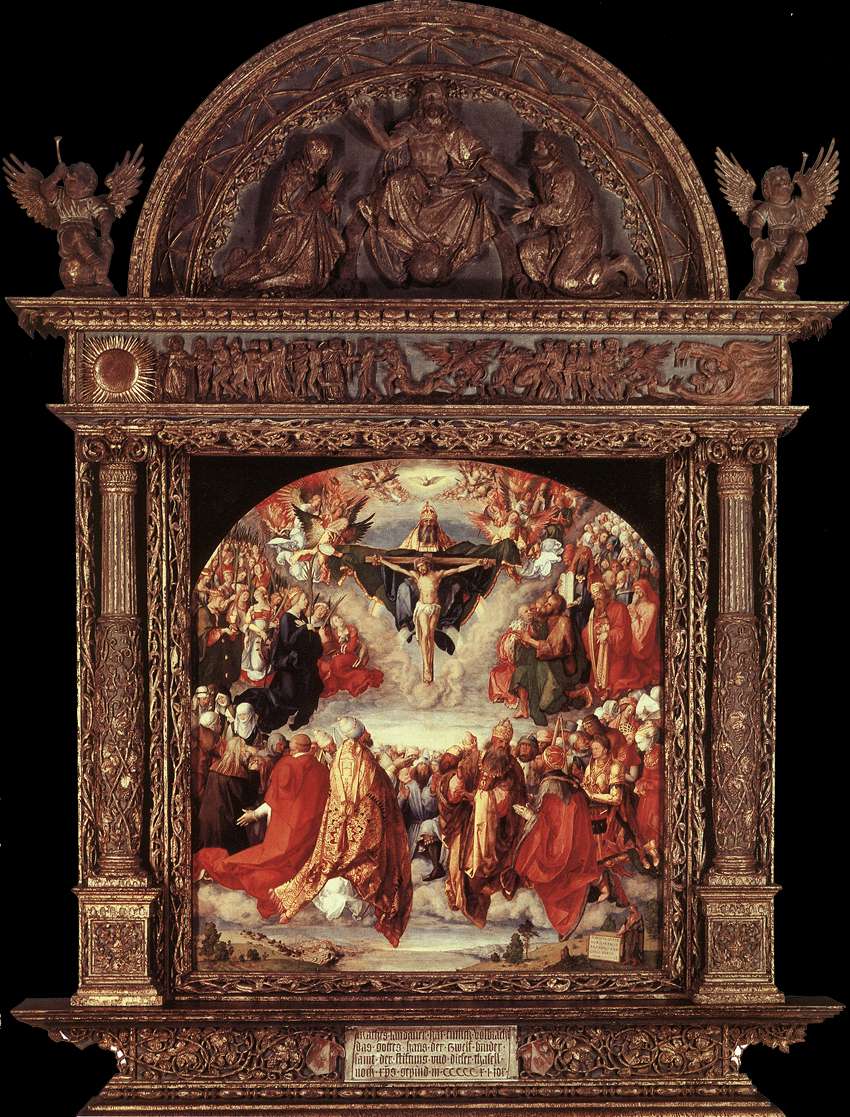
Adoration of the Holy Trinity

Albrecht Durer, Adoration of the Holy Trinity (Landauer Altarpiece), 1511

By LIBBY ROHR

Behold the majesty of one of Durer's later and greater works. Painted in 1511, begun shortly after his return from an extended trip to Italy to study the works of the great southern masters, was completed over the course of arguable his four best years as an artist. Durer painted this work as an altarpiece to go in the chapel of the "House of 12 Brothers," a retirement home for aging artists donated by Nuremberg metal trader Matthaus Landauer. Due to the nature of this commission, he would have had to be particularly sure of his skill in this work to be presenting it to his most experienced peers. As he originally studied wooden engraving, he also carved the frame it originally existed in, though the two have been separated for quite a while now. The one it resides in now is an exact replica, but a replica nonetheless.

The frame itself depicts the last judgement in stunning, meticulous detail, in carved and painted wood. As in the painting itself, the focus of the frame is a trinity. In this case, the Christ figure atop a globe with the kneeling Virgin on his left and kneeling John the Baptist on the right. Their presence is announced by two cherubs on either side. The climbing vines that encircle the painting itself reflect a gorgeous delicacy and care that bleeds into the painting itself. 

Originally in my selection, I chose this painting due to its color. What with centuries of fading, it may not be as brilliant as I can imagine it once to be, but in looking at the juxtaposition even in this particular rendering, it's clear that as magnificent as the color is, it would have been even more so when first painted. In this particular work, the contrast between the gold and dark green of the tapestry behind Christ and the crisp white of the clouds that surround him especially help to emphasize him. The vibrancy of Durer's reds, golds, greens, and pastel blues cannot be understated, although the bulk of his works are black and white engravings. This work in particular seems to glow. 

The geometry in this work is particularly evident. First, the painting is divided in half vertically (through the line of Jesus's body on the cross, the figure of God, down through the split of the congregation below) and horizontally (splitting the realm of heaven from earth). In the heavenly half, Jesus embodies the trinity in the clear triangle that frames him on the cross, splitting the crowd of saints in two. In addition, much of this painting flows out in concentric hemispheres around the central dove above the head of the Lord. The first ring is that of holy golden light, followed by creatures with the bodies of doves and the faces of cherubs, then by the angels holding up the cross of Christ, then the clouds around the christ figure, and finally by those adoring his holiness.

The upper right congregation is that of the male Old Testament saints, most notably and visibly Moses and King David. To the left are the female New Testament saints carrying palm ferns lead by the Virgin Mary, clad in blue as always, looking to her son in absolute devotion. The bottom grouping are the earthly Christians. Front and center, the pope is clearly emphasized, clad in gold, body turned upwards in worship. To the left of this lower group, the older man being embraced by the bishop is that of the patron, Mr. Landauer. The remainder of this group are other notable figures like the emperor alongside ordinary religious men and women, suggesting the inclusion of the audience into this portion. 

Below this is a short landscape of which he was particularly fond of painting in his earlier years as well as my favorite of his self portraits. Rather than simply signing this work, Durer placed a likeness of himself in a red turban next to a plaque announcing his name and the date. He appears to be showing off, quite proud of what he's just painted. And in this case, he should be. This painting effectively through work of the brush, unites heaven with earth visually and in the emotional response. When observing this masterpiece, one has never been closer to the realm of God.

  • 7:00 AM

Mrs. Waldorf Astor

John Singer Sargent, Mrs. Waldorf Astor, 1909

"Let No Charitable Hope"
By ELINOR WYLIE 

Now let no charitable hope 
Confuse my mind with images 
Of eagle and of antelope: 
I am in nature none of these. 

I was, being human, born alone;
I am, being woman, hard beset;
I live by squeezing from a stone
The little nourishment I get.

In masks outrageous and austere
The years go by in single file;
But none has merited my fear,
And none has quite escaped my smile.

Editor's Note: Students were asked to pair a poem and a painting with no explanation as to the connection between the two. 
  • 7:00 AM

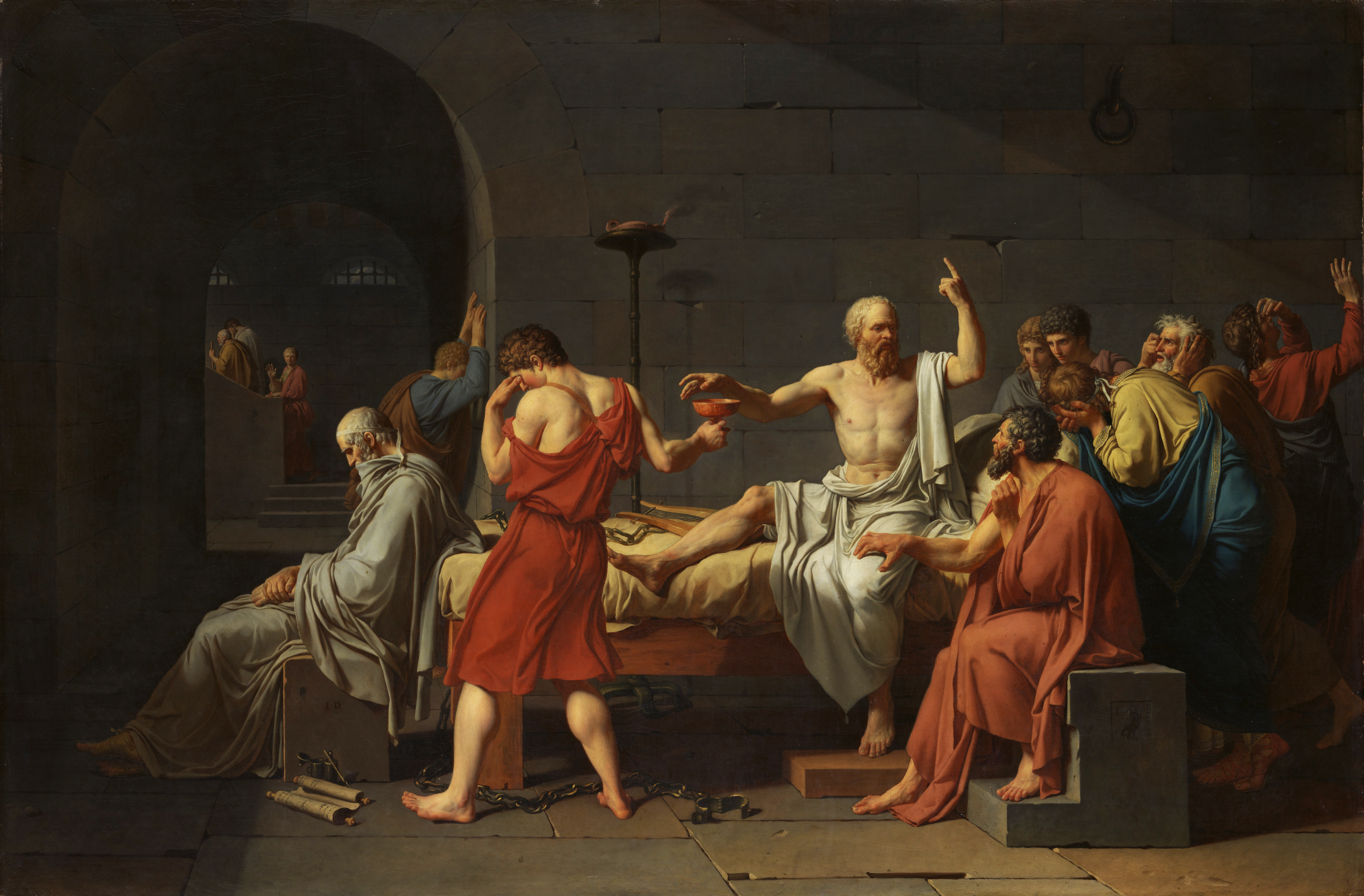
The Death of Socrates


Jacques-Louis David, The Death of Socrates, 1787
By LIBBY ROHR

Dear dummy who wishes to be refered to as the artist who wishes to be refered to as Doctor,

Welcome to the wonderful, if slightly pretentious, world of Art History. This seems like one of those things you would vehemently deny enjoying sheerly because of your own preconceived notions, however I suggest you give it a chance. If you are still unwilling to give Art History a try, at least open yourself to this painting. I have a feeling you'll enjoy it.

Ian, meet Jaques-Louis David, a French Neoclassicist painter who did work in a time of near global revolution. Here we see Socrates, front and center, choosing to drink hemlock to end his life rather than to stop speaking the truths he believed in. He was convicted, technically, of corrupting youth, and yet in this painting he wears white, symbolizing purity. I take it as the purity and clarity that comes with knowledge and pursuit of truth. In his dark, gray cell, a spotlight seems to come from nowhere and illuminate his form. On all sides of him, his followers are openly weeping, and yet with his last breaths, the great philosopher is still speaking with conviction, as evidenced by that definitive skyward gesture as he reaches for the cup of hemlock. While those closest to this great man are reduced to their worst in this time of trial, Socrates is stronger than ever and positively resolute.

I picked The Death of Socrates because this is how I see you. Living with a life of philosophical pursuits, principle, and conviction, without compromise. You ask all the right questions at the right times. You are ridiculously strong. You have more mental, emotional, and physical endurance than any other human being I know. You say what needs to be said, not what is most appropriate or acceptable. You are painfully stubborn. You are a devil's advocate. You think too much (but then again so do I). You have the temperament of a grumpy old man. In all of these ways, you are like this unyielding and seriously ripped Socrates here. However, the most apt comparison between the two of you is that, of all the people I am close to, you are the one who would be most willing to lay down his life for the things he cares about. This Socrates is a reflection of the values I see in you, and a reflection of your role in my life.

You're strong, loyal, trustworthy, exceptionally intelligent, snarky, and sincere. Thank you for everything. Thank you for our long talks throughout the years. Thank you for always being up for a trip to Penn Station and a car ride. Thank you for the endless showings of our favorite movies. Thank you for being so protective of me. Thank you for the philosophy over brunch. Thank you for helping me to be fearless. Thank you for showing up when I need you and staying at my house later than you should just because you care. I hope you know that it never goes unnoticed. The sheer number of times you've changed my point of view, given me the clarity I needed, and talked me down from a freak out is positively astounding. Your grip of the human mind and logic are phenomenal and the effect of your various advices has been invaluable through the years.

We're crazy people, I get that. But no mater what, I know you're a solid base to come back to, and I appreciate that to no end. Thank you for being my shoulder to cry on, my greatest confidant, my home away from home, my take-out food companion, the Sargent Nicholas Angel to my Danny Butterman, my own real-life Rick Ford, and my brother. Thank you so much for that.

Wherever we go next year, I'm not worried. Let's be real here. We've been through a lot together these past seven-ish years. Too much to lay down here. It's been a veritable roller coaster ride of a friendship, but no matter what, I know you'll always be there for me. You are my family and you, arguably, know me better than anyone else in the world and I'd like to think I know you pretty well too. Through all the good and the bad of it, befriending you and Sam has been one of the better choices I made in my life. I don't know how I got so lucky.

Happy Holidays,
Libbuhtayy

  • 7:00 AM

Adoration of the Magi

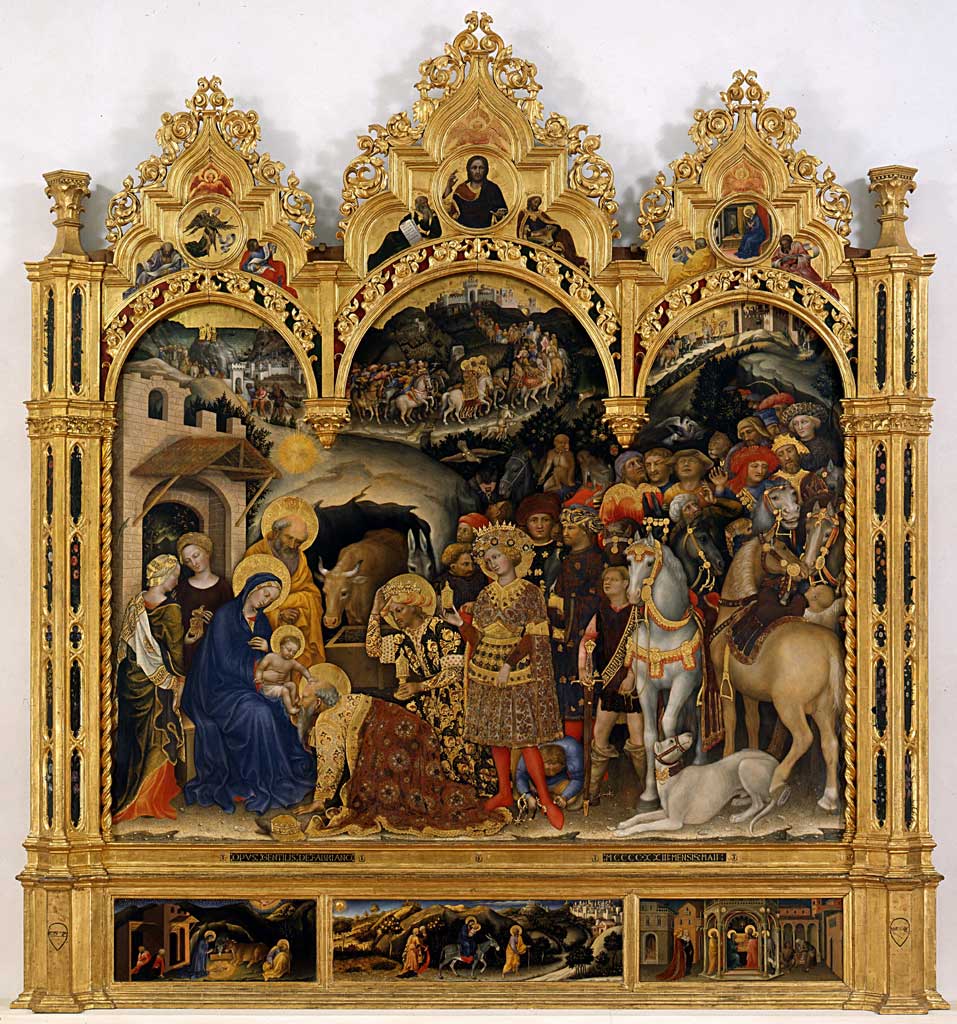
Gentile da Fabriano, Adoration of the Magi, 1423
By LIBBY ROHR

I stand in the dim light of the church, watching the dancing glow of candles flicker on the altarpiece in front of me as I pray. Reds, blues, and golds burst into life and seem to move with the shifting light. To me it seems glorious and decadent, a symbol of the majesty of the Lord. My knees are growing weary pressed against the hard ground of the Santa Trinità church. Outside the sun is beginning to set, and I can hear the final bustles of the day slowly winding to a halt in the streets before the people of the night emerge. Florence is moving outside as fast as it ever has before but here it is silent. Here I am at peace with God. 

In my church, I have stared at the altarpiece for hours upon hours in the couple of years since it has been here accompanying the sermons of our priest. He speaks with vigor and devotion and his stories come to life on the walls of this church, but none so like the scene of adoration at the altar. So detailed in vibrant color, I can never manage to tear my eyes from its glory. I look at the waves of those so devoted to a child, hardly born, the son of my God. They exalt and adore Christ, demonstrating the dedication I have learned to live by. This image of my Lord accompanies and invigorates my prayer. As I surrender to God further and further, Jesus begins breathes stronger and stronger in front of me.

The silence is at once broken as the doors in the back were thrown open into the church and with the rush of voices, reeking of self-importance, echoed in the structure. I took a deep breath and glanced back over my shoulder. Palla Strozzi, the unbelievably wealthy patron of the church, wearing rich colored garments and waving his arms in demonstration. He wore a proud, boastful expression under his well-groomed beard. He seemed to be addressing the man to his right who appeared equally important in manor and dress. The man to his left was much younger, with curly hair, holding himself proudly stood back a bit from the other two. Strozzi seemed to be showing him off.

I caught a portion of their conversation as he practically shouted into the otherwise quiet church, "You will see how magnificent it is. Young Gentile has a real talent and as you know, only the best for me!"

I watch the trio make their way farther into the nave leaving me unnoticed as they approached the altarpiece. Strozzi asks him to explain his work to the other gentleman, and Gentile swiftly agrees sweeping up towards his work. 

He begins to speak once they are close with passion and I understand he must be the artist, "All around the central work I've included images telling the story surrounding the birth of Christ, all biblically accurate. At these circles at the top here we see the Annunciation in the phase of acceptance, to best express the love of Christ. The middle image at the top is Christ himself at adulthood. The central image shows the adoration of Christ by the three Magi from the east. For the I chose to show lines of people to teach reverence and the vibrant gold to communicate the glory and wealth of God. To emphasize the virgin, she is the only one wearing her color of blue and she holds her hand over her chest to show her reverence. The charity of the wise men comes through the red in their robes. Many wear black as well to symbolize their humility in the presence of the Christ child. Jesus himself wears the white of purity with his hand outstretched in a gesture of blessing. The contrast invigorates even the simplest the onlooker to bask in a passion for the Lord Jesus Christ. Truly, it's one of my greatest works."

Although I do not quite understand the conclusions he comes to for his art, I like what he has to say. I enjoy understanding the deliberation. The two older men go back and forth in pride and praise for the work speaking mostly of its value and what another such work would cost. Having finished my prayer, I stand to exit, tired of their bantering. I make my way, still unnoticed, back down the aisle of the chapel. As I reach the door, I steal a glance back and catch a glimpse of the altarpiece between the forms of the rich men. I ignore them to focus on the small representation of my beloved Christ in front of me before emerging back onto the streets of Florence.
  • 7:00 AM

Art History Hotties: The Baptism of Christ

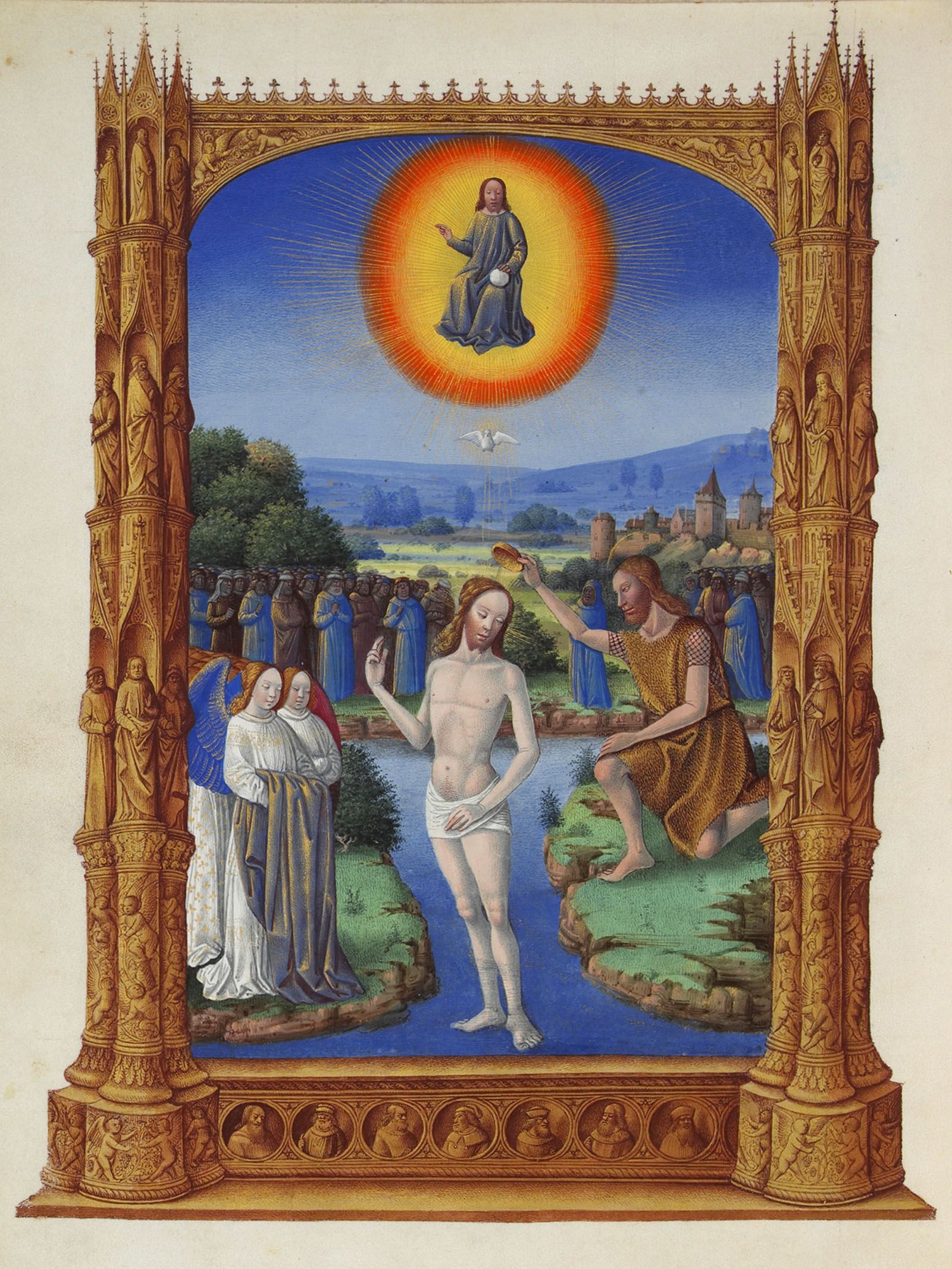
The Baptism of Christ, The Limbourg Brothers

By LIBBY ROHR

Jesus is a professional model.  He speaks in that Zoolander voice. He knows how to pose. He's the kind of hot that doesn't even have to look in the mirror. He doesn't have to comb his hair, but he did spend six hours the other day styling his beard. The two pointed look is really en vogue right now. He's bringing sexy all the way back to 15th century. No wonder Christianity caught on. Look at those abs. That muscle definition. The soft alabaster skin. The flowing hair. The sloping calves. The tiny white mini-skirt. What more could you want from the Lamb of God? If God created this Jesus in his image, then God must be smoking. Even the angels agree. They're blushing so hard their wings are turning color. That never happens. Even John the Baptist can't help but to stare. I mean look at those collarbones! It makes me consider the literal interpretation of a "divine glow." Holy men congregate in hordes behind him. They're not staring at his butt in that insanely short wrap. Of course not. They're definitely just here for the spiritual stuff. Definitely. This Jesus is making idolatry pretty tempting. Forget your "french girls," Leo, paint me like 15th century Jesus.

Well done, Limbourg brothers. From the trio that brought us a slew of over-the-top rich people festivals and a line of farmers using the chamber pot,  Paul, Jean, and Herman Limbourg now grace us with the presence of sexy Jesus, one of the most appealing forms of Jesus out there. Hey, if you can't get them interested in scripture, maybe you can entice some converts with this masterpiece. Unfortunately for the masses, these French masters were experts at illumination and in particular creating illustrations for customized books for the upper class. 

Often time religious works of this era were created to educate, stir emotion, and add a visual accompaniment to help better understand these stories as the life of the son of God. As a result, many frescoes in the early Renaissance featured nondescript, "ordinary" faces that reflect the type of people that would be seeing their works in an effort to connect the audience to the stories. The figure of Jesus, obviously, offered the least room for interpretation. He is always pictured with relatively dark hair that curls at the bottom and a full beard in an effort to ensure the accuracy of the image. Yet, looking at works like this one it would be hard to believe it wasn't at least slightly tailored to the audience. For one thing, these figures are all European, not Middle Eastern like Jesus would have been. The the incredibly white skin and the auburn hair for one suggest that the Jesus in this image is french like its onlookers. Furthermore the landscape of this work, from the sloping mountains, deciduous trees, and the Gothic castle behind them, is decidedly French. Between these connecting factors, the accuracy of the image presented, the vibrancy and the skill of the painting itself, and Jesus's glorious form, this illumination goes above and beyond its requirements and showcases the (smokin') work of true masters.
  • 7:00 AM

The Mystic Nativity

Mystic Nativity, Sandro Botticelli, 1500
By LIBBY ROHR

Sandro Botticelli has been a favorite of mine since I first laid eyes on his work as a young child, gazing up at the beautiful copy of Primavera on my best friend's wall. His figures are as distinctive as Fragonard's trees in their soft glowing skin and gracefully clothed bodies. In The Mystic Nativity, we see new emphasis on nature similar to that of Primavera, but with a stronger message. The robes of several of the angels seem to flow into the elements of the earth around them through the use of the deep green color. The inclusion of the forest background, greenery in the hands of angels, and the natural landscape of the foreground shows the placement of heavenly value on the natural world. To include so much nature in in such an auspicious scene with such godly figures extends an auspicious and godly status to these earthly aspects in a way that has not existed in art before this time. Recently, we read a passage in class from Pico Della Mirandola's Oration on the Dignity of Man which says that human beings were put on Earth "to ponder the plan of so great a work, to love its beauty, and to wonder at its vastness." As art progresses, Botticelli lives out this purpose in the exploration of a holy natural earth in his work as well as the emphasis of the interaction between man and the angels. 

Botticelli's use of color in the verdant greens and rosy pinks gives this painting its graceful nature. Mary and Jesus are framed by their shelter first and then again on all sides in the figures of the angels and onlookers. In a ring at the top of the painting, angels rejoice in the heavenly realms, serving as a portal to the unthinkable, to God. In composition, this painting can be split in thirds horizontally, the bottom representing life on Earth, the top representing the existence of heaven, and Jesus in the middle as the bridge between God and man. In the lower third of the painting, we see images of angels embracing humans as further demonstration of this bond. In the realm of Jesus under God, all are equal and at peace. Olive branches appear in the hands of every angel in the painting. The sharp, twisting road to Jesus shows the difficulty and the specificity of following Jesus's "way." However, as the Bible promises to good Christians, Christ himself is waiting at the end.

In the bottom third of the composition. If you look closely, you'll notice four grotesque figures of the devil. My personal favorite happens to be the blue one in the bottom right, with curly horns like a ram and a disgusting warthog face. Each one of these satanic figures is crawling back beneath the earth to hell. In the presence of Jesus, they can no longer exist on the earthly plane. Botticelli tells us that through Jesus's education for the world, he rids us of sin. There is no idea more en vogue for the Renaissance than this idea of humans as chosen beings and transcendence through education and study. Mirandola claimed human beings to be, as pictured in this painting "the intermediar[ies] between creatures, the intimate of the gods, [and] the king of the lower beings." Our free will is what makes us human. We have choice to either "degenerate into lower forms of life" or "to be reborn into higher forms." Whether or not you happen to believe in God, the idea of free will, choice, and following a path of love or hate is the thread that binds every human being together. At first glance, this may resemble a simple nativity scene, however this message to humanity is what makes it "Mystic." Although this is a deeply religious work, any person could walk up to this painting and feel the message of optimistic life through peace and the utopian world so many of us strive for.
  • 7:00 AM

Lamentation

Arena Chapel: Lamentation, Giotto, 1305
By LIBBY ROHR

Starting this year with Renaissance painting had me skeptical. How could I compare my love for modern masters like Monet and Chagall to the likes of Duccio and the Limbourg Brothers, literally hundreds of years of skill and progress behind my favorites? However, after a year of art history, I've learned to trust the process. After all, if I can learn to love and appreciate Malevich's White on White then I can figure out these guys, too. 

In studying the Arena Chapel works, I see the creation of something, like art is a child at play learning that if she moves her legs a bit faster, she can run. Here, perspective is being born. It's still a bit crude and unrefined, as you can see in the folds of the fabric. Outlines are still utilized to define figures, but unlike its predecessors, shading and shadow is coming into being in the faces of Mary and Jesus. The blue of the background is stunning, making the golden halos pop all the more. Giotto begins to play with the idea of staging here, as the back rock wall frames the scene, and the man to the far right grounds us with his (slightly misshapen) feet. The rocks form a line, leading wandering eyes back to Jesus at every turn. In fact the eyes of every person or angel in the painting are directed at Jesus. No matter where you look, Giotto has a tool to refocus you. Directly above his body is a hole in the crowd, a passageway to the heavens, leaving him in full view of God. I can see Giotto working the audience into the spectacle with the two men in front. Backs to us, their faces are hidden, a long time artist's tool for including the onlooker. It may as well be you or I hunched over mourning Christ.  

Jesus, maybe for the first time, looks truly human. He lays limp and mortal in the arms of his mother, distinguishable as holy only by his halo. Staring at his mother's face, I see the other revolutionary piece of Giotto's work, the appearance of emotion. This lamentation is actually that. Angels and people alike, divine and imperfect, rich and impoverished, brought together in despair that shows. The pleading in Mary's face, just inches from her son's, is heart-wrenching. Yes, he's still Jesus, but forget the crowd, forget the angels, forget who these people are. Looking at this scene, it's a mother and a child, a perversion of the natural order strong enough to break so many. Yes, I still see Jesus, but he's presented in an a way that any onlooker can relate to. When I see Jesus and Mary, I also see my aunt crying over her brother's casket. I see my mother's clients in the hospital, holding their hurt children for their last times. I see myself kneeling next to my grandfather's bed in his last hours.

We all have tragedy in our lives. We all understand the pain of loss whether or not you've experienced the death of a loved one. Giotto creates this painting on the wall of a chapel, so in many ways it's functional. It tells the story of Jesus and glorifies the church itself, but it goes so much deeper than that. By showing a lamentation that we can all understand and creating a composition that draws us in, he brings Jesus and religion to the life of the onlooker. He has the power to change the worshipers' relationship to the story. No longer is Jesus some unattainable, distant, holy figure, in this painting he is your experience of loss and as a result Giotto gives the audience to own the story of Christ for themselves, too. That's where art is always the same, whether we're talking Proto-Renaissance or Suprematism. You don't have to know the story or the artist or the time period to see this Lamentation and feel the connection to Jesus and Mary. Giotto doesn't need to play off of anything other than our humanity. And no matter who you are, reader, that's the one thing we'll alway's have in common.
  • 7:00 AM

Dance Valley

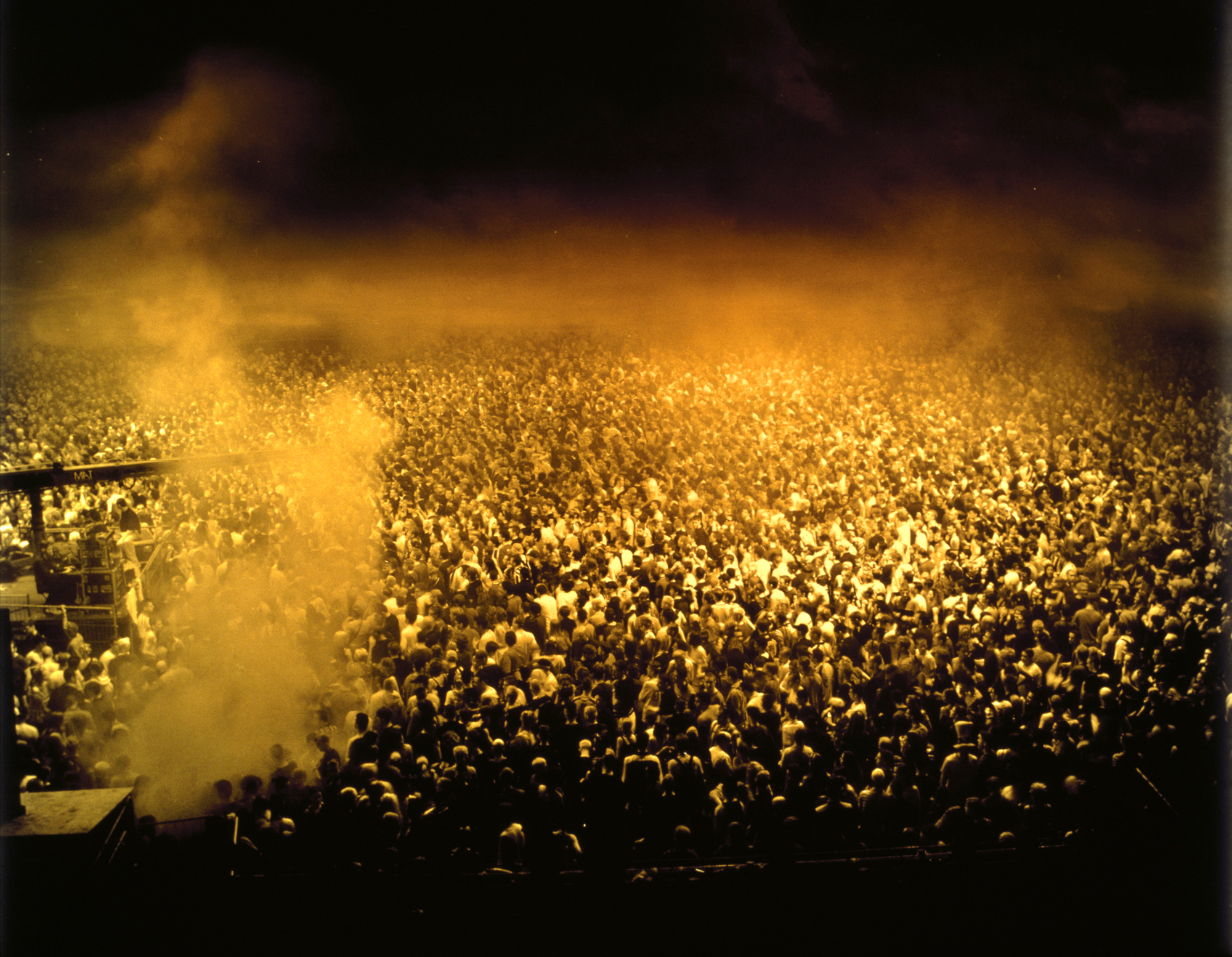
Dance Valley, Andreas Gursky, 1995
By LIBBY ROHR

You can feel it in your bones, lungs, muscles, and your brain. Your heart seems to vibrate with the beat, reverberating out of industrial-sized speakers so loud the earth seems to tremble where you stand. An earthquake of beauty in music shaking you alive again. It smells like alcohol, smoke, perfume, and sweat. The air is congested from all the bodies, the heat, and occasionally the fog machine. No matter where you look, there are people, in a swarm all around you, bouncing in waves with the beat, all vibrating, hearts beating to the same feeling as you. It's a collective experience, probably the most uniting experience we can get in this life. Now imagine it here, at Dance Valley in the Netherlands, at the first installment of the festival that continues to today. On the 23rd of July in 1995, at this first show, eight-thousand people showed up to the massive concert that would one day be nicknamed the "Woodstock of Dance." Amongst these eight-thousand was german photographer Andreas Gursky, in one of the most actively global periods in his work.

Born in East Germany in 1955, Gursky's father was a commercial photographer and they spent much of his childhood moving from place to place. After attending art school, he began working under Bernd and Hilla Becher who inspired much of his style throughout his career. The Bechers, unlike Gursky, worked primarily in black and white, often photographic interesting pieces of architecture and design. You see their influence in Gursky's wide, landscape perspective, defined lines, and often subject matter. One of the first photographers to fully embrace digital technology to alter or enhance his photos, the composition and color in his photos is constantly captivating. Gursky's work gives a panorama-like view of contemporary life, ranging from photography of beaches, to office buildings, to mountains, to hotels, to rallies and even dance festivals. Through his travel, Gursky's work is truly Global and has discovered a level of compositional beauty that is worldwide. Recently one of his nature landscapes, Rhine II, sold for $4.3 million at Christie's, making it the most expensive photo ever sold.

Although Rhine II is undeniably beautiful, in looking through his work, it was Dance Valley that struck me differently. Unlike most of his work, composed in high saturation with crisp, contrasting colors, Dance Valley is relatively monochromatic in a way that appears almost sepia toned. In Gursky's other photographs of crowds, it showcases the individuality in the masses through color and sharp lines, but Dance Valley does the opposite. The oval mass of the crowd, encircled by the vignette of darkness, they look like a single organism, glowing in the gold-tinted light. The haze of smoke gives this photo an ethereal quality, united, turned towards one stage. Unlike so many concert photos, we see no performer. Instead, the subject is the fans, the dancers, the listeners of the music, the ones that determine success or failure in the first place. At concerts, there's a tendency to focus on the performer as the make or break aspect of the show, but in reality it's the audience. There's a saying in theater that the ensemble can either infuse the show with life or it can suck all the life from it, and in this case the crowd is the same way. Individually, each person is one in eight-thousand, but together they have the power to come together and ramp up the energy and create an unforgettable experience like this festival. Dance Valley might not be the clean-cut, vibrant photo we're accustomed to from Gursky, but the feeling of unity that this photo invokes creates a universal and incredibly powerful experience for the onlooker. This is Gursky's greatest talent. He doesn't just create a pretty picture, he encapsulates a moment in time.
  • 7:00 AM