Madame de Pompadour

Francois Boucher, Madame de Pompadour, 1756
By EMMA SHAPIRO

Jean-Antoinette Poisson, famously known by the name of Madame de Pompadour, defined herself as more than just the mistress of the French King, King Louis XV, exhibited perfectly by Francois Boucher. She became one of the most learned and intelligent woman of the 18th century while simultaneously satisfying the King through sexual pleasure. Francois Boucher, Madame de Pompadour's favorite artist, depicts her in his 1756 piece with a bookshelf in the background, obscured by a shadow. By placing the books in the back and an open one in hand, Boucher exhibits Pompadour's interest in the enlightenment and enlightening herself. 

Due to her admiration for fine arts and architecture, Pompadour commissioned countless paintings of herself, however, those composed by Boucher exclusively hung on the walls of her chateau. The lavish lifestyle illustrated dominates the identity of Madame de Pompadour. The eye immediately draws to the detailing of her ornate dress filled with flowers to symbolize love and passion. The books on the wall and flowers littered across the floor contrasts love with intellect . Boucher paints Madame with her legs crossed to present Pompadour as a conservative woman. Although a mistress, she did not necessarily enjoy the sexual side of her and the king's relationship but continued because she loved his company. The image of Madame de Pompadour encompasses desire and titillation, like many of Boucher's seductive paintings. The face of Madame de Pompadour appears unhappy and almost bored, suggesting the possible perils of luxury. The painting shows the understanding by the owner of the importance of nature and natural beauty and undermines the obsession with wealth, and materialistic cravings. The clock ticking in the back while Pompadour reads a book with a half-sealed envelope and quill, paired with Madame de Pompadour's blank face, leaves the viewer in wonder.

This painting brings in an element of wealth and beauty to wherever it hangs. The association of luxury and elegance with the face of Madame de Pompadour, intensify with the beautiful brushstrokes of Boucher. Even the paintings not done by Boucher of Madame de Pompadour, typically had some influence from him. Madame de Pompadour always has the same expressionless, soft, yet beautiful face no matter the setting, or her attire. Unlike some of Boucher's more seductive or nude paintings, the one of Madame de Pompadour has a timeless beauty that will remain appreciated through the ages. The idea of intelligence before wealth and materialistic cravings present in such a lavish artwork exhibits that although the art piece may be opulent like the life of Madame de Pompadour, the beauty owes to the intellect that went into the creation and out of the subject.

Editor's Note: The authors were asked to write sales copy for Edme-François Gersaint, the prominent rococo art dealer who offered a printed catalog of available works.
  • 7:00 AM

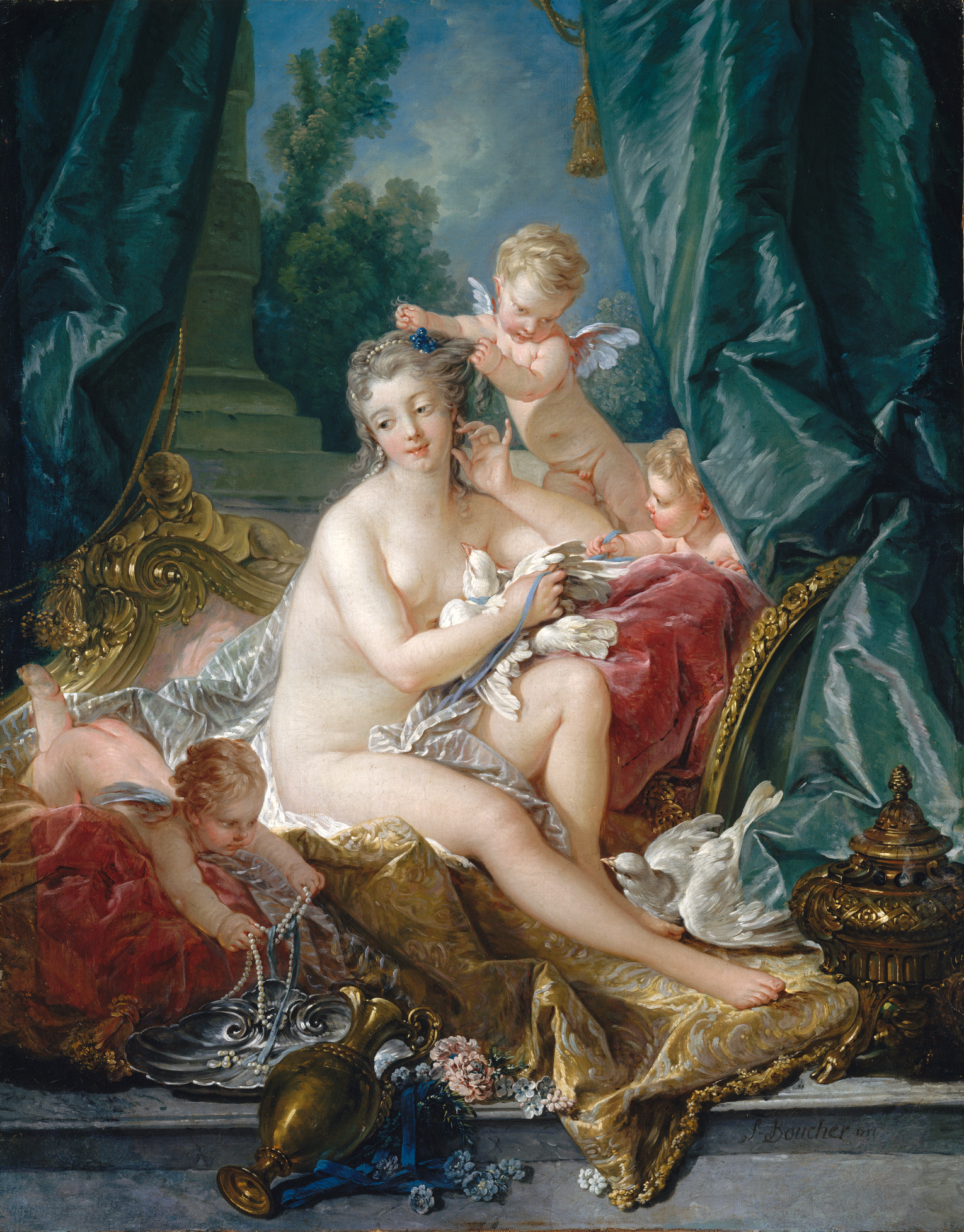
Toilet of Venus

Boucher, Toilet of Venus, 1751
By MADELINE VASQUEZ

In early 18th century Paris, Rococo style art began. Delicate colors and curvy lines surrounded the painting, making it extremely masterful. Concepts of love, nature, goddesses, and youth, bring about the complexities of the ornamental arts of the Rococo period. Although not everyone may be interested or intrigued by this form of art, each one has depth and meaning behind it. One of the most amazing artists of this time was Francois Boucher. The feeling that people get when looking at his art is utter amazement, and you will hopefully feel the same.

Boucher is known for his pleasant, sensual paintings that usually revolve around pastoral scenes and exquisite goddesses. His mythological scenery depicts such passion and emotion that you feel what he is painting through expression, no matter the emotion in it. His paintings have a sense of theatrical staging as if you were looking at a staged show. This layout is captivating and makes the painting more enjoyable to look at and costly.

In Toilet of Venus, created in 1751, Boucher depicts the mythological scene of the Goddess of Love. This painting contains Venus sitting on a stage, with a natural backdrop, surrounded by cherubs admiring her and playing with jewelry and ornaments that are tumbling over the edge of the stage. This represents the concept of luxury which draws wealthy buyers in because they are able to relate to the painting more so than others. The pastel and soft colors make the Toilet of Venus overall harmonious and delicate, but also detailed. The body of Venus and her cherubs are soft and playful. The intricately folded red velvet and golden couch, silk, and drapery are beautiful and eye catching. When looking at this painting you feel peace and tranquility, but also empowered in the sense of richness.

Personally, I would see this painting appealing to wealthy women in this day in age. It could be given as a gift that could be greatly admired in a luxurious bedroom or bathroom. Thus, relating to Boucher painting this for Madame de Pompadour, for a series of panels for her bathroom. Knowing a sophisticated woman as herself would want Boucher, one of her favorite artists, to paint for her, is in itself a reason that this painting is worth buying.

Editor's Note: The authors were asked to write sales copy for Edme-François Gersaint, the prominent rococo art dealer who offered a printed catalog of available works.
  • 7:00 AM

The Toilet of Venus


Sticking to Boucher's ultra-extravagent style, The Toilet of Venus perfectly exemplifies a Rococo piece.  Rococo art was most popular during the reign of King Louis XV. In this piece, Venus is modeled after a good friend of Boucher named Madame de Pompadour. Madame de Pompadour was a mistress of King Louis, which helped jump-start Boucher's career. Not only did the painting have a strong tie to politics at the time, but it also possesses many other Rococo aspects. In many Rococo pieces, there are upper class people doing something elegant. Though the painting is of Venus, it shows the elaborate lifestyle the wealthy French experienced. 

The cherubs dressing Venus immediately reminded me of Snow White being dressed by the animals of the woods. The painting is so elaborate that it is obvious that its sole purpose was to showcase extreme wealth. The casual chaos of the jewelry and flowers show how the wealthy felt they were too good to care about even the nicest of things. The curtains in the background also provide a feeling of acting. Though the lack of realism of the setting is acceptable for Venus, it is meant to play up the luxuriousness of Madame de Pompadour. In addition, though the grace of God is not shown through beams of lights, Boucher uses white doves to represent de Pompadour's religious side.

  • 7:00 AM

The Chinese Garden

Boucher, The Chinese Garden, 1742

While scanning the page of Boucher's masterpieces, I stumbled across this beauty and wondered, How does this painting belong with the others? Why are there such rad colors in this and not the others? Where can I buy that sweet orange hat? What is up with that guy's hair? The more I looked at this, the more I fell in love with it, and the more interesting it became.

When I looked closely at this painting I realized that there were some aspects that were typical of a Boucher, while there were other aspects that were unique to this painting. This change represents Boucher's transition from his traditional work to the chinoiserie style. For example, what initially drew me to this painting was the vibrant blues and oranges. The use of these colors immediately made me realize that this painting was unlike many of the others that Boucher painted, as he traditionally used more pastel colors with intricate gold work. In addition, the background of the painting seems like it could stand alone as a Chinese landscape rather than a lush forest.


The theme of the painting, on the other hand, remained the same. Like many of Boucher's paintings, there is a highlighted woman being pampered. Although there are no distinct rays of light or shadows to draw the eye to one particular person; however, the woman having flowers put into her hair is obviously significant because of how pale her skin is. The lightness of the skin seems to increase with the ranks of the people painted. One detail I thought was interesting was the fact that even though this painting is of a Chinese garden, the women of focus in the painting are wearing clothes that resemble the European women's clothes that Boucher painted in other works. Another similarity in this work is the level of fancy "fluff" in the painting. The flowers put in the woman's hair are similar to the jewels that surround many other women that Boucher painted. 


At first glance, it seems as though this painting does not fit with many of Boucher's other famous works, but in reality, many details stay true to Boucher's traditional style, while others were slightly influenced by the new chinoiserie craze.


  • 7:00 AM

Portrait of a Woman Scorned: Madame de Pompadour

Portrait of a Woman Scorned
The Fairer Sex Treated Not-So Fairly
Curated by Katherine Anderson


 Francois Boucher, Madame de Pompadour, 1750.
Madame de Pompadour had all a rich, French woman could desire - an education, a fabulous wardrobe, close friendships with Voltaire and other prominent philosophes, and legendary poise. So it was no surprise when Louis XV honored her with the spot as his favorite mistress. Yet with this position came unconquerable amounts of hatred and scorn for poor Pompadour. Whether from jealousy or pure disgust, wealthy, impoverished, and royal Frenchmen shunned Louis' mistress even more than the indulgent princess that took her place.

Thus, when Louis XV commissioned Boucher, one of France's most esteemed portrait artists of the Rococo period, to illustrate Pompadour's grandiose life, the sound of dropping jaws rang across France. Now, Pompadour had permeated nearly all creative stimulation within the nation. With the painters and philosophers bowing at her feet, Madame de Pompadour became the emblem of French culture across Europe. Though the French people were embarrassed by this representation, Madame de Pompadour's portrait ushered in a new breed of female - informed, pampered, and respected by men.

  • 9:00 AM

Progression of Human Form - Diana Leaving the Bath

Progression of Human Form
Curated by Shahzad Aslam

François Boucher, Diana Leaving the Bath, 1742    

“Progression of Human Form” is an exhibit designed to study the evolution of the human form and the relevant artistic movements that impacted artist’s interpretations of figure. The seven pieces in the exhibit depict women. Some women are depicted with clothing while others are nude. The exhibit addresses works beginning in the 18th-century Rococo period up to abstract expressionism in the mid twentieth century.

The female nudes depicted in Boucher’s Diana Leaving the Bath are exemplary of the Rococo style and are somewhat reminiscent of the Baroque era. Rococo artists such as Boucher retained some qualities from the baroque while breaking away from others. The rich use of creamy colors, and irregular balance, were kept from the baroque period while the grandeur, overly ornate, and heavily politically focused aspects were forgotten. Moreover, as depicted in Diana Leaving the Bath, the subject matter of rococo works often were more playful and had an air of sexuality and connection to the natural world unlike the preceding works in other artistic movements. Boucher’s depiction of the nudes appears visually and anatomically realistic. The style is reflective of the renaissance masters. Boucher paints the goddess Diana and a nymph in perfect human form with approximately normal features.

  • 12:00 AM