Rothko and No Country for Old Men

Mark Rothko,  No. 5 (Red, Black, and Brown), 1963


Chigurh is the inexorable push of death personified. The assassin, realized menacingly by Javier Bardem, stops at nothing in his frenzied quest to kill. In a way, his assassinations are driven by concepts of justice. He believes the people he kills deserve to die. This quality makes him so dangerous—he feels no pity as he does what he believes is simply his duty to the cosmos. In the scene above, we see him dressed once again in all black, pushing the limits of evil. He walks into a gas station, and after the clerk tries to make conversation with him, one of the most menacing scenes in movie history begins. It ends with a coin flip, a duality that resurfaces throughout McCarthy’s novel and the film. People say he considered murdering this man because the clerk noticed he had Dallas plates on his stolen automobile. If this were true, I think he would have killed the man without a second thought.  I think he considered taking this man’s life more because he could.


As Mark Rothko aged, he too began to feel this inexorability. Death, chaos, loss pressed down on him, seeping into every corner of his life. His nemesis may not have been consciously evil like Chigurh, but it must have felt much the same. Black swallows red. Looking at No. 5, one of the last before the total eclipse, I get a sensation of flooding. The red still pulses, hot to the touch, but it seems as though it’s not even there anymore. Black’s victory is inevitable. Red is just not in the cards. Chigurh and the black really represent the same thing. They are evil. They are the visible force that pervades and forms the world, that Rothko felt, that McCarthy feels. It doesn’t matter that Chigurh didn’t kill the pathetically unaware gas station clerk. It matters that he could have. He would have. Whether a character burned dimly or as bright as one of Chigurh’s greatest rivals, the assassin could kill at will. Black will always swallow red.

  • 7:00 AM

Brook in the Woods near Oosterbeek and The Road

Matthijs Maris, Brook in the Woods near Oosterbeek, ca. 1860

"Once there were brook trout in the streams in the mountains. You could see them standing in the amber current where the white edges of their fins wimpled softly in the flow. They smelled of moss in your hand. Polished and muscular and torsional. On their backs were vermiculate patterns that were maps of the world in its becoming. Maps and mazes. Of a thing which could not be put back. Not to be made right again. In the deep glens where they lived all things were older than man and they hummed of mystery." - Cormac McCarthy, The Road 

A post-apocalyptic world filled with horror and misery around every turn for a father and son. Death and destruction described in practically every scene, and yet, McCarthy leaves the reader with this passage. Gracefully depicting the flow and design of fish swimming in untarnished streams, McCarthy uses this imagery to impart buried wisdom to the readers, wisdom that completely escaped me the first time I read the passage. Class discussion and personal reflection on the novel allowed McCarthy's hidden lesson to float to the surface, and I realized that this passage, in conjunction with the novel, was the most powerful thing I had ever read. The contrast of this passage to the rest of the novel is shocking, as if McCarthy just needed to reach a quota of 287 pages and decided that confusing readers would be fun, but at same time, the novel would be incomplete without this addition.


Mystery lies on each page in the novel, and this final passage explores the power of mystery. McCarthy never explicitly tells the reader the event that altered the Earth, or the names of the two characters the novel follows or what really happens to the boy in the end. But isn't that what we want as readers? We get to shape our own opinion regarding the novel without being handed every minute detail. Suddenly, the boy and father become the reader and the reader's father, hopelessly trekking the barren Earth in search for some sign of hope or faith. The reader begins to imagine the scenes in his head, playing out similar scenarios and seriously contemplating, "What would I do?" And while the boy and father never directly locate their goal, the reader finds a semblance of faith in the last passage. The presence of fish, and life, and flowing, pure water refresh the reader after the dismal novel, suggesting that life may return to the Earth as it once was. However,  McCarthy simultaneously suggests that not everything can be undone. Even the last passage, although it alludes to the power of mystery in the rest of McCarthy's novel, contains mystery in itself. Can the barren land recover what it once lost? Or has man completely unraveled and destroyed nature to an irreversible state?

The final passage of The Road leaves no question answered, but explains why the reader has so many questions. And much like the novel, this painting alludes to that mystery. I may not know where that brook goes or who will swim in it or who or what will eventually tarnish it, but I do know that my imagination will create a multitude of possible endings, something that would be impossible without the presence of mystery.

  • 7:00 AM

The Creation of the World and The Road


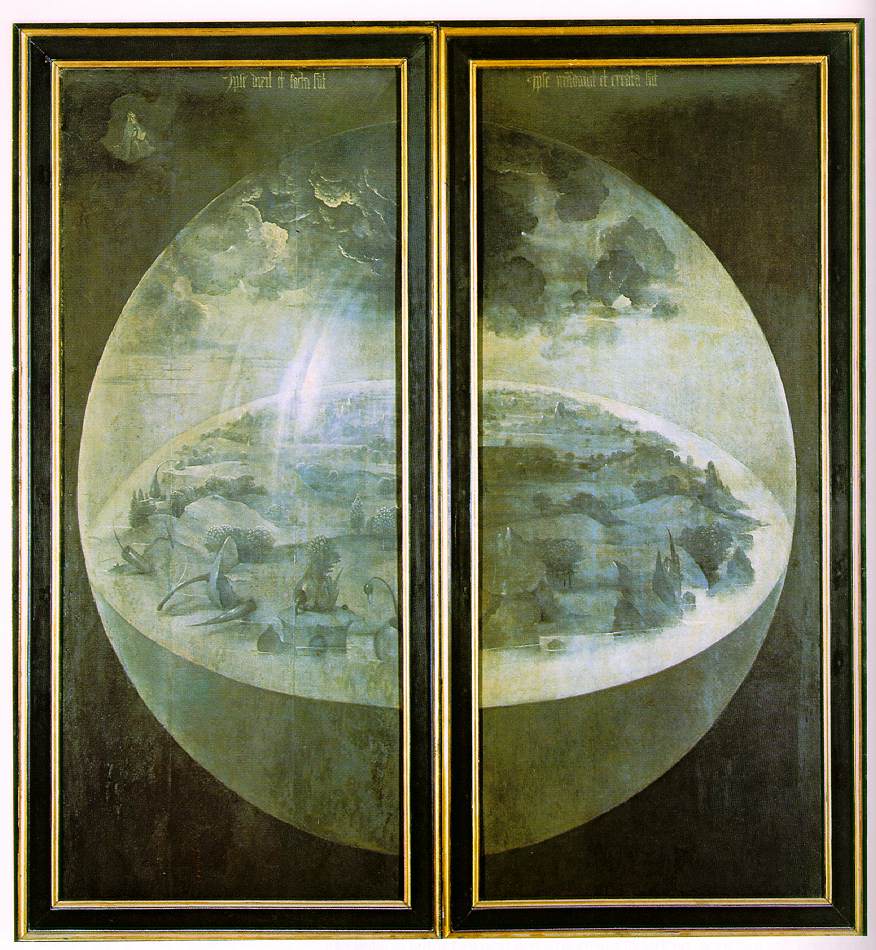
Hieronymus Bosch, Creation of the World, 1490-1510


"The cold relentless circling of the intestate earth. Darkness implacable. The blind dogs of the sun in their running. The crushing black vacuum of the universe. And somewhere two hunted animals trembling like ground-foxes in their cover. Borrowed time and borrowed world and borrowed eyes with which to sorrow it." - Cormac McCarthy, The Road

Hieronymus
 Bosch's work, Creation of the World, lies painted on the outer panels to his famous triptych, Garden of Heavenly Delights. However, Creation of the World consists of a work of art in its own right, in its curiously muted grey tones. The bleakness of the world's landscape on the third day of its creation brings to mind the depiction of the Earth after its devastation in The Road. There, the bleak, ash-covered scenery, described in Cormac McCarthy's understated, staccato prose, results from some unknown destruction bringing civilization to its knees. But the pristine mountain streams hint that some hope remains for the rebirth of the world. Here, the world's raw, dreary landscape, with its curiously mineral-like textures and colors, suggests a grander panorama yet to come. Indeed, the triptych inside explodes in a riot of color, complete with Bosch's signature fantastic animals and hybrid creatures.


The undeniable religious themes in Bosch's paintings, and indeed in most paintings of the time, are echoed in The Road as well, where a deep spirituality reveals itself even in the grim, oppressive atmosphere of the novel. In Creation of the World, the figure of God looks upon the nascent Earth, a thin disc of land encased in a fragile sphere, with an almost morose expression and posture. His stance suggests resignation, as though already his creation moves under its own power and its fate cannot be changed. The inscription, "Ipse dixit, et facta sunt: ipse mandávit, et creáta sunt," or "For he spake and it was done; he commanded, and it stood fast," from Psalm 33, corroborates this. Once God began the process of creation, it could not be undone. 
This heavy inevitability lays over the entire narrative of The Road, as the boy and his father struggle to survive and carry the fire.


  • 8:00 AM

Lichtzwang and All the Pretty Horses

Anselm Kiefer, Lichtzwang, 1999
It's getting rarer and rarer to be able to look up at the night sky and see stars. Really see them. Sure, a wink or two here and there piercing through the smog could do the trick, but there's something about being able to  lay back and take stock of the heavens that's truly moving. Too often we move about in our own orbits thinking we're the center of the universe. The night sky gently, but beautifully, reminds us that we are next to nothing compared to the raging balls of gas millions of light years away. Anselm Kiefer captures the majesty of the night tableau with his panoramic painting, Litchtzwang.

When I stumbled across this painting on Artstor on a late Thursday evening, my mind immediately jumped to a striking passage in Cormac McCarthy's novel, All the Pretty Horses. As I viewed the painting slightly askew from my head's resting place on my outstretched arm, I realized I was staring at the Milky Way. The more I took the painting in, the more my eyes unfocused - most likely due to lack of sleep - and the image on my screen started to come alive with movement. For a minute, I felt like John Grady Cole as

“…he lay looking up at the stars in their places and the hot belt of matter that ran the chord of the dark vault overhead and he put his hands on the ground at either side of him and pressed them against the earth and in that coldly burning canopy of black he slowly turned dead center to the world, all of it taut and trembling and moving enormous and alive under his hands.”


And then I blinked. 

The magic of the night sky and paintings like this is that the harder you look, the less you see. If you stare intently at a star, it'll start to fade. There are biological reasons for this - shenanigans involving photoreceptors and sweet spots in the your vision - but the philosophical repercussions interest me more. This painting is supposed to be experienced like you would the night sky. You need to be completely relaxed, in good company, and you can't be looking for anything in particular. Litchtzwang puts things into perspective and reminds all of us to stop obsessing over the details of the day-to-day and step back to see the big picture - because nine times out of ten it's much more meaningful. 

  • 8:00 AM

City Square

Alberto Giacometti, City Square, 1948


"He carried the revolver in his belt at the front and wore his parka unzipped. The mummied dead everywhere. The flesh cloven along the bones, the ligaments dried to tug and taut as wires. Shriveled and drawn like latterday bogfolk, their faces of boiled sheeting, the yellowed palings of their teeth. They were discalced to a man like pilgrims of some common order for all their shoes were long since stolen." - The Road, Cormac McCarthy

Lost. Lonely. Fragile. Alberto Giacometti's figures have an aura of alien beauty. Like mirages in an endless desert, the shadow-people of Giacometti's City Square do not seem to be human, but rather resemble wraiths wondering a barren landscape. They evoke the deeper, darker essence of humanity. From the time that Giacometti first developed his mature style - the thin shadowy sculptures that most people associate with him - he became obsessed with capturing in an instant the world around him. Now whether this image of the world came from something that he saw in things, or whether he wished to capture the feeling that things gave him, even Giacometti did not know.

But one thing remains clear: In a world where once great cities lay in ruins from the war, and wanderers shuffled through the wreckage, Giacometti's wraiths wandered beside them. The Existentialist symbols of a world wracked by destruction remain even today, cast and trapped in a bronze tomb. Perhaps it is the sense that Giacometti's figures represent something supernatural, that the viewer is not quite alone when standing before works such as City Square, that haunts and captivates the imagination. Forever frozen in time, Giacometti's bronze ghosts stand as a testament to the power of sculpture. They are beautiful. They are horrifying.

  • 12:00 AM

Robert Demeritt, Rest in Peace


Robert Demeritt, longtime teacher of History and Chinese at the Barstow School, passed yesterday in his sleep. And our hurt can be tempered by doing what Bob always did: investigate, contemplate, write, and share.

Intelligent, humorous and stubborn, Bob taught with skill, precision, and passion. With trademark bow tie and a wit that could polish puns, Bob made the act of learning fun. He also possessed that rarest of traits - the ability to listen. 

I said goodbye to Bob on Saturday afternoon. I told him thank you, I asked if he was ready to go. I told him I didn't have any bad jokes. He smiled at me. We held hands. I had wanted to share a passage with him, but the situation didn't really call for it, as he began to drift in and out of light sleep. The passage comes from Cormac McCarthy's
All the Pretty Horses, as the headstrong, but honest John Grady Cole heads off into the sunset. McCarthy writes: 

"The desert he rode was red and red the dust he raised, the small dust that powdered the legs of the horse he rode, the horse he led. In the evening a wind came up and reddened all the sky before him. There were few cattle in that country because it was a barren country indeed yet at evening he came upon a solitary bull rolling in the dust against the bloodred sunset like an animal in sacrificial torment. The bloodred dust blew down out of the sun.  He touched the horse with his heels and rode on.  He rode with the sun coppering his face and the red wind blowing out of the west across the evening land and the small desert birds flew chattering among the dry bracken and horse and rider and horse passed on and their long shadows passed in tandem like a single being.  Passed and paled into the darkening land, the world to come."

That imagery of the red turning black reminded me of the paintings of Mark Rothko, especially his 1964 work Black, Red over Black on Red. Rothko's canvases got progressively larger as he grew older. Rothko certainly knew that, from an art historical perspective, that gigantic canvases tended to be read as "grandiose and pompous." But Rothko went big because he "desired to be intimate and human." He continued, "To paint a small picture is to place yourself outside your experience. However you paint the larger picture, you are in it."

Robert Demeritt, too, painted his life on a large canvas. I am proud to call Bob my friend. I am lucky that he taught me how to be a better teacher, that he showed me how to stay hungry, that he modeled what it meant to be a professional. I miss working with him, talking literature with him, and clinking glasses with him; I  also understand his absolutely fundamental importance to the Barstow School. 

Barstow will miss you, Robert, but what you crafted there lives on. I will miss you, Robert, but your impact on me lives on. 

It goes back to The Bard, again, Robert. "Goodnight, sweet prince. And flights of angels sing thee to thy rest." 

  • 9:13 PM