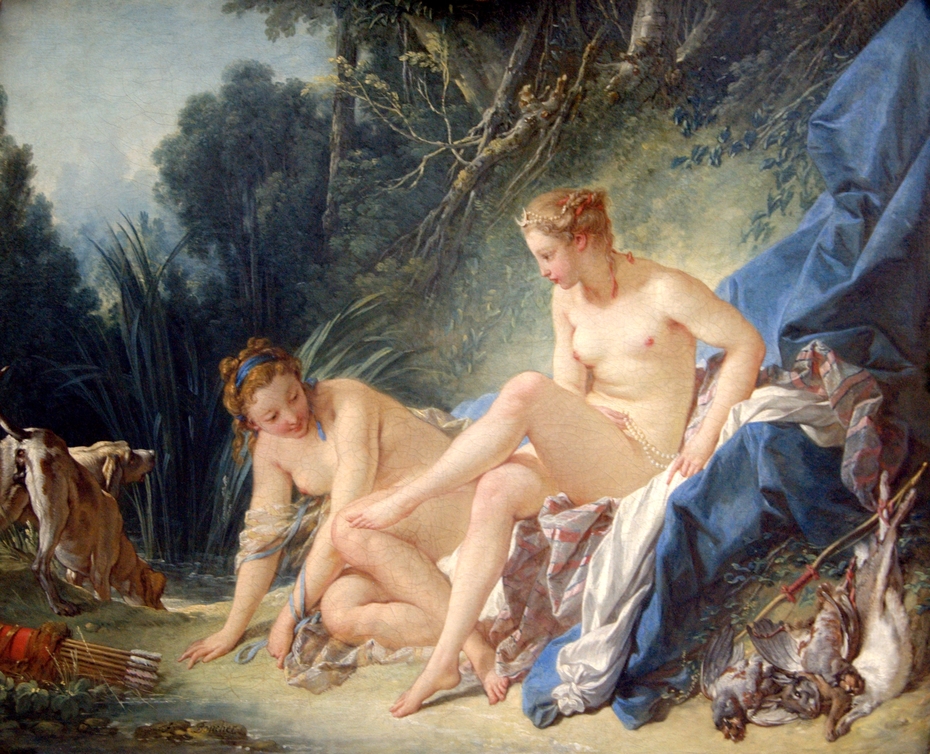
Diana Leaving Her Bath

Francois Boucher, Diana Leaving Her Bath, 1742
BY CARLY HOFMANN

In Diana Leaving Her Bath, Boucher demonstrates his expert manipulation of color, lighting, and form to create an idyllic and erotic portrayal of the innocent goddess, Diana. His subject matter is mythical in nature, but also takes on a sensual connotation. Boucher intentionally contrasts the dark blues and greens around the periphery of the painting with the bright golden tones in the center to emphasis his subject matter. In regards to perspective, the manipulation of color also brings the center of the painting forward, while pushing away elements such as the hunting dogs and forest. The lighting works in conjunction with this structure. The pseudo-natural lighting, possibly a beam of sunlight through the trees, emphasizes Diana and her hand maiden. 

A series of lines run through the painting, creating structure and visual focus. The main linear structure runs from the arms of the assistant, through Diana's legs and up through the infamously reoccurring blue curtain. The painting is very well balanced along this diagonal line and provides an untraditional sense of symmetry. Again, Boucher sticks with his trademark circular composition. In regards to form, the bodies of Diana and her aid are very proportional and anatomically accurate. They are crafted in a delicate and sensual manner that is aided by the texture of the brushstrokes. The soft, feathery, and well blended strokes around the skin add to the ethereal effect of the painting. 


Beyond the formal elements of the painting, Boucher has crafted a very specific narrative. Diana is identified by her signature attributes: the golden crescent settled in her hair and the bow and game lying next to her. However, most prominent here are the traits in fashion under the reign of Louis XV. Her the milky complexion, small full face, and curvaceous figure are emblematic of beauty standards at the time. 

Her virginal state distances her from any ill intent and she reveals her nudity only out of the necessity of her bath. She does so with total frankness and lack of prudery, like a novice to the world of romance. Diana is presented as a ravishingly pretty and demure girl. Many critics describe Diana as having “a voluptuous vacancy on her face” and argue that the lack of animation in her expression increases her charm. Her features reveal nothing of the hard-hearted goddess of the hunt. Though Diana is so desirable, she seems without desires, in a state of innocence that borders on ignorance. She is almost aloof in her routine. 

Boucher is above all interested in the relationship between the body and nature. The intense blue of the drapery is offset by the rosy freshness of skin and the subtle green of the landscape. The treatment of the nude female body is particularly delicate here and the modeling of the body is sensual, yet realistic. Boucher’s depiction of Diana reflects a totally human woman. His idealizing touches are restricted to the refining of the ankles and wrists, the arc of the brows, and the deeper red tinting of the lips. 

The most famous story relating to a bath of Diana is that in which the hunter Actaeon, coming across the bathing goddess, spies on her. Diana in her anger at Actaeon, who once boasted that he was her equal in hunting, causes her to turn the man into a stag. His own hunting hounds devour him. Is this painting a recreation of the pose of a goddess only recently having dealt with an affront to her glory? A goddess who calmly returns to her routine as her servants serve and her subjects reel in terror? 

  • 7:00 AM

The Triumph of Venus

Francois Boucher, The Triumph of Venus, 1740

By ZOE BROUS

When I first absorbed Francois Boucher's Triumph of Venus, I was originally bombarded with chaos. However, Boucher uses overwhelming motions of nymphs, dolphins, and baby cupids to convey the intense praise that Venus receives. Movements of the different subjects overwhelms Venus. After I processed the abundance of naked bodies, I then began to appreciate Boucher’s complexity. 

The multiple subjects convey an abundance of emotions, with each character’s eyes wandering somewhere different. Despite the surplus amount of humans, Venus acts as the main subject. Venus is the god of love, sex, beauty, and fertility. Although Venus is the same shape and size of the other women, she stands out to me. Her position is higher above the other humans, which portrays status. Boucher also plays with light by illuminating Venus. Dolphins, nymphs, and cupids bombard and honor Venus. According to Greek mythology, Venus was born in the sea out of a clam. In the painting, Venus receives pearls inside of a clam, which alludes to her birth. Boucher honors and pays tribute to Venus’s beauty and love. The notions of love and nature perfectly contribute to the Rococo movement.

Boucher paints his well-known circular motions in Triumph of Venus. The circular motions are displayed in the fabrics held by the cupids. Boucher includes both wind and wave circular motion. The waves creates drama with circular motion. The motion continues towards the top of the canvas up the sharp cliff. The circular brushstroke make Venus the center of the movement. Furthermore, Boucher’s circular brush stroke movements pays tribute to Venus. 

Boucher plays with light and dark. The dark waters complement and place a glowing effect on Venus and the other naked humans. The lighter complexion of the human’s skin makes them stand out from the darker waters. The light and dark clouds distinguishably set a horizontal separation of the painting. The light and dark blue colors create a distinct composition of the landscape. The delicate blues in the waters and clouds set a satisfying and lighthearted tone. The light blues contribute to the playful Rococo qualities. Boucher plays with fantasy and imagination. Boucher perfectly combines traditional mythology with a twist of playfulness and sexual elements.
  • 7:00 AM

Rinaldo and Armida

François Boucher, Rinaldo and Armida, 1734
By MISSY ROSENTHAL

Boucher's Rinaldo and Armida elevates the classic figures from the 16th century epic poem. Rinaldo and Armida are the two central characters in "Gerusalamme Liberata"( Jerusalem Delivered) written by Torquato Tasso. Gerusalamme Liberata takes place during the first crusade. An army captain, Rinaldo, was spotted by the king's sorceress, Armida, she in turn kidnaps him and takes him into the Garden of Pleasure. In the Garden of Pleasure, Armida places Rinaldo under a spell to fall in love with her. Rinaldo's General and his brother decided to save Renaldo by finding a hermit to break the spell. The hermit gave them a diamond mirror that was percieved to cure Rinaldo's infatuation. The two soldiers found the hidden garden and broke the spell, leaving Armida heartbroken for eternity. 


Boucher places the two subjects in the Garden just as the two soldiers are about the break Armida's spell. The artists places the lower and the cherubs in a circular composition. The red fabric engulfing the two lowers shows their infatuation with one another. The piece is lit by a singular white cloud, while the rest of the background's grays are meant to symbolize the impending doom for Armida. Boucher splits his work by using many diagonals. These diagonals give focus to the two main subjects by creating staging for the piece. 

The realistic fabrics are true characteristics of Boucher's works and the Rococo movement. The Rocco movement showcased the life of the aristocracy. The incredibly wealthy were often well read and this portrait portraying classic literature and architecture are other example of the movement. Boucher's masterful portrayal of "Gerusalamme Liberata"showed the best of Boucher and the Rococo time period.
  • 7:00 AM

The Secret Message

The Secret Message, Francois Boucher, 1767
By ANTHONY MADISON

Francois Boucher was a French painter that worked with the Rococo style of art. Most of his painting have similar structures with a small opening for the sky on the left hand side with the subject normally in the middle. Boucher also chooses to incorporate animals and a blue tarp, which is seen on the left under the woman's straw hat. The painting depicts a dove bringing a woman a message in the woods most likely from a lover of hers. With the title, the action in the painting becomes more clear. It adds an actual substance or meaning to the paper the woman is holding. The way the woman is staring at the dove, it forces the feeling of love upon the viewer.

In the painting, Boucher seems to have intentionally made the background get darker the further you look from the subject. The woman's body is well lit and you are able to see every single one of her features, which is the point. But, as you looks around the edges of the canvas, it gets harder and harder to make out what is around her. The blue tarp is so poorly shown it almost looks like it is just a part of the woods. The balance between the light and dark sides of the canvas make for an easy to look at picture. The balance allows your eyes to easily glide across the different colors and shades from the foreground, all the way to the subject.
  • 7:00 AM

A Portrait of Madame Pompadour

François Boucher, A Portrait of Madame Pompadour, 1756

by ELISE FINN

For someone who knows nothing about the French Rococo style might think that A Portrait of Madame Pompadour is another portrait of some rich lady painted long ago. However, the portrait represents more than money and fame. It celebrates the success of an unlikely woman and incorporates the beauty of Boucher's artistic methods. 

The woman in the painting is Jeanne Antoinette Poisson, the chief mistress of Louis XV. Known modernly as an undesirable title, Madame de Pompadour took the name and made it her own. She commissioned François Boucher to paint a number of her portraits, and her fame grew within French royalty.

Boucher uses blue and pink, both popular colors of the Rococo style, to catch the attention of the viewer and direct it to the most important part of the portrait, the dress. They contrast with the gold curtains positioned next to the woman, creating this center focus on her. Boucher uses light to further focus the attention on the woman by shining the light from the window to focus on the woman's chest and face. Her pale skin shines. She sits in a relaxed position, looking away from the viewer, creating an air of importance about herself. The dog beneath her represents a symbol of loyalty, fidelity, yet its use seems ironic considering it's featured in a portrait of a mistress.

I was attracted to the slightly curved lines. The lines create the intricate ruffles of the dress, a beautiful way to bring its elegance to life. My eyes follow the ruffles of the dress and notice that they form a triangle at the bottom of the dress. Each line directs your attention to a different part of the woman's body. After looking at the portrait so many times, I realized that the background is actually a mirror, yet it does not picture the artist. The exclusion of the artist from the painting further proves the point that the mistress is the only focus. 

Although the portrait focuses on the importance of the woman, Boucher's famous use of a blue tarp in most of his paintings serves as a signature of his and informs the viewer that this work is his own.
  • 7:00 AM

Diana Leaving the Bath

Francois Boucher, Diana Leaving the Bath, 1742
By LISA MAEDA

Let's be honest. Upon encountering this scene, these ladies would make sure you would leave with a face full of arrows. Luckily for you, they won’t notice, as Francois Boucher has conveniently frozen them in place.

Boucher puts us in an awfully uncomfortable position. We peep in on an intimate scene meant to be shared by only Diana, an esteemed Roman goddess, and her assistant. Freshly bathed, they emerge from the waters to their repose on land. She poses, cross legged and relaxed. Her helper leans forward, examining the fair deity to assure her cleanliness. Remnants of today’s excursion hang off Diana’s bow – a not so subtle reference of her hunting excellence. Yet, even with that blunt reminder of the goddess’s ferocity, the Diana of the moment is unaware of our presence.

Though the two women are at the focal point of the picture, Diana takes precedence. She adheres to the bodily fashion of the times, an intentional gesture by Boucher to make the painting more appealing to collectors. It’s no wonder that his character was brought under scrutiny after he began producing paintings more on the bare side. Even more so, when he reduces divine women into vulnerable young girls. Diana Leaving the Bath is a prime example of this concept. Everything seems a smidge too perfect, especially from a man’s point of view. Her bow has been tossed aside to focus on her unblemished figure, a testament to her oath to remain pure. Rather than a goddess, she is reduced to an idealized symbol of virginity. Way to be gross, Boucher.

So why buy it? To show that you’ve tamed the goddess, of course. Sure, she’ll never take a man’s hand in marriage, but that doesn’t mean a man can’t own her. Put it up on your mantle and have a good laugh with the guys! Or, thoroughly upset your wife. Either way, this pervasive piece of art will make an unforgettable impression.

Editor's Note: The authors were asked to write sales copy for Edme-François Gersaint, the prominent rococo art dealer who offered a printed catalog of available works.
  • 7:00 AM