Adoration of the Magi

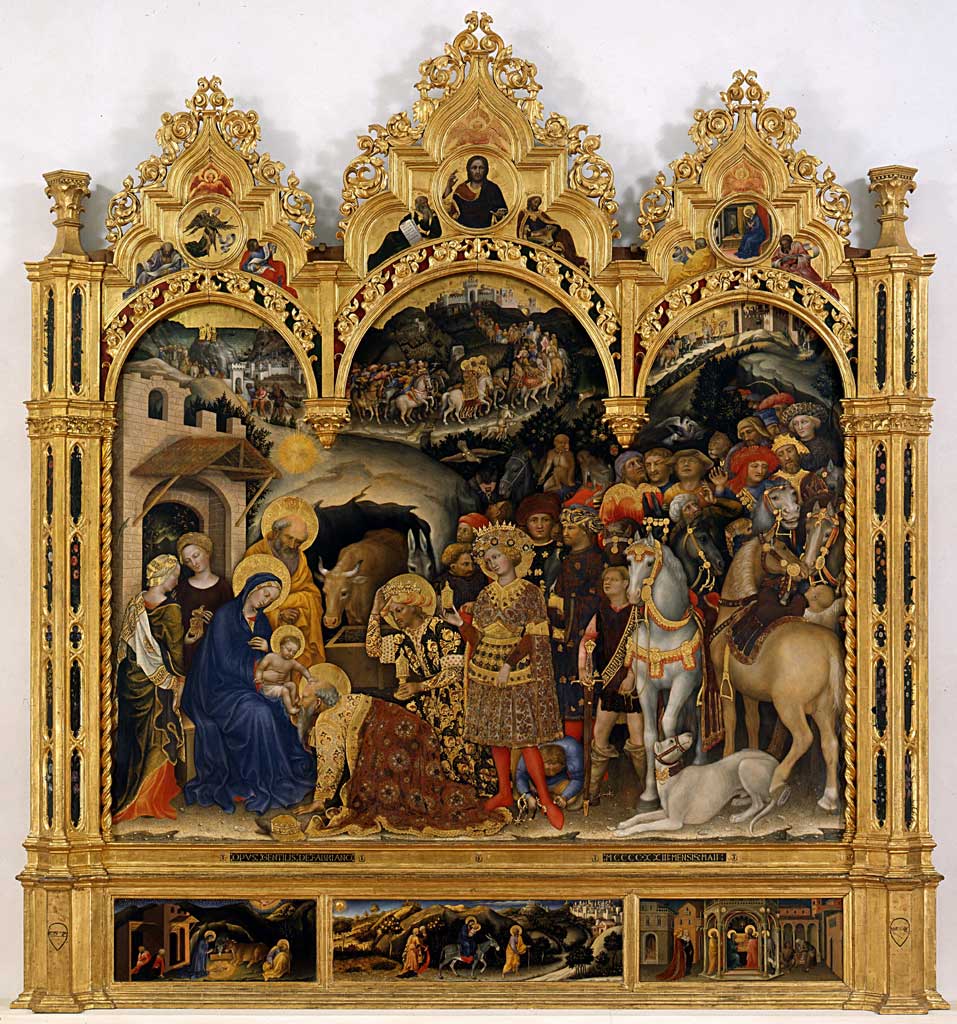
Gentile da Fabriano, Adoration of the Magi, 1423
By LIBBY ROHR

I stand in the dim light of the church, watching the dancing glow of candles flicker on the altarpiece in front of me as I pray. Reds, blues, and golds burst into life and seem to move with the shifting light. To me it seems glorious and decadent, a symbol of the majesty of the Lord. My knees are growing weary pressed against the hard ground of the Santa Trinità church. Outside the sun is beginning to set, and I can hear the final bustles of the day slowly winding to a halt in the streets before the people of the night emerge. Florence is moving outside as fast as it ever has before but here it is silent. Here I am at peace with God. 

In my church, I have stared at the altarpiece for hours upon hours in the couple of years since it has been here accompanying the sermons of our priest. He speaks with vigor and devotion and his stories come to life on the walls of this church, but none so like the scene of adoration at the altar. So detailed in vibrant color, I can never manage to tear my eyes from its glory. I look at the waves of those so devoted to a child, hardly born, the son of my God. They exalt and adore Christ, demonstrating the dedication I have learned to live by. This image of my Lord accompanies and invigorates my prayer. As I surrender to God further and further, Jesus begins breathes stronger and stronger in front of me.

The silence is at once broken as the doors in the back were thrown open into the church and with the rush of voices, reeking of self-importance, echoed in the structure. I took a deep breath and glanced back over my shoulder. Palla Strozzi, the unbelievably wealthy patron of the church, wearing rich colored garments and waving his arms in demonstration. He wore a proud, boastful expression under his well-groomed beard. He seemed to be addressing the man to his right who appeared equally important in manor and dress. The man to his left was much younger, with curly hair, holding himself proudly stood back a bit from the other two. Strozzi seemed to be showing him off.

I caught a portion of their conversation as he practically shouted into the otherwise quiet church, "You will see how magnificent it is. Young Gentile has a real talent and as you know, only the best for me!"

I watch the trio make their way farther into the nave leaving me unnoticed as they approached the altarpiece. Strozzi asks him to explain his work to the other gentleman, and Gentile swiftly agrees sweeping up towards his work. 

He begins to speak once they are close with passion and I understand he must be the artist, "All around the central work I've included images telling the story surrounding the birth of Christ, all biblically accurate. At these circles at the top here we see the Annunciation in the phase of acceptance, to best express the love of Christ. The middle image at the top is Christ himself at adulthood. The central image shows the adoration of Christ by the three Magi from the east. For the I chose to show lines of people to teach reverence and the vibrant gold to communicate the glory and wealth of God. To emphasize the virgin, she is the only one wearing her color of blue and she holds her hand over her chest to show her reverence. The charity of the wise men comes through the red in their robes. Many wear black as well to symbolize their humility in the presence of the Christ child. Jesus himself wears the white of purity with his hand outstretched in a gesture of blessing. The contrast invigorates even the simplest the onlooker to bask in a passion for the Lord Jesus Christ. Truly, it's one of my greatest works."

Although I do not quite understand the conclusions he comes to for his art, I like what he has to say. I enjoy understanding the deliberation. The two older men go back and forth in pride and praise for the work speaking mostly of its value and what another such work would cost. Having finished my prayer, I stand to exit, tired of their bantering. I make my way, still unnoticed, back down the aisle of the chapel. As I reach the door, I steal a glance back and catch a glimpse of the altarpiece between the forms of the rich men. I ignore them to focus on the small representation of my beloved Christ in front of me before emerging back onto the streets of Florence.
  • 7:00 AM

Adoration of the Magi


Sandro Botticelli, Adoration of the Magi, 1476

By HARPER TRUOG

In The Prince, Niccolo Machiavelli talks about religion as a necessary tool to maintain order among the masses. Machiavelli says that princes should, in the eyes of his subjects, be saint-like. A prince must appear merciful, but is not physically able to be holy. A strong leader has the mindset of doing everything necessary to keep himself in power and his subjects under control; the ends justify the means. Religion is an excellent way of uniting a group of people and support from a church only strengthens that unity.

Sandro Botticelli painted the nativity scene with several members of the Medici family, a wealthy family in Florence. Cosimo de' Medici, the head of the family, is the man kneeling before Mary and touching baby Jesus' feet. Cosimo de' Medici is not a religious figure and was inserted into the painting to display his power. By posing him close to Mary and touching Jesus, people would have assumed that he had some sort of divine power or right. Many people in powerful positions use religion to justify their rule and to unite their subjects.

Machiavelli also discusses if it is better for a prince to be feared or loved. He says that one should strive for both, but if a choice must be made, then fear trumps love. Fear is more consistent than love in people's reactions to a price. The painting by Botticelli is a subtle reflection of that fear. If Cosimo de' Medici is so important that he is on the same level as Mary and Jesus, then what will the retribution be if someone insults them? He is supported by divine figures that represent holiness and whoever crosses him will suffer consequences.

By painting members of the Medici family into a religious setting, Botticelli has elevated their status.

  • 7:00 AM

Adoration of the Magi


 Boticelli, Adoration of the Magi, 1475 
It looks like things have not changed since the Renaissance.  Botticelli constructs Adoration of the Magi to display the social classes of the fifteenth century.  During the 1470s, the Italian classes were separated into four categories.  The relationship between the Renaissance culture and modern society portrays identical behaviors in wealth, greed, and values.
The pompous noble men, furthest from Jesus, reminds us of the “ Vice President Joe Biden.  Biden’s smirks and condescending comments ("That’s a bunch of malarkey" "Oh, now you're Jack Kennedy?") reflect those men in Adoration of the Magi.  Biden outward appearance implies a strong religious faith that cares for the poor.  Nice try, Biden.. and other “generous” Americans, your $5,540 of $379,035 (1.5%) of charitable giving is 6.1% less than the average donations given by the middle class.  Botticelli’s painting delivers the truth behind the hypocritical upper class.

Traveling deeper into the circle, we see a lack of devotion.  While Jesus sits several feet away, Botticelli paints men as if they finished watching five hours of “Dora the Explorer.”  In modern society, we would call this “the Christmas Eve attenders.”  
The people kneeling by Jesus are the charitable givers and the devoted.  As watching a crippled and abandoned Guatemalan woman walk to church every Sunday, the true definition of devotion and charitable giving reflects the poor.  The hope and happiness received by those in need has a significant value compared to all the money in the world. 

Botticelli paints Adoration of the Magi with refection of all social classes.        
  • 7:00 AM

Adoration of the Magi


Giotto, Adoration of the Magi, 1305

Complimented by a background of Giotto blue, Adoration of the Magi depicts the presentation of the Son of God to the three wise men. Even though he's the smallest figure, the eyes of surrounding important (haloed) characters, including the angel on Mary’s left, draw the eye to the swaddled newborn and his mother.

Above Joseph, the star followed by the three magi plummets in the direction of Jesus and his mother, ultimately leading the wise men to their destination. Madonna, shown in a faded blue gown, showcases Giotto’s early mastery of depth by drapery, an artistic element made known and popular by Giotto.

Sent by King Harrod, the three wise men find the infant Jesus and present him with gifts, as told in Matthew 2:11, 

“And when they were come into the house, they
saw the young child with Mary his mother, and
fell down, and worshipped him and when
they had opened their treasures, they presented
unto him gifts; gold, and frankincense and myrrh.”

On a rock beneath the infant Jesus sits a crown that will be placed on the head of the King of Man when he becomes able. Even without it, his halo still exists, indicative of his early regality and the anticipation of his soon-to-be followers. Even in his infancy, Jesus earns the Adoration of the Magi.

  • 7:00 AM