Dear Uccello,
My first impression of you was a simple Google search: “Uccello paintings.” My prior readings of your work hailed you as an innovator of perspective, a great Renaissance artist, perhaps in the ranks of Donatello and Botticelli. But what I saw was a surprisingly mediocre gallery.
Nothing was particularly striking or attention-grabbing. I was disappointed, to say the least. In an era of Ghiberti and Masaccio, your work pales in comparison. In fact, it quite literally pales, as no one bothered to properly preserve any of it and it is now in various degrees of deterioration. No one even bothered to preserve your mosaics, which were supposed to have been great masterpieces. However, based on your paintings, I am forced to question the accuracy of this statement. Clearly the tastes of patrons were less refined than modern perspectives.
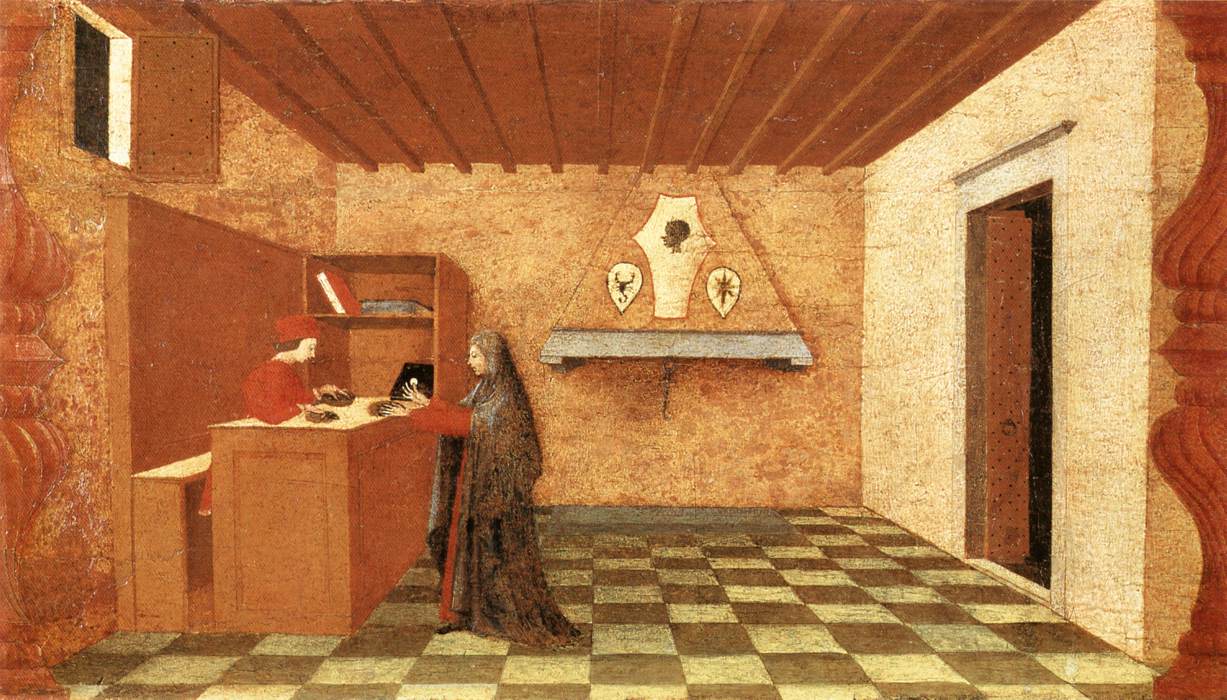
And then there is the question of your so-called perspective. I find it hard to believe that you spent hours on end in your workshop mastering the art of vanishing points and size relativity. For, had you really mastered these skills, your paintings surely would have utilized them? Or so one would think. Yet I look at The Miracle of the Desecrated Host and see botched perspective and unrealistic proportions. Why are the figures in Scenes from a Monastic Life as tall as trees? And, what really gets me is your strategic placement of lances in The Battle of San Romano, which serve to guide the viewers’ eye along the lines of perspective that you so clumsily created. This cheap shot at fabricating vanishing points only confuses viewers and adds to the chaotic untidiness of the painting.
So, why do you keep trying?
After studying your works for the better part of two weeks, I can decisively say that we are not on good terms. I do not like you, Uccello. I would rather look at a Fra Angelico or a Verrocchio. The only enjoyment I get from looking at your paintings is from laughing at them. Both representations of Saint George and the Dragon are laughably outrageous, The Hunt is filled with anatomically bizarre animals, and your cartoonish characters in pretty much all of your paintings are endlessly amusing. Your legacy is average at best. I will not apologize for my opinions in this letter, but I will leave you now to rest.
My first impression of you was a simple Google search: “Uccello paintings.” My prior readings of your work hailed you as an innovator of perspective, a great Renaissance artist, perhaps in the ranks of Donatello and Botticelli. But what I saw was a surprisingly mediocre gallery.
 |
| Paolo Uccello, The Battle of San Romano, 1435 |
 |
| Paolo Uccello, Miracle of the Desecrated Host, 1466 |
 |
| Paolo Uccello, The Hunt, 1470 |
After studying your works for the better part of two weeks, I can decisively say that we are not on good terms. I do not like you, Uccello. I would rather look at a Fra Angelico or a Verrocchio. The only enjoyment I get from looking at your paintings is from laughing at them. Both representations of Saint George and the Dragon are laughably outrageous, The Hunt is filled with anatomically bizarre animals, and your cartoonish characters in pretty much all of your paintings are endlessly amusing. Your legacy is average at best. I will not apologize for my opinions in this letter, but I will leave you now to rest.
Sincerely, Emma Krasnopoler