Art for the Private Viewer - Reclining Nude

Art for the Private Viewer
The Broad Usage of Sexual Figures in Art
Curated by Sree Balusu

Amedeo Modigliani, Reclining Nude, 1917
"She represents a powerful male fantasy of a highly sexual, supremely confident, alluring female offering endless pleasure and a bit of danger." Book 1, Chapter 1: The Siren, p. 11

Amedeo Modigliani is famous for his large series of nude paintings. These nudes lie on a dark bed cover that intensifies the glow of their skin. Their slender bodies span the width of the canvas. Their hands and feet often remain outside the frame of the image. They usually face the viewer, drawing him in temptingly and alluringly.

There is a key difference between Modigliani's nude paintings and many of those from earlier centures: the issue of context. Many earlier nude paintings had mythological or anecdotal context. Modigliani's paintings do not. In fact, Modigliani even said "The function of art is to struggle against obligation."

Modigliani believed that his paintings need only to depict the subjects he thinks of and not to serve the purpose of representing some separate concept. In his mind, art was not meant to be a slave to outside influences.

As expected, Modigliani's women appear more frank and outwardly provocative.

This painting is an example of how sexual figures in art have been used to create an erotic and inviting feeling for the viewer, while giving off an aura of mysteriousness and uncertainty. It is also remarkable in its depiction of eroticism for its own sake, instead of for representing mythology or literature.

  • 10:49 PM

Art for the Private Viewer - Nude Descending a Staircase No. 2

Art for the Private Viewer
The Broad Usage of Sexual Figures in Art
Curated by Sree Balusu

Marcel Duchamp, Nude Descending A Staircase No. 2, 1912
Here Duchamp combines futurism and cubism to create an artwork that depicts the movement of a human (in this case a naked person). Duchamp admitted being influenced by stop-motion photography, most notably Muybridge's Woman Walking Downstairs. Duchamp said, "If a shadow is a two-dimensional projection of the three-dimensional world, then the three-dimensional world as we know it is the projection of the four-dimensional Universe."

Duchamp's unique way of perceiving reality influenced his work on this painting. Instead of simply painting an unclothed woman in the midst of walking down a staircase, he painted a series of frozen moments in time that show a progression of movement using a nude figure constructed from geometric shapes and lines.

The geometry that Duchamp uses to construct the figure conveys its movement as the lines and shapes meet at differing angles. The viewer can also see the downward orientation of the staircase in the foreground and a series of steps in the background that show that the woman is descending the staircase.

Duchamp's Nude Descending a Staircase is an example of how nude figures in art have been used abstractly to represent human motion and form, rather than any themes or symbols.

  • 10:22 PM

Art for the Private Viewer - Blue Nude

Art for the Private Viewer
The Broad Usage of Sexual Figures in Art
Curated by Sree Balusu

Henri Matisse, Blue Nude, 1907
"Androgyny refers to a specific way of joining the 'masculine' and 'feminine' aspects of a single human being."--June Singer

This painting was met with complaints almost immediately. In 1913, during the an exhibition of the infamous "Armory Show" at the Art Institute of Chicago, it was burnt because it offended critics and viewers.  

Matisse painted Blue Nude after one of his sculptures depicting this figure shattered. When looking at the painting, one can see that though the subject is clearly a woman, it has certain male characteristics in its body form. Matisse did say, "What interests me most is neither still life nor landscape: it is the human figure."

According to some, Henri Matisse added the woman's muscular arms, thick neck, large feet, and short hair to create a painting of a subject that had his own form mixed into it.

One can also see a similarity between the subject's form in this painting and primitive art. For example, the large buttocks of the woman in this painting are quite like those of figures in cave paintings. Interestingly, the figures in said cave paintings were men, which further strengthens the notion that this figure is intentionally androgynous.

Using a uniquely constructed naked figure, Matisse managed to create an interesting fusion of Primitivism and Fauvism that became part of his collection of modern art.

  • 10:45 PM

Art for the Private Viewer - Man with Red Drapery

Art for the Private Viewer
The Broad Usage of Sexual Figures in Art
Curated by Sree Balusu

Man with Red Drapery, John Singer Sargent, After 1900

"Once I pass'd through a populous city imprinting my brain for future use with its shows, architecture, customs, tradition,
Yet now of all that city I remember only a man I casually met there who detained me for love of me,
Day by day and night by night we were together - all else has long been forgotten by me,
I remember I saw only that man who passionately clung to me,
Again we wander, we love, we separate again,
Again he holds me by the hand, I must not go,
I see him close beside me with silent lips sad and tremulous."
-- Once I pass'd through a populous city
, Walt Whitman

Many who argue that John Singer Sargent was gay, point to a series of paintings (which includes this painting) depicting men in sexual poses as clear evidence.

The naked man has only his dark red drape covering him as he poses erotically. The man expresses longing (possibly for a lover), as his arm is thrown upward while his head is tilted far back. The subject may remind viewers of a stage actor. Looking closely at the man's posture, we can see how it is poetic and even theatrical in its depiction of the sadness in being separated from a lover.


Sargent did say "Cultivate an ever-continuous power of observation. Wherever you are, be always ready to make slight notes of postures, groups and incidents. Store up in the mind... a continuous stream of observations from which to make selections later. Above all things get abroad, see the sunlight and everything that is to be seen." He thoroughly follows this idea in Man with Red Drapery, as he creates a very specific figure that shows unhappiness.

This painting is an excellent example of the way that sexual figures in art can be used to create an aura of grief and nostalgia.

  • 10:31 PM

Art for the Private Viewer - Death of Marat

Art for the Private Viewer
The Broad Usage of Sexual Figures in Art
Curated by Sree Balusu

Edvard Munch, Death of Marat, 1907
On July 13, 1793, Jean-Paul Marat was murdered by Charlotte Corday, a woman who opposed his political propaganda and decided to act.

There is apparent nudity in this painting, and Munch's use of a sexual theme in which to depict this scene creates both a powerful symbolism of this murder.

Similar to David's Cupid and Psyche, Charlotte Corday is white in color, which seems to reference purity. This could allude to her clarity and her vision. She believed in ridding the country of the unjustified hate and political manipulation that Marat had created.

It is important to note the placement of blood in this painting. There is a large blot of blood stained on the bed where Marat lies dead, which signifies the blood from the wound where Corday stabbed him. However, there is also blood on the very bottom of Corday's legs. It looks as though Corday and Marat have just finished sexual intercourse and that Corday has given birth to the murder.

Corday and Marat's sexual intercourse is a physical union that symbolizes the historical union of these two figures. Without Marat's death, Corday would not have become a famous/infamous historical figure. Without Corday's killing him, Marat would not have become renowned as a saint through the work of Jacques-Louis David, who forever changed Marat's image.

Because of David's painting, Marat became publicized as a martyr for supporters of his political party (which explains Munch's use of a crucifixion pose to depict Marat on his bed). Through the lens of history, Corday and Marat are inseparable, which is symbolized by the proximity of Corday and Marat's right hands.

Through the concepts of physical union and reproduction, Edvard Munch accurately depicts both Corday and Marat's place in history along with what they are remembered by -- the murder, which is effectively their child.

  • 5:14 PM

Art for the Private Viewer - Cupid and Psyche


Art for the Private Viewer
The Broad Usage of Sexual Figures in Art
Curated by Sree Balusu

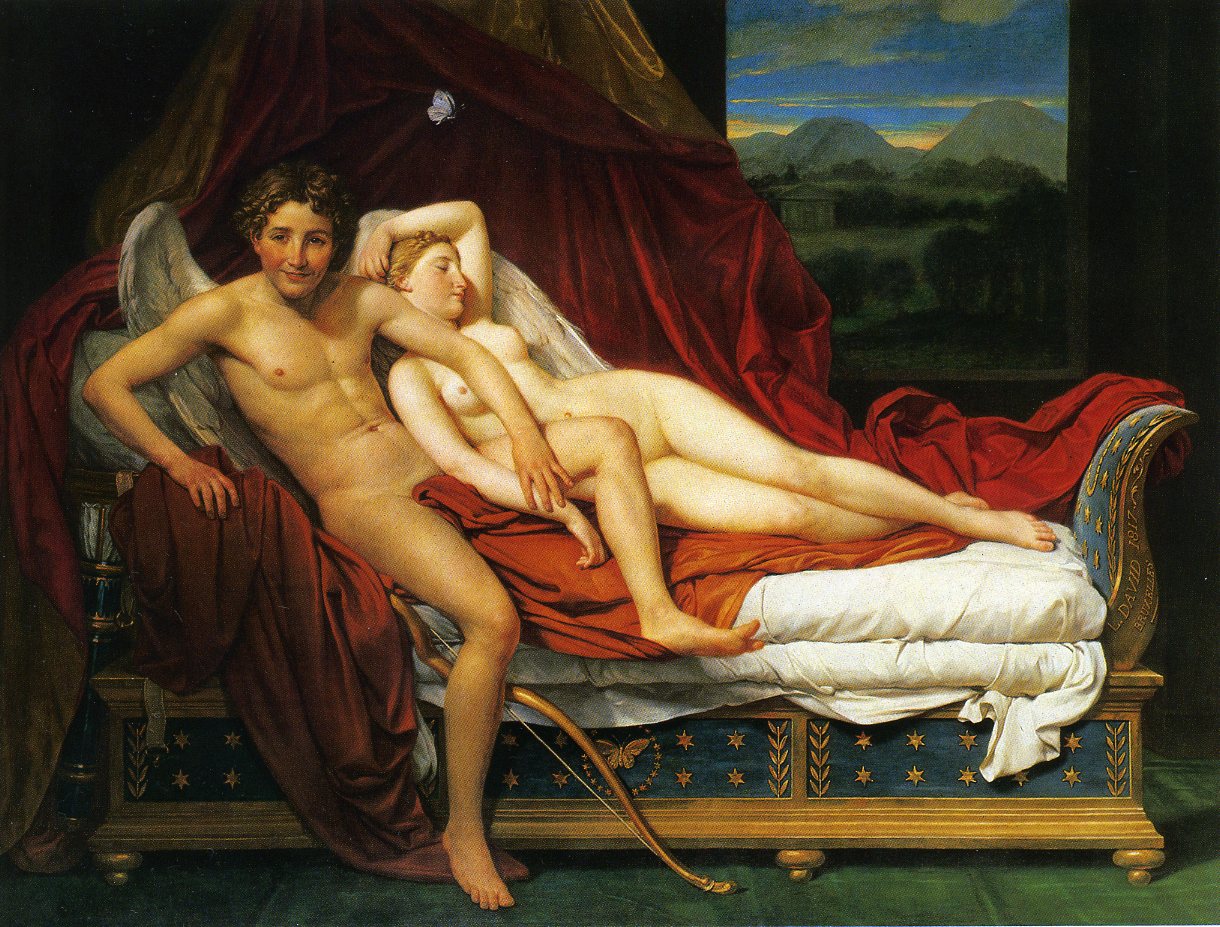
 Jacques-Louis David,Cupid and Psyche, 1817

"Cupid prepared to obey the commands of his mother. There are two fountains in Venus's garden, one of sweet waters, the other of bitter. Cupid filled two amber vases, one from each fountain, and suspended them from the top of his quiver, hastened to the chamber of Psyche, whom he found asleep. He shed a few drops from the bitter fountain over her lips, though the sight of her almost moved him to pity; then touched her side with the point of his arrow. At the touch she awoke, and opened eyes upon Cupid (himself invisible), which so startled him that in his confusion he wounded himself with his own arrow. Heedless of his wound, his whole thought now was to repair the mischief he had done, and he poured the balmy drops of joy over all her silken ringlets."
Bulfinch's Mythology

After Cupid pierces himself with his own arrow, he falls in love with Psyche. He eventually starts to come stay with his wife only at night times, having to leave immediately at dawn. Cupid is the symbol of love and the meaning of "Psyche" is soul. Therefore, this painting shows the post-physical union of love and the soul.


Both Cupid and Psyche lie naked in bed. Cupid is getting out of bed ,while Psyche is still laying down on her side. The painting accentuates Psyche's hips and curvaceous figure to increase the sensuality of the scene. Her white form and figure represent, ironcially, purity and beauty. Cupid has a smile on his face and the bow pointed toward the ground symbolizes his, ahem, satisfaction. While both subjects of the painting are naked, David uses the positions of Cupid and Psyche's bodies to provide an interesting contrast between innocence/purity and sexual desire/satisfaction.

David's Cupid and Psyche is one work of art that proves that it is not nudity itself that necessarily provides the sexual tone in art, but rather the position and physical orientation of each subject's body.

  • 5:14 PM

Art for the Private Viewer - Nightmare

Art for the Private Viewer
The Broad Usage of Sexual Figures in Art
Curated by Sree Balusu
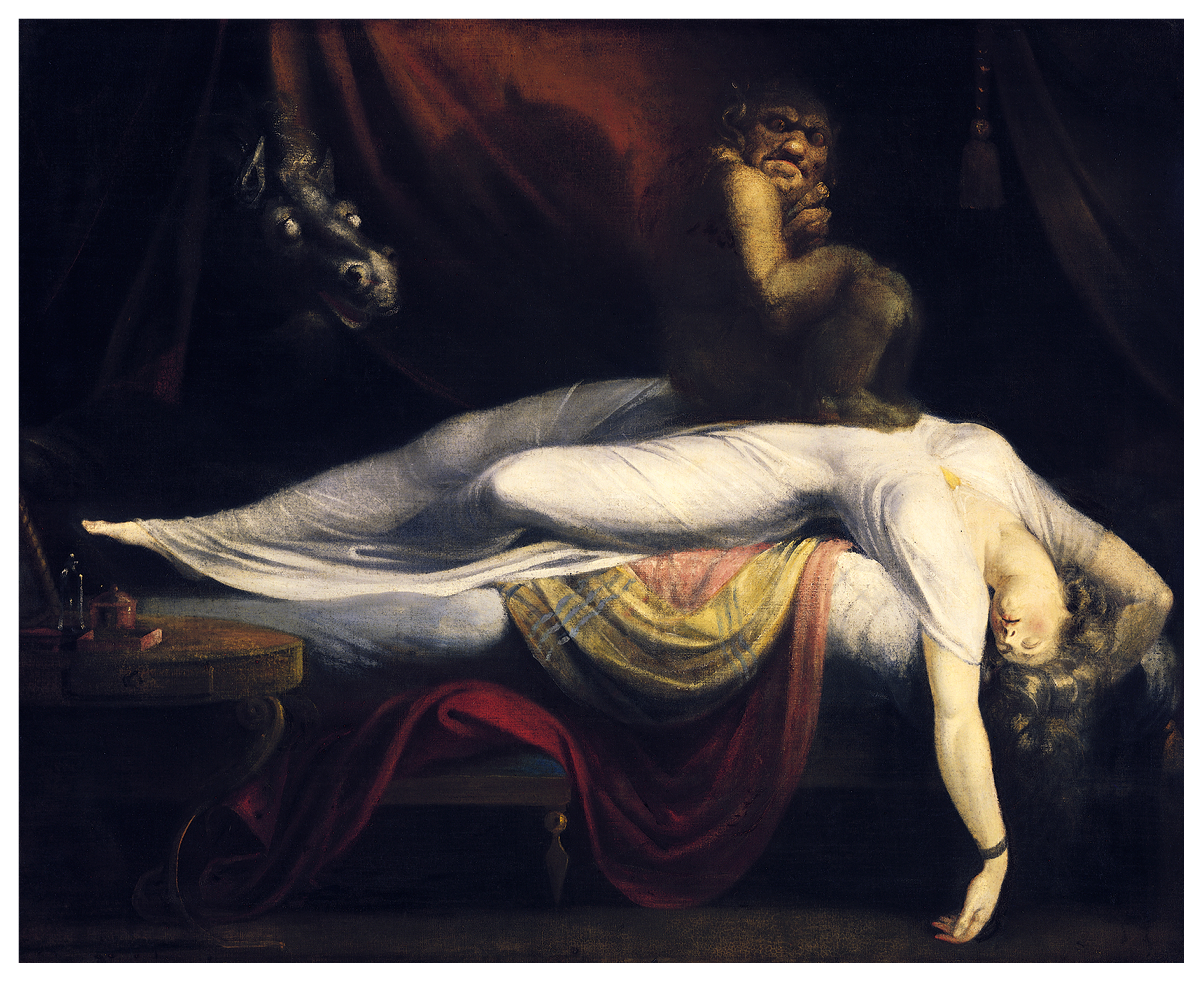
Henry Fuseli, The Nightmare, 1781

"I was bewildered, and strangely enough, I did not want to hinder him. I suppose it is part of the horrible curse that this happens when his touch is on his victim." Dracula, Bram Stoker

An inundatory combination of horror and seduction, Fuseli's Nightmare portrays a woman trapped and helpless in front of a sex-craving monster. The demon sits atop and crushes her to hold her in place while a devilish horse gazes from the menacingly dark-red curtains. Though she initially fears and resists the demon's advances, the woman eventually submits as the red blanket falls from her bed to the floor. Forced into submission, the woman assumes a revealing position that accentuates her legs and leaves her chest upright as offerings to the hungry demon.

One of the popular interpretations of this painting is its depiction of Henry Fuseli's relationship with Anna Landholdt. Fuseli fell in love with Landholdt, the niece of Johann Lavater (a good friend of his), and intended to marry her. However, Anna Landholdt's father disapproved the proposal to marry his daughter to Fuseli and instead had her married off to a family friend. In a letter to Lavater, Fuseli described a dream he had of Landholdt:

"Last night I had her in bed with me--tossed my bedclothes hugger-mugger--wound my hot and tight-clasped hands about her--fused her body and soul together with my own--poured into her my spirit, breath and strength. Anyone who touches her now commits adultery and incest! She is mine, and I am hers. And have her I will...."

The demon in this painting represents Anna Landholdt's husband who Fuseli imagines as a monsterous figure abusing the woman that is rightfully his. The horse represents Fuseli as he gazes perpetually at the horrific scene and at the woman he can never have.

Fuseli's painting provides interesting contrast to other paintings that depict sensuality, as it portrays this unusual yet fascinating mixture of fear and sex. It is a testament to the thematic flexibility of sex in art.

  • 10:19 PM

The Match Seller

Otto Dix, The Match Seller, 1920
As a World War I veteran discharged of service after a neck wound, Otto Dix had first hand experience and exposure to the ugliness of war. As a post-World War I painter, he became known for his artistic criticisms of Weimar society.

Many of his paintings, such as this one, ridiculed the elite and showed the horrible conditions of soldiers and war veterans.

The Match Seller depicts a war veteran who has lost his arms, legs, and sight due to injuries. Despite the service he gave for his country (which was propagandized while the war was going on as a heroic effort that deserves recognition), the only attention he gets is a Daschund urinating on him. While this is going on, the wealthy citizens of Germany are walking around him in all directions as if he is just another beggar. Dix also emphasizes the stark difference in clothing: the legs of the citizens around the veteran depict fancy clothing, while the veteran sits crippled in tattered cloth. This veteran is not getting any respect or recognition.

Just as this match seller is disgraced and stripped of all respect, Otto Dix received the same sort of treatment (at least in a certain period of his life) after the Nazis took power. Hitler hated modern, and Dix drew special attention as a prominent voice in the anti-war movement, because of which he was stripped of his professorship at a German university. His paintings were quickly displayed in the Degenerate Art Museum in Munich. Many of them were later destroyed. After a few years, Otto Dix was drafted into the German military but soon became captured and put into a French facility for war prisoners. This lasted the duration of the Second World War.

After the war Dix did, fortunately, come back into painting and continued working until his death in 1969.

  • 12:00 AM

Portrait of Carolus-Duran

John Singer Sargent, Portrait of Carolus-Duran, 1879
By age 13, John Singer Sargent spent much time studying paintings in museums. Everywhere he went, he took his notebook to sketch and paint what he saw. Mrs. Sargent (John's mother) had friends who encouraged her to arrange professional training for her son. It was a result of this early interest that Sargent met Carolus-Duran.

Sargent first met Carolus-Duran in 1874, when his parents enrolled him in Ã‰cole des Beaux-Arts, an art school in Paris. Carolus-Duran, after assessing Sargent's portfolio, decided to let him study art as his pupil. According to Carolus-Duran, Sargent was to unlearn certain methods he had acquired, but expressed optimism at the young boy's natural talent.

He quickly became one of Carolus-Duran's best students and gained the respect of his peers through his sheer innate ability. The school emphasized the importance of drawing as the foundation of visual art, while Carolus-Duran had his own ideas. He focused on manipulating the paint sensuously. Carolus-Duran held that artists should paint in a fluid way.

Originally, Sargent was interested mainly in landscapes (which explains his numerous sketches of mountains and seas). However, after studying under Carolus-Duran, he developed an interest in creating art out of the people he met. It was with Carolus-Duran's guidance that Sargent started his career in portraiture and gave him an interest in the subject.


  • 12:00 AM

Ophelia and Being Dead

John Everett Millais, Ophelia, 1851
"She did not have the leisure or the knowledge to be fearful. She just felt -- for a tumbling instant -- like she'd often felt at night, half conscious in the falling shudders of a dream. Winded, weightless and betrayed. Hear heard collided with her ribs. Her body shook and arched. Her head was loose and hurtling through rimless chambers. Some conjuror had vaporized the earth and emblazoned all the space through which she fell with pixilated, pulsing lights. Her final moments were kinetic, abstract, pointillist."--Jim Crace, Being Dead.

Millais's Ophelia depicts Ophelia, from Shakespeare's Hamlet, floating in a river just before she drowns and meets her demise. Ophelia's face symbolically reflects her quickening transition from life to death, as her eye lids seem to be on the verge of closing. She is surrounded by a pitch-black pool that seems to be draining the life out of her. In addition, the painting's representation of her body position shows a sinking movement. Her waist seems to be pulling her down under water while her hands drifting right above the water with curled fingers, exhibit a drowning sensation. It seems as though death itself is sucking Ophelia into its grasp--a bottomless pit of despair.

While Millais's painting of Ophelia shows a girl in despair, it also showcases a type of romanticism of her situation. Though the black water is murky and sinister, the dying Ophelia is depicted rather beautifully through her facial features, dress, and flowers floating around her. In addition, her arms are spread out and her facial expression is strangely provocative. Just like Ophelia, Celice from Being Dead is quickly approaching her end. The narration shows rapid progression from the state of consciousness to death. In addition, Celice's physical positions while dying (her head being loose and her body arched) show her vulnerability and weakness in the face of death, just as death sucks Ophelia into the water. Neither ever had a chance and both only committed the "crime" of love. The last main similarity between Ophelia's situation and Celice's situation is that both are victims of nature. Ophelia's body is surrounded on all sides by plants, grass, and other forms of nature which prevent her escape, the same way that Crace's novel expresses the nihilist concept that life is a product of nature and will end in nature's hands with no real purpose.

  • 12:00 AM

Bathers at Asnières

Geroge Seurat, Bathers at Asnieres, 1884
During the later parts of the 1870s, Seurat was a student of the French School of Fine Arts. It was this school that taught him to create sketches and drawings of subjects before putting them directly on a painting. It was thought that this method would allow a smooth preparatory phase in which artists could identify issues so that they could fix these problems and make the final painting closer to perfection.

Asnières is an industrial suburb west located at the Seine River. It is west of Paris. Seurat used live models and created 10 drawings as well as 14 oil sketches. Using these as reference, he created the painting. This painting was the first of Seurat's large scale compositions and came out of a long process.

Painted in 1884, Bathers at Asnières was created before Seurat came up with his pointillist technique. However, after a few years Seurat reworking the painting to include several dots of contrasting color to instill a more luminous effect.


  • 12:00 AM

Evening: Landscape with an Aqueduct

Theodore Gericault, Evening:Landscape with Aqueduct, 1818

Gericault completed Evening during the summer of 1818. This painting is one of the four landscapes painted to portray different times of day.
It highlights the ruins of an aqueduct in the Italian countryside, which Gericault visited in 1817. During his visit to this site, the weather started to become turbulent and sun started to disappear as pitch black clouds invaded the sky. This scenery was quite fitting for the personal turmoil that Gericault had at that time, as he had fathered the son of his uncle’s second wife.
However, Gericault saw this as a sublime scene of beauty and action, which he felt compelled to paint rather than wallow in. Despite his short life of 32 years, it was with this stormy aesthetic that Gericault fathered the styles of emerging Romanticism.
Some critics say that the painting is unusually large for a landscape from that era, and depicting an ambiguous scene, cast in slanting light, of swimmers bathing near a hill town. However, many argue that like other Gericault paintings, Evening is energetic and brilliantly colored.
Unfortunately, Gericault was able to only finish two out of the remaining three landscape paintings (Morning: Landscape with Fishermen and Noon: Landscape with a Roman Tomb) due to the family conflict with his illegitimate son.
  • 1:00 AM

Saturn Devouring His Son

Francisco Goya, Saturn Devouring His
Son
, 1818-1823

As one of Goya’s 13 Black Paintings, Saturn Devouring His Son was painted directly on his house wall—specifically, the wall of his dining room.

During the period it was painted (between 1819 and 1823), Spain was undergoing turmoil as its government, the Liberal Triennium, struggled to stay in power. Government forces seized the royal palace and took King Ferdinand VII prisoner. In 1822 Ferdinand’s supporters staged an uprising in Madrid, which sparked a national civil war. At this point, the government had almost zero power.

Just a year later, France invaded Spain, slaughtered the remaining constitutionalists, and made Ferdinand VII an absolute monarch. The corpse of Saturn’s son portrays Spain’s death at the hands of political strife, while the culprit stands in an almost off-balance position.

A giant monster, Saturn, opens his mouth wide open to chomp off another piece of his son’s body. However, while covering the left side of Saturn’s face, the observer notices a scared, frail middle-aged man constantly regretful of what is happening. When covering up the right side of Saturn’s face, his left eye stares piercingly at the observer. Saturn is a fierce Titan stopping at nothing to assert his dominance. Supporters of both the constitutional government and the monarchy were themselves terrified of the violence in Spain, but masked their feelings with a false sense of confidence.

In the end, revolutionaries promoted their own agendas at the expense of the country, just as Saturn sacrificed his sons in an effort to continue his rule.
  • 1:00 AM