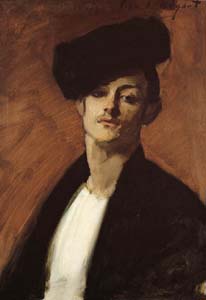
Albert de Belleroche

John Singer Sargent. Albert de Belleroche. 1883.
The way John Singer Sargent and Albert de Belleroche met was the prelude to a beautiful bromance. Belleroche, then a student at Carolus-Duran’s studio, happened into Sargent’s favorite restaurant one night in 1882. The two had met briefly once at a dinner honoring their mentor Carolus-Duran, but they did not know each other then. On that night at L’Avenue, Sargent was so captivated by Belleruche’s slender figure and exaggerated features that he sketched Belleroche without him knowing it. Later Belleruche was overjoyed to find his portrait in the restaurant’s album. He tore the page out and took it home. 
John Singer Sargent. Head in Profile of a Young Man. 1883.

The two quickly began friends, sharing a studio space in Paris where they sketched and painted each other. Sargent painted Belleroche in more thirty works of various poses and costumes, ranging from a medieval courtier to a Spanish aristocrat. Even when Sargent focused on his masterpiece of Madame Gautreau, he was thinking about Belleroche. Sargent’s drawing, most commonly thought of as a sketch for Madame Gautreau Drinking a Toast, has been proposed by art historians that Sargent merged Madame Gautreau and Belleruche into one image. The “brooding and romantic quality” in these works, argues Deborah Davis, suggests a relationship went beyond friendship or mentorship.

Sargent had started to draw Amelie but transformed her into Belleroche, an indication of his emotional confusion in that summer of 1883. Some even go as far to say only when Sargent confirmed his desire towards Belleroche had he lifted his artist’s block and allowed himself to concentrate on Madame Gautreau. Could the peripatetic lifestyle and loneliness in Sargent’s early life make him afraid of “otherness?” After all, as an expatriate, otherness was a feeling Sargent knew all too well. Other than his works, however, there is little evidence about the artist’s private life. But if he was gay, does it matter? On the bright side, this speculation gives Sargent scholarship a new direction. Until recently, Sargent was seen as a slick, superficial society painter. Discussions about his sexuality, whether relevant to the art, forces people think about implications of sexuality.
  • 11:50 PM

Pygmalion and Galatea and Twelfth Night

Jean-Léon Gérôme, Pygmalion and Galatea, 1890

From Twelfth Night
By William Shakespeare

If music be the food of love, play on;
Give me excess of it, that, surfeiting,
The appetite may sicken, and so die.
That strain again! it had a dying fall:
O, it came o'er my ear like the sweet sound,
That breathes upon a bank of violets,
Stealing and giving odour! Enough; no more:
'Tis not so sweet now as it was before.
O spirit of love! how quick and fresh art thou,
That, notwithstanding thy capacity
Receiveth as the sea, nought enters there,
Of what validity and pitch soe'er,
But falls into abatement and low price,
Even in a minute: so full of shapes is fancy
That it alone is high fantastical.

Editor's Note: Students were asked to match a poem to a picture. They could do so with or without comment; they could be serious or playful, profound or goofy. We will leave it to our dear readers to make their own connections.
  • 7:00 AM

The Mother and Sister of the Artist

Berthe Morisot. The Mother and Sister of the Artist. 1869-70.

The Morisot sisters, Edma and Berthe, had the same dream of being an artist. Only they ended up with Berthe as the painter and Edma as the painted. Born in a middle-class bourgeois family in Bourges, France, the sisters had their parents’ support to pursue this rather peculiar profession for women. The two artists enjoyed a close relationship until Edma chose marriage and motherhood over an artistic career. In The Mother and Sister of the Artist, Morisot paints her sister as sad, submissive, and completely blocked by her mother. In the late 19th century, the avant-garde Impressionists gained little appreciation from the public or the critics. This criticism was especially harsh on women painters, one art critic dismissed the Impressionists as "five or six lunatics, including one woman."

Morisot depicted mostly domestic mother-and-child scenes, partly because she wished to show women in their everyday life, also because, as a young bourgeoise, she outright could not be seen at the popular cafes and bars that the males painted.  The situation for Morisot and fellow women painters such as Mary Cassatt is clearly shown in Morisot’s relationship with Edouard Manet. Manet painted Morisot more than twelve times but Manet never posed for her. Morisot, anxious about sending Mother and Sister to the Salon, solicited Manet's advice. Rather than offering verbal suggestions, Manet extensively repainted the whole canvas. Manet's suave shorthand, seen in the mother's features and black dress, differs visibly from Morisot’s light touch in her sister's features. “My only hope is that I shall be rejected,” Morisot wrote to her sister in agony. The painting was accepted. 

Painted during 1969-70, four or five years before the First Impressionist Exhibition, this painting already shows the main features of Impressionism. Unfinished, casual strokes and open contours highlight the artistic qualities that Morisot and her close circle practice. The contrast between Edma’s pearl-colored dress and her mother’s black dress enhances a sense of entrapment, both for Edma and for Berthe. The chair leg is an interesting choice, too, in its simple, almost abstract form. 

  • 7:00 AM

A Bar at the Folies-Bergère

Edouard Manet. A Bar at the Folies-Bergère. 1882.

Edouard Manet completed A Bar at the Folies-Bergère during the last two years of his life in 1882. The subject of the painting, the bar, is depicted through a reflection behind the barmaid. This incredibly modern approach creates much mystery and ambiguity that its meaning is still debated among art historians. The big question lies in the inconsistency between reality and reflection. From the way the barmaid’s eyes meet the viewer’s gaze, the viewer should be standing directly facing her, yet the reflection of her and the male customer seems to suggest the viewer’s position is much more to the left. In fact, in Manet’s preparatory sketch of the painting, the reflection adheres more to reality. Manet changed the work substantially from the sketch; was he trying to convey something entirely different through the placement of the mirrored figures? 

Edouard Manet. Oil Sketch for A Bar at the Folies-Bergère. 1881-82.
One argument could be made that the mirrored image is an alternate reality. The barmaid dresses in the standard attire with the revealing neckline that the job requires. In the late 19th century, rapid modernization in Paris led to massive development of the entertainment industry, played out in various bars and nightclubs. The barmaid’s face reveals a profound sadness and blankness as she is trapped in her job and in life; she is exposed, distanced and vulnerable. On the contrary, her reflection indicates the way she is supposed to act, leaning in, intimate and responsive to her male customers.  Therefore the mirrored image contains more than physical but the psychological reflection of the barmaid’s world. In the alternative world, she stands back, meditating on the events that led her to this clearly miserable job. We as viewers are drawn to the sensual, as well as emotional aspect of the painting, wanting to help her escape from reality. Manet conveys his sympathy for the unnamed barmaid, suggesting that women like her are the victims of the bar culture. 

  • 7:00 AM

The Sweet One

Hannah Höch. The Sweet One (Die Susse). 1929.
Collage, a technique now frequently seen on popular social media like Tumblr, had its origins in Germany after World War I. Hannah Höch, among other Dadaists, developed techniques of collage and photomontage as a response to the instability of the Weimar years. In Germany after the Great War, life restored and soldiers returned home to their wives, but there was no joy—streets were filled with crimes and senseless gunfights. Germans felt the humiliation of losing the war and suddenly faced six thousand millions of reparations that had to be squeezed out of their pockets. Post-war confusion haunted every German’s mind, including the avant-garde artists who chose to attack all established institutions, the only way they thought would better the society.

Hannah Höch’s photomontages depicted the turbulence and violence of the era with reassembled pieces and expressive watercolor backgrounds, but above all, she addressed the experience of the modern woman. Her longtime companion and fellow Dadaist Raoul Hausmann, despite his revolutionary “feminist” theories, was psychologically violent to Höch during their relationship. In The Sweet One (Die Susse), the distortions of the female body express Höch’s struggle to establish her identity in her relationship as well as in a society that called for the “new woman.” She took images of beautiful and subservient women from newspapers and cut them up, then recombined them to show their true fragmented, powerless state. 

By violating the integrity of the body, Höch criticized society for the perception of women as literally the sum of their parts. Created in 1929, The Sweet One was a product of “The Golden Years” in Germany. In the late 20s, the price of the war had gradually faded beneath the surface of prosperity. Germans, aware that this artificial abundance wouldn’t last for long, celebrated their overdue peace with excessive spending. As nightlife flourished, women enjoyed more sexual liberation than in past decades of restrictive governance, but also became increasingly objectified by men. Hannah Höch promoted a artistic revolution in body representation and provoked a question that is still relevant today, whether female identity can exist independently of the male gaze.

  • 7:00 AM

The Last Door and Breaking Bad

Georgia O'Keeffe, My Last Door, 1952


“If you take a flower in your hand and really look at it, it’s your world for a moment.” 
---- Georgia O'Keeffe   

This was not her last door, as Georgia O’Keeffe painted nearly twenty versions of the door during various times in a series titled Patio. All of them were dedicated to the same door in her second New Mexican home in Abiquiu, now owned by the Georgia O’Keeffe Museum, the place where Jesse and Jane visit in this flashback. This scene with Jesse and Jane carries so much sentimental value since Jane’s death in season two—the art exhibit Jane keeps nagging Jesse about, Jane’s lipstick traces on the butt of her cigarette, even Jesse’s annoyingly loud yellow clothes seems to remind us of a happier time. Contrary to what Walt believes, Jane has plenty of good influences on Jesse, dating her is like taking a college-level course for him, artistically speaking. 

First thing we see in the opening flashback is My Last Door with two silhouetted figures standing in front of it (unfortunately not included in the clip). Once in the car, Jesse argues that O’Keeffe painted that door to perfection while Jane insists that each time was different, and it was about making that feeling last. The painter herself remarked, “I work on an idea for a long time. It’s like getting acquainted with a person, and I don’t get acquainted easily.” This fixated feeling did not stop at her “last door.” O’Keeffe passionately believed colors’ effect on emotional connection with subjects, considering her last door is depicted entirely in black and white, it suggests O’Keeffe had dropped her paintbrush on a bad note with her door. Many other paintings in the same series are identical in composition, the only difference lies in her choice of color, as if the viewer is traveling in a visual documentation of the ups and downs in her relationship with the door.

This rare colorless painting of O’Keeffe’s echoes with Jesse’s ongoing abasement. The show has never let go of an opportunity to add to Jesse’s miserykicked out of his family, beaten up by Hank, Jane’s death, later Gale, Brock, and Andrea...He tries over and over again to do the right thing, and in his mind, O’Keeffe does the same trying to achieve aesthetic perfection of a door. In the first half of season three, Jesse laments on Jane’s death in his own ways, a fact strongly emphasized through his wardrobe change, another amazing quality of Breaking Bad. He starts dressing predominately in black, and gone are his cheerful combinations of yellows and reds. Like the black negative space, Jesse slowly falls into a downward spiral. 

  • 7:00 AM

Wishbone and Don't Cry

Nikolaos Gyzis, Wishbone, 1878


It’s extraordinary how paintings and music employ only one of our basic senses (sight and hearing, respectively) and yet release so much power. At first I wasn’t sure what about Wishbone by Nikolaos Gyzis reminded me so much of Guns N’ Roses until I saw the Chinese Democracy poster. The brick red background and black clothing are almost the exact shade, and the despair on the woman’s face echoes with the theme of "Don’t Cry," one of my favorites of the band.

"Don’t Crystarts in an extremely calm manner, quiet, serene, as if a whisper in your ear, telling you don’t take it too hard. The lyrics say, “Don’t you cry tonight/ There is a heaven above you baby/ And don’t you cry tonight.” It's a story of sorrow. Axl Rose said in an interview, “The song was [about] a girl that Izzy had gone out with, and I was really attracted to her, and they split up, and we wrote the song.” When I first heard this song, I discovered that a blues balled by a hard rock band brings a whole new level of impact, even the heavy chords, which I used to associate with anger and aggressiveness, hit like a persistent melancholy. Axl’s brilliant ending note seems to go on forever, like a deep sigh, or a desperate plea that ends with the singer’s last breath. 

I came across Wishbone purely by accident. Without knowing anything about the artist or the painting, I searched for any evidence of the circumstances in which the painting was made. But nothing. Then I look at the woman’s eyes, red and puffy, clearly resulted from hours of crying, and I could feel for her loss and misery without knowing her story. Gyzis painted in such realistic style, with his bold choice of color in the background that gives a surprisingly touching quality. Rather than the conventional blues and cool tones when depicting sorrow, Gyzis opted for a dark red that conveys entirely different emotions, much heavier than the blues. The tension between red and black seems to bring the woman’s inner turmoil directly onto the canvas. 

I couldn’t say exactly what connects the painting and the song, but it seems like the two senses complement each other, and suddenly when I listen to "Don’t Cry" while looking at the painting, what I hear is what I see. I believe I have found my perfect Guns N’ Roses girl. 

  • 8:52 PM

Snow Storm: Hannibal and his Army Crossing the Alps

J.M.W. Turner,  Snow Storm: Hannibal and his Army Crossing the Alps, 1812

Turner’s works have always been an experience to look at. Yes, I said experience, because of the daring colorist he was, the raw, emotional depiction of nature, and the brilliant handling of light, as well as the historical importance he raised through artall summed up on one single canvas. Although the use of light and color might be compared to the more vibrant and innovative Impressionist style, we must keep in mind that Turner came before the salon de refuses, some may even argue that Turner’s works inspired the Impressionists. The emotional approach to painting, choosing colors based on intuitive feelings rather than direct transcription of actual colors, is undoubtedly unprecedented in Turner’s years.

Snow Storm: Hannibal and his Army Crossing the Alps serves as a great example of Turner’s emotional take on nature. Romanticism, in every aspect of the arts, painting, music, literature, and poetry, all stressed the glory and beauty of nature. Rather than John Constable’s idyllic pictures of the British country side, Turner chose to capture the awe-inspiring power of the natural world. In Snow Storm, our eyes are fixated upon the swirling vortex of snow and wind. The storm is so strong that the figures of Hannibal’s soldiers fighting in the foreground seem fairly insignificant. We can barely spot Hannibal, the title figure of the painting, riding an elephant in the far center. The heart of the picture is the black curving storm that threatens to swallow not only Hannibal and his troopers, but even the sun itself. 

So that’s why I find dauntingly beautiful about Turner’s oceans. We rarely find such intense light shining through pure, dominating dark colors and such powerful water splashing through the sky. Was it his spit, or even sharp fingernails? Perhaps. It was more, maybe, of Turner’s keen eye and intuitive sense towards nature.

  • 7:00 AM

The Bather of Valpinçon

Jean-Auguste-Dominique Ingres, The Valpincon Bather, 1806

At first glance, The Valpinçon Bather passes on a sense of calming simplicity. Sitting on the edge of the bed, the model is framed by
tapestries that highlight the arching curve of her back. The staging is minimal: only green draperies and white linen bed sheets surround the sole subject of the painting—the bather. The folds and pleats of bed sheets accentuate the smoothness of her back while the heavy, solid green color on the draperies contrast the weightless quality of her flesh. The lighting is incredibly delicate; the model is bathed in diffuse light, as if a transparent gauze veil covers the surface. She seems consumed in her own world, unaware of the intrusion. 

During his career, Ingres takes on an unrelenting journey searching for the “ideal beauty.” He said, "I take as my example the great Poussin, who often repeated the same subjects." Ingres focuses on sensuous female nudes, a subject he is now most famous for. The Valpinçon Bather is considered the precursor to many Ingres’s later nudes, notably The Turkish Bath, with the same female nude model on the foreground. Despite the similarity, The Turkish Bath depicts an overly sexual theme whereas the model in The Bather conveys the exact opposite. 

More than a century later, the calm, idealistic portrayal of the bather inspired Man Ray, an American photographer, to create a series of photograph titled Le Violon d'Ingres (Ingres's Violin). Man Ray, an admirer of Ingres, altered the classic nude by rephotographing prints of f-holes onto the body. He photographed his favorite model, Kiki, in a setting and pose reminiscent of Ingres’s enchanting painting. As a tribute to Ingres, Ray’s transformation made the female body a violin, which is Ingres’s greatest passion besides painting. The title of the famous photograph eventually became an idiom in French, meaning a second hobby beyond the one by which a person is mainly known.

  • 7:00 AM

Napoleon Crossing the Alps

Jacques-Louis David, Napoleon Crossing the Alps, 1800

Against the strong wind, Napoleon Bonaparte sits astride  rearing white stallion on the journey up the Alps. His right hand points up to the summit, encouraging exhausted soldiers to follow and overcome obstacles for victory. Napoleon Crossing the Alps by Jacques-Louis David depicts historical events in May 1800, when Napoleon led his troops over the Alps in a military campaign against the Austrians, whom he later defeated in June at Battle of Marengo. 


Besides its tremendous artistic value, Napoleon Crossing the Alps ultimately served propaganda purposes for Napoleon’s public image, which became crucial when he rose to power in 1804. David certainly idolized the man. Voilà mon héros (he is my hero), David told his students when they visited his studio. Naturally, when David was asked to craft this painting, he romanticized his hero. The painting measures 260 x 221 cm, and undoubtedly exerts an impact at whoever stands in front of it. In reality, Napoleon did not lead his troops across the Alps, but followed a couple of days after them on a mule. He was wrapped in furs, not in a flowing red cloak. And his finger points to the summit? With him facing directly to the viewer, one feels Napoleon is calling them to follow, not the soldiers. Some of this romanticization, of course, is necessary to portray Napoleon as a leader bringing peace and stability to France. However, as for the straying from reality, David is not the one to blame. Napoleon, famously, refused to model for the painting (perhaps to make the painting more believable to the public). Instead, he sent David an earlier portrait and the uniform he had worn at Marengo. David’s son posed for the painting in the uniform, which explains the youthful physique of Napoleon in the painting. David often uses inscriptions to reinforce the theme of his paintings. In Napoleon Crossing the Alps, the foreground rocks read Karolus and Magnus, heroes who led their troops over the Alps, with the later, coincidentally, also portrayed once in an equestrian statue.

Immediately after the release of the painting, David was appointed Premier Peintre (First Painter) of Napoleon. The painting itself, was so adored by Napoleon that he ordered three additional versions, with the fifth one stayingat David’s studio. All in similar sizes but different hues, five versions of Napoleon Crossing the Alps were hung all over Europe to represent his breadth of conquests. 

  • 7:00 AM

Dripped and Pollock

Jackson Pollock, Number 8, 1949


Welcome to Jackson Pollock’s secret lifetime story. Early 1950s, New York City—Jack, consumed by the desire to absorb the brilliance of his favorite artists, decides to steal their paintings and eat them. When he finishes every painting in his apartment, he tries to create his own. However, his still life turns out to be utterly nauseous. Originality might be the magic behind his artistic adventures. The film also shows us how Pollock developed his famed “drip paintings:” out of frustration. 

Just as the animated character literally consumes famous paintings of different time periods, Jackson Pollock’s work brought together elements of Surrealism, Cubism and Impressionism. Pollock grew up with great masters such as Picasso and Dali, shown in the short film as Cubist art hangs all over the walls of Met. Pollock understood the essence of art as it developed over time. His artistic style has, to some extent, kept the radical and the simplicity of past periods, and transcended them all. His paintings drew attention from around the world to the U.S. and carried art movement forward to a brand new period. The film ends with visitors standing in front of a wall in Met, now hung with Pollock drip paintings. 

Pollock’s greatness lies in his unconventional approach to paintings. He preferred laying canvas on the floor and rarely used a brush or a plate. Rather, Pollock dripped paint from sticks and knives, flung and poured it to create coiled lines while he moved around the canvas. He said, “It doesn't make much difference how the paint is put on as long as something has been said. Technique is just a means of arriving at a statement.” Pollock created art in action, which implies the actual application of paint is a form of art. He began to work in the air above the canvas, tracing the unwinding images in three-dimensional space. He merely started the process, the paint decided where it wanted to fall. Consequently, the painting we see now hanging in museums is just a part of the art, rather, the result of it. It extended to the application, when Pollock himself danced with his sticks and knives.
  • 7:00 AM

Head of a Girl

Jean-Baptiste Greuze, Head of a Girl

In my research of Jean-Baptiste Greuze, the word “sentimental,” or “sentimentality” often came across my radar, which was deemed so essential to Greuze’s work that critics then described his style as “sentimental art.” I never comprehended the meaning of it until I saw this portrait, Head of a Girl.

The majority of Greuze’s later work (1769-1805) consisted of titillating portraits of young girls, some of which involved girls who exposed their breasts under thin gauze, strongly suggesting sexuality under the surface appearance of childhood innocence. This portrait captures the immediacy of beauty. The young girl turns her head around, and gazes into the direction of the painter. The pigment of her face looks incredibly real, her natural blush adds color to the skin, and her dark eyes look peaceful.  Greuze’s artistic skills undoubtedly are showcased on this face. The brush strokes are light and delicate, with a certain ambiguity in application that blends the colors and adds softness to the painting.

The girl’s dress falls half down, exposing her left shoulder: all of a sign of flirtation. She exposes her back while looking back, as if inviting the painter/viewer to join her. Now we realize her true reason for blushing. Greuze achieves sentimentality through his careful work of facial expressions that exudes emotions, especially innocence. While having the face of a child, the girl’s sexually suggesting actions tell the opposite. Under the thin disguise of purity, she remains inherently corrupted.   

  • 7:00 AM

Broken Eggs

Jean-Baptiste Greuze, Broken Eggs, 1756

Upon his first meeting with Cosette, Monsieur Gillenormand can’t help but exclaims, “How pretty she is! She is a Greuze.” This reference of Greuze in Les Misérables clearly demonstrates the acknowledged touching quality of his paintings, as if bringing up the artist’s name immediately provokes an image of a misty-eyed, love-craving teenage girl.

Truthfully, Greuze did his fair amount of teen girl portraits. Unlike the fellow painters of his time, Fragonard and Hubert Robert, Greuze devoted himself in the picturesque details of the contemporary life of ordinary people, rather than indulging in the ancient art and brilliance of the Renaissance. Genre paintings, a term that arose in 18th century France to describe painters who, like Greuze, specialized in elimination of idealization and focusd on the rudimentary conponents of life. And what’s a better example of daily life than broken eggs? 

Finished in 1756, the time when Greuze first rose to fame, Broken Eggs presents a moral teaching to all. A young woman dressed in working-class clothes sits at the lower left, again looking sad and embarrassed; besides her a basket sits of broken eggs. The middle figure, a young man dressed in fancy attire tries to get to the woman, but he is being held angrily by what appears to be the girl’s mother. Then we recognize a naughty boy on far right, who completes the compositional triangle of the other figures. 

The broken eggs on the floor suggest the impossibility of repairing what’s broken, hinting the girl’s lost virginity. The mother looks aggressive and angry, threatening the young man to take responsibility of he has done. The man, on the other hand, does not seem that he’s going in a bloody fight with the mother, rather he shows a determination to fix the situation. This strikes a similarity even 250 years later, when people still try to restore the innocence that’s already lost, or deal with the consequences of irreparable actions. Greuze, the moral compass of 18th century French art, here, teaches us an important lesson - what’s broken is broken. 

  • 7:00 AM

Eleven A.M - The Great Gatsby

Edward Hopper, Eleven A.M.

"I began to like New York, the racy, adventurous feel of it at night, and the satisfaction that the constant flicker of men and women and machines gives to the restless eye. I like to walk up Fifth Avenue and pick out romantic women from the crowd and imagine that in a few minutes I was going to enter into their lives, and no one would ever know or disapprove. Sometimes, in my mind, I followed them to their apartments on the corners of hidden streets, and they turned and smiled back at me before they faded through a door into warm darkness. At the enchanted metropolitan twilight I felt a haunting loneliness sometimes, and felt it in others—poor young clerks who loitered in front of windows waiting until it was time for a solitary restaurant dinner young clerks in the dusk, wasting the most poignant moments of night and life." 
—F. Scott Fitzgerald, The Great Gatsby

Eleven A.M., like majority of Edward Hopper’s paintings, reflects solitude and missed connections. Here we see a woman staring aimlessly at events unfolding on the streets of New York. Although the outside is not shown, we can easily assume a busy morning start in the restless city, which echoes with Nick Carraway’s perception of New York as “racy, adventurous” and filled with the “constant flicker of men and women.” In the ever-expanding metropolis in the 1920s, a subtle placelessness seems to be growing as well. It is easy for individuals to feel like “just a number,” and Fitzgerald depicts just this spiritual emptiness in flamboyant lifestyle of the riches. 

Realistic, firm and direct construction of buildings was Hopper’s calling card. The straight lines on the door frames, curtains and cabinet suggest sureness, coldness even, and gives a sense of solitude to the painting. Sunlight falls on the woman, making her isolated from the crowds of solid, dark background. Outside the window we see the top of another building, suggesting a relative high place this bedroom is. Therefore the woman is physically separated from the people or events outside. With her legs slightly apart, arms resting on her knees, she leans towards the window yet still sits deeply in the chair. Hopper conveys her indifference and detached attitude from body position without painting a single facial feature. 

Similarly, Nick Carraway senses his own sense of loneliness at the high of New York party scene. Returning from Gatsby’s elaborate gatherings, he walks and fantasizes about romantic encounters with strange women. I find this idea oddly compelling. Nick prefers personal imagination of intimacy over the enforced, physical closeness at parties. His sense of solitude, much like the woman in Eleven A.M., reaches high in the restless modern urban life. 

  • 7:00 AM