Cherry Time

Salvatore Postiglione, Cherry Time, Unknown (late 19th century)
By KATHERINE GRABOWSKY

There Is a Garden in Her Face 
by Thomas Caampion

There is a garden in her face
Where roses and white lilies grow;
A heav'nly paradise is that place
Wherein all pleasant fruits do flow.
There cherries grow which none may buy,
Till "Cherry ripe" themselves do cry.
Those cherries fairly do enclose
Of orient pearl a double row,
Which when her lovely laughter shows,
They look like rose-buds fill'd with snow;
Yet them nor peer nor prince can buy,
Till "Cherry ripe" themselves do cry.
Her eyes like angels watch them still,
Her brows like bended bows do stand,
Threat'ning with piercing frowns to kill
All that attempt with eye or hand
Those sacred cherries to come nigh,
Till "Cherry ripe" themselves do cry.

Editor's Note: Students were asked to match a poem of their choice with a painting of their choice. The relationship between the two shall be determined by the viewer/reader.


  • 7:00 AM

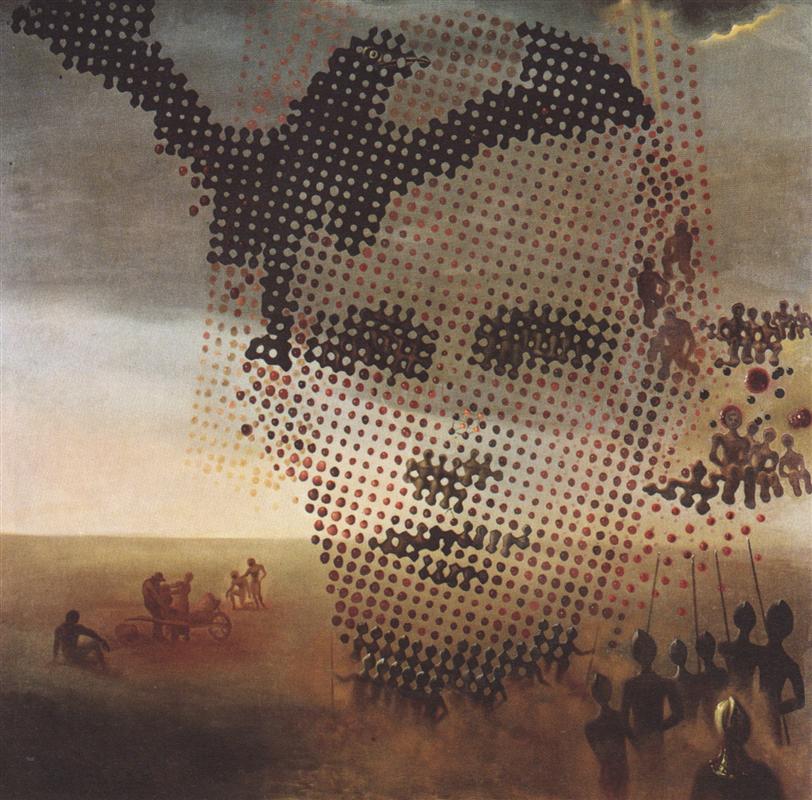
Portrait of My Dead Brother

Salvador Dali, Portrait of My Dead Brother, 1963
By LISA MAEDA

There's a certain Slant of Light
By Emily Dickinson

There’s a certain Slant of light,
Winter Afternoons –
That oppresses, like the Heft
Of Cathedral Tunes –

Heavenly Hurt, it gives us –
We can find no scar,
But internal difference,
Where the Meanings, are –

None may teach it – Any –
‘Tis the Seal Despair –
An imperial affliction
Sent us of the Air –

When it comes, the Landscape listens –
Shadows – hold their breath –
When it goes, ‘tis like the Distance
On the look of Death –

Editor's Note: Students were asked to match a poem of their choice with a painting of their choice. The relationship between the two shall be determined by the viewer/reader.
  • 7:00 AM

A Sad Girl

Carlos Saenz de Tejeda, A Sad Girl, 1921

BY MADELINE VASQUEZ 

The Princess: Tears, Idle Tears
By Lord Alfred Tennyson

Tears, idle tears, I know not what they mean,
Tears from the depth of some divine despair
Rise in the heart, and gather to the eyes,
In looking on the happy Autumn-fields,
And thinking of the days that are no more.

Fresh as the first beam glittering on a sail,
That brings our friends up from the underworld,
Sad as the last which reddens over one
That sinks with all we love below the verge;
So sad, so fresh, the days that are no more.

Ah, sad and strange as in dark summer dawns
The earliest pipe of half-awaken'd birds
To dying ears, when unto dying eyes
The casement slowly grows a glimmering square;
So sad, so strange, the days that are no more.

Dear as remember'd kisses after death,
And sweet as those by hopeless fancy feign'd
On lips that are for others; deep as love,
Deep as first love, and wild with all regret;
O Death in Life, the days that are no more!


Editor's Note: Students were asked to match a poem of their choice with a painting of their choice. The relationship between the two shall be determined by the viewer/reader.

  • 7:00 AM

The Arab and His Steed

Jean-Leon Gerome, The Arab and His Steed, 1872
By MELISA CAPAN

To the Desert 
Benjamin Alire Sáenz

I came to you one rainless August night.
You taught me how to live without the rain.
You are thirst and thirst is all I know.
You are sand, wind, sun, and burning sky,
The hottest blue. You blow a breeze and brand
Your breath into my mouth. You reach—then bend
Your force, to break, blow, burn, and make me new.
You wrap your name tight around my ribs
And keep me warm. I was born for you.
Above, below, by you, by you surrounded.
I wake to you at dawn. Never break your
Knot. Reach, rise, blow, Sálvame, mi dios,
Trágame, mi tierra. Salva, traga, Break me,
I am bread. I will be the water for your thirst.

Editor's Note: Students were asked to match a poem of their choice with a painting of their choice. The relationship between the two shall be determined by the viewer/reader.
  • 7:00 AM

Dance at Bougival

Pierre-Auguste Renoir, Dance at Bougival, 1883 

By ISABEL THOMAS

Roman
by Arthur Rimbaud

On n'est pas sérieux, quand on a dix-sept ans.
- Un beau soir, foin des bocks et de la limonade,
Des cafés tapageurs aux lustres éclatants !
- On va sous les tilleuls verts de la promenade.
Les tilleuls sentent bon dans les bons soirs de juin !
L'air est parfois si doux, qu'on ferme la paupière ;
Le vent chargé de bruits - la ville n'est pas loin -
A des parfums de vigne et des parfums de bière....


- Voilà qu'on aperçoit un tout petit chiffon
D'azur sombre, encadré d'une petite branche,
Piqué d'une mauvaise étoile, qui se fond
Avec de doux frissons, petite et toute blanche...
Nuit de juin ! Dix-sept ans ! - On se laisse griser.
La sève est du champagne et vous monte à la tête...
On divague ; on se sent aux lèvres un baiser
Qui palpite là, comme une petite bête....

Le coeur fou Robinsonne à travers les romans,
Lorsque, dans la clarté d'un pâle réverbère,
Passe une demoiselle aux petits airs charmants,
Sous l'ombre du faux col effrayant de son père...
Et, comme elle vous trouve immensément naïf,
Tout en faisant trotter ses petites bottines,
Elle se tourne, alerte et d'un mouvement vif....
- Sur vos lèvres alors meurent les cavatines...

Vous êtes amoureux. Loué jusqu'au mois d'août.
Vous êtes amoureux. - Vos sonnets La font rire.
Tous vos amis s'en vont, vous êtes mauvais goût.
- Puis l'adorée, un soir, a daigné vous écrire...!
- Ce soir-là,... - vous rentrez aux cafés éclatants,
Vous demandez des bocks ou de la limonade..
- On n'est pas sérieux, quand on a dix-sept ans
Et qu'on a des tilleuls verts sur la promenade.


Editor's Note: Students were asked to match a poem of their choice with a painting of their choice. The relationship between the two shall be determined by the viewer/reader.

  • 7:00 AM

Woman at the Window

Salvador Dalí, Woman at the Window, 1925
By SARAH XU

Ode on Solitude
By Alexander Pope

Happy the man, whose wish and care
A few paternal acres bound,
Content to breathe his native air,
In his own ground.

Whose herds with milk, whose fields with bread,
Whose flocks supply him with attire,
Whose trees in summer yield him shade,
In winter fire.

Blest, who can unconcernedly find
Hours, days, and years slide soft away,
In health of body, peace of mind,
Quiet by day,

Sound sleep by night; study and ease,
Together mixed; sweet recreation;
And innocence, which most does please,
With meditation.

Thus let me live, unseen, unknown;
Thus unlamented let me die;
Steal from the world, and not a stone
Tell where I lie.

Editor's Note: Students were asked to match a poem of their choice with a painting of their choice. The relationship between the two shall be determined by the viewer/reader.
  • 7:00 AM

Flirtation al Pozzo

Eugene de Blaas, Flirtation al Pozzo, c. 1843
by LILI TUCKER 


Thou Art Not False, But Thou Art Fickle 
by Lord Byron

1.
Thou art not false, but thou art fickle,
To those thyself so fondly sought;
The tears that thou hast forced to trickle
Are doubly bitter from that thought:
'Tis this which breaks the heart thou grievest,
Too well thou lov'st—too soon thou leavest.

2.
The wholly false the heart despises,
And spurns deceiver and deceit;
But she who not a thought disguises,[bv]
Whose love is as sincere as sweet,—
When she can change who loved so truly,
It feels what mine has felt so newly.

3.
To dream of joy and wake to sorrow
Is doomed to all who love or live;
And if, when conscious on the morrow,
We scarce our Fancy can forgive,
That cheated us in slumber only,
To leave the waking soul more lonely,

4.
What must they feel whom no false vision
But truest, tenderest Passion warmed?[65]
Sincere, but swift in sad transition:
As if a dream alone had charmed?
Ah! sure such grief is Fancy's scheming,
And all thy Change can be but dreaming!


Editor's Note: Students were asked to match a poem of their choice with a painting of their choice. The relationship between the two shall be determined by the viewer/reader.


  • 7:00 AM

Monk Talking to an Old Woman

Monk Talking to Old Woman, Francisco de Goya, 1825
By GARY WHITTAKER
Much Madness Is Divinest Sense

By Emily Dickinson

Much Madness is divinest Sense-
To a discerning Eye-
Much Sense-the starkest Madness-
'Tis the Majority
In this, as All, prevail-
Assent-and you are sane-
Demur- you're straightway dangerous-
And handled with a Chain.

Editor's Note: Students were asked to match a poem of their choice with a painting of their choice. The relationship between the two shall be determined by the viewer/reader.
  • 7:00 AM

Gassed

John Singer Sargent, Gassed, 1919

By TROY WORKMAN

Arms and the Boy
by Wilfred Owen

Let the boy try along this bayonet-blade
How cold steel is, and keen with hunger of blood;
Blue with all malice, like a madman's flash;
And thinly drawn with famishing for flesh.

Lend him to stroke these blind, blunt bullet-heads
Which long to muzzle in the hearts of lads.
Or give him cartridges of fine zinc teeth,
Sharp with the sharpness of grief and death.

For his teeth seem for laughing round an apple.
There lurk no claws behind his fingers supple;
And God will grow no talons at his heels,
Nor antlers through the thickness of his curls.


Editor's Note: Students were asked to match a poem of their choice with a painting of their choice. The relationship between the two shall be determined by the viewer/reader.
  • 7:00 AM

Four Darks in Red

Mark Rothko, Four Darks in Red, 1958
By ELLIE SCHNEIDER

Insensibility by Wilfred Owen

III
Happy are these who lose imagination:
They have enough to carry with ammunition.
Their spirit drags no pack.
Their wounds, save with cold, can not more ache.
Having seen all things red, 
Their eyes are rid
Of the hurt of the color of blood forever.
And terror's first constriction over,
Their hearts remain small-drawn.
Their senses in some scorching cautery of battle
Now long since ironed,
Can laugh among the dying, unconcerned.

IV
Happy the soldier home, with not a notion
How somewhere, every dawn, some men attack, 
And many sighs are drained.
Happy the lad whose mind was never trained:
His days are worth forgetting more than not.
He sings along the march
Which we march taciturn, because of dusk,
The long, forlorn, relentless trend
From larger day to hunger night.

V
We wise, who with a thought besmirch 
Blood over all our soul,
How should we see our task
But through his blunt and lashes eyes?
Alive, he is not vital over much;
Dying, not mortal overmuch;
Nor sad, nor proud, 
Nor curious at all.
He cannot tell
Old men's placidity from his.

Editor's Note: Students were asked to match a poem of their choice with a painting of their choice. The relationship between the two shall be determined by the viewer/reader.

  • 7:00 AM