The Gross Clinic


Technological Effects on Society
Curated by Austin Krause 
Thomas Eakins, The Gross Clinic, 1875

One of the most important fields for developing new technology is in the medical field. In the modern day, it is one of the only fields that is seen to be necessary to develop new technology in. In the 21st century curing AIDS, diabetes, autism, and many other severe diseases/ disabilities are the ideal accomplishments for today's generations. It is the ideal goal for society and it is something that the human race has been trying to solve for the longest time.

The advancement of technology is accompanied by the increase of population in not just the human race, but in all living life form that is present on the earth. Increases in medical technology ultimately lead to better procedures in hospitals, safer ways to treat a disease, deliver a new born, or just cure the common cold. This is something that the human race can never have enough of. Howeverith technology growing, new obstacles arise.

  • 10:15 PM

Fireside Chat

Technological Effects on Society
Curated by Austin Krause
The Fireside Chat - Created by Sculptor Georg Segal - Located in the Franklin Delano Roosevelt Memorial
George Segal, Fireside Chat, 2007

Imagining our world today with out television will prove to be difficult. But only a few generations back did the radio rule the technological era for many reasons. It was something unheard of, being able to broadcast ones voice over a vast region that will be heard in almost everyone home in america if tuned to the right station. The Radio was so interesting and unique to the public that almost every home in america had a radio in it. It was technology that forever changed society.

Not only did the invention of the radio change the world, but it changed society. It wielded the power to glue countries and communities closer. One of the most famous uses of the radio was Fireside chats with Franklin D. Roosevelt. FDR used the radio to communicate greatly with his people of the nation to help inform them first hand about what he plans to do and how.
  • 10:09 PM

Galileo Before the Holy Office

Technological Effects on Society
Curated by Austin Krause
Joseph-Nicolas Robert-Fleury, Galileo Before the Holy Office, 1855

It was hard to keep up with technology advancing so quickly in the age of Enlightenment. Not only were people introduced to new technologies and critical ways of thinking, but they also were introduced to new lifestyles all together. The scientific revolution ultimately led to the creation scientific communities that were centered around the idea of thinking in a more reasonable manner. Scientists began to ask questions, wondering why it is this way with not evidence to support it.

Galileo was ordered to a stand trial because of this claim. The church and public were worried that he might be right, which would conflict with religion The church wanted to maintain the power it had over civilians. With Galileo claiming that the heliocentric idea is right and having the evidence to prove it, the church was put on the spot. Their authority was in jeopardy. Just by making this claim and the church rejecting it, it was used as proof that the church was against science and new knowledge, and anything else that would conflict with it.

  • 10:02 PM

The Iron Forge

Technological Effects on Society
Curated by Austin Krause
Joseph Wright, The Iron Forge, 1772

Joseph Wright of Derby was one of the first artist that I truly took time to study, and he quickly become one of my favorites. Everything about the way he painted the Enlightenment made him stand out in a more unique way. Not only did he paint about the Enlightenment like most artists of his time, but he did not always portray it in a positive way. In most of his paintings, there are two light sources: Religion and Knowledge. In between the two light sources is darkness which seems to compress the light of knowledge while allowing the light from nature/religion to flow freely through it.

When observing his painting The Iron Forge, it can be seen that the new knowledge of his time produces a glow that is beginning to overpower the second light source in the painting, the moon. The moon is what symbolizes religion, through nature. It represents the idea of God creating the earth for what it is and how it is. But without saying that that statement is false, it shows that the effect that technology and knowledge have on society is proving to be the more reasonable way of thinking as people start to realize: “Hey, that sounds like it makes more sense!”

  • 9:55 PM

The Potato Eaters

Technological Effects on Society
Curated by Austin Krause
Van Gogh, The Potato Eaters, 1885

The enlightenment era was not all that it is cracked up to be. Even though it opened up a new way of thinking while changing science and math permanently, it did not do anything as dramatic as ending world hunger, or automatically spreading endless wealth through out the world. The class structure still remained the same. With new cool gadgets coming into being, they still had a price. Cuckoo clocks, telescopes, pocket watch, and many more inventions were still only affordable by middle to upper class people.

In Van Gogh's The Potato Eaters, He wanted to show that although technology advanced rapidly in the generation before, it did not effect the class structure. Gogh wanted to portray the lower class as they really were. He showed that life was just as depressing and miserable as ever for these low paid workers as it shows in the painting through the blackness and shear hell that they are living in.

  • 9:53 PM

An Experiment with an Air Pump


Technological Effects on Society
Curated by Austin Krause

Joseph Wright, An Experiment with an Air Pump, 1768

The Age of Enlightenment promoted the studies of math and science to benefit society in technological ways. Many new inventions and improvements were made in this time period to benefit everyday life. To accompany these improvements, the belief and faith of religion was also challenged in many ways. New ways of thinking, such as the Heliocentric theory, were unheard of. The new age of science versus religion is portrayed in most paintings through the glowing effect of an object. In this painting, that object is an air pump which was invented by a German physicist in the 17th century.

People were scared of change, they denied the heliocentric theory and dismissed it as illogical. As seen inJoseph Wright's painting, all of the subjects are intentionally avoiding the light, the new age of knowledge which the children will grow up with. This is seen with one of the older gentlemen embraces them, trying to explain that this is going to change everything including the way they live and the way society lives.

  • 7:23 PM

The Eiffel Tower

Robert Delaunay, The Eiffel Tower, 1911
Robert Delaunay, born in Paris, knew at an early age that he wanted to become an artist. Following his dreams, he was influenced by the “city of painters” which was where he adopted his renowned style of abstract forms and unusual combinations of color that closely relates to Paul Gauguin and Wassily Kandinsky. Delaunay found his biggest love in Orphist paintings. He loved to paint well recognized abstract forms, such as the Eiffel Tower, accompanied by “trippy” combinations of color. Experimenting with colors, angels, depth, and tone was the love that he found in painting.

Delaunay fell in love (and later married) a Russian painter named Sonia Terk. Through out their pre-marriage relationship, the couple did not paint together. Only when they were married that Robert Delaunay and Sonia Delaunay became a painting duo. Her style was almost a complete opposite of Robert's, as seen in the main black and white portraits that were currently being painted. But through the years and shared experiences with her husband, her artistic painting style slowly transformed to be identical to Robert's Orphist style of painting.

One of Robert Delaunay's most famous series is the Eiffel Tower Series. Delaunay worked diligently to complete over six paintings of the Eiffel Tower. The interesting thing about these paintings is the fact that they are all unique in their own way. After each one he completed, he strived to make the next one ever more appealing. The way that this was done was through color harmonies and the angel in which the spectator of the painting views the abstract figure, the Eiffel Tower, and can recognize it as an entirely different work, but by the same artist with the same style.

The Eiffel Tower, painted in 1911, is one of the most appealing works that Delaunay completed. The extreme color combinations are not present in this painting which makes it seem all the more mellow and relaxed. Accompanying the different choice in color harmony than usual, Delaunay painted the buildings to both sides of the renowned monument to sway and flow with the deformed tower itself. But at the same time, the free flowing buildings, while looking like they can be easily manipulated in soft wind, produce a comfortable amount of depth with almost no effort. The “trippy” style that Delaunay has evolved over the course of his artistic career has truly made it entertaining to view his work for long periods of time, something that not all artists have.

  • 12:00 AM

Madame X

John Singer Sargent, Madame X, 1884
John Singer Sargent was an American painter who loved his country but spent most of his life in Europe. Despite his American roots, early in his career he was was mainly active in French. Being the intense hard worker that he was, he focused mainly on portraits and landscapes. He was recognized as the “darling” of Paris until the scandal over the Madame X painting arose.

Madame X was a painting that was going to greatly impact and boost his fame as an artist and help his career. The subject was a Paris beauty named Madame Gautreau. Gautreau was renowned in social circles in Paris for her beauty. She had such tremendous beauty that most artist considered her to be apart of an “elite class” of women. She defined the new type of Frenchwoman, one who was defined by her sophistication.

This painting was hung in the upcoming Paris Salon in 1884. Reception of the painting was not exactly what Sargent was hoping for. The public in Paris could not stop talking about Madame X and the pose of Gautreau, whose right strap of her gown was hanging down off her shoulders. The painting caused outrage, and quickly destroyed Gautreau's public life, as she was mercilessly dogged by newspapers and gossip. After taking it down, Sargent repainted the strap on the subjects folder to face upwards. The scandal and portrait of Madame X did nothing but lower his fame in the city of Paris. It would take him years to get his reputation back.

  • 12:00 AM

After Death: study of the head of a corpse and The Tell-Tale Heart

After Death: study of the head of a corpse, Theodore Garicault, 1819
Theodore Gericault became one of the most influential French artists during the Romantic period. He began to succeed early in his artistic career when his first painting, The Charging Chasseur, was displayed in a Paris Salon in 1812. This was just the start to his success in the arts. Only a couple years later, still youthful in the game of art, he painted Wounded Cuirassier, which displayed in the same salon in 1814. In 1819, Gericault painted a not so successful painting, After Death: study of the head of a corpse.
     
Edgar Allan Poe wrote in "The Tell-Tale Heart": “I talked more quickly -- more vehemently; but the noise steadily increased. I arose and argued about trifles, in a high key and with violent gesticulations; but the noise steadily increased. Why would they not be gone? I paced the floor to and fro with heavy strides, as if excited to fury by the observations of the men -- but the noise steadily increased. Oh God! what could I do? I foamed -- I raved -- I swore! I swung the chair upon which I had been sitting, and grated it upon the boards, but the noise arose over all and continually increased. It grew louder --louder -- louder! And still the men chatted pleasantly, and smiled. Was it possible they heard not?”

Guilt is an emotional state in which a human being regrets an action that one completed, but believes that it should not have been done. This emotion also has the power to motivate human beings to make amends and attempt to fix what they feel guilty about. A person can be driven mad by the thoughts that go through their head, making them see and hear things that might not be there. “The Tell-Tale Heart” by Edgar Allan Poe displays a perfect example of the unique power that can almost control a guilty human entirely.

  • 1:30 AM

Paris Street; Rainy Day

Gustave Caillebotte, Paris street; Rainy Day,1877

      Paris, being one of the biggest tourist destinations in the world, is best known for its luxurious lifestyle along with its landmarks: The Eiffel Tower, Louvre, Arc de Triomphe, and many others. The stories of the catabombs and underground tunnels below echo through out the city. Tunnels run below the city of Paris that lead the giant lime stone quarries. These quarries are the key source to most of the stone used to make these monuments buildings that we know today. The mining of these quarries resulted in over one hundred and fifty miles of tunnels and caverns that weave through out the underside of this monumental city.

     The maze that is the underside of Paris provides a strong history lesson. An explorer, within the endless miles of tunnels, can find Nazi Bunkers, French resistance rooms, and graffiti on the wall from the French Revolution that is sketched in with carbon black. It is not recommended for claustrophobic people to explore the catabombs due to their tight spaces and at some points, the explorer has to army crawl on his stomach. These tunnels are not all about fun and games. Exploring them is risky because they are often flooded and they have the possibility of collapsing. In 1774, the street “Rue d'Enfer” collapsed because of the strain on the tunnel walls. It is interesting to learn about the darker side of the "City of Light". These tunnels provide more than a story, they provide a historical background about revolution, progress and art.
  • 12:00 AM

Paul Gauguin

Paul Gauguin, The Midday Nap, 1894
Vincent van Gogh was a post-impressionist painter who was best known for the famous story that is taught in early elementary school art class. Throughout his painting career, he met and painted with interesting artists, including Paul Gauguin. Paul Gauguin was also a post-impressionist painter who specialized in simplified shapes and color harmonies. Gauguin was invited to stay with Van Gogh in Arles. When he arrived, the two artists started to paint vigorously together. They even painted portraits of each other and recreated each others paintings.

In recent years, German art historians claim that the old story of Van Gogh cutting off his own ear is false.  These historians claim that the true story never arose because the two, very close, painters kept a pact of silence. Hans Kaufmann and Rita Wildegans claim that it was a violent sword attack executed against Van Gogh, not Gogh's madness that led him to his death. The old story claims that the artist cut off his own ear, wrapped in cloth, and then handed it to a prostitute the same night Gauguin fled from him after an unhappy visit. The German art historians claim that Gauguin exited Van Goghs house while carrying his fencing sword in hand. Gogh followed Gauguin  and tried to make things right after a recent fight they had which resulted in Gogh throwing a glass dining piece at him. As Gogh starts to approach Gauguin in a rapid pace, these historians claim that Gauguin turned and cut off his ear with his sword, in either a fit of rage, or in self defense. It is not known which story is true, but it is probably safe to say that the classical story most closely represents the actual situation.

  • 12:00 AM

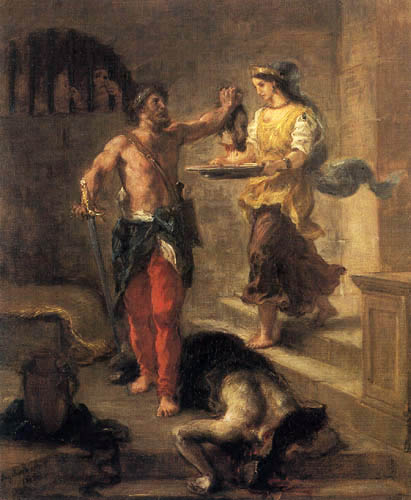
Death of St. John the Baptist

Eugene Delacroix, Death of John the Baptist, 1858
Eugene Delacroix learned how to paint in an interesting way. He was self taught by traveling to the Louvre in Paris and copying famed work. The amount of work that he created during his lifetime well exceeds 3,000 pieces, including Death of St. John The Baptist. The setting of this painting was to be about the beheading of St. John the Baptist  The Gospel of Luke states that the birth Jesus was announced by the angel Gabriel, and John's mother was but three months from giving birth to John.

St. John the Baptist was imprisoned by Herod Antipas. Herod imprisoned John because John criticized Herod for divorcing Phasaelis, his wife, along with stealing Herodias, Herod's sister in law. A party was thrown in celebration for Herod's birthday. Herodias' daughter, Salome, entertained the king and his guests by dancing in front of them. Through Herod's drunkeness, he promised Salome one thing that he wished for, and he said he would fulfill it. It was then that her mother, Herodias, told her daughter to ask for the head of St. John. Herod agreed to this request and followed up his promise by executing John.
  • 12:00 AM