The Peasant Wedding


Pieter Bruegel. The Peasant Wedding, 1567
BY HARPER TRUOG

Parties and family gatherings have hardly changed since the 1500s. People crowd onto tables and hands pass platters of food up and down the rows. The house starts out clean, but there is no hope of keeping it that way, and meager decorations hang on the walls. Loud chatter fills the room and even the seated bodies move with expressive gestures. Stories are retold and passed down the table with laughter following close behind. Children clean their plates and lick their sticky hands while an adult refills his glass even if he should not. The food keeps coming out of the kitchen like a parade. Someone brings out the dessert and everyone is eager for a bite.
Bruegel's figures are proportional and busy with movement. No person stands stiffly against a wall and the movement gives the sense of a lively celebration. He uses earthy tones like browns and greens with splashes of red to add contrast. The red draws the eye to the musician, the people carrying the tray of bowls, and the child's hat in the bottom left corner.


Bruegel showed a commoner's wedding in 1567, but many people today do things during parties that were done back then. When celebrating, humans gather with loved ones, eat an abundance of food, and listen to music or stories. Bruegel displays peasants having a good time and filling the house. The tables are full, but there is a crowd lined up out the door, which shows a plethora of good company. These peasants are not rich, but they have a fulfilling celebration with what they have.
  • 7:00 AM

The Land of Cockaigne

Image result for land of cockaigne bruegel
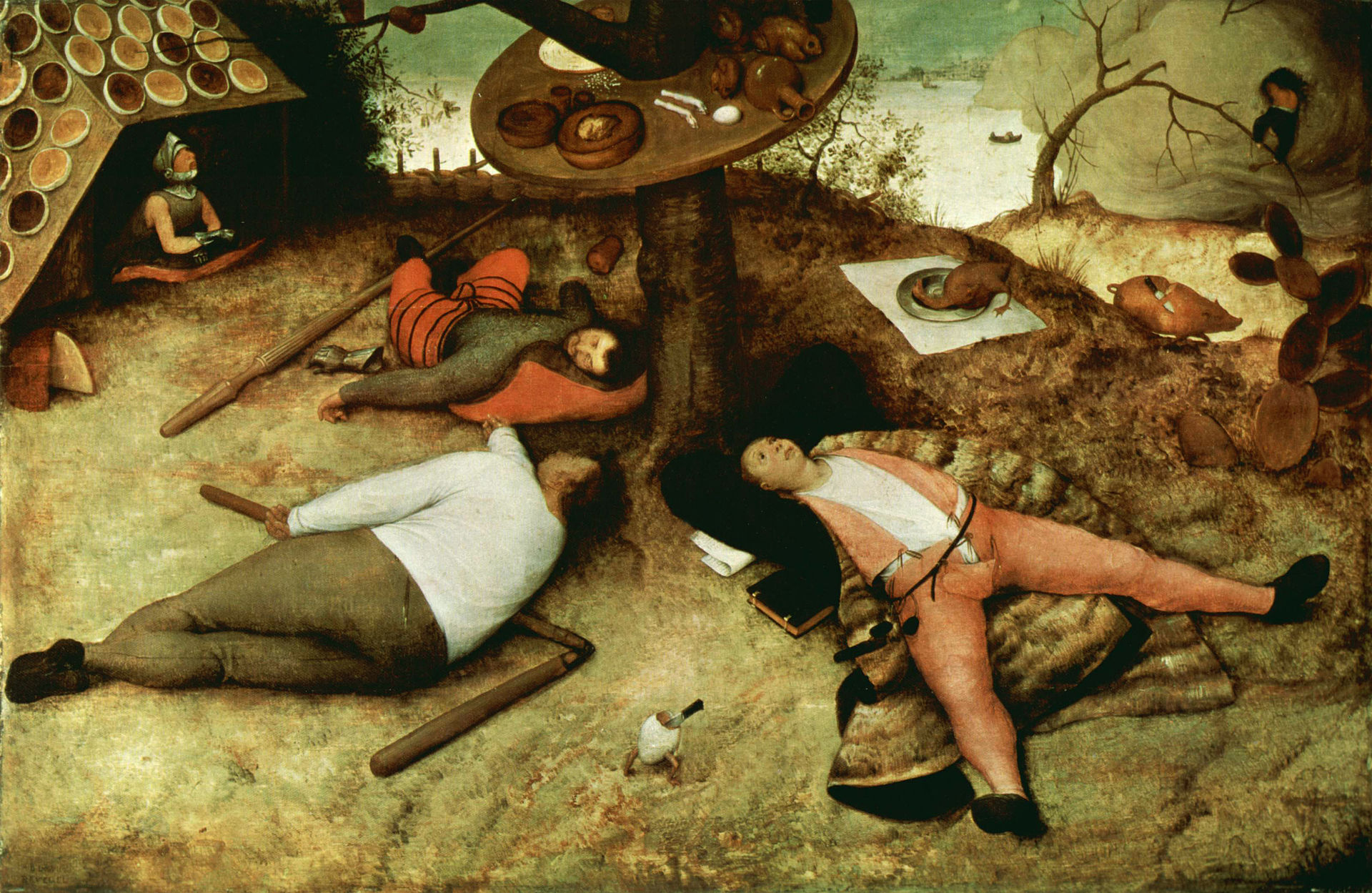
Pieter Bruegel the Elder, The Land of Cockaigne1567

By EMMA SHAPIRO 

Cockaigne is a land of gluttony and laziness in medieval myths where the harshness of peasant life ceases and everyone lives in extreme luxe and ease. The imaginary land symbolized freedom to indulge in comfort and pleasure. Scornfully, Bruegel depicts Cockaigne in a manner which mocks humanity. Like many of his paintings which teach lessons to society, this one shows that the world is sinful, greedy, and indolent.

In Bruegel's The Land of Cockaigne, a clerk, peasant farmer, and soldier are sprawled lazily under a tree. The clerk's books and pen lie on the ground, along with the farmer's threshing tool, and the soldier's glove and spear. The tree above them lends shade through it's leaves, but even more through the table of partially eaten food attached. Not only are the men consumed by lethargy, but in their dormancy they only consume and lie around. Behind the men a form of dead fowl sits on a platter and napkin, and a pig with a knife stuck through runs around - each ready to be eaten. On the right, a man falls from a supposed cloud of pudding onto a tree branch. And on the left, another soldier awakens from his nap under a roof of pie.

Bruegel began a long line of painters in his family. With the continuation of the family trade through generations, and growing popularity of prints, Bruegel's influence has endured. Bruegel most commonly illustrated peasants in his works, earning the nickname "peasant Bruegel." Although this name hints to him being a peasant, that is a misconception. Bruegel depicts peasants in all different realms of life. Although his peasant paintings and engravings seem to be merely replications of everyday life, they also reflect his views on humanity, his absurd imagination, and his innate skill. The Land of Cockaigne differs from the other peasant paintings. Instead of portraying the difficult life of a peasant, this shows an ease for all men. The peasant farmer, soldier, and clerk lay together in peace with their respective tools out of hand. Bruegel draws similarities between the men - painting them as equals. He may be trying to convey that all men are lazy and useless, or perhaps that regardless of status, everyone needs a nap and some pie now and then. 


  • 7:00 AM

Triumph of Death and The Future

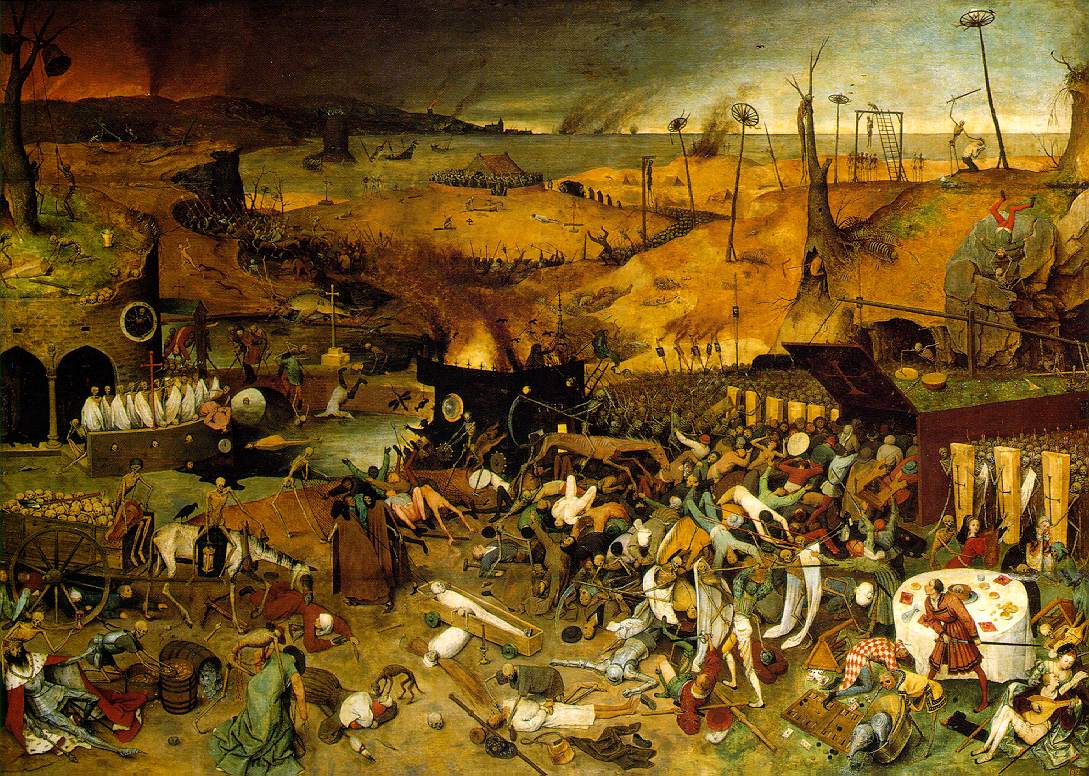
Pieter Bruegel the Elder, Triumph of Death, 1562


Who doesn’t love a good reminder of their own mortality?

Bruegel, in his Triumph of Death, illustrates humanity’s ever-present fear of death. We hold it off as long as we can but we inevitably succumb to its clutches. In this painting, death comes as an army of skeletons, as hellfire, as disease. It comes as human suffering, debauchery, and pain. The colors are sickly and striking. I can almost hear a dirge in the back of my mind.

Our lives go by too fast/ Nobody lives to see the future

I see destruction everywhere. Houses are being burned, fields slashed, lives lost. What little shreds of humanity were left are being carried away by a wagon of skulls. A choir of corpses sends the living off to Hell. Other than the crosses that are being carried or painted on coffins, there is a surprising lack of religious imagery. While religion still dominates the arts at this point, Bruegel has chosen to explore a different perspective. Unlike an altarpiece or religious painting, Bruegel’s work focuses on regular 15th century folks doing regular 15th century stuff. So although the Church may have influenced some of the most famous art of this time, Bruegel’s work can be thought of as a more honest representation of the lives and outlooks of the peasants.

Ain't got much faith in God or modern-day mythology/The lies and fables, fate, and luck directing everything
During this time, ideas about death and salvation were becoming very different. This explains why a painting by Bosch signifying death would look (and mean) nothing like a work by van der Weyden. The struggle to understand death and its purpose haunts this painting. No Christly figure has come down to save the condemned from their fates. Even Heaven is eclipsed by smoke and blackness. Why did these people deserve to perish in damnation? Did they live in corruption, reject religion, and surrender to evil? Maybe. But perhaps this painting isn’t just a narrative of the annihilation some base village. I see a materialization of fear -- Bruegel’s fear of dying inflicted upon innocent villagers. Although this manifestation of the unknown is far from comforting, at least Bruegel didn’t sugarcoat his fear of death and the unknown.

No heaven in the sky, no pearly gates on clouds and stuff.

I’ve often been asked why I like the song “The Future” by The Limousines. It’s not exactly enlightening or catchy. But it comforts me somehow; much like this painting probably comforted Bruegel. To put your fear on canvas and to let others view what has been haunting your mind in hopes that it resonates with them is therapeutic. That is not to say that looking at The Triumph of Death brings me inner peace, but it does provide an outlet for my own fears. Not a lot has changed in the past few centuries with regard to death and the “afterlife.” There is still no concise answer to the plethora of questions surrounding this topic.

But that’s okay.
  • 7:00 AM

Adventure Time and Mad Meg

Bruegel Mad Meg, 1562


Bruegel's, Mad Meg tells the story of a woman from a Finnish proverb who is said to have the power to enter hell and return unharmed. She is painted with a group of followers who raid a house close behind. They are doing things their way and saying "enough" to duties and boundaries. Bruegel continues this trend of breaking rules with the armor he has placed on Meg as she runs from the mouth of hell, stolen goods in hand. This piece is out of control, and Meg and friends seem to really make a mess of things on their journey to Hell. Uncontrolled tempers, fearless behavior, and bad ass women can only remind me of one thing: The Flame Princess. The Flame Princess in Adventure Time, lives in the Fire Kingdom, already similar to the Mad Meg scene, but she also has quite the attitude. In this clip Finn and the Princess disagree as to how they should fight through the goose skulls and snap dragons.

Flame Princess tells Finn that she wants to do things her way and turns up the heat. She loses control as her powers take over...fire addict. Her behavior reminds me of Meg's, she breaks the rules by burning down the doors much like Bruegel paints Meg breaking out of classic women's roles. Meg throws herself in harm's way knowing her own strength to make it out, and the Flame Princess allows her strength to overcome her and turns into the evil shrewd-like woman that Meg represents. Both characters are powerful without question, and both have the capability to influence others with their strength.

Meg inspires the other women to join her pillage on hell, but the Flame Princess' powers of destruction impact Finn in a different way. She puts Finn in danger when her fire powers take over and she loses control. The beauty of Mad Meg is how Bruegel paints her in complete control of her actions, she knows how to get what she wants. The Flame Princess, in search for short cuts, loses this control and puts herself in danger.

  • 7:00 AM

Bad Boys – The Bearing of the Cross

Bad Boys
The Men Who Saw Art and Chose To Change It
Curated by Gabrielle Fenaroli

Pieter Bruegel, The Bearing of the Cross, 1564
Usually when I’ve encountered painting involving Jesus it has never been a round of Where’s Waldo trying to find him. However, Pieter Bruegel the Elder likes to make his viewer work for the prize in his 1564 piece The Bearing of the Cross. Our eyes scan the image as we gaze over each part as not to linger on one place too long. So many different scenes transpire before our eyes, and if we are not careful, it becomes easy to lose ourselves with the endless possibilities. We could be drawn to the right hand corner to four figures that appear still and larger than the rest. The draping of the oversize blue veil makes it clear the woman is the Holy Virgin Mary. She appears with a sickly complexion and in a position of utter defeat and loss. Many scenes depict Mary weeping with her companions, but this is not a depiction of the Deposition of Pieta. Christ is nowhere near them, and their sorrow intensifies with the sense of isolation and separation. So where is Christ?

Maybe you eventually see him because of white stag standing almost dead center of the painting. If not you eventually come to realize that the tiny outline of Christ covered in blue, is crushed beneath the weight of the cross. He staggers to find his footing after he has fallen. It seems odd that Bruegel has chosen to paint Chris so small, and it almost makes viewers ashamed that they did not recognize him earlier. Instead of giving us the image right away, Bruegel allows the viewer some freedom in tracing the journey and creating the narrative. The viewer can continue to search around the painting but cannot forget what they’ve seen in the middle.

What makes the canvas a landmark is the ability Bruegel gives to the viewer to make mistakes. He refuses to give the public an image they will automatically know and recognize. In creating a piece with so much chaos and action he allows for moments of reflection and thought. He does manage to make a point in portraying the Spanish army as those dressed in scarlet that are clearly oppressing Christ. At the time there was a great repression of Protestants and terror was widespread throughout the Netherlands. Bruegel does a phenomenal job of mixing the past with the present and once again creating a bridge for the public to connect with divine.

  • 7:00 AM

Structure and Paintings: Tower of Babel

Structure and Paintings
Analyzing Architecture and Perspective within Paintings
Curated by Max Cantu-Lima

Peter Bruegel, Tower of Babel, 1553

"A dynamic composition encourages the eye to explore."
#40, 101 Things I Learned in Architecture School, Matthew Frederick


Peter Bruegel has been the most influential artist on how I view art. This painting relates directly to Paul Auster's City of Glass, which we read in our AP Literature class and concerns itself with the issues of identity and purpose. The Tower of Babel plays a role in the narrative of this novel with the fall of language, stating that our language has lost its meaning. While this may be the case, Bruegel speaks with a universal language of color, inserting light blues, yellows, and reds within the painting to give it that burst of presence from the stretching horizon of green. The beauty of this painting is the chaos that takes place as these workers attempt to construct this monstrosity. The viewer could lose themselves within the minute details of Bruegel's work.

I have chosen to write over The Tower of Babel as our fourth painting as we analyze architecture because of its creativity. Bruegel produced this from his imagination. Sure he probably was inspired by the Roman Colosseum, but still, to produce this intricate world of workers that live on this building like bacteria inspires my creativity. The viewer can see the process of how the construction is taking place as most of the top is left exposed. Also the levels of the tower as they progress differ in the style of arches. What the painting attempts to instruct, in my mind, is the concept of being able working with others effectively as well as narrowing in on an idea. That no matter how great the idea is, if it's to big of an idea, your infrastructure is at risk of collapsing.

Bruegel is truly a master. Just look at how he produces the stones in the foreground and the sprawling landscape. The time he invests into getting all the details right. The coast and the ships proportionally correct. This imaginary world invites the viewer as it utilizes the majority of the canvas with interesting subjects to analyze. While it's only a two-dimensional picture, even with the paint you still feel that sensation of  "Wow." Gazing at this structure the mind still wanders off. Its nearly impossible not to think of something from this painting. The depth Bruegel is able to produce with his use of shadows brings the painting to a semi-real state of being, we begin to believe the narrative Bruegel is telling us. That's what makes him and this painting great. The fact that we can lose ourselves within it, and while all art does that to some degree, Bruegel makes it effortless.


  • 7:00 AM

The Harvesters

Pieter Bruegel the Elder, The Harvesters, 1565

This is why I love Art History. Bruegel’s work in general captures the magic of the present through his subject matter. This painting is one of six paintings in a series where Bruegel captures the peasantry in Antwerp through several different seasons and weather conditions.

Now I could speak about the painting formally, but do I have to? Just looking at the painting you can see the balance and the use of colors. You witness its beauty.

In The Harvesters, Bruegel has depicted exactly that - peasants tending to the fields, the cogs of this town in motion. And within this heaven, this little niche under a tree, the viewer finds a sense of home. Bruegel accurately paints the feeling of being a part of a community. This idea is what I take away from the painting. Bruegel has created this scene where people are hard at work, doing their daily chores and duty. That is their life on a day-to-day basis. The church, obscured in the background, sits in the back of everyone’s mind, yet it is not their main concern. They’re too focused on the work ahead of them, which is entire left side of the painting of wheat yet to be harvested.

They beauty is the commonality Bruegel has captured within these people. Taking the Northern Renaissance a step even further away from the in your face religious depictions in the south. Through the composition of the flora in the right side of the painting, Bruegel takes the emphasis off of religion and pulls back the curtain to reveal the landscape, a town, and its people. I get a feeling similar to Bruegel’s Hunters in the Snow, where although they are all performing a laborious act, it is for the greater good, all these people coming together to improve their quality of life in unity. You feel the warmth.


  • 7:00 AM

Mad Meg

Pieter Bruegel the Elder, Mad Meg, 1562
Originally known as Dulle Griet/Dull Gret (which is also a medieval "super-gun" from Belgium), Mad Meg is a unique character of Finnish folklore. Gret is also a derogatory name given to any ill-tempered, shrewish woman - use it wisely. So the story goes, this demon-kickin' lady raided Hell itself and looted its riches along the way. Totally apocalyptic at first, but it has so many comic overtones when you try to wrap your head around the story and scenes within the piece. Upon initially viewing it, Mad Meg looks completely over-sized compared to the characters she shares the piece with, but Bruegel's pieces are usually viewed from above, which gives the feeling that she had already raided Hell and was escaping the uproar she left below. The thing I love here is that, especially for the time period, Meg has such power and she's clad in male armor...and with a weapon, no less. Underneath her armor is the usual haus-frau garb, but her different layers, both metaphorically and literally, give her such depth.

Light plays a great role in this piece, sweeping the gaze from the light source up in the right corner to the mouth of hell. The colors in the piece scream chaos and confusion, with each individual scene almost blending in with the others in one big, hellish mess. Bruegel portrays other strong women here, Meg's followers, in the scene directly to the right of Meg, fighting off demons themselves. His characters here are Bosch-esque, showing such perversions of God's creations much like in Hell, leaving me curious if he had a bit too much of the insane root. The castle wall metamorphosed into a face with a mouth gaping open as the entrance to hell is a prime example. Also indicative of Bosch are the deviations of religious symbols in the piece, like the eggs, which usually signify fertility but are all rotten now.

While the story of Mad Meg is worthy of a page in itself, the thing I loved about the background of this painting is the Dutch Revolt, or Eighty Years' War, going on during this period. The Dutch Protestants craved freedom of religion, but Charles V and, later, Philip II wanted only to defeat Protestantism. Bruegel's piece here includes some scenes of scathing political criticism, like the faceless soldiers venturing into hell itself and engaged in meaningless struggle (with a fish man... insane root, I'm telling you). To skip a history lecture I don't want to write, the revolt ended with the creation of the Dutch Republic - the first republic ever, but also the first one with the separation of church and state. Bruegel comments on the political state around him just as much as he illustrates a crazy Finnish folkloric tale in one big chaotic mess that somehow says so much in its crazy contents.


  • 7:00 AM

Peasant's Dance

 Bruegel, Peasant's Dance,1538
Bruegel’s Peasant’s Dance makes a statement about the unholy practices and pursuits of the lower class. At least two of the seven deadly sins are portrayed in the painting. The lustful couple on the left of the composition, as well as the vain man with a peacock feather, turn their backs on the church as they dance together. Not a single face is turned to the muted hues of the church. The tavern banner, however, hangs prominently and brightly, accentuating the skewed priorities of the lower class.

Music, dancing, and gluttony consume the activities of the painting while the image of the virgin hangs on the tree behind the scene. Though Peasant’s Dance could imply Bruegel’s disapproval of second class culture, he was known for dressing up like a peasant to acquire first-hand insight for his works. These experiences allowed him unmatched access to varied social and political interpretations between the classes, subtly and bluntly worked into his paintings. Full of religion, iconography, and folk displays, Bruegel’s Peasant’s Dance accurately represents his typical subjects and themes.
  • 7:00 AM

Water Graves - Landscape with the Fall of Icarus

Water Graves 
Reflections on the Illusions of Drowning in Art
Curated by Taylor Schwartz

Pieter Bruegel the Elder, Landscape with the Fall of Icarus,  1558
“Proud of his success, the foolish Icarus forsook his guide, rising upon his wings to touch the skies; but as he neared the scorching sun, its heat softened the fragrant wax that held his plumes; and heat increasing melted the soft wax—he waved his naked arms instead of wings, with no more feathers to sustain his flight. And as he called upon his father's name his voice was smothered in the dark blue sea, now called Icarian from the dead boy's name.” Metamorphoses, Ovid
In another of Ovid’s myths, Icarus, son of the craftsman Daedalus, is given a pair of wings made out of feathers, wax, and leather, given to him by his father as a method of escape from the island Crete. Ignoring the warning from his father, Icarus flew too close to the sun, eventually melting the wax and leading him to his death.

In Bruegel’s Landscape with the Fall of Icarus, the farmer and plough seen in the foreground dominate the composition, a strange but effective choice on Bruegel’s part. The yellow-tinted light highlights the banks of the bay, drawing the eye away from the title character. It is only after the eye moves toward the right of the composition that the viewer sees Icarus. Well, part of Icarus. His flailing legs are the last to plummet into the cold green sea. Icarus will inevitably drown, a consequence brought about by his ignorance. But in a way, Icarus, in this depiction, has already drowned. He has drowned in the landscape of this chaotic composition, his existence forgotten. Such is the nature of the cruel sea.

His suffering will forever be ignored as the peasants of the foreground continue to wade through long days and short nights. In his poem, “Musee des Beaux-Arts,” W. H. Auden writes “In Breughel’s Icarus, for instance: how everything turns away/Quite leisurely from the disaster; the ploughman may have heard the splash, the forsaken cry,/But for him it was not an important failure” (14-17). It is a tendency for man to bury things he cannot withstand or cannot worry himself with. He buries them in work, play, and love. We all have memories, regrets, and losses condemned to the benthos of our subconscious. We just pray that they don’t resurface.

  • 12:00 AM