Art History Hotties: Bacchus


Caravaggio, Bacchus, 1595
By KAELYN ROSS

Oh, Bacchus. You know my one weakness -- the way your pectoral muscle defines your masculine chest. My eyes immediately focus on your suggestive yet elegant torso. After appreciating that area, my eyes wander to your flawless, hairless arm pits. The shadows created by your muscles pull me in continuously deeper into that arm. But, no! Not yet. I pull myself out of it because I know that your biceps also require praising.

Your protruding ivory collarbones guide me on a journey to your superbly highlighted shoulder. I trail down your forearm to notice your hand as it gently pinches the draped sheet that unfortunately covers the rest of your chest. The surplus of your off-white linen sheets swathes a tainted pillow, which is kind of gross. I am willing to ignore it for all of your positive aspects.

Your flamboyant headwear that your mother probably made for you from findings in the background truly captures how greatly you value family. Aw. I admire your courage to spray tan only your face, beautifully defining your jawline. You obviously are staring at me, giving me that signature smolder. And the eyebrows, of course! The framing of the whole face. They say that eyebrows are sisters and not twins, but oh my, I beg to differ with yours.

That hair... Those curls are like millions of little arms reaching out to embrace me. This photo is obviously him asking me out. Yes, a million times YES!
  • 7:00 AM

Beautiful Paintings of Terrible People: The Taking of Christ

Michelangelo de Caravaggio, The Taking of Christ, 1602
Beautiful Paintings of Terrible People
By LIBBY ROHR

Midway through the year, while driving around aimlessly to clear my head, I found myself passing the Nelson-Atkins Museum of Art. As visions of Turner, Caravaggio, and Singer-Sargent flashed through my brain, I thought about the end of this semester and what I wanted to do for my final project. At the time, I was working on my Bosch and Bruegel blog post that required me to engage in my favorite task, scrolling through paintings looking for something outrageous to write about. Eventually I stumbled upon a bearded and crucified lady-saint and found myself falling down the research rabbit hole and enjoying every twist and turn of this woman’s folk lore. Somewhere along the way, giggling and pointing out my favorite tidbits to my mother, it hit me. I wanted to dive into the world of specific research and do so in a way that plays off of the ridiculousness of perspective. Now, without further ado, I present you with my final set of blog posts titled “Beautiful Paintings of Terrible People.” Seeing as this is Renaissance Art History, I figured I’d kick things off biblically with one of our most unfortunate people to ever grace the bible as painted by one of my top three favorite artists in all of my study.

Judas. Everyone knows one. Whether it’s an actual sell-you-out-to-the-Romans-with-a-gesture-of-love kinda guy, or Benedict Arnold, or just a friend you know will ditch you for her boyfriend at a party the first chance she gets, they're all over the place. Judas is arguably the worst sinner of all due to the severity of his crime and his level intimacy with and proximity to Christ. He lived by Jesus’ side for years, as his most trusted apostle, hand picked, who witnessed all of Jesus’ miracles, and handled the most sacred of tasks. Jesus, through his own divinity, understood that someone close to him had to be his betrayer long before Judas’ lips grazed his cheek, making the story all the more unbearable. Caravaggio’s greatest talent lies in bringing the world and stories of God and Christendom into the brutal light of primal humanity. Caravaggio strays away from painting holy people as anything other than everyday human beings and uses this theme to forge often violent depictions of these moments that are shocking and painful and most of all horrifyingly real.

Caravaggio uses this cramped composition to garner a feeling of intimacy between Jesus and the audience, and his lack of background (characteristic of his portraits but not his religious scenes) forces the eyes to focus all the more on the tension at hand. As a master of movement, you can feel the forward momentum of Judas and the guards, as emphasized by his hand gripping the shoulder of the teacher he’s just betrayed. Caravaggio uses color here to show us what we need to see. The dark armor of the soldiers makes them drift into the background, pushing us to look at three things in particular. First, the follower directly behind Jesus, St. John the Evangelist, screaming into the night. It’s difficult to know just from this painting whether he is attempting to flee or to get help but either way there’s no aid coming. Second, Jesus, Judas and the agony between the two. In this moment Jesus begins to understand his fate just as Judas starts to realize what a sin he’s just committed. Jesus turns from Judas, pulling back from his betrayer and the rushing soldiers behind him with a mixture of sadness and resignation on his face.  Finally, the onlooker behind the soldiers, a typical Caravaggio self-portrait, tucked in a back corner, holding up a lantern. Is this a symbol for the effect he wants his paintings to have on the audience, an illumination of the bible, or merely another opportunity for a self-obsessed painter to show the world how cool he is by casually dropping himself into one of the most crucial moments in Christ’s story? Likely both. There is also a third option, which might be equally as true, guilt. It’s no secret Caravaggio didn’t run with the nicest, or the most law-abiding people. And he has put himself in this painting, watching Jesus be carried off to his death, doing nothing and apparently not trying either. What’s more he’s staged behind the soldiers, compositionally helping in the strength of their push towards Jesus. To me this detail is also a statement of the guilt of the frozen witness. To quote, of all things, the musical Hairspray, “Just to sit still would be a sin.”

Clearly selling out christ for 30 silver pieces is an unbelievably horrific thing to do, particularly of someone of Judas’ position in Jesus’ group of followers. That much of the story is clear. So clear in fact that Judas is incapable of living with what he’s done and commits suicide shortly thereafter. But examining the big picture theological role of Judas is a little more muddled and complex. Without Judas’ terrible betrayal Jesus would not have been crucified, an act this powerful, the sacrifice is believed to have given pardon to all good, repenting Christians. It becomes complicated, is Judas somehow partially responsible for Christian salvation. Did this act of betrayal need to happen for the will of God to play out, and if so, was Judas acting as servant of God in this act or should he remain the lowest of the low? These are questions we must ask, yes because this is a biblical post, but also throughout this final series. Growing up, my mother always used to tell a story of one of her law professors of which the punchline is “All the world is gray. If you can understand that, one day, you might turn out to be a competent attorney. You might even turn out to be a halfway decent human being.” And when it comes to confronting this topic, with the lowest of the low, we have to see this concept and understand, if even for a moment, these terrible people are still that, people. Not black and white, or good and bad, but convoluted, indefinable, mixed up creatures with big brains and a particular propensity for illogical rationalization. Caravaggio’s mastery comes in making us see that.
  • 7:00 AM

Reflections from Locker #14: Basket of Fruit


Caravaggio Basket of Fruit.jpg
Caravaggio, Basket of Fruit, 1599
Reflections from Locker #14
By MEGAN GANNON

From love to fear. What could you possibly fear in high school? I mean grades, college, friendships, life in general, the fact puberty is a thing? At times it feels like rotten apples are pushing you, the grapes are holding you tight, while leaves seem to drift away. 

Your evolution will occur when you least expect it, friendships will fade with differing class periods, and late night decisions will alter the course of your experience. You’ll make the wicker basket your temporary home, but as the days weigh on, you and others will start to press on the flexible fibers, as ripe and overgrown fruits now too heavy for the once large basket. 

With fear comes anxiety. As much as I hate to admit it or give metaphorical power to the belief that anxiety is a part of high school, and growing up, it seems to be true. Although I ask you this, should it be? 

Should kids feel like they need to distinguish themselves as the most pristine grape or apple in order to achieve great things? 

Trust me, I’ve had the panic attacks, laid on the floor as I wondered what I am doing? And what am I doing in this basket, where I’m pushed and pulled, and told that this it’s normal. 

The normalcy of taking anti-anxiety medication in order to walk the hallways of this claustrophobic fruit basket. 

Caravaggio did not attend high school, yet with his Basket of Fruit, he seems to capture the sentiments of a secondary school environment. 

The apples, although slightly cumbersome and outnumbered, appear to cultivate precious space while they slowly rot from the core. They press on those around them, submitting them to a status beneath them, they appear solitary yet hold so much power. To the left, Caravaggio tackles the pear, with unique roots that sprout from all angles, and slightly off beat, practically falling out of the basket. He fills the rest of the space with differing grapes that seem to sweat before your eyes, and strategic branches and leaves in different stages of dying to demonstrate the complexity of the ecosystem. 

The basket placed up against the yellowed background, makes it appear isolated, creating a vibe that this basket could be placed anywhere and contents of the fruit inside would not differ. 

As the year comes to a close, the basket will grow lighter as the fruits begin to tumble off into a multitude of directions, some will bruise, others will blossom, but none will call the criss-crossing wicker strands home anymore. 

Although for all those still stuck within the confines of Caravaggio’s table, what advice to you give? Do you tell them to wait out the harvest, or reduce themselves to occupying less space? I hope not. Caravaggio by placing the fruits on top of each other, references how suffocating high school can be. His coloring and attention to detail demonstrates the subtle intricacies that no one would notice as first glance, yet are necessary in order to fully comprehend the painting. 

The trick is to see the intricacies and value them, but them put them away, or else they will consume you. Instead of you tumbling out of the basket, you’ll recede into the wicker. The moments of doubt will pass, and in the end you’ll be glad that you had a such a nice basket to call home for a little while.
  • 7:00 AM

Fine Tuning: The Musicians

Caravaggio, The Musicians, 1595
Fine Tuning
By NATALIE BEYER

Do these boys want to be together, practicing their instruments? Do they look as though they are having a good time? I would say "no" for the sole fact that the boredom washing over their faces looks like they've been sitting through a two-hour ACT prep class late on a Monday night. 

However, many of Caravaggio's subjects show true emotion instead of the bliss that other artists placed on their subjects' faces. His style allowed for a darker setting, with little to no light source and in many of his paintings, he would leave space pitch black. He brought a new level of emotion and intensity to the table for artists at the time, and many criticized him for painting in such a way. He would paint grotesque images such as decapitations and violent struggles. Caravaggio would paint from life instead of drawing and planning what he was going to paint first, and artists at the time saw this as bizarre and against the grain. He, like many struggling artists in Italy, faced problems with patrons, and even had a bad temper.

Unable to control himself, he was known for brawling and even was accused of killing multiple people while in Italy. He gambled and got in trouble with the authorities, eventually getting himself exiled multiple times, each time returning to the thing he loved the most - painting. Caravaggio never married and had no known children. Art Historians today are not completely sure the sexuality of Caravaggio, but many argue that because of the homoeroticism in his paintings could hint to his homosexuality.

Getting to this painting in particular, The Musicians feature a lute and a tiny violin. (Definition of a Lute: a stringed instrument having a large pear-shaped body, a vaulted back, a fretted fingerboard, and a head with tuning pegs which is often angled backward from the neck). By pressing your fingers on the strings at different parts of the finger board, the player shortens or lengthens the length of the desired string the is vibrating, like a guitar, producing higher and lower pitches or notes. The boy in the middle of this painting seems to be tuning his lute while his friend looks at the sheet music. The boredom on their faces shows just how interested they are in playing instruments.
  • 7:00 AM

Magnificent Beards: St. Jerome

Caravaggio, Saint Jerome, 1608
Magnificent Beards
By HARPER TRUOG

Saint Jerome’s beard is long and white, not curly. It goes well with the red robe which gives him a real saintly look. His bald head looks like the skull on his desk. The lighting is great, especially on the beard. Does he ever get ink in his beard? Do long beard enhance holiness and wisdom? Saint Jerome is sitting at his desk working like anyone else would, putting holy figures in human scenes in Caravaggio’s specialty.

Caravaggio’s use of light never fails to impress. The skull on the desk is highlighted and bright against the dark, almost black, background. Skulls in paintings usually mean the ever presence of death. Saint Jerome translated the Bible into Latin, a dead language. He also died of old age and since that is the age being depicted in the this painting, he is close to death. The red cloak indicates his rank as cardinal even though there were no cardinals during his lifetime. It is added in for artistic interpretation because he was secretary to the pope and those people were depicted as cardinals.

Caravaggio rarely puts halos on holy figures, but he chose to in this painting. It is thin and small, but stands out against the dark background. Saint Jerome is associated with encyclopedias literature, so he is usually depicted writing a book. Saint Jerome’s beard adds to his experience living as a hermit. It’s long and shaggy signifying his religious status and living conditions.
  • 7:00 AM

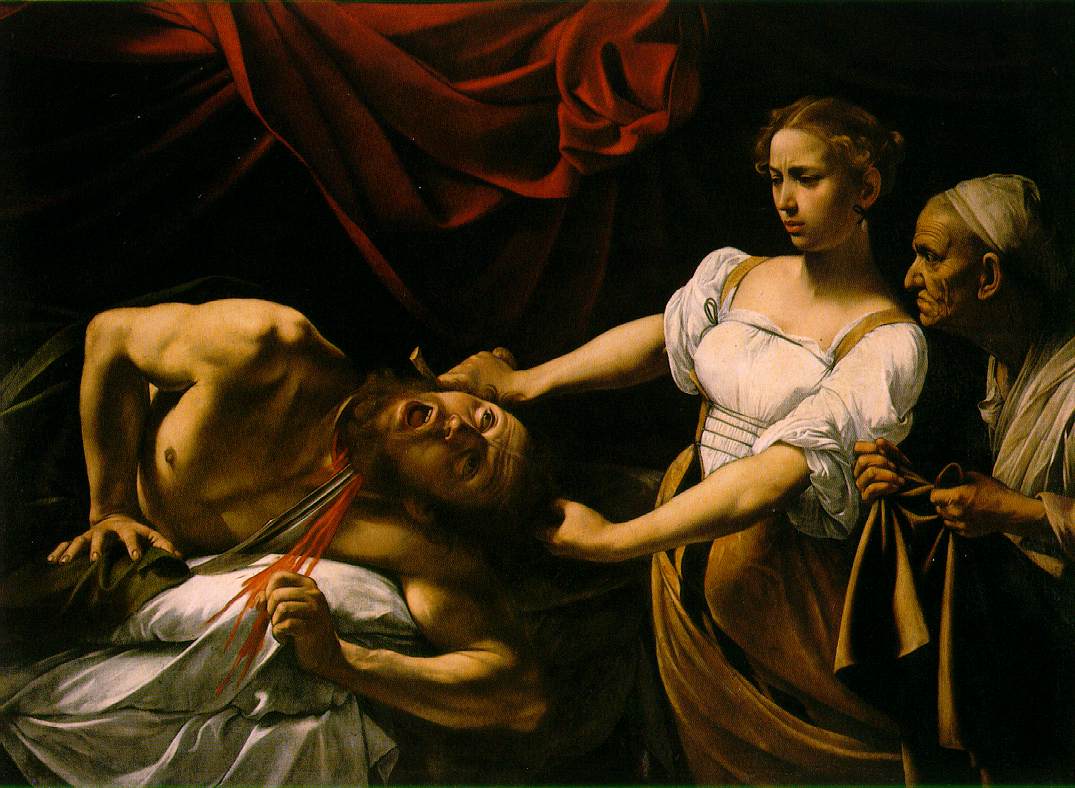
Brawlin' Broads: Judith Beheading Holofernes

Caravaggio, Judith Beheading Holofernes, 1599-1602
Brawlin' Broads
By Bhux


Countless artists have depicted the beheading of Holofernes since the original recounting of the story. Caravaggio's rendition has attained acclaim for centuries and inspired countless artists. He chooses to take the unique perspective of depicting the event at its dramatic climax, while other artists of the day chose a more passive, somber approach. A popular topic of the time, Judith Beheading Holofernes is a classic story of the bible. Judith saves her people by seducing the Assyrian general Holofernes. Holofernes rests vulnerably in bed, power damped by nudity and intoxication. Judith severs his head to put in her sack and force his people to retreat. Judith became known as a symbol of triumph over tyranny for her dramatic role in the bible. Her purity and calamity contrasts with the savagery and pain of Holofernes as Caravaggio divides the work in half. Caravaggio allows the viewer to watch this violent act unfold, unable to intervene and haunted by Holoferne's inhuman screams and contorted face frozen in time.

Caravaggio's masterfully depicts human emotion through his beautiful use of color, depth, and shadow. He shows Judith's ambivalence towards the gruesome act. The viewer feels her repulsion, but also her desperation and willingness to sacrifice for her people. Caravaggio perfectly paints these contrasting emotions within Judith's face. Her body language and facial expressions show her unwavering determination but also reservations about the beheading. Her servant stoically holds her bag open in anticipation to aid her master. The firm, emotionless figures of the right sharply differ from the man in excruciating pain on the left. His eyes show not only surprise, but shock of the unexpected betrayal of Judith. He has no time to think or react consciously; his face contorts to express his despair and hopelessness until his death.
  • 7:00 AM

Death of the Virgin

Caravaggio, Death of the Virgin, 1605-6
By ETHAN DOSKEY

A man of controversy himself, Caravaggio's work followed suit. This painting at completion was rejected by the clergy and by the patron because of its indecency. There were rumors that the model for the Virgin Mary was a woman of the night that Caravaggio found in a river and dragged into the studio.

Additionally, the suggestion that she is dead welcomed even more distress among the Catholic community. Her sickly and bloated feet and hands along with her frazzled hair suggests that she is, in fact, dead. To quote Monty Python, she "is no more! [She] has ceased to be! 'E's expired and gone to meet 'is maker! 'E's a stiff! Bereft of life, 'e rests in peace!"

It appears that her death occurred and was neither instantaneous nor holy. The Apostles and the young woman in the foreground (who I will assume is Mary Magdalene) grieve like she had died like any other mortal, and did not assent into heaven without "dying," as it is suggested in the Bible. Unlike other artists at the time, Mary is not embracing the heavens or is surrounded by angels and cherubs. Instead, she appears grounded on Earth. And her halo is barely visible. While this is a spiritual painting, few clues suggest this.

One of these indications is the beautiful red draping fabric that mirrors the scene below it. Somewhat of a mannerist flare to the image, it covers about one third of the painting's composition. Because its color is the same as the Virgin Mary's dress, Caravaggio hints that this is her soul ascending into heaven. Other Assumption of the Virgin paintings of this time appear almost nothing like this rendition. This masterpiece looks to be happening right before us as if we are standing right behind the brass bowl on the ground. Like in Giotto's Lamentation about three hundred years before, Caravaggio welcomes the viewer right into the scene as if we were witnessing this biblical scene with the rest of them.

This is just one of several dark, Earthly, captivating, controversial and so well executed paintings Caravaggio produced as he matured and grew more insane. How can such a mad man create such beautiful and contemporary art?

  • 7:00 AM

Boy with a Basket of Fruit

Caravaggio, Boy with a Basket of Fruit, 1593
By ELLIE SCHNEIDER

In 1884, John Singer-Sargent famously painted Madame X, which was displayed at the Salon in Paris. In the painting, Madame X dons an elegant black gown with straps. A little known facts is that Singer-Sargent originally painted one of the straps to fall off of her shoulder. This scandalous choice received backlash from viewers and the model, enough so that Sargent repainted the strap securely around her shoulder.

John Singer-Sargent, Madame X, 1884

In 1593, Caravaggio painted Boy with a Basket of Fruit. When I first looked at this work, my eyes were drawn to the boy’s muscular shoulder, rather than to the vibrant fruit. His the white cloth of his shirt rests below his shoulder. Immediately I remembered Singer-Sargent’s Madame X. Is Boy with a Basket of Fruit the original Madame X?

The fruit is captured at its peak of ripeness. The boy, at 16 years of age, is also at peak ripeness. Caravaggio could have just painted the fruit, like he did with Basket of Fruit in 1599. Rather than set his basket of fruit to a plain background, he places it in the hands of a boy, who was actually fellow painter Mario Minniti. By painting a boy holding the fruit, he adds depth and emotion to the work, since he captures the strong colors of the fruit, the emotions of the boy, and the tension between the boy’s body and the basket.

The boy stood for who knows how long as Caravaggio painted this masterpiece. His muscles are flexed from holding the basket and his head is leaned back. His face shows a look of annoyance and boredom, as if the face was painted a few hours into his modeling session. Still, face also has a sensual look. The boy’s sleeve has conveniently fallen off the boy’s shoulder, letting the viewer get a nice view of his built upper body.

The light hits the boys’ face and shoulder, causing him to glisten. The fruit is also highlighted by the light source coming from the upper left corner. The boy, his white shirt, and the colorful fruit pop against the shadows in the background. His dark hair adds interesting contrast with the lightness of the background at the top of the painting.

Caravaggio is a master of details. The wicker basket looks intricate and well-constructed. The folds in the boy’s shirt look real. Each morsel of fruit looks freshly picked. The boy’s face and flesh looks realistic. Caravaggio’s great eye for detail and skill helps his paintings come to life.

*In Simon Schama’s The Power of Art: Caravaggio Andrew Garfield portrays the Boy with a Basket of Fruit. I would like to start a petition for praise of his performance. #Oscar4Andrew, get it trending people.
  • 7:00 AM

Martha and Mary Magdalene

Caravaggio, Martha and Mary Magdalene, 1598

By MEGAN GANNON

Mary Magdalene is often seen as the woman lamenting over the feet of Christ. Although in Caravaggio’s depiction of the young women she resembles a well put together socialite, not a grieving widow. A woman before her life was changed by God. Caravaggio, not one to fuss around with titles, simply called the painting Martha and Mary Magdalene. Despite the ordinary name, through Martha and Mary Magdalene Caravaggio intimately captures a moment between two sisters as they debate the meaning of life. 

He draws the viewer in the with blockly table, exposing the slightly run down corner on the left to demonstrate the wear and tear of the space Martha and Mary Magdalene occupy. Additionally he brings the viewer’s gaze upwards with the lacks of objects on the table. Caravaggio closes off the left-side of the paintings with Martha’s attire. His use heavy draping mimics the background and table, demonstrating how Martha exists as part of the scene, part of the world with the worn down corners. 

Mary Magdalene represents the opposite with her ornate dress, with the heavy beading on her bodice in comparison to her sister’s simpleton dress. Despite different styles, Caravaggio's parallels the sister’s bond in the the red hues that fall of their left shoulders. Although here by painting Martha’s red slighter duller and without elaborate folding, Caravaggio references Martha’s maturity and responsibility. While Mary’s vibrant red cloth hints at life just being, a red not yet tarnished or dulled by time, but awaiting it’s arrival into the world. Caravaggio continues this theme with the green hues as well, juxtaposing the Mary vibrancy with Martha's dullness. 

Despite the lack of blood and violence in Martha and Mary Magdalene, Caravaggio still creates immense tension regarding the bond between the two. According to the New Testament story, this scene depicts Martha attempting to convert Mary Magdalene to follow Jesus Christ. Through Martha’s open palms, one feels her desperation and with Mary Magdalene’s gnarled fingers one feels her anxiety and fear of the unknown. 

Martha’s openness indicates her lack of fear, while Mary Magdalene’s desperate clutch on the flower in her hand and attachment to the mirror to her right represents a fear of letting go. Mary Magdalene’s right hand hovers above the light source of the painting which stems from the a slightly off centered point in the mirror. Mary points to this unknown source of light, asking to her sister, "Is this glimpse of light God?" Martha's upward glance of the head toward Mary and the light confirms Mary's beliefs. Yet do they agree? 

Caravaggio uses different lines of sight for the two women to represent a disconnect between the two, to demonstrate that despite the obvious similarities between the two women a spiritual connection is nonexistent. 

I love the intimacy of the painting, the feelings that I am invading a private moment between two sisters and questioning whether I should slowly tip toe out the backdoor. Caravaggio does not need blood to make the viewer uncomfortable. By making you feel as if you have intruded on something, Caravaggio makes you feel a part of something more important than yourself. 

Caravaggio takes religious figures outside of heaven to relate them to his people of Rome. For God acts the same on the filthy streets of Rome as he does in the most prestigious rooms of Vatican. In the case of Caravaggio perhaps his desire to see everyone on his level, relates back to his lack of title and sufficient funds. Caravaggio proves how little pedigree matters by ripping God out of the heavens and placing him in a darkly lit room, home to the ordinary. 

I charge you to look at Martha and Mary Magdalene without thinking of the biblical story or title, think about two women just talking about life, weighing out wealth and fulfillment, just trying to figure out their place in this great big world. For in the eyes of Caravaggio, we peasants are the models of God. Caravaggio forces you to recognize your humanity head on. It’s time get your head out of those gold trimmed clouds and let the dark Earth engulf you.
  • 3:55 PM

Narcissus

Caravaggio, Narcissus, 1597
By EMMA SHAPIRO 

Ovid's Metamorphoses tells the greek myth of Narcissus, a hunter. The story goes that Narcissus's beauty caused many to fall in love with him. Narcissus, however, greeted all affections with contempt, thinking of no one as worthy. One day as Narcissus hunted through the forest, the mountain nymph, Echo, fell and love and followed him. When he began to catch on that someone was following, Echo revealed herself to him with open arms. Narcissus, being a narcissist, rejected Echo, leaving her brokenhearted. Nemesis, the G-d of revenge, then decided Narcissus deserved punishment for his evil actions. Nemesis brought Narcissus to a pond, where he saw his reflection and fell in love with it. Initially, Narcissus did not recognize the thing as his own reflection, but when he figured it out he committed suicide over the sadness that his love could not become real.

In Caravaggio's painting of Narcissus, Narcissus acts as the only light in a void of black. The boy stares down longingly and leans into his own perfectly reflected image. The way Caravaggio tilts and pulls forward the head brings it in line with the boy's shoulders to create a parabolic body. The connection of the two semi-circles from the land and water creates a circle. The circle shuts out the background and focuses on Narcissus's self obsession, and his living within his own bubble. It also draws in the theme of the never ending cycle of narcissism. Minimal evidence exists to prove that Caravaggio painted this Narcissus, but the soft and sinister shadowing is characteristic of Caravaggio's style.
  • 7:00 AM

Judith Beheading Holofernes

Image result for caravaggio
Caravaggio, Judith Beheading Holofernes, 1598
By HARPER TRUOG

Holofernes was an invading general poised to attack Judith's city, Bethulia. As the city leaders were about to surrender, Judith walked into Holofernes' camp and used her womanly super powers of seduction to get the general drunk and distract him. She slept with Holofernes then slit his throat as he lay passed out from the alcohol. Judith is often seen with her hand maiden, an elderly woman, who holds the bag to put Holofernes' head in. Caravaggio captures the general's pain and surprise and Judith's determination perfectly. The old lady looks pissed at Holofernes for bleeding on the sheets; she looks like she just said, "He finally got what he deserved."

The red cloth above them could represent Holofernes' soul leaving, like in Caravaggio's painting of Mary's death. But, the fabric does not have the same upward movement, meaning that Holofernes' soul is not going to Heaven. The red cloth cold also mean that the threat to Bethulia dissolved with the beheading of the general. Bethulia's salvation came with the blood/head of Holofernes.  Another interpretation is that the downward motion of the fabric is a divine force guiding Judith's hand.  One of the folds lines up perfectly with her sword arm.

As much as I would celebrate Judith's actions, I doubt her fellow villagers would agree. She was an unmarried widow who slept with an enemy soldier, then she killed him. She may have saved her city, but a woman's worth at that time was based on their purity and softness. Judith's actions would have resulted in the degradation of her reputation and possibly punishment. I like to think that she knew what the repercussions could be and decided to carry out her plan anyway.
  • 7:00 AM

The Martyrdom of St. Matthew


The Martyrdom of St. Matthew, Caravaggio, 1599-1600
By ELIZABETH ELLIS
The story of the painting is one from the Bible. Hirticus, a king, wanted to marry the niece of St. Matthew, Iphigenia. However, because she had been resurrected by St. Matthew and was an abbess of a convent, St. Matthew refused the marriage. Enraged by his refusal, Hirticus had him killed. Caravaggio was known for mixing religious devotion with the chaotic modern world, in which death, cheating, and murder happened daily.


Caravaggio's painting depicts the inside of a dark, vast church, where converts wait, undressed and prepared for their baptism. Despite the religious precedents for this painting, in which they focus on the ascension of St. Matthew as the center of the painting, Caravaggio chooses to place the assassin at the center of the painting, light falling on him, as his figure and the figure of St. Matthew form a triangle at the center of the painting. This is an odd irony; the light falls, godlike, on the killer, while St. Matthew's body seems almost ready to fall backwards into the abyss below him. As the assassin prepares the killing blow, the figures of the converted scatter and flee, while the only one to stay is the angel descending, ready to place the palm of the martyr into St. Matthew's outstretched hand.
  • 7:00 AM

The Beheading of Saint John the Baptist

Caravaggio, Beheading of Saint John the Baptist, 1608
By SAI GONDI
Brutal...violent...and just downright Caravaggio.

Caravaggio portrays the gruesome beheading of John the Baptist, removing divine aspects commonly associated with religious works. The impulsive painter created this altar piece following his admittance into the Order of St. John while taking refuge in Malta. When The Beheading of Saint John the Baptist was revealed to an audience of knights and nobleman, everyone gazed with an eye of eerie discomfort and brutality. Caravaggio takes a saintly figure and violently buries him into the Earth, evoking no sentiments of becoming closer with God or passage to Heaven. The muscular assassin seemingly pins John downward with no escape, turning this into a seemingly back alley murder in a dainty corner. Even the figures around the corpse, aside from the old woman, lack emotion standing next to a horrible act of murder. Caravaggio pushes the boundaries even further, signing "F. Michelan" in the spewing blood from John's neck. Some historians believe this is short for Fra Michelangelo, meaning Brother Michelangelo (his first name). Or, could he be comparing himself to one of the greats?

The composition is split by the dark brick column, part of the larger arch behind the figures. Caravaggio leaves a noticeable amount of excess space, all of which are somber browns and near blacks. The earthy color scheme helps John's piercing red cloak strike the viewer more intensely. In other Caravaggio paintings, he used red sheets to represent the transfer of a body from Earth to Heaven, however here its different. The murderer's foot pins the red cloak down, suppressing from John from advancing upward. The gory imagery of John being so heavily defeated seems ironic given Caravaggio intended this painting to go to the Order of St. John. Though, are we really surprised? Undeniably one of the most talented in history, Caravaggio's unpredictability and rebellious nature makes his works even more enjoyable to study. 
  • 7:00 AM

Young Sick Bacchus

Caravaggio, Young Sick Bacchus, 1593
By NAYOUNG KWON

Caravaggio's mythological characters are always seem more like humans rather than God. His more bright version of Bacchus is more youthful and cheerful with his brightly-colored cheeks. The model of this painting also looks just like random person from the streets.

Painted in 1593, another edition of Bacchus painting was added to Caravaggio's collection. More opposite and twisted version of Bacchus, the party and wine god. Bacchus's translucent skin, and pale lips gives the illusion of him slowly wilting, just like the grapes his holding and the plant crown he's wearing. The facial expression of Bacchus seems more mature and physically aged.
  • 7:00 AM

The Cardsharps

The Cardsharps, 1594, Michelangelo Caravaggio
By REID GUEMMER

Carvaggio, an unmatchable talent of the Italian renaissance, had an exceptional yet short lived career. He clearly mastered portraying emotions. No matter the scene his characters all carry out the intended reaction perfectly. He creates the composure by manipulating the facial muscles of his characters. Specifically the man in the far back of the painting with forehead creases draws my attention. The characters are overlapped creating a circular motion around the scene, especially through their eyes.

By portraying emotions so well, Caravaggio is also able to represent the evil in the world through the petty crime. Typically done through violence, this is an unusual scene for Caravaggio to paint. During this point in his career Caravaggio was working to become an independent artist. In The Cardsharps, Caravaggio portrays a man being cheated out of a card game in one of his more colorful works. Perhaps Caravaggio was portraying his excitement about his advancement as an artist while experimenting with ways to show the evil in the world without gore.
  • 7:00 AM

The Musicians

Michelangelo Merisi da Caravaggio, The Musicians, 1595 

By MISSY ROSENTHAL 

This masterful work, The Musicians, epitomizes the Baroque period through its composition and artistry. Caravaggio extenuates drama and tension throughout his work, characteristic of the Baroque era. The Baroque period marked change in music and arts. Music of the period featured staccato phrases and the emergence of many new stylistic forms: including the fugue, sonata, suite and concerto grosso. Caravaggio created The Musicians to illustrate his support for the arts and the convergence of music and visual art. Additionally, Caravaggio uses his life-like folds to frame the piece. The folds and varying hues give the viewer a focal point, he establishes this with the figure wrapped in the red robe.

Caravaggio created a body of works with the musical motifs intended to be displayed in rehearsal halls and performance places. Cardinal Francesco del Monte held The Musicians in his home, where he invited musicians to perform. The painting features instruments specific and popular to the time. He illustrates four aspects of performance and composition: practice, analysis of the piece, nervousness ( as portrayed by the boy facing the audience) and luck/faith in the piece ( as depicted by cupid's presence). In addition, Caravaggio uses shadow to portray another aspect of performance in the Baroque period, opulence or special treatment for the talented. The artist shows this through the use of shadow hiding the grapes toward the side of the painting. In conclusion, Caravaggio depicts the complicated life of the performer. 
  • 7:00 AM

Bacchus

Michaelangelo Merisi de Caravaggio, Bacchus, 1595
By Bhux

Considered a masterpiece of the Italian Baroque period, Bacchus portrays the young god in an unusual way for the time. Caravaggio takes this unconventional approach to humanize the god by placing him in a comfortable and intimate setting. One of Caravaggio’s earlier works, it shows his interest in naturalism. The god is not shown with heavenly details or divine characteristics. Instead, he is a round-faced, rosy-cheeked, drunken teenager. He holds a strange, shallow wine glass in an extended hand as if to hand it to the viewer. Caravaggio utilizes a dark background comprised of earth tones instead of the traditional landscapes that were used at the time. The darkness contrasts sharply with the cascading white fabric that falls gently on Bacchus. He emphasizes the humanity of Bacchus instead of focusing on sumptuous ornamentation. Caravaggio chooses to add humanizing details to the scene by placing Bacchus in front of a rotting bowl of fruit and giving him dirty fingertips. The bowl of wilting fruit it thought to be a vanitas symbol. It is meant to show the fleetingness of time and futility of life on Earth. The bowl serves as a reminder for the viewer of the endless cycle of death and rebirth. By showing him in an earthly and hospitable form, Caravaggio welcomes the viewer into the scene to join Bacchus for drinks in the informal and warm room.


Caravaggio's use of mirrors and reflections is not immediately obvious in Bacchus. It is speculated that the artist sat in front of a mirror and used himself as the model for Bacchus. Bacchus holds his wine in his left hand in a position that would be hard to hold for someone who was right handed. Caravaggio painting his reflection in a piece of glass is one possible explanation to the mysterious gesture. On close inspection, one can also see Bacchus’s reflection within his glass of wine. Another strange detail of Bacchus is the alleged self-portrait on the glass in the bottom left corner that was not spotted until 1922. Immediately to the right of the circular light smudge is an extremely faint outline of a man. Art historians believe is was once clearly visible but after years of damaging restorations, it has nearly vanished. A layer of paint was added in one restoration which has left the portrait practically invisible to the naked eye. Using a special x-ray type machine, historians were able to see through several layers of paint to get a more clear image of the portrait. Through this technique, they were able to confirm rumors of a secret portrait hiding on the wine glass, but are still unable to be certain that it is of Caravaggio. Caravaggio takes his interest in reflections even further by painting a self portrait of him painting the subject in the reflection of the extended wine glass. However, I personally had a difficult time finding anything on the glass that resembled this. Still full of unanswered questions, Caravaggio’s Bacchus continues to mystify art historians and viewers alike even centuries after its completion.
  • 7:00 AM

The Calling of St. Matthew

Michelangelo de Caravaggio, The Calling of St. Matthew, 1599-1600
By LIBBY ROHR

Michelangelo Merisi, now known to the world as Caravaggio, started his life as a nobody and ended it a murderer, overcome with disease and exhaustion, begging for a pardon from the Pope. However, the works created between the nobody and the dead fugitive are nothing short of miraculous. The Calling of St. Matthew and the other painting that accompanies it in the Contarelli Chapel became Caravaggio's tipping point. The church's Patron originally requested his first boss in the art world, Giuseppe Cesari, however, finding him overbooked, turned to the young Caravaggio for the commission instead. By the time he finished these incredible works, the entire art world of Rome had its eyes on Caravaggio. Even as a mere Art History student, it's obvious why.

It's characterized Baroque by the dramatic posing and theatrical composition, however, Caravaggio transcends that game. The Calling of St. Matthew exemplifies the most famous and unique facets of his work, the tenebrism, the modern dress, and, most of all, the depiction of real people carrying out the events of the Bible. Each person in this work lives, breathes, and moves before your eyes in unabashed realistic detail. Anyone who might look on this painting could see the events of Matthew's life in a way that may as well be in a small room down the street, not some magical far off land years and years ago. He brings religion to life.

It's a striking image. The beam of light spotlights the table of greedy tax collectors young and old, hunched over a table of money. Only the three on the right side have even noticed Jesus's presence; the other two still focus on the little metal pieces in front of them. But that beam of light slices through the shady room as directed by Jesus's Creation of Adam style finger at Matthew. That thin delicate halo is the only part of this work that couldn't truly be found in some crusty back room somewhere. It's mystical, but mystical within the bounds of reality which, for many, makes the image all the more powerful. The man in the middle looks at Jesus with a startled expression, pointing at himself as if to say "who me?" Or maybe he's pointing at one of the men to his side. There are many interpretations of this, but to me, his ambiguity seems intentional and serves to further his point. A sinner, a nondescript nobody, being called to God shows the world that important lives are not restricted to the people on top. Caravaggio argues quite convincingly with his painting that anybody can be called. The men around those tables may as well be you, me, a drunk passed out at a bar, or even the guy who cut you off in traffic. Caravaggio's focus in The Calling of St. Matthew is not on a blinding Jesus, glowing with the light or God and salvation, it is on the man, the everyday-Joe-type sinner experiencing a transformation. Jesus is merely a facilitator of God's will. It shows a world where we don't worship the man doing the blessing, we're worshiping the force and that force is streaming out to cover the layman. 

There's no doubt that Caravaggio had unparalleled talent and revolutionized religious painting, but the real question has to do with his own mental state. Is Caravaggio a religious man unable to control his vicious and lustful streaks, or is he a lover of anarchy taking advantage of the religious roots of painting to succeed with his gift? Are his brutally honest scenes in an effort to enhance the religious and force it into the lives of his viewers, or is it an artist's rebellion, throwing the barbarity of reality in the face of the religious? Could it be some combination of the two?

We'll likely never know the answers to these questions, but I would argue that the answers don't actually matter. Caravaggio can mean all of these things to different people, but so long as he's provoking something within his audience, he's doing his job as an artist. For me, I see people I know in The Calling of St. Matthew and it reminds me of the sermon on the mount.


"Blessed are the poor in spirit, for theirs is the kingdom of heaven. 

Blessed are those who mourn, for they will be comforted. 
Blessed are the meek, for they will inherit the earth. 
Blessed are those who hunger and thirst for righteousness, for they will be filled. 
Blessed are the merciful, for they will be shown mercy. 
Blessed are the pure in heart, for they will see God.  
Blessed are the peacemakers, for they will be called children of God. 
Blessed are those who are persecuted because of righteousness, for theirs is the kingdom of heaven."
 
I know, says Caravaggio, and here they are, basking in God's light. And I must say, I find some part of that image incredibly comforting.

  • 7:00 AM

Judith Beheading Holofernes

Caravaggio, Judith Beheading Holofernes, 1599
By NATALIE BEYER

Although Judith appears to be afraid and uncertain in this rendition of Holofernes' beheading, Judith is a strong, independent, and charming woman, as is portrayed in the Book of Judith.  Judith, as a whole, embodies the power of the people in Israel and sneaks her way into the tent of Holofernes, a commanding general. She and her maid dress to catch the eye of all passing men, with the intention of getting caught by the Assyrian Border Patrol. Once captured, she makes up a credible story that she is a direct descendant to God, and slyly promises to lead Holofernes and his army through Jerusalem without fatalities. After waiting three days with the full trust from Assyrian army, Judith makes her way into Holofernes tent. All alone with him, she makes him drunk and steals his sword. With his own sword, Judith beheads Holofernes and takes down the enemy of Israel with her stunningly good looks. 

Caravaggio portrays this beheading in a way like no other artist has ever attempted. The blood-red drapes sprawled in the background, the old maid holding the bag for Holofernes' head, and the blood spouting from Holofernes' neck captures the exact moment in which Judith took down the most crucial general in the Assyrian army. Judith's face as she beheads Holofernes looks almost as if she is saying "that looks like it is going to leave a mark" as she drags Holofernes' sword through his thick neck. The black darkness surrounding all light parts of the painting leaves the viewer curious for what is in the tent. Caravaggio, like most of his paintings, illuminates only the essentials in his masterpieces, and in this painting, the viewers eyes are drawn right to the pain in Holofernes' face and Judith bright white dress. 
  • 7:00 AM

Medusa

Caravaggio, Medusa, 1597 
By CHARNAI ANDERSON

Though most are familiar with the story of ill-fated Medusa, I must retell the story because even though her myth continues through verbal telling, as I read about her myth I must admit that there are details that no one has mentioned to me before, and if you only know Medusa through what you have heard then you might feel the same after reading this.

Medusa was one of Phorcy, a sea god, and Ceto, his sister-wife's, three daughters. Medusa was said to have luscious golden hair. She was also a priestess of Athena with a supposed life devoted to celibacy. After being enticed by Poseidon, she left her vows behind and married him. Medusa abandonment of her vows is the reason we have the Medusa we now infamously know and love. To punish her, Athena turned each and every wavy golden lock of hair that Poseidon so admired into a venomous snake, and her once gentle, affectionate eyes turned into "blood-shot, furious orbs, which excited fear and disgust in the mind of the on-looker." Discernibly Medusa was appalled and not very pleased with her new look, and it's said that in despair she fled from her home to Africa, where as she wandered restlessly a young snaked dropped from her head. This, according the to Ancient Greeks is why Africa became the hotbed for venomous reptiles. Medusa continued to turn everything she gazed upon into to stone until conclusively Perseus put her out of her misery by chopping her head off therefore killing her.

Something I have realized while looking at Caravaggio paintings is how well he is at showing emotion and motion through 2-D objects such as paintings. He is also really good at detail as well from the outside rim of this circular background to the very detailed snakes and splattered blood. Another thing that amazes me about Caravaggio paintings is how modern and clean they look. The emotion being displayed on Medusa's face is beyond amazing.
  • 7:00 AM