David

Bernini, David, 1624
By HARPER TRUOG 

Bernini’s David was made for Scipione Borghese’s villa and completed in 1624. For unknown reasons, Bernini stopped working on Apollo and Daphne to make David in only seven months. David is about to throw the stone and which will allow him to behead Goliath. David did not wear armor, it lays at his feet, because he fought better without it. There is also a harp by his feet which shows that he was a talented musician. 

A statue of David was never made like this before. The figure is in the middle of the action and life-like. His face is scrunched in concentration and his body is tense. He is in the middle of fighting, so he does not have a perfect, sublime face or display Goliath's head like other statues. He steps forward towards the viewer and twists his body in anticipation of throwing the stone.

  • 7:00 AM

Know Your Chapeau: David

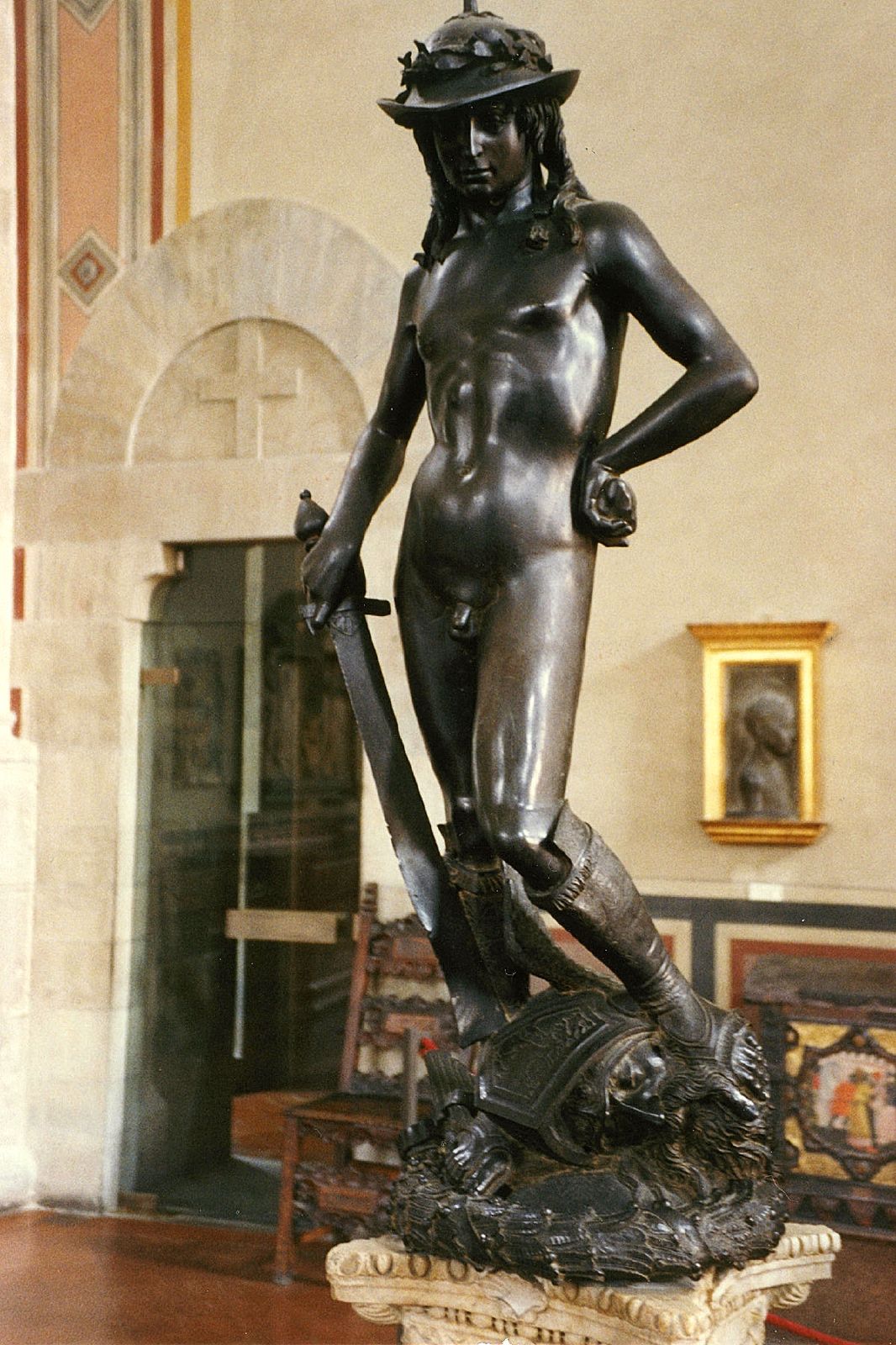
Donatello, David, 1440?

Donatello's David, renowned as the first free-standing bronze sculpture of the Renaissance, was quite controversial at time of release. While heralded as a great modern (at the time) work by some patrons, others considered it risque, especially in its nude and effeminate depiction of David. But one thing about the statue that has drawn considerable attention is David's hat. Being the only real article of clothing on the statue, it was bound to be imbued with speculative myths and hackneyed meaning.

But the actual hat itself is also quite enigmatic. The design of the hat is anachronistic of the time, it being more of an Italian mercenary's hat than anything that could have come out of the Biblical Era. And while the rest of the sculpture screams masculinity ...not, the hat at least conjures up the image of the violent Goliath and his supposed indomitable nature. But then there're the flowers.

While the hat itself seems out of place, what's weirder still is the presence of laurels and other flora. Taking an anachronistic hat and putting laurels (which are native to the Mediterranean region) on as accents seems like a bold move. But, this may make the sculpture better, at least historically. Unlike the Davids of other artists (read: Michelangelo), this David may indeed be more adherent to the Bible, depicting David as a somewhat weaker-looking person. In the narrative, David's weakness is extolled as a virtue, making its symbolic depiction here seem intentional.

  • 7:00 AM

David

Andrea Del Verrocchio, David, c. 1475

Although my love for paintings seems vast and never ending, I have recently been turning to sculptures for some aesthetic pleasure. While I could probably stare at anything by Bernini for the rest of my life, I'm not writing my blog post about him.

Enter Andrea Del Verrocchio. When he was first assigned to me, I knew nothing about him, just that he was a sculptor. My first thought was, "This'll be a great way to appease my sculptor craving." Upon looking at his work, though, I was unimpressed. This will be great quickly changed into "He's no Bernini." Comparison can be tricky, especially when it comes to a statue like David. Verrocchio's rendition doesn't come close to Donatello's Pan-ish tribute or Michaelanglo's youth.

But to truly appreciate Verrocchio, you have to throw all of those comparisons out the window. He might not be great, but he is pretty darn good. Verrocchio creates soft beauty through the use of curls and drapery. His David may not be as slick or stunning as the others, but there is a boyish charm in the smirk he dons; Goliath's head thrown on the floor like it's dirty laundry.

He is an artist lost in the shadow of others, and I can connect to that.

  • 7:00 AM

The Lictors Bring Brutus the Bodies of his Sons

Jacques-Louis David, The Lictors Bring Brutus the Bodies of his Sons, 1789

Few paintings embody so well the worldview of their creator.

The story of Brutus and his sons ends poorly. Brutus famously overthrew the original monarch of Rome, deposing the seventh king of the city and ushering in 500 years of industrious republican government. Brutus became the first consul of Rome and saw about overseeing the transition to a republic. However, even as he worked to strengthen the republic, trouble brewed right under his nose. The recently deposed king’s family, none too happy at their current predicament, immediately began a plot to retake the city and reinstitute a monarchy. They even managed to sweet-talk Brutus’s sons into joining their coup. It failed—one of the intended conspirators turned out to be on the republic’s side—and punishments had to be doled out. Brutus’s job looked unfriendly. The consulate, with Brutus’s approval, sentenced his sons to death. He then attended the execution, which was carried out barbarically so as to deter future conspirators (it didn’t work—another attempt at restoring the throne occurred the very same year). This brings us to the scene that David elected to paint. Brutus sits stoically in the foreground, his curled toes the only sign of the immense pain he must have felt.

A couple of important compositional traits allow David’s sentiments to shine through. Two different worlds exist, divided by the columns. On the left lie the sons and Brutus. Brutus is the image of masculinity; even the death of his sons cannot move him to show emotion. On the other side of the painting, bathed in light, Brutus’s wife and daughters mourn the loss of the sons. This parallels closely the composition of David’s Oath of the Horatii—he depicts strong, determined men cut off from their better halves.

Finally, this painting must be viewed in the context of its creation. Painted in 1789, a time when the king still held influence, the work is a not-so-subtle dig at the monarchy. Not only does the story of Brutus obviously paint the rapacious, treacherous Roman monarchy in a negative light, but the idea of making sacrifices for the revolution must have seemed a particularly salient idea as the pace of executions ramped up in revolutionary France.

David the painter could rarely divorce himself from David the politician, and this painting is of course no different. David’s concepts of masculinity, patriotism, and sacrifice ring loud and clear in this tribute to the first overthrow of a western monarchy.

  • 7:00 AM

The Coronation of Napoleon and Josephine

Jacques-Louis David, The Coronation of Napoleon and Josephine, 1807

On a cold, rainy day in pre-modern Paris, weak sunlight filters through the high windows of the Cathedral of Notre Dame.  Forward steps Napoleon to crown his beloved Josephine, who waits with bended knee to assume her place as wife and continue the Napoleonic line.  A catholic cross stands auspiciously at the exact center of the picture.  With its political undertones masked in religious intent, Jacques-Louis David's The Coronation of Napoleon and Josephine represents a well-executed propaganda piece.  Its commissioner, Napoleon, was right to approve.

Thematically speaking, religion becomes immediately obvious.  Two of the central compositional shapes highlight religious symbols.  A main arc of people sweeps from the left side of the painting and ascends up to the golden crucifix.  A cross standing strategically at the work's center tops another smaller arc from Napoleon's arm to the crown.  David has placed the paralleled figures at lofty heights in an assertion that Napoleon rules under God.  In case the message weren't clear enough, a ray of light literally streams in from the window to illuminate Napoleon.

But, almost subversively, David has placed subtle political messages.  Note how Napoleon stands higher than the Pope.  Although Napoleon instructed that he be depicted to look supportive of the rising leader, the Pope historically did not approve of France's new government ever since the previous revolutionaries had turned their country away from the Catholic Church.  The revolutionary regime deemed it too indulgent and embodying the very nobility they had just overthrown.  David's scene shows the threat of Napoleon becoming more powerful and influential than the church.

The painting appears rather austere and only moderately embellished, still a clear departure from the old nobility's flamboyant rococo.  David, first the French Revolution's propagandist and head artist, eluded exile from France as Napoleon's regime took hold and struggled into his former seat of power over the public.  His illustration of a militant emperor superseding the old methods of leadership would resonate with the people as a profound change.  Accordingly, a Neoclassicist approach appears in Napoleon's laurel wreath and Roman-like robes, recalling old European empires and marking Napoleon as a sort of Augustus Caesar incarnate.

The imposing painting of around six by ten meters attempts to establish authority for Napoleon.  This work showed the public a clear leader, garbed in Imperial Roman treasures and apparently held in esteem by the Church and, vicariously, God.  With the all-powerful lending legitimacy, the painting said, and with Napoleon the reincarnation of the father of Europe's greatest historical empire, nothing could stop France from expanding.  As during the Revolution and the reigns of kings before, this propaganda delivered a singular message to the common folk - to bow down to a new regime.

  • 7:00 AM

David's Self Portrait

Jacques-Louis David, Self Portrait, 1794

At 46-years-old, it seemed that Jacques-Louis David’s life had come to a halt. His career as the artistic face of the French Revolution was dismantled along with the Reign of Terror. His friend and partner-in-crime, Robespierre, had been executed. And now David found himself in jail waiting for his own execution day. With no one to step up and save the most controversial and politically-influential painter in France, David took measures into his own hands.

He painted his Self-Portrait from jail in 1794. The painting is of himself, yes, but not the 46-year-old political-painter-turned-convict version of himself. He painted a younger David, hair romantically tousled, clothes charmingly disheveled, and an expression that could only hint at the future that modern David would suffer. He is clutching a palette and brush, as if to say, “Who, me? I’m just a humble painter.” But his eyes tell a different story. His gaze falls just below the viewers, as if he can’t bring himself to look the people of Paris in the eyes. His expression is passionate, yet tormented. David was not trying to take back what he had done. No, he believed what he had painted throughout the Reign of Terror was justified. The people of Paris had needed him. He made the Revolution accessible to the masses. Horatii, Brutus, Marat – they were not mistakes. But in painting them, David had let himself be viewed as just a symbol, an image for the Revolution. As the Reign of Terror fell, so did David. His famous paintings that had captivated and engaged the French people had become his downfall. Now he painted himself.

It was a last resort, a meager attempt to save his life. Or, maybe it was a cunning scheme to win the people of Paris once again. He was expert at it by now, always being acutely aware of what makes people tick. He understood how to manipulate people through his art. He had been making people see his way for years, from Brutus and the Lictors to Marat, and now this. Even with his tainted reputation, David still had enough credibility to attempt to pull this off. And he wasn’t about to go down without a fight.

So did it work? I mean, really?

Of course it did.


  • 7:00 AM

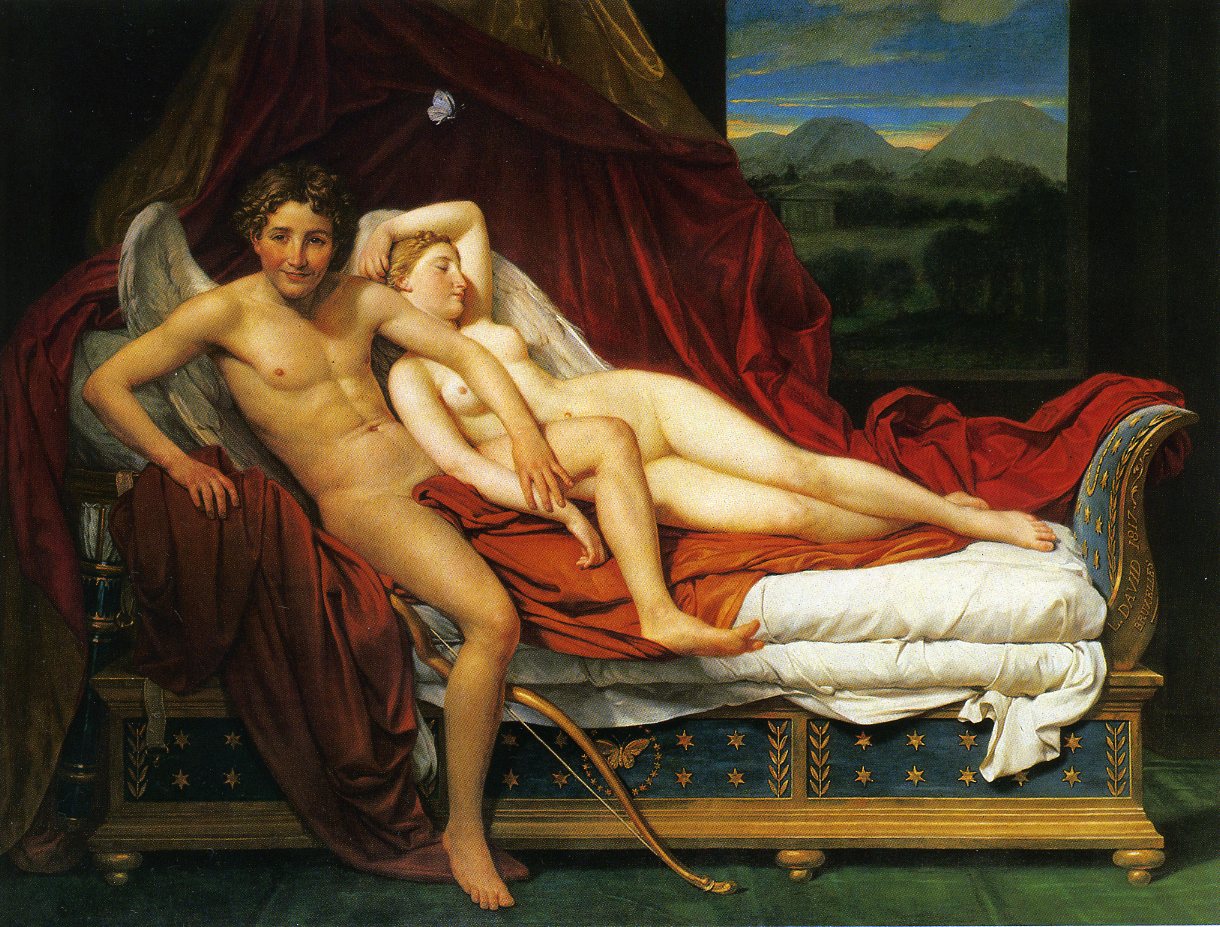
Cupid and Psyche

Jacques Louis David,  Cupid and Psyche, 1817

Girl, would you look at that body? Perhaps Jacques Louis David's funniest painting, Cupid and Psyche depicts the beginning of the couple's tumultuous relationship. "Tumultuous?" you may well ask. "How is this tumultuous? A handsome young man and his fair skinned maiden just waking up from a light night 'tumble,' all seems right to me." And that it should. David has gone out of his way to spice up the allegory from Metamorphoses, and has done so brilliantly. It's nothing too glaring: Just a smug grin on cupid's face, a gentle moving of the lover's arm, an open window and a winged rogue to escape through it. These details are what first made me love this painting.

The story behind the work is a wonder in and of itself: Once, a king and queen raised had three daughters, the youngest by the name of Psyche. Psyche was so beautiful that the people of the kingdom gave offerings to her instead of Venus, the goddess of love and beauty. Of course, this made Venus pretty upset, and so she asked Cupid to enact some sort of punishment upon the young girl. Cupid, like any good henchman, falls in love with the young girl instead.

 Basically, time goes on, Cupid doesn't do his job, doesn't claim Psyche for himself, and eventually people start to wonder why Psyche hasn't been married. An oracle cries wolf - or rather unholy dragon offspring - and Psyche is whisked away to a mansion in the middle of nowhere where an invisible Cupid seduces her and makes her his wife. All right, all right, let's get to the good parts by doing this middle bit quick: Cupid leaves every morning before sunset (again, note the pleased grin), all goes well until Psyche's sister comes to visit and insists that Psyche look upon her lover. Cupid is so hot that she spills hot lamp oil all over him and he runs away. Smooth.

So while Cupid runs home and sobs into his manicured hands, Psyche wanders the earth looking for him. She tries in vain to call on the help of the goddesses Ceres and Juno, and finally offers her service to Venus herself. Venus gives her three tasks of increasing difficulty, and Psyche finds herself constantly wishing for death, but each time she is saved by an animal or talking object that encourages her to keep going. Finally, after completing these first three trials, Psyche is tasked with traveling to the underworld to borrow some of the queen of the underworld's beauty. She performs her task beautifully until she opens the box and falls into a deep cursed sleep.

"Oh no!" you may say, but fear not! True love wins out in the end as always. Cupid finally nurses his "wounds" and comes to wake Psyche with ambrosia, the drink of immortality. The two are married and give birth to a beautiful daughter. Note: Daughter. Not a scary dragon.

  • 7:00 AM

David

Bernini, David, 1623-1624

Persevere. It’s the hardest part.

One of my oldest friends once told me his philosophy about life. The world doesn’t seem balanced, but it is. A good thing will come along that makes you happy. Then other good things follow. You all of a sudden have this feeling of superiority. This elated state prevents you from feeling bad about the less than thrilling parts of life. Nothing can bring you down until something actually does. The safety net breaks and you fall hard. Your peace shatters. One event or several that simultaneously occur will begin this downfall. As you drop to the floor, all the tiny things matter. They sting and bruise. And nothing can bring you back up again, until you let it. You find the strength to climb back up and find the good again. When you start climbing, the good comes. The cycle begins again. Good days pass followed by bad ones. Karma, fate, random happenstance; they all achieve balance in the end.

How do we persevere through our hardships? My friend and I are still working on that. We’re two young adults who have no idea what we want from the world. Did you expect our philosophy to be flawless? In fact, we both recently had troubles persevering. Hell, maybe I should not have used the past tense in the preceding sentence. We, being young, get stuck on things.

As I rebuild past moments in my head and kick myself, I can look at Bernini’s David to get a good idea of what I should actually be doing. Bernini creates movement. He forges action out of motionless rock. Sitting alone in my room will not help. I must move. David and I both stand in the middle of a storm, but you cannot see a physical cloud hovering over us. Bernini did not sculpt the giant David must slay. Instead he focused on the hero’s internal struggle. David stands hunched over, readying his slingshot. This hunching brings the weight of the world down upon him. The strain can be seen on his face and in his physique, but does it look like this will stop David? No. His left foot pushes off the ground, canceling the downward force. He can hold himself up. He sucks in his lips. Nostrils flare. Eyebrows scrunch. David will not stop. He will move towards the giant. He will slay the giant.

Triumph comes to those who try. David moves against the problems facing him. My friend and I must do that. Rolling over and dying simply isn’t our style. And I refuse to let it become us. I feel secure in our philosophy. Good days will be good if you let them, and if you do not dwell on the preceding bad one.

  • 8:00 AM

David


File:Florence - David by Donatello.jpg
Donatello, David, 1430-1440
Donatello’s famous sculpture, David, typifies the Renaissance. Donatello relied on wax for the foundation of David.  Unlike gothic culture, Donatello created David with ease and a realistic posture.  Wax enabled David’s relaxation and masculinity to demonstrate a normal appearance of the David and Goliath story.  In 1440, a bronze layer covered David to finish Donatello’s masterpiece.
During mid-1400s, King David symbolized power in Florentine Italy.  As the icon for the Florentine Republic, Palazzo Medici transferred David to the center of the courtyard.  David remains the first courtyard center piece in Florence.  Through the incredible work of David and other sculptures, Donatello experienced the rare popularity in society.   
  • 7:00 AM

Portrait of a Woman Scorned: Madame Recamier

Portrait of a Woman Scorned
The Fairer Sex Treated Not-So Fairly
Curated by Katherine Anderson

Madame Recamier, David, 1800.
Under a facade of white wraps and virginal beauty comes the story of Madame Recamier - the headstrong dame caught up in the downfall of her royalist family. At a young age, Recamier's father forced her to marry a man of his age in the interest of saving the family money after the French Revolution. But this hardly resolved the issue. When her beau lost the money with the rise of Napoleon Bonaparte, the family name was the only remnant of glory. But this hardly put Recamier in a position of glory. After avoiding demands to serve as a lady in waiting for the new elite, Madame Recamier and her now-elderly husband were expelled from France by Napoleon himself. After her husband's continuous refusal to allow her to marry again for money, Recamier returned to France and hid away in a convent until her death from cholera.

Though her family's royalist ties and dwindling bank accounts quickly made Madame Recamier a pariah in France, it was her virginal appearance that ultimately excluded her from prominent socialite circles. Rumors flourished about Recamier's suspicious marriage to a much older man, including that she was allergic to sexual encounters or that she was infertile. Thus, when David chose to paint Madame Recamier in 1800 (despite the family's commission of another artist), her angelic attire and awkwardly positioned body displayed this quality. Though many women of the time used portraits to confirm their status, many viewed Recamier's as a disgrace to biology and her family, for she was now clearly portrayed as a completely unsexualized being. The position outcome? The style of seat upon which Recamier lays in David's painting was quickly renamed as "the Recamier."

  • 7:00 AM

Member Dismemberment - Oath of the Horatii


Member Dismemberment
A Look at Limbs 
Curated by Kate Sims

David, Oath of the Horatii, 1784
“[The arts] should help to spread the progress of the human spirit, and to propagate and transmit to posterity the striking examples of the efforts of a tremendous people who, guided by reason and philosophy, are bringing back to earth the reign of liberty, equality, and law. The arts must therefore contribute forcefully to the education of the public... The arts are the imitation of nature in her most beautiful and perfect form... Those marks of heroism and civic virtue offered the eyes of the people [will] electrify the soul, and plant the seeds of glory and devotion into the fatherland.” Goldwater, Artists on Art

David’s Oath of the Horatii illustrates a scene from Roman Legend where two competing cities go to war with each other. Three brothers from the Alba-Longa family plan to fight three brothers from the Horatti family. Each of the brothers is willing to give up his life as the last male standing wins the war for his city. The painting can be divided into three sections. The males do not show emotion with their faces, but rather with their arms. The brothers, who eagerly ask for their father’s blessing, jut their arms forward, mimicking the swords and cascading upward, revealing complete confidence in the situation. Their father, raises the swords with arms spread toward the heavens. He is asking God to look over his sons as they go to war, as well as offering his sons as a sacrifice to the city.

On the other hand, the sisters and mother are holding their heads in their hands or dropping their arms to their sides. Greif has overtaken their bodies and literally immobilized them. The women are the only ones allowed to feel emotion because they do not have heroic responsibilities. The stillness of these characters against a plain dull setting elevate the importance of the situation. The limbs in Oath of the Horatii display the mental and physical differences between men as the tragic heroes and women as the weaker sex.

  • 10:00 AM

Art for the Private Viewer - Cupid and Psyche


Art for the Private Viewer
The Broad Usage of Sexual Figures in Art
Curated by Sree Balusu

 Jacques-Louis David,Cupid and Psyche, 1817

"Cupid prepared to obey the commands of his mother. There are two fountains in Venus's garden, one of sweet waters, the other of bitter. Cupid filled two amber vases, one from each fountain, and suspended them from the top of his quiver, hastened to the chamber of Psyche, whom he found asleep. He shed a few drops from the bitter fountain over her lips, though the sight of her almost moved him to pity; then touched her side with the point of his arrow. At the touch she awoke, and opened eyes upon Cupid (himself invisible), which so startled him that in his confusion he wounded himself with his own arrow. Heedless of his wound, his whole thought now was to repair the mischief he had done, and he poured the balmy drops of joy over all her silken ringlets."
Bulfinch's Mythology

After Cupid pierces himself with his own arrow, he falls in love with Psyche. He eventually starts to come stay with his wife only at night times, having to leave immediately at dawn. Cupid is the symbol of love and the meaning of "Psyche" is soul. Therefore, this painting shows the post-physical union of love and the soul.


Both Cupid and Psyche lie naked in bed. Cupid is getting out of bed ,while Psyche is still laying down on her side. The painting accentuates Psyche's hips and curvaceous figure to increase the sensuality of the scene. Her white form and figure represent, ironcially, purity and beauty. Cupid has a smile on his face and the bow pointed toward the ground symbolizes his, ahem, satisfaction. While both subjects of the painting are naked, David uses the positions of Cupid and Psyche's bodies to provide an interesting contrast between innocence/purity and sexual desire/satisfaction.

David's Cupid and Psyche is one work of art that proves that it is not nudity itself that necessarily provides the sexual tone in art, but rather the position and physical orientation of each subject's body.

  • 5:14 PM

Sabine Women

To Those Which They Never Turned Another Cheek: 
Admiration for Paintings with Major Authority Issues 
Curated by Shweta Vadlamani 
Intervention of the Sabine Women, David, c.1796
History required power. Precedents were set by people who wielded that power. There was one point of time when people believed that the enthroned were the only ones who could oppose the forces of society to make a change. I now proceed to write about the artistic voices who actively refuted that claim.

"There is no luxury in a painting where females reveal their dominant form!"

David paid no attention to the insults of his audiences, choosing only to immerse himself in the creative recesses of his prison-cell. Incarcerated for his affiliations with Robespierre, a visit from his estranged wife inspired David to paint his own rendition of the Sabine classic in her honor.

In direct contrast to the works of Giambologna, Poussin, and Rubens, Jacques- Louis David painted the women in the limelight, as the interveners who, as he named the painting, “enforced peace by running between the combatants.”

Historians attribute the initial rejection of David’s 1796 rendition to the outcome of France’s war, which ended up leading to the Reign of Terror. During a time when man fought man for a form of political relief that was always just out of their reach, The Intervention of the Sabine Women’s blatant worship of women infuriated an already-angry population of patriarchs.

The central form in the painting, the alabaster Hersilia, (also identified as the wife of Romulus,) spreads her arms in effort to separate her father from attacking her husband, simultaneously thrusting herself and her young children between the warring parties. The hesitation depicted on her husband’s frozen movement, as well as through the movement that many soldiers take in order to sheath their swords, reinforce David’s message to the French people. The painter used the power of the female form to plead with France’s population, hoping to inspire them to unite after the violence of the revolution.

Unfortunately, the painting did not succeed in reuniting France. Quite the contrary, the Sabine women insulted French men, who were disgusted with the concept that a woman had to interfere before men may see reason.

  • 12:00 AM

The Death of Socrates and The Book of Laughter and Forgetting

The Death of Socrates, Jacques-Louis David, 1787
“We must never allow the future to collapse under the burden of memory.” 
- Milan Kundera, The Book of Laughter and Forgetting  


Milan Kundera published The Book Of Laughter and Forgetting in 1978. The novel, which tells the story of multiple people in seven integrated parts, provides a new approach to life. Kundera, born in the Czech Republic, became a writer in the midst of communist invasions and life-altering events such as the Prague Spring. Because of his experiences with government and the course of  history in his country, his writing crackles with historical information and political irony. The common line in Kundera’s works goes beneath the surface of examination to explore the unknown aspects of life and to challenge conventional thoughts on topics that seem otherwise mundane. The Book of Laughter and Forgetting explores the burdens of the lives of six people. Kundera says, “We must never allow the future to collapse under the burden of memory.” Aside from the obvious message to progress with life and let memories be in favor of creating a future, Kundera personalizes memory. He gives memory agency.

In Jacques-Louis David’s The Death of Socrates memory must give way to the future. As the story goes, Socrates was put on trial for his political philosophies in the wake Peloponnesian War and the Athenian decline in the face of Spartan power. In addition to his near technical perfection in The Death of Socrates, David creates a story as heartbreaking as it is brave. Socrates, who would rather poison himself than rescind his beliefs, displays unparalleled bravery that consumes the foreground of the painting. While bravery claims the foreground of the painting, heartbreak and memory fill the background. Socrates wife, escorted up the stairs by two men, waves goodbye to her beloved. As Socrates’ followers lament the coming death of their mentor he moves into the realm of memory that Kundera speaks of. The burden of memory similarly consumes thoughts of the future.

While these memories seem to be all that remains of Socrates, and of the times and people of the past, we must move on. The future cannot collapse under the burden of memories.

  • 12:00 AM

Madame Phillippe Desbassayns de Richemont and Her Son, Eugene

Marie-Guillemine Benoist, Madame Phillippe Desbassayns,
1802-1803 
Marie-Guillemine Benoist’s work Madame Phillippe Desbassayns de Richemont and Her Son, Eugene has a bit of a cloudy background. In 1897, the painting surfaced in an exhibition at the Ecole des Beaux-Arts in Paris. This was the first time that Jacques-Louis David scholars had seen the work, and they presumed (wrongly) that it was his.

A member of the de Richmont family gave the work to the Metropolitan Museum of Art in 1953. Family tradition stated that David painted Madame de Richemont and her daughter, Camille, shortly before the girl’s death in an accident. The family sold the painting because the painting alludes to memories of their daughter’s tragic death. Critics speculate that after Camille’s death, the painting was altered to replace the young girl’s portrait with that of her brother Eugene’s. However, the physique of the child in the portrait, as portrayed through its curls and rosy skin tone, does not indicate a particular gender.

While art critics attribute the painting to Benoist, the mannerisms of David, her mentor, shine through the work. The position of the character, short brushstrokes, and wisp-ish quality of the hair mimics David’s style. But, the shade of red in the shawl that adorns the chair contradicts David’s customary color. The orange tones of Benoist’s fabric almost seem too bright and florescent compared to the customary crimson used in David’s works, such Venus Disarming Mars. After studying David’s paintings, it can resolutely be stated that Madame Phillippe Desbassayns de Richemont and Her Son, Eugene was not painted by the late master, but by his studious disciple.


  • 1:00 AM