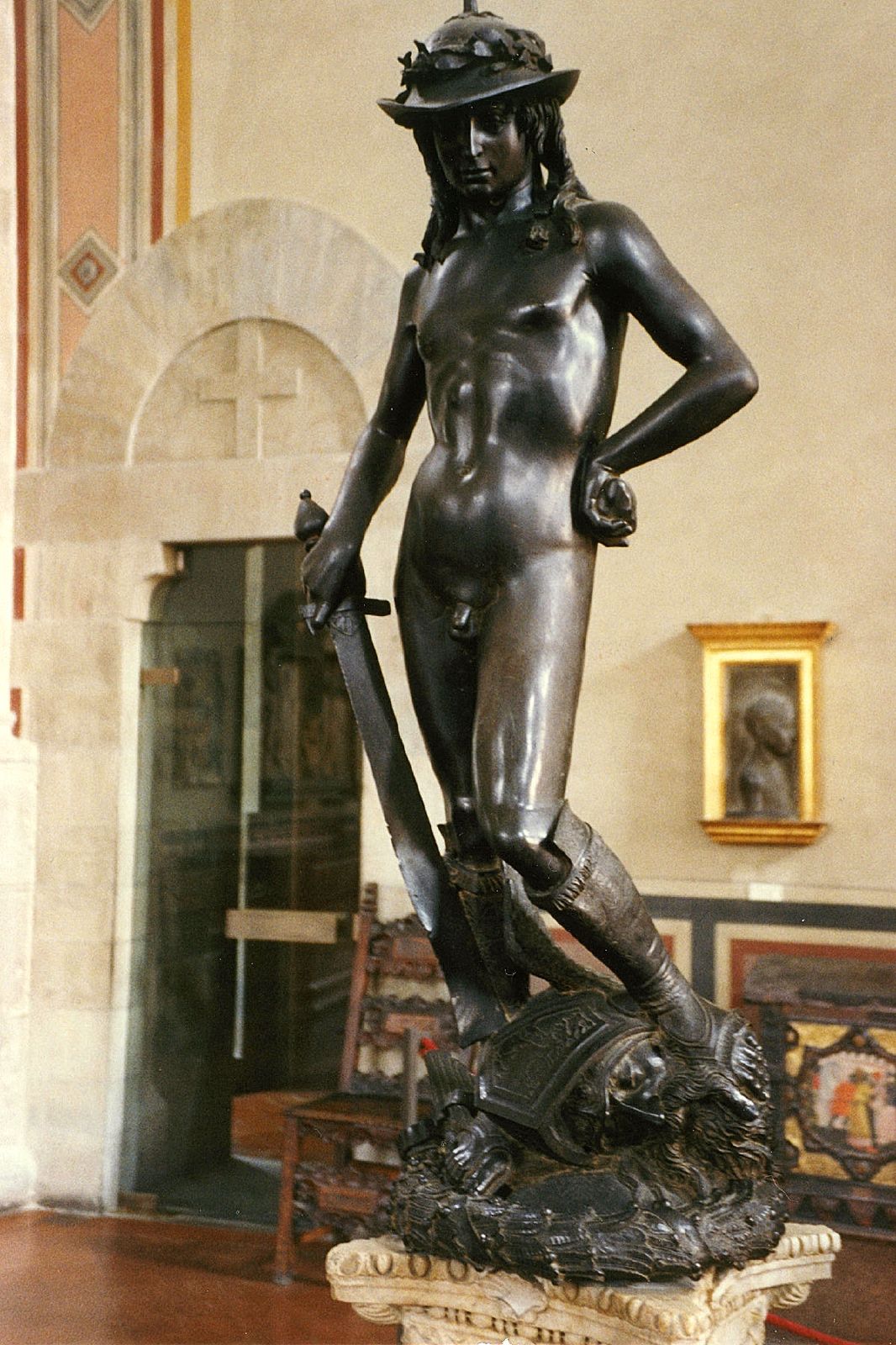
Know Your Chapeau: David

Donatello, David, 1440?

Donatello's David, renowned as the first free-standing bronze sculpture of the Renaissance, was quite controversial at time of release. While heralded as a great modern (at the time) work by some patrons, others considered it risque, especially in its nude and effeminate depiction of David. But one thing about the statue that has drawn considerable attention is David's hat. Being the only real article of clothing on the statue, it was bound to be imbued with speculative myths and hackneyed meaning.

But the actual hat itself is also quite enigmatic. The design of the hat is anachronistic of the time, it being more of an Italian mercenary's hat than anything that could have come out of the Biblical Era. And while the rest of the sculpture screams masculinity ...not, the hat at least conjures up the image of the violent Goliath and his supposed indomitable nature. But then there're the flowers.

While the hat itself seems out of place, what's weirder still is the presence of laurels and other flora. Taking an anachronistic hat and putting laurels (which are native to the Mediterranean region) on as accents seems like a bold move. But, this may make the sculpture better, at least historically. Unlike the Davids of other artists (read: Michelangelo), this David may indeed be more adherent to the Bible, depicting David as a somewhat weaker-looking person. In the narrative, David's weakness is extolled as a virtue, making its symbolic depiction here seem intentional.

  • 7:00 AM

St. Louis of Toulouse

Donatello, St. Louis of Toulouse, 1421-1425

Realism, it's an art. For sculpture, realism is accurately sculpting so that the sculpture represents the model. For Donatello's St. Louis of Toulouse, it is more accurately called a sculpture representing the person's character, ultimately contrasting the realistic majority of Donatello's work from this decade.

However, the work is often regarded as St. Louis the Blunder, the worst work in Donatello's career. Donatello backs his disastrous work by claiming "that he had done it that way only after careful study, since Saint Louis was a blunderer said by Vasari " to have abandoned his kingdom to become a monk." Although an obvious scapegoat for his own mistake, his reasoning takes on a whole new meaning of art. Applying character to modelling style surpasses typical sculpture. Similar to the annoyingly popular phrase, don't judge a book by its cover, the quality of this piece falls beyond the original blundering, and into the actual blundering of this character in biblical terms.


  • 7:00 AM

The Prophet Habakkuk

Donatello, The Prophet Habakkuk, 1423-1426

Lively statues comforting a lonely man, a battle for perfection, and free-loading artists. I do believe we have entered The Hunchback of Notre Dame.

"Speak! Speak! Or be damned!" Donatello dramatically yells as he bursts from frustration in creating realistic features in his Prophet Habakkuk, or as he likes to call it, Il Zuccone. One part of the five sculpture series, Il Zuccone accurately portrays Donatello's talent in facial features. Showing realistic expressions, thoroughly sets Donatello apart from any other sculpture in the Renaissance. Donatello's confidence in sculpting grew from his incessant craving for perfection in his art. Demonstrated by the swear-worthy Il Zuccone, Donatello shows self-improvement from his peasant-like Crucifix created ten years earlier.

Giving life to the lifeless, is arguably the common goal of all artists. Whether it be canvas, stone, brick, or the side of a converse shoe, the idea is apparent. Donatello's life work of attempting to sculpt vitality, to the point of yelling at his sculptures to speak back, reveals his own progressiveness as an artist. Before this, I often disregarded sculptures, un-entertained by the lack of color and the overall banality of using one substance. However, Donatello's greatness far surpasses my expectations when beginning my research. The beauty of creating life from one substance now impresses me, not to mention the amount of sass one artist can bring to stone.

  • 7:00 AM

Mary Magdalene

Donatello, Mary Magdalene, 1453-1455


Donatello’s collection of classical, perfectly proportioned sculptures make his departure from that formula all the more shocking. His Mary Magdalene, grim, unapologetically realistic, sacrifices those niceties to create a grim figure of human suffering and loss, but also of redemption. Wearing only her long, knotted hair, Magdalene looks slightly upwards, her lips parted and hands joined in prayer.

It is possible that Donatello himself - over sixty years old at the time of sculpting - might have suffered a debilitating illness before creating this work, and that his own suffering changed how he treated Mary Magdalene’s penance. Certainly Donatello had never created anything like this stark, emaciated figure. His contemporaries, too, were shocked. The fashion in Florence at the time was smooth, glazed clay statues such as those produced by Luca della Robbia. The public had no idea how to react to this radical new style.

Personally, I find the Penitent Magdalene stunningly beautiful. The emotion in Magdalene’s face and the raw empathy of the piece mean that it still holds meaning today. This piece was one of the first in our Art History course to provoke that emotional reaction, in contrast to those first stiff, fumbling efforts away from the Byzantine style. It has lost none of that impact today.
 Editor's Note: The students were assigned to write about the artwork that has impacted them the most. These pieces will run for  about two weeks. 

  • 7:00 AM

Habakkuk

Donatello, Habakkuk, 1425
Donatello's Habakkuk, often known as Pumpkinhead, was the eighth of twelve minor prophets in the Old Testament of the Bible. As Habakkuk's self-titled book reveals next to nothing about the prophet himself, Donatello took some artistic license while rendering Habakkuk's form. Donatello departed from the traditional  way of portraying prophets and other significant biblical figures as perfectly handsome, relatively young men. Instead, Donatello created a more realistic version of the eighth prophet, one thin and tired from fasting and devotion to God.

This sculpture acquired its nickname, Pumpkinhead, from the oddly proportioned head that Donatello gave to the prophet. The problem corrects itself, however, when viewed from the position that the sculpture was originally designed for. Donatello customized each of his sculptures, keeping in mind the perspective that the viewer would have, and adjusting the proportions accordingly. What at first appears to be an error, upon a closer inspection, reveals yet another level of Donatello's genius.

The skillfully crafted drapery tells of the muscular form beneath, and Habakkuk's posture and expression give the sculpture a sense of weariness and age. Habakkuk has obviously persevered through trial and persecution alike, and his form, although thinned by time, won't be giving up anytime soon.

  • 7:00 AM

Mary Magdalene

Donatello, Mary Magdalene, 1454-55
Mary Magdalene depicts a story of a woman who was a strong disciple of Christ. According to the Bible, Magdalene was a "woman of sin." In which her story dictates of her being saved from seven demons. After becoming a passionate follower of Christ, she became a role model for other female followers. At one point Magdalene refused to eat, she intended to rely on "heavenly nourishment" alone, which is why Donatello captured her with sunken, corpse-like eyes.

Donatello's attention to detail in this wood carving is astonishing, with every single drape of her dress and twist in her hair looks like it is dripping right off her. Magdalene's rugged body, brings back the idea of her only consuming heavenly nourishment. If one were to look at her face, she expresses a need for one last bite of heavenly nourishment which instills her loyalty to Christ.

Through Donatello's attention to detail comes along the striking humanistic qualities. Donatello goes as far as to carve her broken teeth poking out through dehydrated lips. What my eyes were drawn to were her eyes. The eyes are carved with an iris. Her head is pointing down, but her eyes remain looking up.

This portrait of Mary Magdalene is unlike any other done. Other works show her as a beautiful woman, with long blonde hair and fit. However, in other renditions, her eyes are all looking up, or at Christ himself. Donatello's version shows a different side of her, one that exemplifies her true passion for Christ.

  • 7:00 AM

David


File:Florence - David by Donatello.jpg
Donatello, David, 1430-1440
Donatello’s famous sculpture, David, typifies the Renaissance. Donatello relied on wax for the foundation of David.  Unlike gothic culture, Donatello created David with ease and a realistic posture.  Wax enabled David’s relaxation and masculinity to demonstrate a normal appearance of the David and Goliath story.  In 1440, a bronze layer covered David to finish Donatello’s masterpiece.
During mid-1400s, King David symbolized power in Florentine Italy.  As the icon for the Florentine Republic, Palazzo Medici transferred David to the center of the courtyard.  David remains the first courtyard center piece in Florence.  Through the incredible work of David and other sculptures, Donatello experienced the rare popularity in society.   
  • 7:00 AM

Feast of Herod

Donatello, Feast of Herod, 1427

Donatello has significantly distributed the characters vertically as well as horizontally in this piece. There are four distinct lines that pulls the eye upward. If one looks at it in vertical halves it seems to be more unbalanced. There is more weight and darker hues on the right than the left. But the commotion on the left balances the right.

This scene is chaotic. The figure’s bodies are all pointing to the figure on the far left. The three characters surrounding the man on the left seem to be presenting him food. The group on the left appears to cringe, creating a deeper story within the piece. 

Donatello has manifested such detail and dimension, it feels that one could see the so much further than what is actually there. He pulls the viewer into the middle of all this chaos, which is what drew me into this piece.

  • 7:00 AM