The Scream

Edvard Munch, The Scream,  1893
By ANTHONY MADISON

Edvard Munch's The Scream has been one of the most iconic painting ever created in modern art history. It has provided inspiration for the 1996 slasher movie called "Scream" and the cover for the 1990 movie "Home Alone."

The colors of the painting give a contrast between the orange and red colors in the sky with the dark blue of the water. The reflection of the sky in the water on the left hand side of the painting near the top mixes the two colors well.

Towards the end of the 18th century, artists began expressing their inner emotions and feelings through their work. Usually, artists would paint to display their painting abilities to show how good they were. As this new era of painting came about, Munch changed up his style a bit. Munch had issues with anxiety which he chose to express with this piece instead of focusing on artistic skill.
  • 7:00 AM

Amor and Psyche

Edvard Munch, Amor and Psyche, 1907
Call Munch’s Amor and Psyche a representation of myth without the myth. Amor, more commonly known as Cupid, lacks any sense of godliness. He has no wings, no bow, and no arrow. Munch has also taken Psyche’s astounding beauty that gave her the ability to seduce a god. She merely looks tired and deformed.

Munch attacks his subject matter in an entirely different way than all other painters our class has examined this year. His post-impressionism seeks to represent more abstract ideas than the Renaissance styles. These painters focused on literal representation and their symbolism extended only so far as to include halos and chimeras. Now, you may say I am overlooking very important and big exceptions, but guess what? This is my blog post, and I am tired of looking at angels, saints, and Jesus. Now, you know your class has looked at way too many religious paintings when the Catholic kid says something like this. So buckle up and ride along with my gross, untruthful generalization. I miss my Munch, and I want him back for a day.

Metamorphoses describes the tale of Psyche and Cupid as thus. A princess named Psyche possesses such beauty that the goddess Venus becomes jealous. So she sends her son Cupid down to take care of the problem. Cupid’s mission is simple: make Psyche fall in love with the ugliest dude he can find. There’s only one problem. Cupid has kind of a soft spot for beautiful princesses. So instead he secretly marries Psyche, but does not allow her to know his true identity. Henceforth, Cupid only visits her in the dead of night. Finally, she gets fed up with this arrangement and lights a lamp. She then discovers Cupid’s godhood. Needless to say this causes some complications for their relationship, but it all works out in the end.

I’d call this a rather peachy story, but Munch rejects that interpretation. Instead he plays with the idea of darkness and the fragile structure of the mind within these godlike figures. Notice the heavy, black brush strokes over Amor. These are prison bars. They are on Psyche’s face as well. The background has similar brush strokes, but they are white. I imagine the whiteness represents Psyche’s turning on of the light. The light then begins to illuminate the two figures. It has reached all of Psyche’s body and Amor’s shoulders. In the myth, Psyche discovers Cupid’s godliness. In Munch’s painting, she discovers a lonely, naked man. Also, the beauty Psyche supposedly possesses does not seem apparent. She looks blurred and delicate. These two bigger than life figures are really fleeting ideas that can be repressed. Amor, or love, and Psyche, the mind, are illogical. Munch did not want these things in his life, along with God. I believe I have already written a blog post talking about Munch’s atheism, but to reiterate Munch thought the world too ugly of a place to be created by a perfect all-knowing entity. There are only people, and they create myths in order to explain the things they cannot understand, such as the mind and emotions. However in Munch’s time, Freud had dissected the mind. Myths were no longer needed and to Munch, neither was love or rationality.

  • 7:00 AM

The Swallows

Edouard Manet, The Swallows, 1873
I'm thankful for the countryside. For any day that I can lie lazily lounging in the open air, as the wind rushes through fields of Kansas blue stem. I am thankful for the rusty-palette and quiet splendor of autumn, the biting chill of winter on my cheeks, the budding beauty of spring, the sweat of summer nights. I am thankful for the hot July night, two years back, when I saw thousands of fireflies flicker between the trees, like the willow-the-wisps of folklore, so that the night sky and the woods around became as one. For the afternoon I spent at the pumpkin patch on Holmes with my sister, laughing and racing through the corn maze, willingly losing ourselves in the winding aisles of crop. For the days before my license, when Michael, Adam, Will, Deko, Chris, and I would trek for an hour just to waste the day at the park or wander the aisles of Price Chopper. The nights that we would steal out of our homes to play Manhunt.

And with these last two, I've touched upon something that I had not considered when I set out writing this post: That these moments stand out because they are shared. I've enjoyed my share of lonely days wandering the hills and creek beds near my grandparents' home, and I cherish those evenings of self discovery. But those shared moments of glory - whether the wonder was lost on my company or not - are those that truly shine.

Just two weeks ago, Max and I fixed up bikes in the driveway of his new home, desperate to set off in search of adventure in the last hours of sunlight. Our repairs made, we mounted up and raced through his neighborhood, up sidewalks and down asphalt roads, past joggers and couples and children playing in yards. In that moment we were free. We smiled like we hadn't since the year began.

  • 7:00 AM

Puberty

Munch, Puberty, 1893
Midway on our life's journey, I found myself
In dark woods, the right road lost. To tell 
About these woods is hard - so tangled and rough
And savage that thinking of it now, I feel
The old fear stirring: death is hardly more bitter.
 - Inferno, Dante, Canto I

I don't envy Dante for going through his mid-life crisis in 14th century Italy. Carrying the weight of depression, regret, and doubt before the invention of motorcycles, hair restoration, and dating services sounds like Hell on earth. The poor guy's true love died, and he'd only ever seen her twice. His political party had lost power, and his wife nagged him nightly about leaving the chamber pot lid up. A modern poet would have taken to the bottle, but whiskey hadn't hit the shelves in Italy just yet. Instead, Dante put pen to parchment and scrawled out one of the greatest poetry epics known to man, The Divine Comedy. His cantos cast his enemies into hell, placed his beloved Beatrice in heaven, gave him Virgil as a spiritual guide, and secured his place in history as il Somma Poeta.

Admittedly, I have no experience on which to base my feelings on Dante's situation. I'm a seventeen year old kid cracking jokes about people of an age more than twice my own. In some way, I am in no position to muse about the pains of growing old, but I have wandered through dark woods of my own. I suppose I'm lost in some right now. 

Each night when my head hits the pillow I sigh, and reflect, and many nights I reach the same conclusions: I am happy, but not fulfilled. I am busy, but not productive. I care deeply, but do not act. I can't decide whether I'm waiting for things to fix themselves, or for Cormac McCarthy to float through my window and show me the right road (preferably not the one he wrote about). The only thing I'm certain of is that the latter won't happen. And it shouldn't. I'm not alone in these woods. Though the brush and bramble may block my view, I know that there are others, and that many deserve their guide's attention more. 

  • 11:14 PM

The Flight into Egypt

Elsheimer, The Flight into Egypt, 1609
And following its path, we took no care
To rest, but climbed: he first, then I--so far,
Through a round aperture I saw appear
Some of the beautiful things that Heaven bears,
Where we came forth, and once more saw the stars. 
- Inferno, Dante, Canto XXXIV, 136-40

Adam Elsheimer, a German artist, created his famous The Flight into Egypt in 1609 in Rome. The painting pictures the Holy family makes its way through a dim landscape below an expanse of starry sky. The moon, the torch held by Joseph, and the campfire provide the three main sources of light. The river bank and the outline of heavily dense trees form a diagonal across the picture. It echoes with the milky river, a symbol often believed to be the path to Heaven. The Holy family walks towards the left to where the campfire  is located and to where the milky river leads upwards, implying to the audience that a shelter and a auspicious future await them.

Just like the King Herod is after the Holy family, the horrible demonstration of Hell scares Dante away. Coincidently, the starry sky is always in the background. In addition, Dante's Purgatorio and his Paradiso, like the Inferno, end with the word stars.

I frequently pictured Dante in my head as the screaming man painted by Edvard Munch. I try to think what his face looks like when he finally gets out of the bloody Hell. I was expecting Dante would spend another Canto to depict the gorgeous landscape above the ground, and his ecstatic mood towards the ravishing view of man's world. But he did not. No more views are mentioned but the stars, and no more words are said but, "the beautiful things that Heaven bears." Short, but powerful. After witnessing scores of horrendous tortures in Hell,  Dante says that above the starry sky, Heaven never abandons you; and only can the mighty God create such a view of silence, peace and solemnity.

  • 7:00 AM

Gentlemen's Club - Olympia

Gentlemen's Club
Courtesans and Seductresses Depicted in Art
Curated by Gabbi Fenaroli
Édouard Manet, Olympia, 1863 
“So sweet and delicious do I become,
when I am in bed with a man
who, I sense, loves and enjoys me,
that the pleasure I bring excels all delight,
so the knot of love, however tight
it seemed before, is tied tighter still.”
- Veronica Franco

Gazing into the eyes of Manet’s Olympia, it becomes difficult to look away. The private moment Manet has created for the viewer does not go unnoticed. What shocked the masses at the 1865 Paris Salon was not her bare breasts and exposed body. They took offense to her provocative gaze, and the blatant fact that she was a courtesan. Some items pointing to her profession include the orchid in her hair, the black ribbon that contrasts her pale flesh, and the playful slipper falling of her foot. What sets Olympia apart from other paintings featuring a bare model, is that she is attainable. She exists in modern culture.

Paintings record history and depict events occurring in society, and prostitution was not a piece of history Parisians wanted recorded. In contrast with the painting that inspired Olympia, Sleeping Venus by Giorgione, Olympia appears more boyish than Venus.

Olympia undermines the female bargaining power of sex, since her job trades pleasure for money. Olympia threatens women’s power, especially in 19th-century Paris, because of what she offers to men - no strings attached, no guilt involved.

  • 8:00 AM

Art for the Private Viewer - Death of Marat

Art for the Private Viewer
The Broad Usage of Sexual Figures in Art
Curated by Sree Balusu

Edvard Munch, Death of Marat, 1907
On July 13, 1793, Jean-Paul Marat was murdered by Charlotte Corday, a woman who opposed his political propaganda and decided to act.

There is apparent nudity in this painting, and Munch's use of a sexual theme in which to depict this scene creates both a powerful symbolism of this murder.

Similar to David's Cupid and Psyche, Charlotte Corday is white in color, which seems to reference purity. This could allude to her clarity and her vision. She believed in ridding the country of the unjustified hate and political manipulation that Marat had created.

It is important to note the placement of blood in this painting. There is a large blot of blood stained on the bed where Marat lies dead, which signifies the blood from the wound where Corday stabbed him. However, there is also blood on the very bottom of Corday's legs. It looks as though Corday and Marat have just finished sexual intercourse and that Corday has given birth to the murder.

Corday and Marat's sexual intercourse is a physical union that symbolizes the historical union of these two figures. Without Marat's death, Corday would not have become a famous/infamous historical figure. Without Corday's killing him, Marat would not have become renowned as a saint through the work of Jacques-Louis David, who forever changed Marat's image.

Because of David's painting, Marat became publicized as a martyr for supporters of his political party (which explains Munch's use of a crucifixion pose to depict Marat on his bed). Through the lens of history, Corday and Marat are inseparable, which is symbolized by the proximity of Corday and Marat's right hands.

Through the concepts of physical union and reproduction, Edvard Munch accurately depicts both Corday and Marat's place in history along with what they are remembered by -- the murder, which is effectively their child.

  • 5:14 PM

Mother Liberty and the Seducer - Berthe Morisot with Veil

Berthe Morisot with Veil
Mother Liberty and the Seducer
Curated by Alex McDonald

Curator's Note: The Mother Liberty and Seducer story arc has come to a close. I now leave you with two stories of thematic importance.

Manet’s brush pushes against the canvas. Colors blend. Shapes take form. Sweat dribbles down the artist’s brow. He works with a mission.

We are going to get your voice heard, Berthe, he promises. There are worse artists out there prospering. Why should you have to starve because of your sex?
            
Manet hears a muffled reply.

Speak up, darling. I can’t hear you.

He does not make out the next gurgled cries.

Berthe, this isn’t going to work if you can’t sit still.


Manet’s portrait stands close to completion. He hopes for his painting to attract attention to his suffering sister in law’s art career. A woman can’t make it anywhere in the world, Manet tells himself. She needs his help. If he can show the world through his art that Morisot demands the critics' attention, she can make it big. Like him. His talent will be the tool she uses to foster her own.
          
I am almost done. I just need to complete the mouth.
A raspy croak sounds from the other side of the canvas. Manet doesn’t look up.

Be quiet, I don’t want to get this wrong. Manet looks up and drops his brush in shock.

Morisot’s mouth is sewed shut. Her eyes stare at Manet with an accusing gaze. A gaze that says all the words Morisot’s mouth cannot say.
  • 12:00 AM

Mother Liberty and the Seducer - Woman in Three Stages

Woman in Three Stages, Edvard Munch, 1895
Woman in Three Stages
Mother Liberty and the Seducer
Curated by Alex McDonald

Curator's Note: This is the fourth installment in a series of blog posts where I have presented short fiction based off the paintings in my collection. If, please go read my three prior posts. Thank you.

The Woman’s revolution succeeds and her image becomes a symbol, a rallying cry for all the abused.

Decades later, a young Girl sees the woman’s image and wonders how can a woman hold such respect? She even has her chest bare. All she has to offer, out in the open for all to see. And they still admire her?

The Girl bites her lip. She is familiar with a different painting, Edvard Munch’s Woman in Three Stages.


The Girl dreams of a wedding on a beach. Her dress will be white like every other bride’s. And on the wedding night she will lie naked before her husband. Nothing will be held back because he wants it all. She will smile and enjoy it.

But after the romance ends, she will cover her breasts and become an old woman.

The Devil smells his chance and laughs.
Where is your husband? He isn’t even in the picture.

Well… He’s….


He never was. You’d do this even if you never found a husband.  Men are not the ones dictating this cycle. Women are. Marriage, sex, death. That’s all you’re good for.


But Mother Liberty? She broke the cycle. Look at her!


Are you like her? Do you flash your chest around for all to rally behind? What have you inspired?


Nothing.


The Devil smiles.
And what are you gonna do about it?

The Girl locks eyes with the Devil.
Everything.


The Girl spits at Munch’s painting. And Mother Liberty. She doesn’t need others telling her how to live. She will make her own decisions.

  • 12:00 AM

Art is Motion - Stag at Sharkey's

George Bellows, Stag at Sharkey's, 1909
We're at the halfway point now in our exploration of the motion of art. At this time I'd like to say that I struggled with the exact subject of this collection for a good long while. The idea came to me as I poured over the text book, preparing for a dreaded test that never reared its ugly head. As I studied up on my 20th century art, I spotted Bird in Space, and immediately began to plan out an elaborate series on Weightlessness. While that may have been a fun experiment, I felt increasingly limited by the specificity. Motion allows for so much more wiggle room.

Just for the sake of demonstration, let's bring gender into the discussion. What defines movements as inherently masculine or feminine? As cool as George Bellow's Stag at Sharkey's may be, it also happens to serve as a prime example of the distinction in society and art made between the two sexes. Up in the ring, two muscular ferocious men duke it out for glory as anxious gamblers and sports enthusiasts look on,  savoring every blow traded between the two men. The painting practically swings on it's mounting with the final collision between the unstoppable force, and the immovable object, their muscles tightened, their veins popping. It is no surprise that a painting depicting boxing in 1909 lacks a single woman in the mix. However, if the crowd and ring were peeled away, the gloves taken, and features removed from the remaining figures, the genderless forms would still appear to most to carry an air of masculinity.

The problem stems from an association with certain motions and poses with gender. Warrior paintings such as Antonio Canova's Theseus Fighting the Centaur and Stag at Sharkey's depict strong male characters lashing out violently, the beauty of the pieces lying in their brutality. If someone walked up to me and said, "Name the two baddest dudes you know from Art History," I'd immediately jump to those works, but just about anyone could come up with some heroic male figure. But replace "dudes" with "dudettes" and suddenly you've reached an impasse.

 You see, we associate females and art with Mona Lisa and The Birth of Venus, pretty faces that occasionally serve as centerpieces to the action about them. For this reason I hail the subverting force of works such as Munch's Death of Marat and Gentileschi's Judith and Holofernes, which place the power in the hands of the women, and challenge gender norms, as did the women they depict.

  • 12:00 AM

Anxiety


Munch, Edvard, Anxiety, 1863-1944 
Munch’s collection of Anxiety paintings, uses the same haunting faces of its characters, draws out a feeling of hopelessness and blank expression from its audiences. I admire Munch’s work in this collection because the unique landscapes and disfigured forms accurately reveal the “anxiety” that the paintings are known for. Of the collection, my favorite work is “Anxiety.”


The fiery colors of the background have no warmth behind the distressed faces, making it seem like a eternally regressing background. The painting clearly reveals Munch’s agoraphobia, through the muted and hopeless expressions of the people. Despite their obvious despair, Munch implies that the characters continue to walk forward, oblivious to anything but their living hell.  


The cool colors and striking contrast in outlines and shading that Munch uses, further pushes his subjects forward, creating a progressive motion that pushes them over the bridge. All his subjects are practically faceless, except for the woman in the foreground who is portrayed with both hands in a strangling motion around her own neck.

The expressions almost seem robotic and inhuman. Uniform motion only adds to the horror of this painting. The swirling colors of the background create a vortex that traps the audience within Munch’s sense of panic that the woman clearly expresses.

  • 12:00 AM

Melancholy


Edvard Munch, Melancholy, 1891
Melancholy by Edvard Munch does not refer to one particular work or medium. It began as a pastel drawing in 1891, in 1892 Munch painted several versions and added “Yellow Boat” to the title, and in 1896 he created a woodcarving. These works were set in AsgÃ¥rdstrand, Norway, where Munch spent most of his summers between 1889 and 1906. The main figure is said to represent writer Jappe Nielsen, who suffered for his hopeless love of Oda Krohg. She is pictured with her newly-married husband, Christian, on the pier. Ironically enough Christian Krohg, Norway’s leading artist at the time, published an article giving the painted version much praise and attention.

I enjoy the pastel sketch the most of the three mediums because I believe that Munch’s ability to portray desperation and melancholy feeling touches the surface of emotion, but both leaves freedom for and encouragingly accepts the honest passionate reaction of the viewer. Jappe’s figure is the most finished portion of the work. Behind him, his memories begin as the canvas unfolds into color and dimension. A darker line extending from the tip of his nose, across the bay and toward the figures seem to connect the two. The characters of his lost love and her new husband seem too painful to remember, thus are barely touched. As is the ocean, which opens up a plethora of opportunities for Oda to sail away and never return.

I enjoy this painting for its external simplicity as well as its complexity of line and movement. The seemingly unfinished canvas leaves a plethora of emotional opportunities for viewers that all revolve around the melancholy Jappe.
  • 12:00 AM

Vampire (Love and Pain)

Edvard Much, Vampire (Love and Pain), 19894
Originally titled Love and Pain, Vampire represented a scandalous work by Edvard Munch in 1894. Between 1893-94, Munch painted three versions of Vampire, highlighting different portions in each. Furthermore, during the 1890s, Munch grouped several works under a common theme of love. These paintings include The Voice, Separation, Jealousy, The Kiss, Love and Pain, and Madonna. These works were displayed initially at an exhibition in Berlin. They were part of a larger undertaking by Munch know as,"The Frieze of Life," which explored themes such as love, fear, death, melancholy, and anxiety.

Vampire
could portray a couple’s loving embrace or a vampire’s tortured grip. Some interpret “vampire” as a reference to prostitution. Either way, Nazi Germany deemed this piece “morally degenerate.” Nonetheless, a thought provoking work, it is hard to deny to the complex feelings expressed in this painting despite Munch dismissing the picture as "just a woman kissing a man on the neck." For the past 70 years, this controversial work featuring a woman with fiery red hair squeezing and pressing her lips against an unidentifiable man has remained in the hands of a private collector. However, in a 2008 Sotheby's auction in New York, the piece sold for $38,162,500, shattering the previous record of 31 million dollars set for The Scream by Munch.
  • 12:00 AM

The Death of Marat


Edvard Munch, The Death of Marat, 1907
Jean-Paul Marat has been immortalized on canvas by the likes of Jacques-Louis David, Pablo Picasso, and Edvard Munch. Depicting Marat on his deathbed, these artists see the event with unique perspectives, each bringing inimitable technique, experience, and emotion to the work of art. Munch, in his 1907 painting The Death of Marat, violently depicts the politician’s death, bringing his signature, horrific elements to a hackneyed subject.

At first glance, the blunt nudity of the two subjects is shocking. Never before have Corday and Marat been painted nude. Perhaps adding the infamous knife or sickly skin to Marat would allow the viewer to infer what is occurring in the painting. But without these tell-tale signs or class-defining garments to shroud the subjects, the viewer only sees two naked figures—one female, standing in the center of a room, one male, bleeding on a sheeted bed.

At closer inspection, one feels entrapped in a room of violent chaos. Long, hurried brushstrokes blur the composition. Each stroke escapes basic geometric boundaries, the muted reds and pinks of the coffee table extending past the round edge and into the space of the room. As the colors attempt to fill the entire composition, they are halted by a stark, ghost-like Corday. She halts all movement and pierces the viewer with her stoic gaze. To her left lies the ded Marat—a bleeding corpse tossed on a filthy bed. His arms and legs are fully extended as his head rests on his right shoulder, imitating Christ’s position at the Crucifixion. Munch’s decision to place him in this position further solidifies Marat’s “martyrdom.”

In an unusual yet intriguing depiction of the death of Marat, Munch plays with psychological aspects of art, conscientiously making the viewer feel trapped in a scene of violent bloodshed. And I wouldn’t have it any other way.

  • 12:00 AM

Le Suicide

Edouard Manet, Le Suicide, 1877 
"Singer left his luggage in the middle of the station floor. Then he walked to the shop. He greeted the jeweler for whom he worked with a listless turn of his hand. When he went out again there was something heavy in his pocket. For a while he rambled with bent head along the streets. But the unrefracted brilliance of the sun, the humid heat, oppressed him. He returned to his room with swollen eyes and an aching head. After resting he drank a glass of iced coffee and smoked a cigarette. Then when he had washed the ash tray and the glass he brought out a pistol from his pocket and put a bullet in his chest." 
- Carson McCullers, The Heart is a Lonely Hunter

Beautiful in its own morbidity, Manet's Le Suicide significantly departs from the delicate forms of his well known nudes, such as Olympia, and replaces them with a horrific, yet calm, image of self-destruction. The man's position on the edge of the bed, and his decision to fire into his gut as opposed to his head denote a reluctance in the act. However, his facial expression seems to be one of bewilderment, more so than pain or regret. He gazes up at the ceiling, towards the sky, and thus towards "heaven." These elements, combined with what is believed to be a painting of a monk on the back wall, and the placing of his body, have led some to believe that the piece represents the crucifixion of artists, with possible autobiographical sentiments from Manet.

Manet had a fondness for creating portraits of Jesus being accosted, such as in his piece Jesus Mocked by the Soldiers. His fascination with such scenes seemed to go hand in hand with the poor reviews that he received throughout his career. The constant flow of negative reviews and the stress from not meeting expectations led Manet to sympathize with to figures such as Christ, who took on unspeakable pain for others. Manet, some claim, seems to be suggesting through works such as Jesus Mocked by Soldiers and Le Suicide that the burden of the artist was similarly painful. John Singer, the deaf-mute protagonist from Carson McCullers masterpiece The Heart is a Lonely Hunter, feels this same burden when he is given care of the trust, hopes, and downfalls of four people in a Georgia town. In the end, the burden, as well as his loneliness lead him to take his own life. In much the same way, Manet seems to suggest that the burden on artists to create meaningful and popular works creates a weight that few can truly carry.


  • 12:00 AM

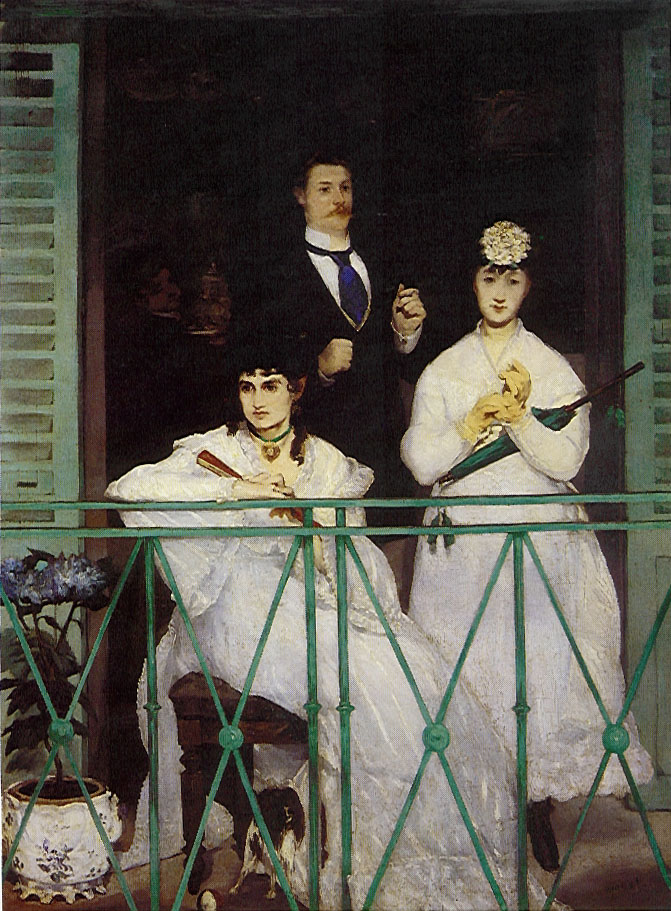
The Balcony


Edouard Manet, The Balcony, 1868-1869
Edward Manet’s 1868 oil painting, The Balcony, was first exhibited at the Paris Salon of 1869.  Obvious inspiration comes from Goya’s The Majas at the Balcony, which stems from the themes of class structure. Two intimidating male companions oversee two young and smiling upper-class women.  In The Balcony a stiff and awkward trio replaces the balanced quartette in The Majas at the Balcony. Manet also exchanges Goya’s sinister balcony setting for a spruced up minty green version. He seeks to express the life of the upper class, and succeeds in unveiling the rigidness beneath the poised façade.

The three polished subjects, who were all friends of Manet, seem disjointed, as if they were taken from other works and pasted together on the canvas. Berthe Morisot, on the left, sits like a romantic waiting for her suiter. Her piercing eyes are the most defined, but send gazes away from the viewer and off the painting. Antoine Gilement, a painter, displays a look of indifference and rigidity. Finally, a young violinist, Fanny Claus, seems completely uncomfortable with the entire situation. She stands holding her hand together and on her tiptoes as if she were to leave the scene at any moment. A small boy carrying a tray in the background is Manet’s son, Leon. Born out of wedlock to Suzanne Leenhoff, Leon, posed often for his father and was the subject in many of Monet’s paintings.

Adding Leon in the background of The Balcony slightly taints the sophisticated rigidity of the painting, but offers a connection to the artist that the viewer does not see within the subjects of the painting.

  • 12:00 AM

Madonna (Conception)


Edvard Munch, Madonna (Conception), 1895-1902
The bare Madonna twists and turns while in the throes of ecstasy. Sperm cells line the red border of the painting. A fetus-Jesus looks on his creation with a melancholy face. Mary has been stripped of all her holiness. What has life devolved into that would even make Christ wish He wasn’t born?

Death walked alongside Edvard Munch his entire life. Laura Catherine Munch, Edvard’s mother, contracted tuberculosis and promptly passed away in 1868. Munch was four years old at the time. Tuberculosis would proceed to take the life of Munch’s sister, the fifteen-year-old Sophia Munch, in 1877. Christian Munch, the father of Edvard, died in 1886. 1895 would see the passing of Andreas Munch, Edvard’s brother. Munch and Death became acquaintances in this time period, but never friendly ones.

Andreas’ death in 1895 coincided with Munch sketching Madonna (Conception). Munch’s tragic life had taken a toll on the artist’s faith. Munch had been raised a devout member of the Lutheran Church, which helped the rest of his family deal with Death’s constant visits though Munch found himself being less and less drawn towards Christianity. Instead, he found pantheism, a belief system where the universe is synonymous with God and possesses the holiness of God. Bordering on agnosticism, Munch wandered through life not giving much merit in Christ’s divinity, but Munch did approve of the overall message of Christianity. Munch’s Christ was one of love, but not divinity.

In 1902 Munch lost one of his knuckles. He had gotten into a fight with a rival artist that resulted in a gunshot wound in Munch’s hand. Tulla Larsen, Munch’s longtime lover, witnessed the fight and soon after left Munch. The couple had been together for many years, but never married do to Munch’s fear of matrimony and anxiety. 1902 was also when Munch had the sketch of Madonna lithographed. Munch then colored in several different versions of Madonna. The work had been finally completed.

Munch leaves Mary with almost no indications of who she is. One subtle hint at Mary’s divinity would be the red halo above her head. Mary, the sperm, and Fetus-Jesus are colored in with a pale white that suggests purity, but white could also indicate frailty. Fetus-Jesus looks starved and unhealthy. The world of unending earthly horrors seems too much for the little guy. Munch wished to impose his own depression on Christ to see if He could take it. In Madonna (Conception), He cannot.
  • 12:00 AM

The Storm

Edvard Munch, The Storm, 1893
In 1893, a large storm hit Aasgaardstrand, Norway causing a huge stir. In a more expressionist, than post-impressionist painting, Edvard Munch recreates this psychologically damaging scene (much like his other paintings). Positioned similarly to The Scream, the women, faceless, stand awestruck in horror, giving off as much coldness as surrounds them. In contrast, the bright windows give "off the only source of light and warmth."

His representational way of painting comes through clearly in the surrounding objects. The woman's hair, a mere slash of oil, blows frantically back with the huge gusts of wind. Perhaps their anguish can come from the society in which they don't want to participate, or are excluded from. Standing apart from sea and the house, almost lost between land and ocean, the women clump together in fear and disillusion. The encasing-like black line that surrounds the further back women make them into one. They blend together, much like society did giving them no more than a name and a husband to care for. As for the woman in white, her dress acts to lift her off the ground and float further away from society and become more refined.

The harsh brush strokes combine both expressionism and symbolism into a rough, but fluid tableau. While the sky is dusk and dreamlike, the harsh strokes still evoke the emotion of dread and fear. The sky mimics the rocky shore leading the viewer still towards away from society with the woman in white. Many later expressionists would later look to Munch for inspiration in a way to manipulate the scenery into jagged emotional trauma.

Munch evokes a nightmarish scene full of personal psyche drama and ideas that may be surfacing from his past and present life.
  • 12:00 AM

Luncheon on the Grass

Edouard Manet, Luncheon on the Grass, 1863
Édouard Manet’s Luncheon on the Grass stands out to me as one of the finest examples of impressionist era pieces because of Manet’s freshness, attention to his audience, juxtaposition of figures and setting, and willingness to paint the taboo. French citizens first got a taste of Manet’s thought-provoking, scandalous work in 1863. Two finely dressed gentlemen sit back comfortably, immersed in discussion, seemingly unmindful of the two naked women that encircle them.

The brilliance of this work, like most impressionist era paintings, stems not from the technical precision of the composition, line, perspective, form or figures like the classical masters delivered. Rather, the work's raw brushstrokes, harsh lighting and rough qualities seem to provoke and shock the viewer, who Manet intends to catch off guard.         

The painting, ironically, exudes a level of tranquility that seems unfit considering the subject matter. Manet juxtaposes the figures by clothing the men while scantily dressing the woman bathing and leaves the works foremost figure completely bare. Manet challenges the audience to judge the women, as if they are saying, “Yes, we are enjoying our perfectly peaceful picnic naked, what are you going to do about it?” By choosing a serene forest scene, Manet illustrates that the real abnormality comes from the clothed men. Indeed the nude women seem to belong more in this setting.
  • 12:00 AM