Crossing Boundaries: Lamentation of Christ

Image result for lamentation of christ mantegna
Andrea Mantegna, Lamentation of Christ, 1480
Crossing Boundaries
By EMMA SHAPIRO

The Lamentation of Christ was a commonly depicted theme for artists from the Medieval ages and the Renaissance to the Baroque. It shows the period of mourning after Christ's crucifixion. Since many artists painted their own versions of the Lamentation of Christ, many variations of design and composure exist. However, Andrea Mantegna's depiction of the Lamentation of Christ differs from most other paintings of the scene in many ways. Mantegna looks at the scene through a perspective that other artists had yet to imagine. He strayed from the common layouts that consist of much more contact between the mourner's and Christ, and uses light, shadows, and drapery to emphasize the suffering of the figures. 

Mantegna portrays Christ at an angle from his feet and uses the method of foreshortening to make Christ appear shorter. At the time this optical illusion was fairly uncommon to artists, but after Mantegna's mastery of it, foreshortening became a standard part in training artists. The shortening of Christ's body and the distance of the mourners pull more emphasis to the anatomical details of the body. From this angle Mantegna can highlight Christ's thorax as well as the holes on his hands and feet. The close intimacy the of the work shows the deep rips of the holes. The drapery falls between Christ's legs and and wraps around his pelvic area to highlight the genitals, a symbol of humanity. 

Mantegna tested the limits of artistic freedoms and painted in a way unimagined before. He took the chance to cross an artistic boundary and received boundless praise for doing so. Artists now model their works off of Andrea Mantegna's creativity and boldness. 
  • 7:00 AM

Crossing Boundaries: Madame X

Image result for madame x singer sargent
John Singer Sargent, Madame X, 1884
Crossing Boundaries
By Emma Shapiro

Amelie Gautreau, the subject of Sargent's Madame X, was a well-established Parisian socialite, best known for her beauty. Although Amelie was born in the United States in New Orleans, she moved to Paris at a young age with her mother and grew up in a life of French nobility. She later enhanced her popularity by marrying a wealthy banker twice her age. Due to this high social standing she had many painters paint portraits of her. John Singer Sargent aimed to become one of those lucky painters.

Sargent vied to paint Madame Gautreau because he believed that doing so would elevate his status as a painter. One of Amelie Gautreau's most defining characteristics was her soft white skin, and Sargent wanted to emulate that skin on canvas. When Sargent had the chance to paint Amelie Gautreau he tried to show her skin, grace, and beauty, but also emphasize her daring attitude and individuality. By portraying her personality though portraiture Sargent thought he would receive praise for his skill and also his uniqueness. To do this, Sargent painted the right strap of Gautreau's gown slipping down her shoulder. But, Sargent's attempt at being innovative failed him.

The painting was first displayed at the 1884 Salon. Sargent had won an award at the salon the previous year which forced the Academie to give him a spot on the wall in 1884. Yet, his painting at the 1884 salon received much more ridicule than praise. People were offended by Sargent's portrayal of one of Paris' elites as coquettish. 19th century society could not believe that Sargent would paint something which condoned adultery. Madame Gautreau's mother requested that Sargent remove the painting from the salon and change the name of the portrait from Portrait of Madame Gautreau to Portrait of Madame X. She wanted the identity of her daughter hidden, because this painting crossed the line.


  • 7:00 AM

Crossing Boundaries: One Way Ticket

Image result for one way ticket jacob lawrence
Jacob Lawrence, One Way Ticket, 1941
Crossing Boundaries
By EMMA SHAPIRO

Jacob Lawrence was born in New Jersey in 1918, but his parents migrated from Virginia and South Carolina. From a young age he took an interest in painting the people surrounding him; neighborhood activity, sideway politics, beggars, and late night commuters. Lawrence then moved to painting scenes of Harriet Tubman and Toussaint L'Ouverture. He painted them in flat, unshaded forms, a style he never abandoned. When Lawrence grew tired of those scenes he decided to begin a large scale documentation of the black exodus from the south, birthing the Migration series.

In his Migration Series, Lawrence does not depict the gruesome scenes of violence and racism but focuses on the internal emotional suffering of the lonely survivors. He is able to convey the struggling that African-Americans experienced during their migration without tossing blame in any direction. Lawrence chose this subject matter because he felt connected to the story.

Jacob Lawrence tells the African-American migration story and even though we are past the pain of this particular historical event, many current stories can relate. People around the world constantly must make the choice to cross physical boundaries in search of new residence. And just like the African-American migration, these boundary crossings are in search of safety, security, freedom, and a happier life.

  • 7:00 AM

Crossing Boundaries: A Philosopher Giving a Lecture on the Orrery

Image result for philosopher giving a lecture at the orrery
Joseph Wright of Derby, A Philosopher Giving a Lecture on the Orrery, 1766

Crossing Boundaries
By EMMA SHAPIRO

Joseph Wright of Derby took an interest in the industrial revolution and the enlightenment and painted a series of paintings displaying scientific and academic subjects. A Philosopher Giving a Lecture at the Orrery preceded An Experiment on a Bird in the Air Pump and followed Three Persons  Viewing the Gladiator by Candlelight. All three of these paintings depict people observing science or studying, are candlelit, and caused a stir in opinions. Joseph Wright of Derby shows scientific miracles in a way which was previously only used for religious paintings. The painting shown also goes by the longer name "A Philosopher Giving a Lecture on the Orrery in which a lamp is put in place of the sun". This title reflects the idea of scientific miracles, such as artificial light, overtaking religious symbolism. Instead of the figures having a religious epiphany they are experiencing a conversion to science.

Joseph Wright of Derby's painting challenged the set hierarchy that favored classical history and mythological subjects. The public was previously only exposed to paintings of biblical heroes, and greek gods. Wright transitions from his classic landscapes, portraiture, and christian themes and attempts to revolutionize subject matter. Wright advocated for the importance of science and knowledge through the concentration of the subjects surrounding the orrery. Their interest highlights the idea that science and reason help advance society. He also includes two young girls leaning on the orrery which shows belief in the future involvement of women in intellectual matters. The people in the painting are crossing the academic boundaries that constrained them, and art, before the enlightenment.
  • 7:00 AM

Crossing Boundaries: The Bolt

Image result for the bolt fragonard
Jean-Honore Fragonard, The Bolt, 1777

Crossing Boundaries
By EMMA SHAPIRO

Jean-Honore Fragonard painted The Bolt (also known by The Lock) in 1777. Initially this painting appears similar to Fragonard’s The Stolen Kiss, a romantic scene of lust and affection. It has the same softness and flowy drapery, but the room is in a disarray. The chairs legs stick out, the harsh red drape falls around the messy bed, and roses scatter the floor. The woman in The Stolen Kiss shows a lack of complete interest in her face, but the tilt of her body confirms her consent. However, the woman in The Bolt looks unhappy in her face and seems to be pulling away from the male grasp. With closer examination of the subject matter and the name the painting loses its loving appeal and adopts a more violent one. 

Fragonard meant for The Bolt to compliment his Adoration of the Shepherds. The Adoration shows sacred love and redemption, whereas The Bolt sends a message of sin and desire. The bed takes up a large portion of the canvas, an obvious symbol of eroticism. Fragonard also draws the viewer to the violence by streaking the light from the bolt and following the pull of the man's arm. The man's arm moves up to the bolt, but his body falls toward the woman. The woman on the other hand has lost her balance and control. Fragonard shows a complete invasion of space. The man crosses the unconsenting woman's personal boundaries as well as her sexual comfort levels. 
  • 7:00 AM

Scala Regia

Image result for scala regia bernini
Gianlorenzo Bernini, Scala Regia, 1666

By EMMA SHAPIRO

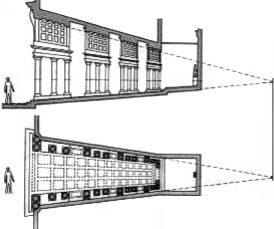
Related imageBefore Bernini redesigned the entrance from St. Peter's Basilica to the Vatican, popes thought of the trip between the buildings as long, difficult, and dark. Alexander and the Popes requested a new entrance for reasons of health and safety, but also so they could enter through a more impressive entryway. Maderno attempted to revamp the entrance before, but Bernini was the one to make a solution. He tore down a tower and realigned the Portone di Bronzo to make enough space for his vision. Even after maximizing his work space, Bernini still had only a constrained area. The hallway was narrow, the lines of the walls were not parallel which created a triangle shape, and the stairway had to begin and end at specific heights.


Related image

The width of the stairs narrowed with ascension, so Bernini installed columns to give an impression of uniformity of length. Where the hallway widened Bernini constructed the columns more towards the middle of the walkway; tricking visitors into believing the stairs were the same length the entire way up. Bernini also decreased the height of the columns as they moved up. Looking at the Scala Regia visitors thought the columns looked shorter, but figured it was only a trick of perspective. To fix the problem of length and darkness, Bernini adapted the stairwell even more. For the stair height, Bernini created a landing between flights to give a sense of space. He then added light to the stairwell to widen the space by opening one window over the landing, and another at the top of the stairs.

Related image
Image result for palazzo spada borrominiBernini referred to his Scala Regia as the most daring operation that he had attempted, and claimed that if he had heard of another artist doing the same, he would not have believed them. But as it turned out, Borromini had used the same approach his earlier, smaller scale, Palazzo Spada. In Borromini's Palazzo Spada, he uses deception to make an 8.82 meter walkway appear much longer. Just like Bernini shortened the columns with ascension through the walkway, so had Borromini. This example exemplifies the complex relationship between Bernini and Borromini. Even if Borromini had been bothered by Bernini's obvious borrowing of his ideas, he did not voice it. Borromini was used to Bernini getting effusive praise. The public easily forgot about Bernini's mistakes, and the help lent to him by Borromini, and consistently regarded Bernini as far more advanced.
  • 7:00 AM

Still Life with Game Fowl, Vegetables, and Fruit

Image result for Still Life with Game Fowl,Vegetables and Fruits
Juan Sanchez Cotan, Still Life with Game Fowl, Vegetables, and Fruit, 1602
By EMMA SHAPIRO

In the 1600s Spanish art began to shift from the idealistic El Greco to a more naturalistic style. El Greco began the effort to emulate nature in his religious paintings, but apprentices and observing artists took naturalism to the next level. Juan Sanchez Cotan painted several still lifes of assortments of game, vegetables, and fruit, contrasted against a black background. He sets the objects in the same space, aiming to separate them as individuals. Although they lie within the same plane, Sanchez Cotan's pattern of naming his paintings puts an emphasis on individual objects. Sanchez Cotan entitled one of his most famous paintings Quince, Cabbage, Melon, and Cabbage, as it portrays one of each. Still Life with Game Fowl, Vegetables, and Fruit contains items from all three of these categories, but Sanchez Cotan fails to specify. Sanchez Cotan's careful emulation of everyday objects force the viewer to contemplate unreligious items and identify the individuality of each form. Paintings like such characterize his work and call for his recognition as the creator of the prototype for Spanish still-lifes.

A horizontal light brightens the surface of the objects and creates a shadow behind each one. Sanchez Cotan's realistically deep shadowing creates for an intimate yet separated, intense work. Sanchez Cotan's portrayal of simple and slightly unattractive everyday objects beautifies them. His ability to do so emphasizes the superiority of simple things over riches. During the period when Sanchez Cotan worked, society continued to glorify the wealthy and ruling class, and the richness of religion, in most paintings. Sanchez Cotan abandoned the usual subject matter to bring the vitality of conventional objects to life.
  • 7:00 AM

Narcissus

Caravaggio, Narcissus, 1597
By EMMA SHAPIRO 

Ovid's Metamorphoses tells the greek myth of Narcissus, a hunter. The story goes that Narcissus's beauty caused many to fall in love with him. Narcissus, however, greeted all affections with contempt, thinking of no one as worthy. One day as Narcissus hunted through the forest, the mountain nymph, Echo, fell and love and followed him. When he began to catch on that someone was following, Echo revealed herself to him with open arms. Narcissus, being a narcissist, rejected Echo, leaving her brokenhearted. Nemesis, the G-d of revenge, then decided Narcissus deserved punishment for his evil actions. Nemesis brought Narcissus to a pond, where he saw his reflection and fell in love with it. Initially, Narcissus did not recognize the thing as his own reflection, but when he figured it out he committed suicide over the sadness that his love could not become real.

In Caravaggio's painting of Narcissus, Narcissus acts as the only light in a void of black. The boy stares down longingly and leans into his own perfectly reflected image. The way Caravaggio tilts and pulls forward the head brings it in line with the boy's shoulders to create a parabolic body. The connection of the two semi-circles from the land and water creates a circle. The circle shuts out the background and focuses on Narcissus's self obsession, and his living within his own bubble. It also draws in the theme of the never ending cycle of narcissism. Minimal evidence exists to prove that Caravaggio painted this Narcissus, but the soft and sinister shadowing is characteristic of Caravaggio's style.
  • 7:00 AM

Seated Scribe

Gentile Bellini, Seated Scribe, 1480


By EMMA SHAPIRO 

In 1479, the Ottoman Sultan Mehmet II requested an artist to paint portraits of him and his court. The Venetian government sent Gentile Bellini to Constantinople to fulfill the request. Gentile Bellini painted countless portraits of the Sultan during his year in Constantinople. He brought Orientalist tradition to Western painting and became well known throughout Europe. His painting Seated Scribe is characteristic of his meticulous attention to detail, and typically dry portraiture.

In Seated Scribe Bellini paints a young member of the Ottoman court while he bends over a writing pad. His caftan, traditional cultural robe, is embellished with gold, and red velvet decorates his arms and neck. His turban beautifully wraps around his head, and holds in place with use of a red taj, a conical cap worn by the Sultan's court.

The painting above does not show purely original work done by Bellini, but has required several restorations over centuries. The painting dimensions have been trimmed and the framing and mounting has been restored to better conserve and historicize the work. A crease near the youth's elbow suggests that prior to the recent mounting, Seated Scribe had been presented as a loose leaf. Giuseppe Molteni is supposed to have repainted the work to an extent which may have even minorly altered the original composition of the painting. Repainting has become increasingly discredited among art historians, for being a practice which changes the pigments and materials employed by the artist. Unlike repainting, mounting practices conservation, modernly a more promoted method than restoration.

Many of Gentile Bellini's works of art have deteriorated, become unidentifiable, or been lost completely. In the late 15th century, Bellini received his most significant commission, the redecoration of the Sala del Maggior Consiglio of the Doge's palace. He replaced deteriorated frescos with 22 oil paintings on canvas, but all 22 paintings were lost in a fire in 1577. Additionally, few paintings from his time in Constantinople have been properly identified. One noteworthy painting of the Sultan remains but immense retouching makes it look like a copy. The lack of evidence from Bellini's career makes it nearly impossible to map his life or construct his development as an artist. 

  • 7:00 AM

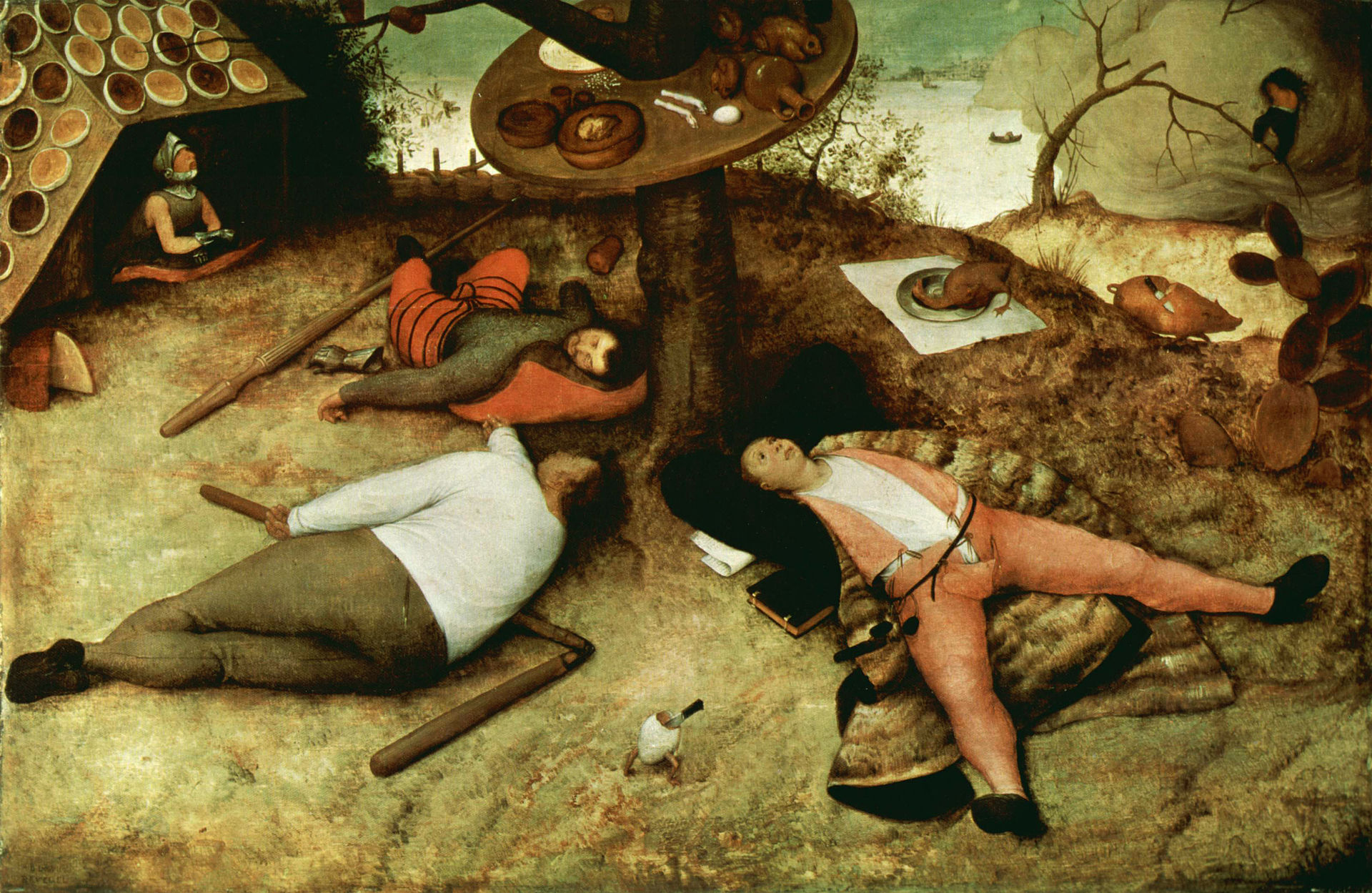
The Land of Cockaigne

Image result for land of cockaigne bruegel
Pieter Bruegel the Elder, The Land of Cockaigne1567

By EMMA SHAPIRO 

Cockaigne is a land of gluttony and laziness in medieval myths where the harshness of peasant life ceases and everyone lives in extreme luxe and ease. The imaginary land symbolized freedom to indulge in comfort and pleasure. Scornfully, Bruegel depicts Cockaigne in a manner which mocks humanity. Like many of his paintings which teach lessons to society, this one shows that the world is sinful, greedy, and indolent.

In Bruegel's The Land of Cockaigne, a clerk, peasant farmer, and soldier are sprawled lazily under a tree. The clerk's books and pen lie on the ground, along with the farmer's threshing tool, and the soldier's glove and spear. The tree above them lends shade through it's leaves, but even more through the table of partially eaten food attached. Not only are the men consumed by lethargy, but in their dormancy they only consume and lie around. Behind the men a form of dead fowl sits on a platter and napkin, and a pig with a knife stuck through runs around - each ready to be eaten. On the right, a man falls from a supposed cloud of pudding onto a tree branch. And on the left, another soldier awakens from his nap under a roof of pie.

Bruegel began a long line of painters in his family. With the continuation of the family trade through generations, and growing popularity of prints, Bruegel's influence has endured. Bruegel most commonly illustrated peasants in his works, earning the nickname "peasant Bruegel." Although this name hints to him being a peasant, that is a misconception. Bruegel depicts peasants in all different realms of life. Although his peasant paintings and engravings seem to be merely replications of everyday life, they also reflect his views on humanity, his absurd imagination, and his innate skill. The Land of Cockaigne differs from the other peasant paintings. Instead of portraying the difficult life of a peasant, this shows an ease for all men. The peasant farmer, soldier, and clerk lay together in peace with their respective tools out of hand. Bruegel draws similarities between the men - painting them as equals. He may be trying to convey that all men are lazy and useless, or perhaps that regardless of status, everyone needs a nap and some pie now and then. 


  • 7:00 AM

Self Portrait at the Age of Twenty Eight

Image result for durer self portrait 1500
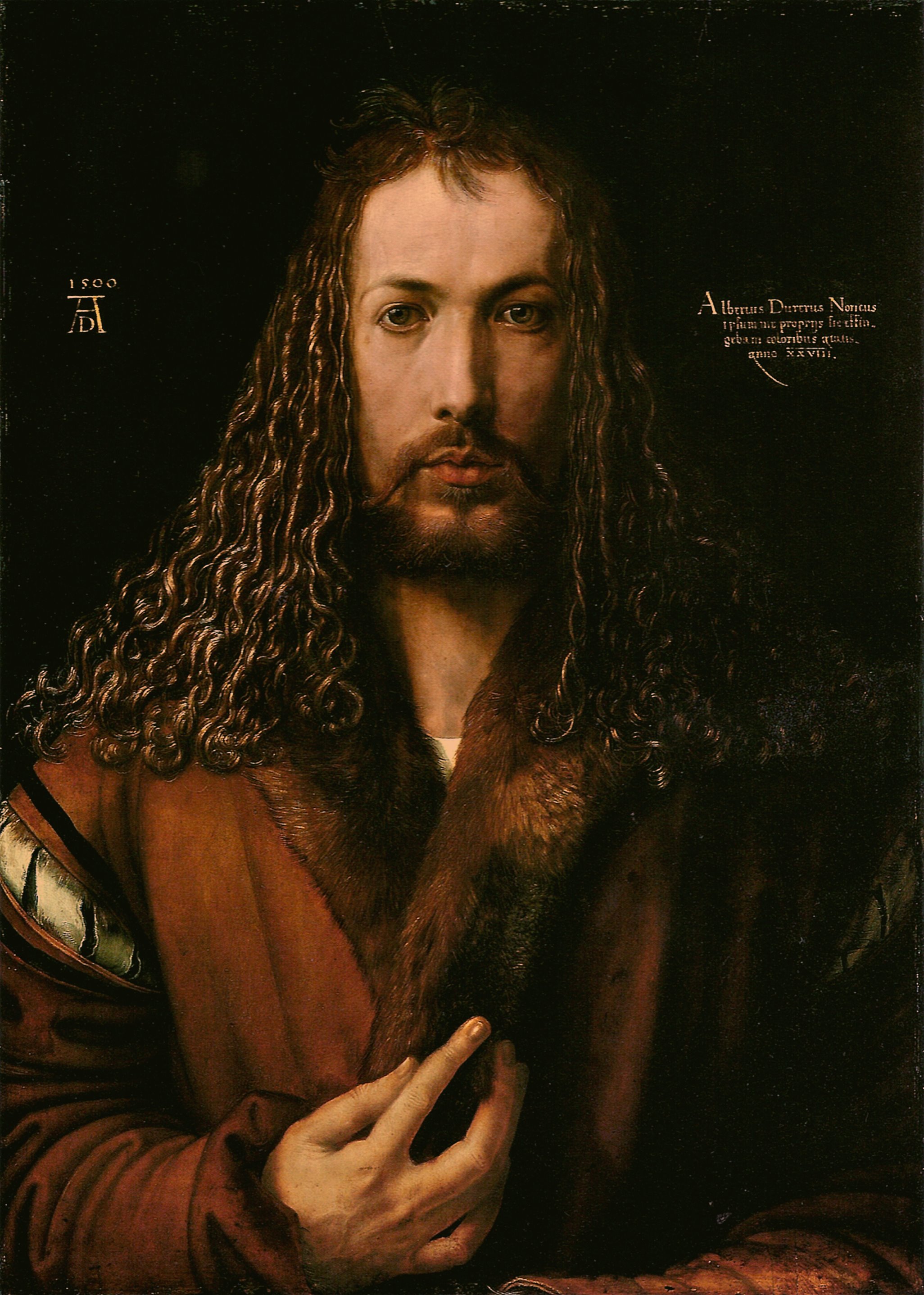
Albrecht Durer, Self Portrait at the Age of Twenty Eight, 1500 
By EMMA SHAPIRO

Albrecht Durer's Self  Portrait at the Age of Twenty Eight outwardly highlights his arrogant self-confidence. Durer earned his favorable reputation as an artist in his early twenties. Durer became one of the most influential artists of the Northern Renaissance. His revolutionary woodcuts became his most noteworthy medium, followed by prints, altarpieces, portraits, watercolours and books.  Judging by the portrayal of himself as Christ in his Self Portrait in 1500, perhaps the early prodigious reviews boosted his morale to a slight extreme.

Durer inscribed his initials "AD" into the left hand side of the portrait, along with text reading "I, Albrecht Durer of Nurembourg, painted myself thus, with undying colours, at the age of twenty-eight years." In this he outwardly states his belief in his own immortality, whether that be in a physical presence or permanent fame. He also played with his orientation in order to emphasize a similar ideal. In most self-portraits during the time period artists positioned themselves in a three-quarters view, but Durer faces directly forward, and zooms in on his image. He also eliminates a background, stressing his self importance.

Durer fashions his body as a triangle, playing with the presence of the trinity within himself. He believed that at the age of twenty-eight he was at a prime. The portrait testifies to this by his supreme artistic expertise. His right hand raises slightly, toying with his seemingly expensive, powerfully red, fur coat. In Becoming a Knowledgeable Artist the author states that "The hand is the instrument with which the right-handed Durer created his art. The artist shows off his long, graceful fingers". In his hand, we see realistic bones and veins. Joachim Camerarius, a German physician and humanist scholar, described Durer saying "Nature gave him a build and a bodily development that, as is right and proper, fit supremely well with the magnificent spirit it encloses...He has an expressive head, glittering eyes, an attractive nose, which the Greeks would call perfect, a somewhat long neck, a broad chest, a taut body, powerful thighs, firm legs; but a finer thing than his fingers have ever seen". Everything about this painting screams self obsessed. Although accounts such as Joachim's suggest his deserving of such praise, his haughty advertisement of his perfection within his paintings is less than admirable.
  • 7:00 AM

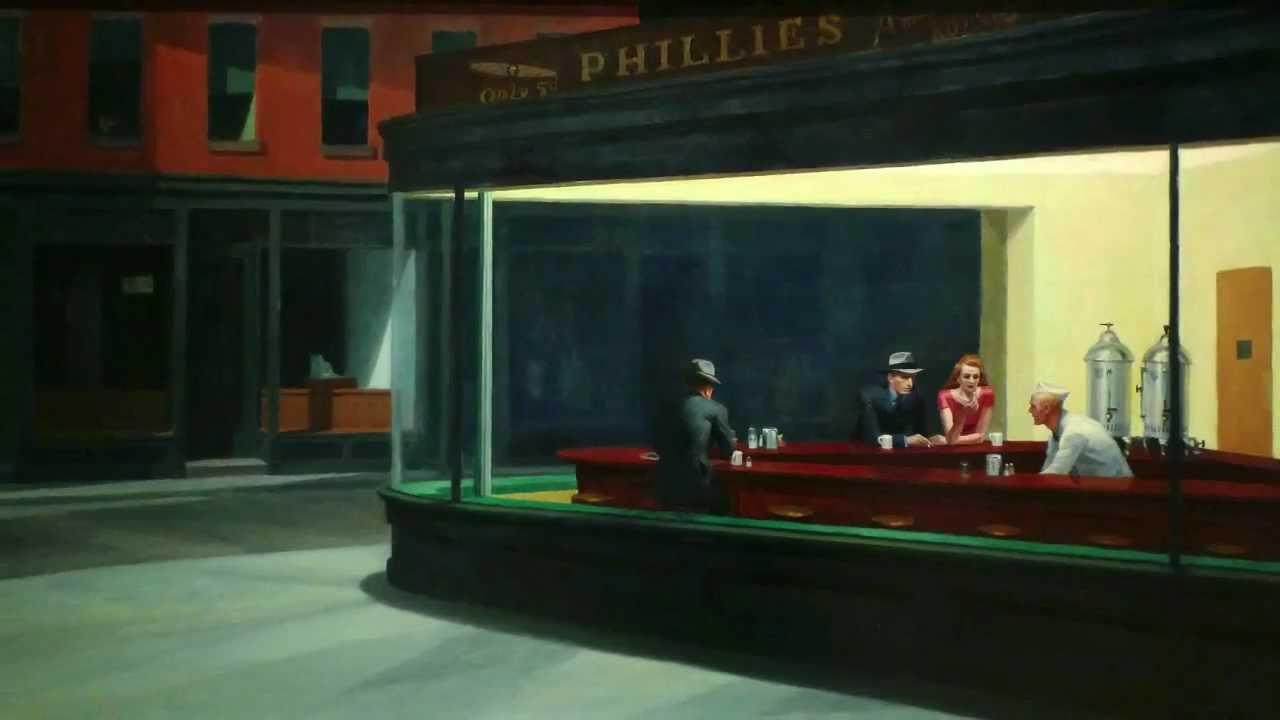
Nighthawks

Image result for edward hopper nighthawks
Edward Hopper, Nighthawks, 1942
"Bar Time" 
By BILLY COLLINS

In keeping with universal saloon practice,
the clock here is set fifteen minutes ahead
of all the clocks in the outside world.

This makes us a rather advanced group,
doing our drinking in the unknown future,
immune from the cares of the present,
safely harbored a quarter of an hour
beyond the woes of the contemporary scene.

No wonder such thoughtless pleasure derives
from tending the small fire of a cigarette,
from observing this glass of whiskey and ice,
and cold rust I am sipping,

or from having an eye on the street outside,
when Ordinary Time slouches past in a topcoat,
rain running off the brim of his hat,
the late edition like a flag in his pocket.


Editor's Note: Students were asked to pair a poem and painting with no explanation of the connection. 


  • 7:00 AM