Eleven A.M - The Great Gatsby

Edward Hopper, Eleven A.M.

"I began to like New York, the racy, adventurous feel of it at night, and the satisfaction that the constant flicker of men and women and machines gives to the restless eye. I like to walk up Fifth Avenue and pick out romantic women from the crowd and imagine that in a few minutes I was going to enter into their lives, and no one would ever know or disapprove. Sometimes, in my mind, I followed them to their apartments on the corners of hidden streets, and they turned and smiled back at me before they faded through a door into warm darkness. At the enchanted metropolitan twilight I felt a haunting loneliness sometimes, and felt it in others—poor young clerks who loitered in front of windows waiting until it was time for a solitary restaurant dinner young clerks in the dusk, wasting the most poignant moments of night and life." 
—F. Scott Fitzgerald, The Great Gatsby

Eleven A.M., like majority of Edward Hopper’s paintings, reflects solitude and missed connections. Here we see a woman staring aimlessly at events unfolding on the streets of New York. Although the outside is not shown, we can easily assume a busy morning start in the restless city, which echoes with Nick Carraway’s perception of New York as “racy, adventurous” and filled with the “constant flicker of men and women.” In the ever-expanding metropolis in the 1920s, a subtle placelessness seems to be growing as well. It is easy for individuals to feel like “just a number,” and Fitzgerald depicts just this spiritual emptiness in flamboyant lifestyle of the riches. 

Realistic, firm and direct construction of buildings was Hopper’s calling card. The straight lines on the door frames, curtains and cabinet suggest sureness, coldness even, and gives a sense of solitude to the painting. Sunlight falls on the woman, making her isolated from the crowds of solid, dark background. Outside the window we see the top of another building, suggesting a relative high place this bedroom is. Therefore the woman is physically separated from the people or events outside. With her legs slightly apart, arms resting on her knees, she leans towards the window yet still sits deeply in the chair. Hopper conveys her indifference and detached attitude from body position without painting a single facial feature. 

Similarly, Nick Carraway senses his own sense of loneliness at the high of New York party scene. Returning from Gatsby’s elaborate gatherings, he walks and fantasizes about romantic encounters with strange women. I find this idea oddly compelling. Nick prefers personal imagination of intimacy over the enforced, physical closeness at parties. His sense of solitude, much like the woman in Eleven A.M., reaches high in the restless modern urban life. 

  • 7:00 AM

The Bridge—The Great Gatsby

Joseph Stella, The bridge, 1922

“Over the great bridge, with the sunlight through the girders making a constant flicker upon the moving cars, with the city rising up across the river in white heaps and sugar lumps all built with a wish out of non-olfactory money. The city seen from the Queensboro Bridge is always the city seen for the first time, in its first wild promise of all the mystery and the beauty in the world” - The Great Gatsby, F. Scott Fitzgerald

I’ve always loved New York. I feel a little corny saying it sometimes—I’m not from New York and I haven’t gone there nearly often enough. But I’ve always liked everything I saw. And in my opinion no one writes about New York better than F. Scott Fitzgerald. More than anyone else, he seems able to capture its power and its beauty. Even though it often serves as the stage for the destruction of Fitzgerald’s characters, it has a presence all its own. In novels like The Beautiful and Damned and The Great Gatsby it provides a stunning backdrop for the action and changes the way the reader understands those novels. 

Fitzgerald was also a Midwesterner who arrived late to New York but always kept a special place in his heart for it. Two of his books take place largely in Manhattan—he lived there with Zelda much of his life. When he wrote those two novels—at around the same time Stella painted The bridge, Americans enjoyed an era of unthinkable plenty and unbridled optimism. The new generation of men and women coming of age glowed with a type of joie de vivre. Although many of Fitzgerald’s characters of course meet tragic ends, men and women like Gatsby still live in the spirit of this great, hopeful era.

The work of Stella and this painting in particular embody this feeling. These cities to Stella represent a newfound opportunity—the painting is awash with bright colors that portray the energy and life that New York has. Great buildings stretch up and out of the painting, dragging the viewer into an ever-brighter future. In spite of this, it seems to me that the work carries a certain malice. The painting is icy—the dark blues and blue-greys feel intimidating. The bridge pulls me in, but I can’t tell if I will like what I arrive at. This is the darker side of this new landscape that both Fitzgerald and Stella seem to notice. Great new cities like New York may offer opportunities never before heard of, but for every success story hundreds of flattened souls lie by the wayside. As they emerged from World War I into the sunny 1920s, men like Fitzgerald and Stella displayed these anxieties in works like The bridge and The Great Gatsby.

  • 7:00 AM

Transfiguration and The Great Gatsby


Transfiguration, by Raphael. 1516-1520
In 1500s, Renaissance Art reflected the Catholic Church. In the Transfiguration, the feet of Jesus represent devotion to Christ, told in John 10:42.   

Either in the sixteenth or twenty-first century, God’s eyes focus on society.  The Great Gatsby reminds “The Roaring 20s” that God watches immorality and the inattention towards Him.  Although the Great Gatsby focuses on the 1920s, this concept applies to the modern day. In Transfiguration, Jesus looks down on the good and leaves the bad in darkness.  The devotion to Jesus’s feet directly relates to the eyes of Dr. T.J. Eckleburg watching society.

The Transfiguration illustrates followers’ hands, necks, chests, or body angles toward Jesus’s Feet.  Attention is directed to Jesus.  The Light of God intensifies to the believers and fades to the sinners.  This painting tells us, that the eyes of Christ always remain on us.  Fitzgerald expresses a similar sentiment in The Great Gatsby.  “‘I spoke to her,’ he muttered, after a long silence. ‘I told her she might fool me but she couldn’t fool God. I took her to the window’ – with an effort he got up and walked to the rear window and leaned with his face pressed against it – ‘and I said God knows what you’ve been doing, everything you’ve been doing. You may fool me, but you can’t fool God!’  Standing behind him, Michaelis saw with a shock that he was looking at the eyes of Doctor T. J. Eckleburg, which had just emerged, pale and enormous, from the dissolving night.  ‘God sees everything,’ repeated Wilson ‘That’s an advertisement,’ Michaelis assured him. Something made him turn away from the window and look back into the room. But Wilson stood there a long time, his face close to the window pane, nodding into the twilight.”        

The reward of believing and following God’s can be seen in the peaceful sunlight behind the gloomy dark world.  Just as T.J. Eckleburg looks down on his domain, Jesus (shown in The Transfiguration) stares down on earth until the Day of Judgment.      

  • 8:00 AM

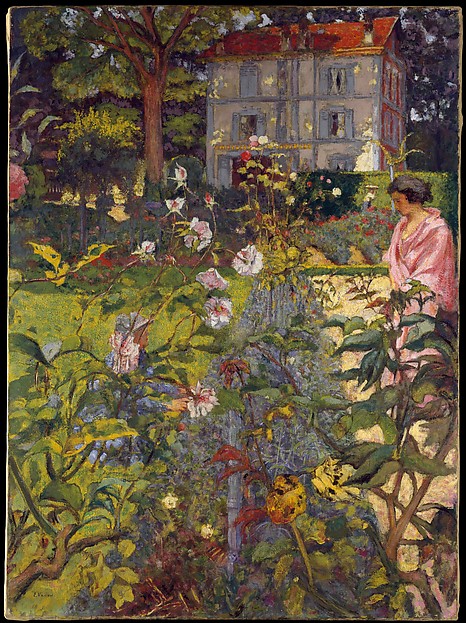
Garden at Vaucresson and The Beautiful and Damned

Edouard Vuillard, Garden at Vaucresson, 1920
Edouard Vuillard's obvious nod to Monet depicts a mademoiselle enshrouded in carnation pink touring her gardens. Barely visible through the foliage lies a gardener bowing beneath the flowers and to her noble employer. The soft brushstrokes and pastel shades give the work a certain level of daintiness, but is there a more interesting story behind this pretty spring scene?

Take, for example, F. Scott Fitzgerald's 1922 novel The Beautiful and Damned. Cast in the light of the sparkling Jazz Age, Anthony Patch and his wife Gloria float through New York atop champagne bubbles, committed to no vocations other than waiting around for inheritance and improved societal standing. Gloria eschews traditional roles in favor of cherishing her days as a flirtatious flapper, even after her nuptials. Fitzgerald best sums up Gloria's perspective in the following passage:

"The reality, the earthiness, the intolerable sentiment of child-bearing, the menace to her beauty--had appalled her. She wanted to exist only as a conscious flower, prolonging and preserving itself. Her sentimentality could cling fiercely to her own illusions, but her ironic soul whispered that motherhood was also the privilege of the female baboon." 

This preservation of beauty that occupied the minds of Jazz Age women not only appeared in Fitzgerald's characters, but also in pieces by artists such as Vuillard. As females sought independence within society, they championed new ideals of youth and physical appearance. The subject of The Garden at Vaucresson chooses the path that leads to elegant aging and a charmed life, rather than the route of the laborer. Perhaps this era of luxury and sophistication appear most evident in such refined works as The Garden at Vaucresson and The Beautiful and Damned, embodiments of Fitzgerald’s 1920s.

  • 5:00 PM