The Sickness Unto Death Pt. V: Head of a Man on a Rod

The Sickness Unto Death 
A Musically Guided Exploration of Artist's Struggle with Mortality
Curated by Aaron Dupuis


Alberto Giacometti, Head of a Man on a Rod, 1947


"I read somewhere that when you face eternity
 You face it alone
No matter what you thought
Or what you had or you had not
Unless you put yourself in God
But tell me God oh where did you go?"
"The Sickness Unto Death," Typhoon 

Alberto Giacometti's sculptures and portraits exhibit a twisted pride in the reduction of the human form to its most basic and fragile states. The Walking Man series, City Square, and Three Men Walking all feature thin, frail figures, lost in the void of empty space around them. The inclusion of several figures upon a single surface - City Square and Three Men Walking for instance - serves to increase the sense of loneliness rather than detract from it. These shades are lost and self-absorbed, worn down to skeletons by the slow steady passage of time. In the aftermath of WWII, Giacometti's works were a statement about the human condition, that is to say, that humans were broken, selfish, helpless things. Not one of these works, however, seems quite as lonely or hopeless or concerned with eternity as Head of a Man on a Rod. 

A man's cry to the cruel, unfeeling heavens captured in cold, rough bronze, Head of a Man uses negative space to its fullest extent. The man's body has blown away, gone like so much dust in so many gusts of wind, leaving only a rod to support the head. Empty space surrounds the silhouette, engulfing the figure in nothingness. The man is crying into a vacuum, the vacuum. He hopes for a reply. A sign. For purpose. For hope. But he receives nothing in return. Instead his head hovers there for eternity, gazing into the abyss, praying at the top of his lungs that something stares back.
  • 7:00 AM

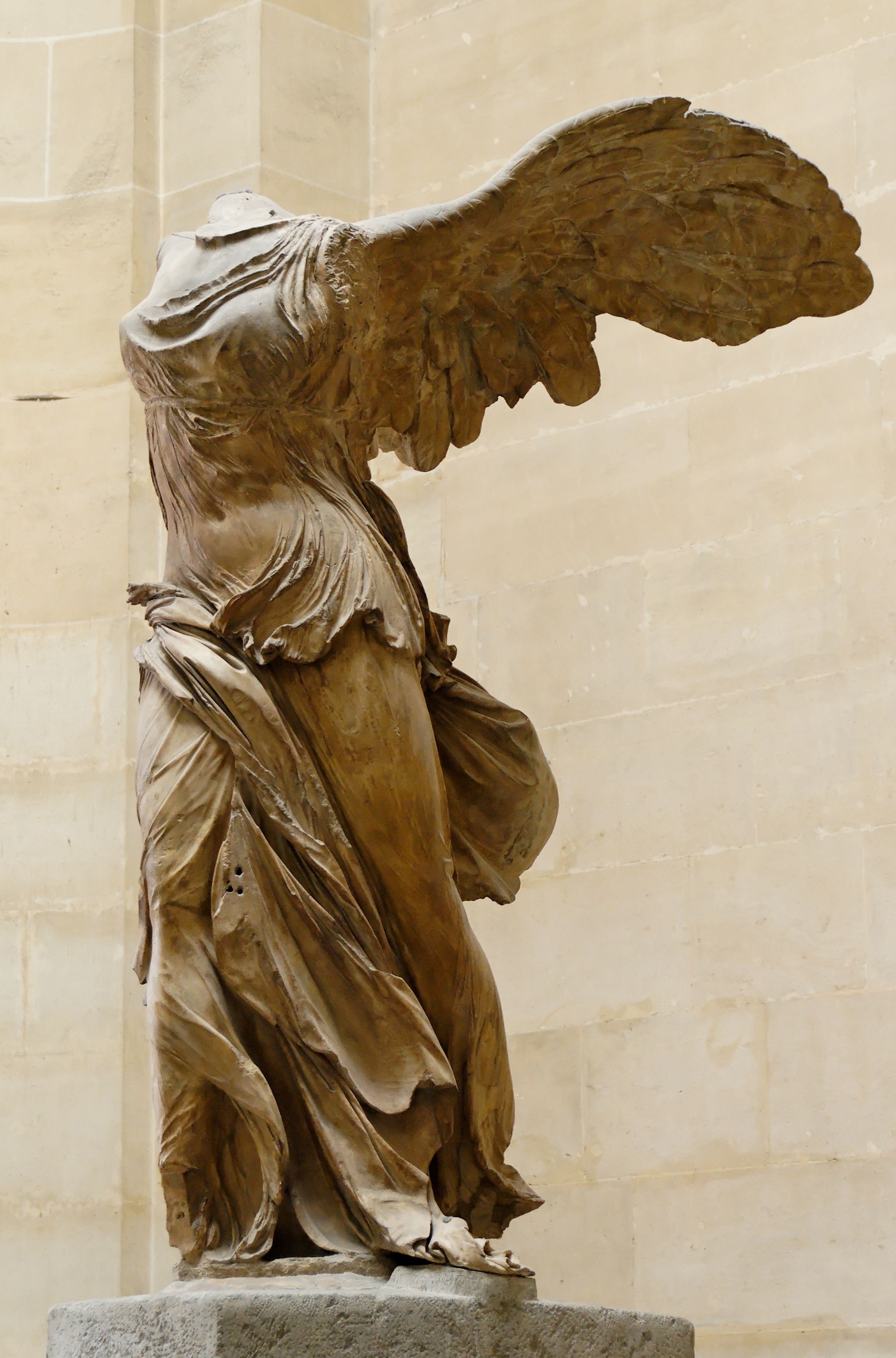
Art is Motion - Winged Victory of Samothrace

Winged Victory of Samothrace, 220 - 190 B.C.
What better way to segue out of a tragedy at sea, than with a statue commemorating a victory of the very same sort. But first, let's talk about intentions. Stay with me here: Let's say that Giacometti and Monet are each asked to paint the same woman. Both of these fine men have a penchant for creating motion in even the most stationary subjects, but the resulting images would likely have two entirely different  emotions behind them.

Monet's piece would likely inspire thoughts of summer afternoons and wind winding through the trees, while Giacometti's painting would leave viewers unsettled. It is not Giacometti's subject matter, but his violent and obsessive technique, that gives his sculptures and paintings such a haunting mystique. In the same way that a dog does not act as a static symbol for fidelity, motion  exists as an evolving motif of art, able to be explored through countless mediums and subjects and limited only by those who wield its awesome power.

Speaking of awesome power, I suppose you want to hear a bit about this statue commemorating that ancient Naval battle that I mentioned. As you may have noticed, this puppy dates way back to the GrecoRoman times, when the arts first began to blossom and togas weren't just for parties. Winged Victory of Samothrace stands proudly at the Louvre to this day, where art fans world wide can come and admire the beautiful handiwork of the ancient sculptors who will, sadly, never get the praise they deserve.

Every inch of the regal statue buzzes with energy, from the fabric that flows wispily in the salty breeze of the ancient Cretan Sea to the stock still legs and wings, poised and ready to launch the statue triumphantly into the air. The attention to detail in the piece remains absolutely astonishing, even by today's standards. Even in the clinging of the cloth to the figures stomach there is a clear movement, namely the stretching of the fabric as the victorious Nike twists and turns in a motion of pure ecstasy.  Not until Bernini would a sculptor again summon such a light and airy effect from the cold clutches of stone.

  • 12:00 AM

City Square

Alberto Giacometti, City Square, 1948


"He carried the revolver in his belt at the front and wore his parka unzipped. The mummied dead everywhere. The flesh cloven along the bones, the ligaments dried to tug and taut as wires. Shriveled and drawn like latterday bogfolk, their faces of boiled sheeting, the yellowed palings of their teeth. They were discalced to a man like pilgrims of some common order for all their shoes were long since stolen." - The Road, Cormac McCarthy

Lost. Lonely. Fragile. Alberto Giacometti's figures have an aura of alien beauty. Like mirages in an endless desert, the shadow-people of Giacometti's City Square do not seem to be human, but rather resemble wraiths wondering a barren landscape. They evoke the deeper, darker essence of humanity. From the time that Giacometti first developed his mature style - the thin shadowy sculptures that most people associate with him - he became obsessed with capturing in an instant the world around him. Now whether this image of the world came from something that he saw in things, or whether he wished to capture the feeling that things gave him, even Giacometti did not know.

But one thing remains clear: In a world where once great cities lay in ruins from the war, and wanderers shuffled through the wreckage, Giacometti's wraiths wandered beside them. The Existentialist symbols of a world wracked by destruction remain even today, cast and trapped in a bronze tomb. Perhaps it is the sense that Giacometti's figures represent something supernatural, that the viewer is not quite alone when standing before works such as City Square, that haunts and captivates the imagination. Forever frozen in time, Giacometti's bronze ghosts stand as a testament to the power of sculpture. They are beautiful. They are horrifying.

  • 12:00 AM

The Palace at 4 a.m. and Shakespeare Sonnet 30

Alberto Giacometti, Palace at 4 a.m., 1932
My dear friend and mentor Robert Demeritt lies in a hospital struggling with cancer and pain. I want to speak to him. I want to tell him bad jokes from the Borscht Belt. I want to read to him passages from Wallace Stegner's The Angle of Repose, which he gave me several years ago. I want to gripe about my day. I want him to explain the intricacies of the Chinese language to me, tell me that story again about cutting high school and running into his dad at a burlesque theatre. I want him to, as he always does about five minutes after setting foot into his home, offer me the good scotch. And then we will talk and laugh. 

Alberto Giacometti constructed Palace at 4 a.m. in 1932, and at one point he called it, "a fragile palace of matchsticks." While the structure's outlines remain set, even sturdy, the interior openness strikes me as particularly isolated. Some may take that as speaking to the distance that we feel from each other, but I do not. Instead the sculpture contains its figures, in fact even celebrates their enclosure. The human condition may be frail, Giacometti tells us, but we do share that fragility with each other. 

In his novel So Long, See You Tomorrow, William Maxwell uses Giacometti's sculpture as a controlling metaphor for his protagonist (really Maxwell) and his feelings towards his childhood and an old friend, focussing particularly on the two boys climbing and playing on a still-being-framed house. But Maxwell's novel goes so much deeper, exploring how we remember and what that memory - whether real or created - means. He writes: 

"What we, or at any rate what I, refer to confidently as memory - meaning a moment, a scene, a fact that has been subjected to a fixative and thereby rescued from oblivion - is really a form of storytelling that goes on continually in the mind and often changes with the telling.  Too many conflicting emotional interests are involved for life ever to be wholly acceptable, and possibly it is the work of the storyteller to rearrange things so that they conform to this end.  In any case, in talking about the past we lie with every breath we draw."

The passage proffers a hard truth in pillow-soft rhythms. We all may change our stories from time to time; we all may feel sorry for ourselves because something doesn't go as we envisioned. However, we also get to live in that palace of matchsticks with others. And that abiding friendship helps salve our pains. 

As I sit here with the house quiet, worried about my friend, I am somewhat comforted by Bob's earlier admission of being at peace with what he faces. Bob and I love words, and those words often bring us to the Bard, who in Sonnet 30 wrote:

When to the sessions of sweet silent thought
I summon up remembrance of things past,
I sigh the lack of many a thing I sought,
And with old woes new wail my dear time's waste:
Then can I drown an eye, unused to flow,
For precious friends hid in death's dateless night,
And weep afresh love's long since cancell'd woe,
And moan the expense of many a vanish'd sight:
Then can I grieve at grievances foregone,
And heavily from woe to woe tell o'er
The sad account of fore-bemoaned moan,
Which I new pay as if not paid before.
But if the while I think on thee, dear friend,
All losses are restored and sorrows end.

My dear friend and mentor Bob lies in a hospital bed, but I shall not moan this sad account. I shall be happy he's my dear friend. 

  • 11:23 PM