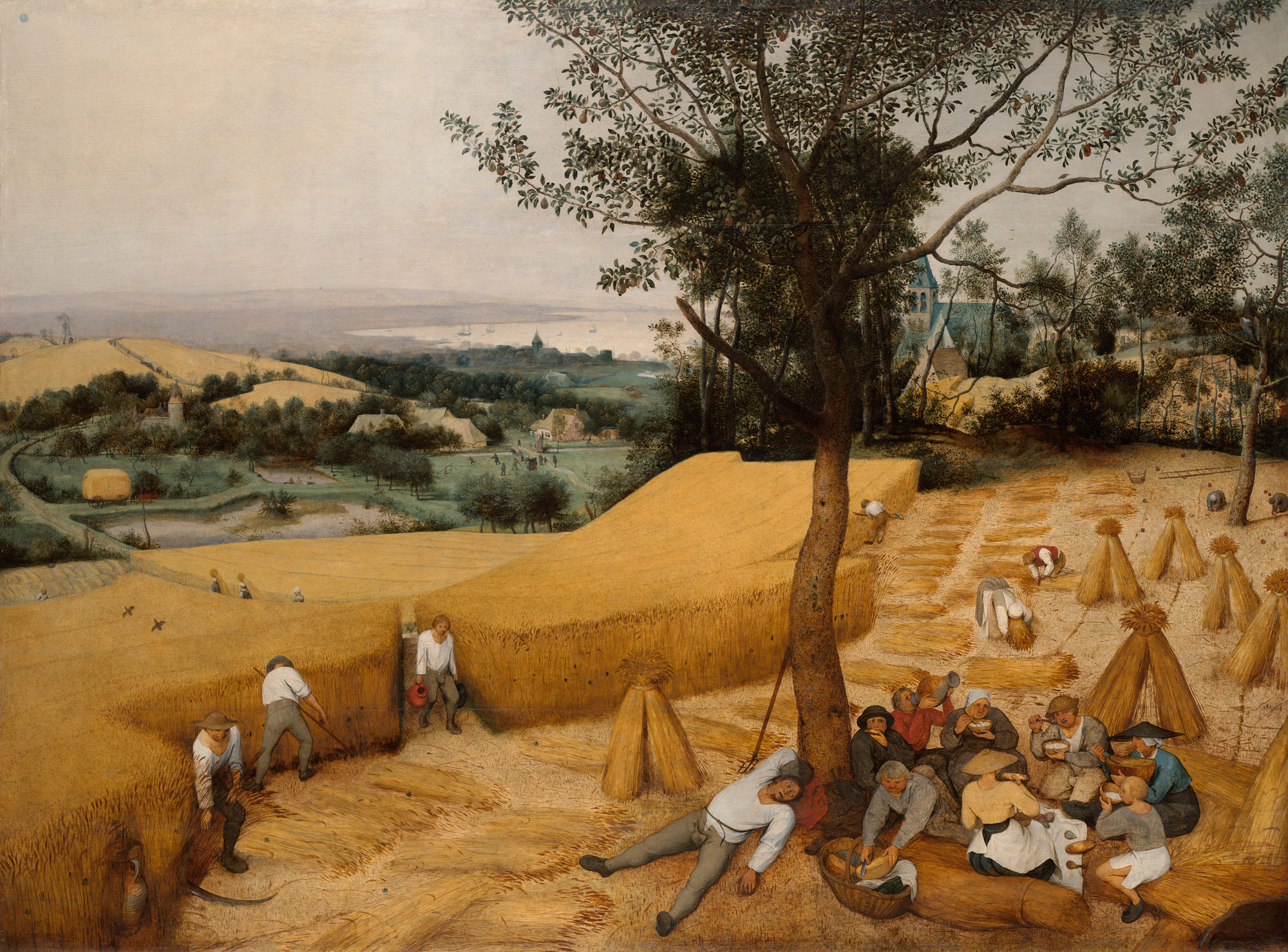
The Harvesters and The Wire

Peter Bruegel the Elder, The Harvesters, 1565

The Wire is a modern-day incarnation of Pieter Bruegel’s Harvesters, with each piecestaking low aspects of life and lifting them into the public eye to create something truly dynamic. Bruegel, an aristocrat by birth, spent more time with peasants than nobility. Most of his work, other than the absolutely crazy pieces, focus upon the day-to-day monotony of life in a normal village instead of making peasant life seem more grand than it truly is. His honesty in this effect actually works to his advantage, because his focus on the peasants in what was considered high art elevates them enough so that he doesn’t have to exaggerate them.

The show does something similar, taking life in broken Baltimore and observing each and every aspect of how its characters live. Praised as one of the best TV shows ever on television, the show is described as a literary work, drawing connections and creating characters with far more depth than what most shows on television ever offered. Bruegel and the writers of The Wire share this innovation in common, taking underrepresented societal groups and bringing them to the forefront, giving them the chance to shine for what they are and not for anything more or less. They allow honesty, which is a rarity for both the arts of painting and television.

Editor's Note: While we love The Wire, we also all like our jobs. We searched high and low for a clip that did not contain explicit language. We had no luck.

  • 7:00 AM

Structure and Paintings: Tower of Babel

Structure and Paintings
Analyzing Architecture and Perspective within Paintings
Curated by Max Cantu-Lima

Peter Bruegel, Tower of Babel, 1553

"A dynamic composition encourages the eye to explore."
#40, 101 Things I Learned in Architecture School, Matthew Frederick


Peter Bruegel has been the most influential artist on how I view art. This painting relates directly to Paul Auster's City of Glass, which we read in our AP Literature class and concerns itself with the issues of identity and purpose. The Tower of Babel plays a role in the narrative of this novel with the fall of language, stating that our language has lost its meaning. While this may be the case, Bruegel speaks with a universal language of color, inserting light blues, yellows, and reds within the painting to give it that burst of presence from the stretching horizon of green. The beauty of this painting is the chaos that takes place as these workers attempt to construct this monstrosity. The viewer could lose themselves within the minute details of Bruegel's work.

I have chosen to write over The Tower of Babel as our fourth painting as we analyze architecture because of its creativity. Bruegel produced this from his imagination. Sure he probably was inspired by the Roman Colosseum, but still, to produce this intricate world of workers that live on this building like bacteria inspires my creativity. The viewer can see the process of how the construction is taking place as most of the top is left exposed. Also the levels of the tower as they progress differ in the style of arches. What the painting attempts to instruct, in my mind, is the concept of being able working with others effectively as well as narrowing in on an idea. That no matter how great the idea is, if it's to big of an idea, your infrastructure is at risk of collapsing.

Bruegel is truly a master. Just look at how he produces the stones in the foreground and the sprawling landscape. The time he invests into getting all the details right. The coast and the ships proportionally correct. This imaginary world invites the viewer as it utilizes the majority of the canvas with interesting subjects to analyze. While it's only a two-dimensional picture, even with the paint you still feel that sensation of  "Wow." Gazing at this structure the mind still wanders off. Its nearly impossible not to think of something from this painting. The depth Bruegel is able to produce with his use of shadows brings the painting to a semi-real state of being, we begin to believe the narrative Bruegel is telling us. That's what makes him and this painting great. The fact that we can lose ourselves within it, and while all art does that to some degree, Bruegel makes it effortless.


  • 7:00 AM

The Hunters in the Snow

Peter Bruegel, Hunters in the Snow, 1565

My two years in Barstow's Art Hitstory class has exposed me to artists and paintings that have redefined how I look at art. From Modern Art History, we looked at Rothko and the Suprematism movement, which are unlike anything I have ever seen. Truly a "My kid could paint that" moment. Those random lines and shapes placed on the canvas in a disordered fashion, this couldn't really be art?  But it is. Those lines and shapes were not random. The paintings played with space and feelings, attempting to produce emotions from you. The freedom of Modern Art allowed artist to express ideas in ways that pushed the medium to new levels. It taught me how to extract meaning from the ordinary and the extraordinary.

Kasimir Malevich, Supremus No. 58, 1916
Modern Art History took place in my Junior year at Barstow. Heading into my Senior year, Renaissance Art History did not seem all that appealing with the more religious influences and more rigid system of painting. Wrong. Renaissance art is the foundation for all modern art. This is where the classical masters lived. Every chapter was another step, evolving with experience. We could visually see the progress from each period as artist developed concepts of depth, composition, and perspective. The beauty in the classical paintings was analyzing the formal aspects of a painting. It built an understanding for what the artist was up to as he or she applied the paint to the canvas. By practicing this I view all art work differently, formally.

This painting by Peter Bruegel is quite famous, depicting hunters, their dogs, and their town as they make their way over the hills. Hunters in the Snow was the turning point for me in Renaissance Art History. While I already respect art, this painting did something more. The detail found in the depths of this painting are transfixing. Someone can actually get lost in this painting, as in not knowing where you are because of how far you're zoomed in. Not only does he accomplish a landscape that stretches back further than expected, but Bruegel also captures the sensations of this moment. The tones and colors allow you to feel the chilling temperature, the overwhelming amount of white weighing down on you. You feel the struggle to make it over the hill in the way the hunters trudge through. This painting found a special place in my heart. Through my eyes it has no faults. You could take a detailed image on any part of the painting, and it would arguably be strong enough to stand as its own work.

Place all of them together and you get Hunters in the Snow, a masterpiece. Compositionally, Bruegel mastered space, perspective, color, and the canvas itself. He created an image that leaves you wishing it wasn't confined to its two dimensional prison.

  • 7:00 AM

Bird Trap

Peter Bruegel II, Bird Trap,1565
When you first look at Peter Bruegel you don't seen elegance or an array of golden charms but rather a gorgeous simplicity. Bird Trap, painted in Antwerp shows the simplicity and beauty in the peasant life. The title pertains to the makeshift wooden plank, un-manned almost forgotten thrust to the right side. Why does Bruegel choose to depict peasants? Is it for their importance to their respective posts? Or is it simply a mockery? The painting highlights the harsh truth that these peasants are a bunch of drunkards who would rather ice skate than do real work.

Cold, one word to describe the bleak white capped buildings and barren trees,.  cold is all around. Green blue mixed in with gray a palletethat Bruegel uses to produce a hues that subdue the warmth in the piece. Despite the chilly climate there is a warmth characterized by a way of life only known to those with little to nothing. Community to summarize it in one word, everyone working together to make it through the harsh winter, to overcome hardship together. The ice skaters blissfully breeze through the harshness of the climate surrounded by family and friends that make the viewer crave companionship.

The beauty in Bird Trap is derived from the simplicity of life; Luther's reform brought about new aspects in which to view ideology and theory. A drastic change to the spirituality of the north frightened many and begged the question of how ones life would change. Amongst those in jeopardy of loosing their lifestyle, the peasants. Bruegel painted this scene to show the way of life that continues to function, a tribute to the past. A futile attempt to preserve the ever changing social strata that now surrounds the north, no one left to trap the birds, no one left to live the simple life.


  • 7:00 AM