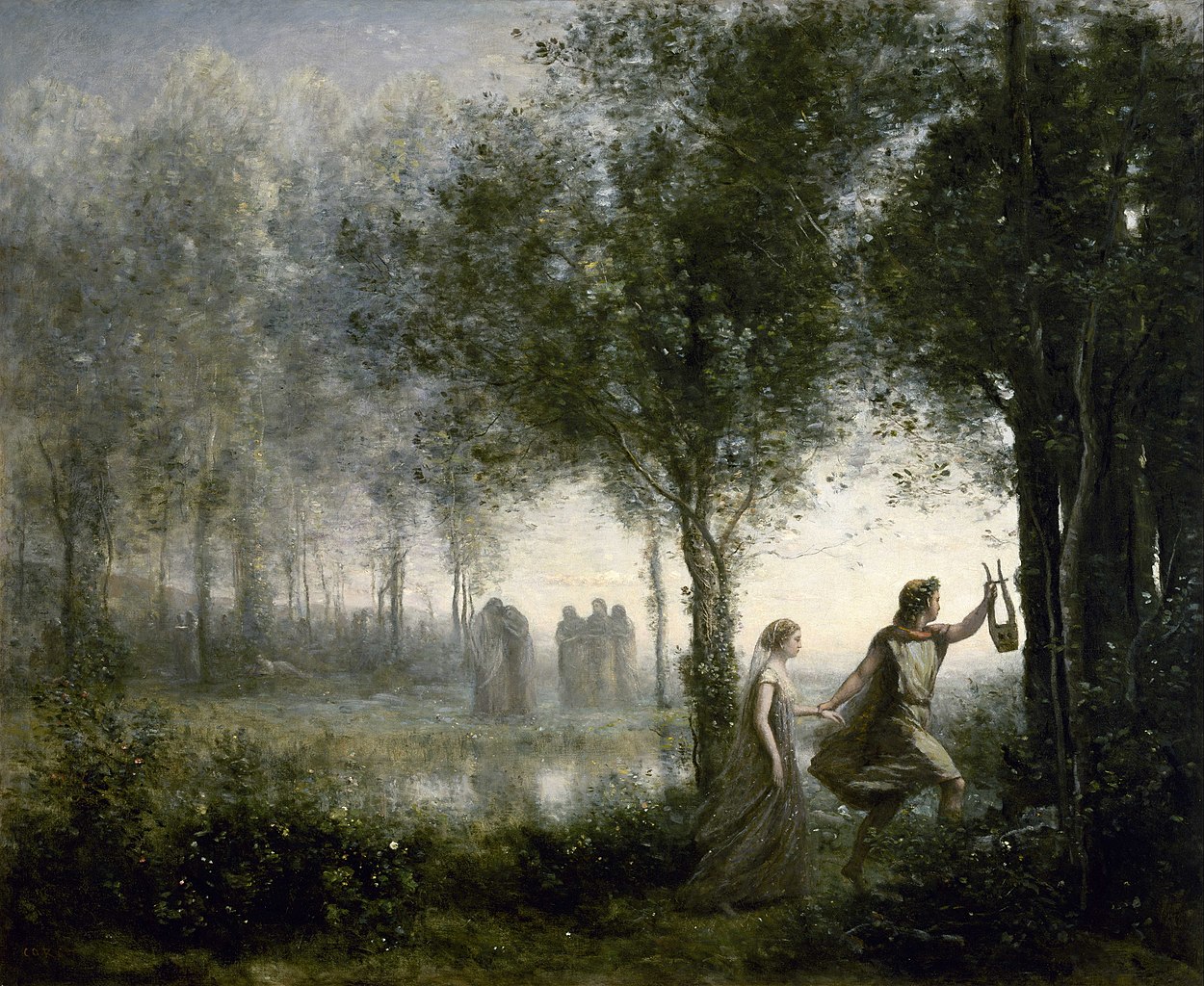
Orpheus Leading Eurydice from the Underworld

Jean-Baptiste-Camille Corot, Orpheus Leading Eurydice from the Underworld, 1861
By LISA MAEDA

Ah, nothing quite like a trip to the underworld. Fiery pits, bone-filled deserts, and the cries of the dead — a truly unforgettable, inescapable place. Or not.

Only the most charming musician can charm Hades, and that musician is Orpheus. He had just married the love of his life, Eurydice. Unfortunately, not even hours after the wedding, she strays from Orpheus and gets bitten by a snake. Virgil's version of the story blames Aristaeus, keeper of the bees, for chasing Eurydice as she denies his affections. Pretty uncool, considering she literally just married another guy. Ovid's telling simply states she went to pick flowers with her bridesmaids. Either way, Eurydice dies tragically, leaving a brokenhearted Orpheus. Unable to cope with the death of his late wife, he decides to ask Hades, "Hey, can I have my wife back?" in song form, and it actually works. There's only one catch: Orpheus must lead Eurydice and cannot look back at her until they have reached the surface.

We watch the reunited couple as they ascend on their trek upwards. The scenery is lush, a harsh contrast to the blazing inferno that we usually associate with the underground. Yet, tension overpowers any semblance of hope.

  • 7:00 AM

The Lion at Home

Rosa Bonheur, The Lion at Home, 1881
By MELISA CAPAN

From sheep to wild cats, Rosa Bonheur painted her way through Paris in her manly trousers. As a young girl, Bonheur exhibited a rather disruptive and boisterous attitude that led to numerous school suspensions. Alas, these suspensions shoved Bonheur into the world of art and helped her emerge as one of the few female artists of the 19th century. Bonheur’s passion for animals comes from none other than her muse and flame, her MOM. In order to furthermore perfect her anatomical endeavors, Bonheur sought permits that allowed her to observe animals in their silent habitat, aka, the butcher shop. After mastering the numerous domestic animals in Paris, Bonheur moved to the leader of the animal kingdom.

Rosa Bonheur could paint impeccable oxen, as seen in Ploughing in the Nivernais; however, her lions are particularly exotic. In Lion at Home, her newly mastered subject matter appears in the midst of thick foliage and other identifiers of nature. The light source appears to highlight the lions as they lay alongside one another. They appear in an oval formation and their position remains no coincidence. As an avid critique of 19th century society,  Bonheur seems to be outlining the traditional family order. The male and female gaze in different directions, and have their sights on different things. The mother shelters the young cubs with her tail crossed in, while the father lies above them, his tail positioned away. Lion at Home directly coincides with the family mold present in the late 1800s where the male lives as the breadwinner and the female as the homemaker. Bonheur represents the “New Woman” in this time period and utilizes Lion at Home in order to compare the supposed intellectual human to the wild lion. I find her attitude to be refreshing and one particular quote of hers resonated with me, “The epithets of imbeciles have never bothered me.” RAWR.
  • 7:00 AM

The Artist's Studio

The Artist's Studio, Gustave Courbet, 1855
By SARAH XU

The title itself suggests the complexity of Courbet’s thoughts. The contrasting definitions of the words “real” and “allegory” in the title leads the viewer to believe some aspects of the painting might have a double meaning. In a letter to a friend, Courbet even says, “It’s pretty mysterious. Good luck to anyone who can make it out!” For example, the landscape on the back wall could be argued as either paintings or windows, so are they real or a representation?

Courbet himself can be seen in the middle of the painting with his signature beard jutting out in an abnormal angle, as seen in Bonjour Monsieur Courbet. Standing by Courbet’s side is a little boy who is literally looking up to Courbet and his painting. Children are known for their lack of exposure to the real world, so their innocence is still preserved. Courbet always strived to see the truth of the world, an ability children tend to have. Courbet could have possibly included the child to portray his skill, something some artists lack.

The painting is divided into two groups of people. To the left, the people are more ragged and represent the world of commonplace life, while the people on the right are more well-dressed and seem more wealthy. Courbet once said, "It's the whole world coming to me to be painted. On the right, all the shareholders, by that I mean friends, fellow workers, art lovers. On the left is the other world of everyday life, the masses, wretchedness, poverty, wealth, the exploited and the exploiters, people who make a living from death." Among the wealthy in Courbet’s painting is Charles Baudelaire, Courbet’s close poet friend, who is painted in the same location Michelangelo puts Satan in The Last Judgement. Behind the easel, there is a crucified figure. Courbet sometimes referred to himself as a martyr in his paintings, such as Self-Portrait as Wounded Man, because of his “suffering” at the metaphorical hands of the French art critics. With the wealthy behind Courbet, it could signify the wealthy are supporting him in the back, while he focuses on his subject of interest, the common world.


After the completion of the painting, Courbet attempted to present it at the Paris World Fair, but due to the size of the painting, which is around 11 feet by 20 feet, the painting not displayed. As a solution, Courbet took about 39 other paintings and created his own exhibition.

  • 7:00 AM

Self Portrait with Black Dog

Gustave Courbet, Self Portrait with Black Dog, 1842
By SAI GONDI

Gustave Courbet, a pioneer of the Realism movement, produced numerous stunning works throughout the mid 19th century. He grew up in an established family amid the rural lands of Doubs, France. Courbet spent much of his later life in Paris, though he constantly returned to Doubs for its beautiful landscapes and inspiration. He thoroughly enjoyed the outdoors, which resonates in his art. Scenery and nature are common subjects for his works, as well as self portraits. Courbet painted numerous self portraits including El Desperado, one his most famous works. 

Self Portrait with Black Dog depicts himself hiking back through his homeland of Doubs. He painted this during his younger days in 1842. The image incorporates two major components of Courbet's life: his origins and the present. First, his past, which shows through the sliver of land in the distance on the right-hand side. The composition places the majority of attention on Courbet and his dog, but in the distance there lies a forest landscape. The symbolism behind this stems from Doubs, his boyhood home. He grew up in rural, farm lands in contrast to the busy, developed Paris. The reason Courbet placed the section of scenery in the distance could be because that portion of his life was in the past. It adds a unique and symbolic element to the composition, though the main focus lies in the front, which shows Courbet's present state. 

The formal garments he has on contrast his humble past. He depicts himself as such to demonstrate his current elite social status. The black he wears and the darkness of the dog help center attention onto him contrasting the light with the somber hues of tan and blue that encompass him. The book beside him has unknown contents, but it clearly shows Courbet's intelligence or lust for knowledge. Also, the pipe in his hand helps further stratify his social status. 

Courbet paints this image beautifully, using colors which help exemplify him in the middle. He possesses an aura of swagger with his posture and demeanor. His flowing hair and stern look help project him as one cool, intellectual dude, but they also make him somewhat resemble the dog. Courbet and the dog create a strange composition. They create a square or trapezoidal shape when you trace around them, which is uncommon in comparison to triangle or circle compositions. Courbet implements unique elements to help outline his life, incorporating the current and the past. All around, I found this to be his best self portrait out of the many he did.
  • 7:00 AM

Girl with White Headscarf

Leibl, Girl with White Headscarf, 1876

By MEGAN GANNON

The first time I met The Girl with White Headscarf I did not appreciate her. I thought she was just another portrait painted by another German. In reading into Leibl’s life I saw the familiar pattern of an artist quitting the academy to find their own way, which is commendable but by this time in our art history journey seems a bit redundant.

So what makes Leibl different? Why remember him? Why remember The Girl with White Headscarf? What makes a Bavarian farm girl from 1876 extraordinary?

My answer. Everything.

With time she works her way into your heart occupying your thoughts. Her perfectly-flushed cheeks appear in your head as you make your way through crisp January days, and Leibl's rough strokes remind you that unlike porcelain dolls she possesses real skin with imperfections.

Leibl paints a girl simply as she is, not adding elaborate embellishments with color or texture, but focusing on her profile with stark contrasts of white and dark pigments. In 1876 when Leibl revealed his painting, many would of refused to recognize this girl as art. Her simplicity would make her unappealing and ordinary, yet upon taking the time to truly admire the girl she would come alive.

One would see the life behind her eyes. The uncertainty she might of felt as a man who knew nothing of her life attempted to paint her. Leibl’s later works mark his vow to paint the people and our girl demonstrates the beauty in the ordinary.

He captures humanity with simplistic style. Leibl’s painting reflects that even though we may construct arbitrary limits of wealth, class, and race in the end we all are human. We all have smiles, eyes, and thoughts. Our farm girl possesses all the beauty and grace of Madame Pompadour. Her rawness makes her worthy of our attention and our respect.

Leibl made me see simple beauty and for that I thank him.
  • 7:00 AM

Death and the Woodcutter

Jean-Francois Millet, Death and the Woodcutter, 1859
By KARL SHEERAN

Jean-Francois Millet pushes the boundaries of realism with this painting: one of serious nature that incorporates a religious aspect of death. The composition of the painting shows a great amount of detail in the foreground, allowing us to view the contours of Death’s bones; but the work lacks sharp lines in the background. This style relates to the literal world as objects are clear up close but lose focus as they are farther away. Millet’s other pieces show lower-class workers as the subjects, but this painting is the only that explicitly displays death. A white robe cloaks Death, against popular belief that Death wears black. Possibly Millet viewed death as pure and clean so he dressed this figure in all white. After all, people have never corroborated that death possesses an evil spirit, but rather our fear of its enigmatic nature generates a nefarious personality about it.

The ditch the woodcutter lies in bears no life, only rocks and brown dead space. He might have fallen down the side of the ditch from the green and alive, wooded area. In the Bible, people would climb mountains in order to be physically closer to God, such as when Moses climbs Mt. Sinai to receive the Ten Commandments. Death may be leading the woodcutter to the mountain that rests in the distance, so that he may ascend into heaven.  
 
As the earliest recorded evidence of the phrase: “Time flies,” Millet’s Death and the Woodcutter displays an awesome but startlingly-realistic aspect of life as death approaches us unexpectedly. The woodcutter appears to be finishing up after a long, toilsome day of collecting branches for which he most likely sells as his livelihood. The Reaper’s scythe represents how each life is like one stalk of wheat in the field of the world. It ends each life cycle as it marks the end of the annual harvest. Each branch the man holds is each year acquired over his life span. As Death pulls him, he loses his grip on the branches, signifying how he has lost his grip on the world. 
  • 7:00 AM

Spurl on the Hunt

Wilhelm Leibl, Sperl on the Hunt, 1895
By GARY WHITTAKER

Wilhelm Leibl entered the Munich Academy of Fine Arts in 1864 and by 1869 had set up a studio in Munich. In the same year, Courbet exhibited a collection of his in Munich. This exhibit introduced Leibl to his painting style, Alla Prima. This unique style requires quick work and deft hands as the paint is applied on top of the still wet layer below. In order to further refine his work Leibl set out for Paris in 1870. This short lived trip lasted nine moths due to the Germans and French doing what they have always done to each other - try to kill each other. After fleeing Paris and the French, Leibl returned to Bavaria, deciding to live in the numerous small villages dotting the countryside. Most of Leibl's typical paintings are made during this time: Usually portraits of peasants with minimal detail, save for the face, against a dark background. Leibl took a very un-German approach to his painting, choosing to paint without sketching the subject first; this freehand style is typical of impressionist painters.

Spurl on the Hunt, does not exemplify Leibl's typical form of painting. The background mountains are very light and have magnificent attention to detail. Peasants, while present, are not the subject of the painting; instead Leibl has chosen himself and fellow painter Johann Sperl as the subjects. The hard edge of the farmland divides the painting horizontally. The color of the mountains and clouds almost makes them appear as one object. The angle that the man in black (probably Leibl) creates a triangle with the figure of Sperl. 

  • 7:00 AM

Palette

Palette, Rosa Bonheur, 1863

By ROSIE PASQUALINI

“Spectral”
I

Avella. Sometimes in toothpaste when drops crust up in the corners of my mouth. Sometimes on the olive-tip nose of a dog. Sometimes on the middle bits of fluorescent lights, where grey feigns silver before turning. Things never just are my color, like grass is green, like shit is brown. Things turn. Avella sparkles harder when I squint; then it burns. I dare you to strike a match and find the yellow. Only the yellow. Do you feel that oppressive blur, that sharpness like a migraine? It splinters your mind; here the yellow emerges, escapes, flickers in, flits out. This is how I meet my color-- like a memory of joy rendered traumatic by a harsher now. I cannot quite face avella for the pain.

Still I search for that hard shimmer in all things. I search in line behind the Kwik checkout counter, but first I examine the candies nestled together in boxes labeled 0.99!!. That's two exclamation points. Two breaths of ink wasted. I think about how stupid everyone is. Then I think my girl might like a Twix-- she’s at home with her friend Sadie-- but I hate the way she eats them. The wrappers drive me mad with their crinkling, which sounds shiny and pretty. There's nothing worse than trash trying to sound pretty.

I have to kneel to consider the Twix and when I stand again the back of someone's ropy ponytail hits me in the nose. I blink hard. There it is-- a flickering in her hair, northern lights cast along those gossamer strands. A sheen distant and vivid as the sun. Avella. Never before have I seen its diaphanous hues taint a human being. Plus this stranger (such a sexy word! stranger) is young and probably beautiful. I touch her shoulder.

She turns around. She is young. She is kind of beautiful.

“What,” says the woman.

“Nice hair.”

“Lots of men like my hair.”

She's at the machine now, pressing her fingertips against the glass. Her nails are crescent moons.

“I like your hair more,” I say. “It’s a color only I can see.”

“Really?”

“Really.”

She slides a box of Plan B beneath the scanning light. 

A guilty shiver scampers, uninvited, from the base of my neck up into my eyes, those half-burning sockets, and it is horrible, I mean it is horrible that nobody ever really knows anybody. I was feeling good, too. I'd taken a shower that morning.

She pays. There's that avella dancing up and down in electric bursts beneath her fat orange hair tie, which in comparison is ordinary to the point of repulsion.

Perhaps I should get the Twix.

By the time I've bought Advil for my headaches she's halfway out the door, ogling an assortment of flowers in the window. There's no wind but the petals shake. She does not look at me. She moves to let me by. She moves in silence.

“I’m sorry,” I say.

“Okay.”

She waits for me to leave.

“How are you,” I say.

...Now she is looking at me.

II [later]

More than a hug. My girl’s hands are all over my cheeks, the back of my neck. Little circles. She keeps dipping slightly beneath my shirt-- you know how they do it, try to lasso your entire ego with a few dextrous lashes of friction. But I am bigger than the world; like the sky I have no surface. Avella fireworks burst in the periphery of my vision, skirting the line between sleep and wakefulness, sanity and sheer madness. The ponytail is still there. It swings like a pendulum in the back of my mind. I damn near choked at the mercy of that brightness. Spiderweb threads, as they say, are stronger than steel.

“You didn’t get me any,” she says.

I emit some sort of sound. Raise the end to make a question.

“Any Twix.”

“I’m sorry,” I say.

“Okay.”

A certain silence. Then my girl puts her hands in her lap and I become an itch forever unscratched, a wave felled too swiftly by the wind.

“Nick,” she says.

“Hm.”

“You aren’t here.”

“Hm?”

“You went somewhere new and you haven’t come back.”

I want to tell her. When we were dating in high school I’d tried to explain avella a million ways. It’s blue, but it’s not. It’s standing at the top of a mountain and looking out in every direction at once. It’s the prickly chill before a sneeze. It’s falling, I mean it’s flying, I mean it’s--!, I would say. My exes would tell her, It’s something he made up to feel special. Little rich boy in his cold marble castle. Nothing left to earn but love. Except I really saw it. Avella. Undeniable as dawn, skirting the edge of every cloud. And it was worse, maybe, that I saw it.

Here’s all I know about people: What we want is understanding. The only true permutation of love. But if that’s impossible--always, with kids-- we need to be needed. That’s not love; that’s survival. A lone self grows inadequate when rushed to stillness in the infinite onslaught of years. Women train themselves to like mystery for mystery’s sake.

But not my girl.

She asked me to find the avella in everything, stared at each quasi-empty spot with the desperately rapt yet evasive gaze of a sinner watching for God.

So it went, so it goes.

We are ordinary with each other. We know each other, almost. Still mystery lives; still deception lives; in myself; in you. I strike it and it lives. I await the fresh cracking of vertebrae, a snap like a gunshot, and all I get is a feeble blink. It lives. Deception is ambiguity, a hundred shadows leeched upon a light-boned face in a phantasmagoria of decay. And I cannot tell how much of this darkness is a remnant of deception’s own rot, that asphyxiated flesh turning to graphite-- or rather a product of the candle on its nightstand, which grows weak in the embrace of its own slime. Deception blinks and I throw her down again. The candle jumps in its metallic socket; the whole room rattles; her body makes no sound. Deception is dead. Mostly. She is dead and looking at me.

I am trying to hold my girl’s hands.

“Don’t be stupid,” I say. “I’m right here, I’m inches away.”

“There’s more than one kind of distance.”

She refuses to be touched.

This makes me angry.

“I met a girl,” I say. “I mean a woman.”

No response.

“We were in line at the checkout. Her hair was avella.”

More quiet. Then: “What did you do.”

I blink. “Don’t be stupid.”

“What did you do.”

“Two years and you still don’t trust me.”

“That’s not--”

I’m in her face now, grabbing her jaw with one hand. “You want to see the painkillers? Huh? Want me to save all my damn receipts? Is that what you want?”

She shakes her head and I can sense her teeth clenching up beneath her cheeks. “Sorrysorrysorry.” She clings to me once I let her go. In the sweet rush of skin I can breathe again. Now she pulls at my clothes; somehow this is the natural progression of things. I wonder, irrationally, whether I smell like flowers. “Find something avella,” she says as my thoughts start to unwind. I point out a tiny fissure in the ceiling.

When I look back she has taken her shirt off.

I squint.

It’s the light, I think. It has to be.

But I feel them, I feel them as I run my fingers across her collarbone, the moons, little crescent moons of red like stationery made for children, and they are slightly wet, and they are elegantly placed, and more, I see more now, along the softness of her stomach, her breasts--

“What’s this,” I say. My voice barely holds. “What’s this, sweetheart? Huh? What did you do?”

“What did I do?” She blinks. “Don’t be stupid.”

I cannot breathe.

She is smiling. There’s a noise outside, a honk, somebody’s car, and a dull ache pulls behind my eyes, and the whole room goes avella for a second, and then it is bland and hard, and she is still smiling.

Breathe, Nick.

In. Out.

“That’s Sadie,” she says. She slips her shirt back on.

In.

“Sadie’s car,” she says. She sits up straight.

Out.

“Sadie’s here.”

  • 7:00 AM

Don Quixote and Sancho Panza

Honoré Daumier, Don Quixote and Sancho Panza, 1864-1865
By LIBBY ROHR

Allow me to introduce you to my newest friend, Honoré Daumier, the 19th century art world’s jack of all trades. You need a sketch? He can do it. A caricature? He’s on it. A painting? Just give him a subject. An unflattering bust of an important person on painted raw-clay? He’ll accentuate his ugly nose. With his astonishing talent and spot on political snark, Honoré Daumier can do anything. This made picking the subject of this post nearly impossible. I spent an hour and a half flipping through pages and pages of his work on ArtStor, only to come up with fifteen odd paintings, sketches, and sculptures that I absolutely adored. Then I stumbled onto his Don Quixote series.

Later in his affluent life, Daumier became enthralled with Don Quixote, painting upwards of 17 works based upon this famed hero narative. During this period, Daumier was becoming incredibly interested in impressionism, but he was also losing his eyesight. This mixture is reflected in each of his Don Quixote paintings. Many have the same organization and positioning of the subjects, but Daumier varies them by playing with his strokes, colors, and figures, discovering how to continue to paint inside of his disability. By combining realism and the up-and-coming impressionism, he learned to convey the same emotive nature and inventive flair in his paintings without the detail.

This version of Don Quixote and Sancho Panza stuck out at me from the fray. With the same earthy color palate as the realists, it shares the indistinct and abstract brush strokes of the impressionists. In this painting, Don Quixote, the gallant knight persona of a delusional, ordinary man, travels with his ignorant but sane sidekick, Sancho Panza. The two trek along a rocky desolate road in the middle of nowhere, with no markers of landscape other than the rocky crag and the beaten down road. Sancho Panza trails in back, hunched over and exhausted by the journey. He appears as a regular man, embodying the heart of the realist movement, incredibly human even in the way his rides his horse. Don Quixote, the valiant hero, rides ahead, alert, lance poised, as if charging off into a battle that does not exist. Even his form is fluid and fantastical, differing from the outlined figures that Daumier usually paints. Metaphorically, this shows Don Quixote as out of touch with reality, living entirely in a fantasy while literally riding off into the sunset. Although we relate to Sancho Panza as the working class man, he is not the focus. The use of the sun as a light source highlights Don Quixote as the subject. It's a circular beam in composition it creates a spotlight on the magical, right down to the mystic clouds lingering at the edges of the sunset. This light bubbles over with warm colors that fade to dark shadows as you reach Sancho Panza's realm of realism. Sancho Panza is in the dark about Don Quixote's identity, literally and metaphorically.

This work divides diagonally along the rock face, separating the two worlds. Don Quixote's ideal fantasy, the subject, the hope, the dream we all long for and Sancho Panza's real life, the one we relate to, the grounded, and the dark. There are many interpretations of what these two worlds represent including, hope versus despair, live versus afterlife, two portions of Daumier's personality, and realism moving to impressionism, all equally valid and clear in their execution. Regardless of which interpretation you choose, this painting has a way of explaining the duality on earth in a way that hooks the audience and moves us to feel the split in our own lives. Despite its unexceptional appearance from a distance, the more you study this painting the more you relate to it, and in that way it's one of the most intimate works I've ever seen. 
  • 7:00 AM

The Unexpected Visitor

Ilya Repin, The Unexpected Visitor, 1888
By EMMA SHAPIRO 

The Unexpected Visitor portrays an intellectual prisoner returning home unannounced from an evidently long imprisonment. The most admirable part of Repin's work on this painting is his ability to exhibit the emotions of six different individuals impacted by this event on a singular canvas. In Repin's original drawing of The Unexpected Visitor, he painted the visitor as a female, but changed it to a male in attempt to mimic reality. He also does this in order to make the visitor not only male, but a son, husband, and father simultaneously. 

The returning prisoner draws the eye of the viewer, due to Repin's meticulous use of linear perspective in the floorboards. The eye then wanders to the grandmother standing weakly in shock, and the daughter glaring in confusion and fear. To the right, the older child, a son, looks up excitedly, recognizing his father's return. Unlike the daughter, his age allows him to remember his father, giving the viewer a hint into how long the man's imprisonment lasted. We notice the wife's preoccupation with playing the piano has shifted to staring in utter confusion and no doubt joy for her husbands return. In the back the maid does her duty politely waiting to see the processions. The maid's eye are fixed on the prisoner questioning his identity as well as his intentions. The cook, equally as dark as the man, peeks from behind the maid, intrigued as any bystander in this situation would be. Repin shows the Tsar's rules effects on a family in the late 19th century, and how it individually impacts each person.

The door divides the painting into two halves. One half contains the wealthy family sitting around the table together, surrounded by chairs, paintings, photographs, a map, and a piano. The other half, that the man stands in, is left completely bare, besides the window offering a light source. The door isolates him from his family and brings him down in the social sphere, including him with the working class of maids and cooks. 
  • 7:00 AM