Vincent Van Gogh

Vincent Van Gogh, Almond Blossoms, 1890
By Nayoung Kwon

Troy,

I would always be brought down by rainfall, drenched in heavy rain, but you've always held my hand so that I don't fall behind. You are always careful and protective of my already damaged petals. If I hadn't met you I would have been lost, confused, and even become non-existent. Each season we spend, we create new memories that cannot be replaced. Our friendship grows each year like this tree... Almond Blossom, representing the beginning of spring and the new life ahead of us.

I am scared and worried...when winter comes, you will no longer be beside me. You will be going on an adventure that will determine your future, and I will stay here, the where we met and wish for spring to come. Until then... I will wait, wait until spring comes then we can once again create wonderful memories like we always did.

Editor's Note: Students were asked to give a painting to someone they cared for. These are their moving responses. 
  • 7:00 AM

The Color Yellow: Sunflowers

Vincent Van Gogh, Sunflowers, 1888
The Color Yellow
By MEGAN GANNON

You walk down the street and a wiff of a horse and you are transported back to your riding days with your faithful Bugs. Colors and smells tug at you just as sights do. For me the color yellow represents the best and worst of life. In yellow I see, no I feel Trevor. I feel his eyes, his laugh, and his bright smile. I feel his wheelchair, his frustration, and his pain. 

With these works we will travel through pieces that utilize yellow to encompass natural, artificial, and complex feelings. There will be no discussion of the beauty of a sunset, a bumblebee, or mustard curd here. Instead an appreciation for a pigment that when everything seemed to be crumble, pulled me in and made me feel safe again. 

The color yellow helped me to understand my brother, his situation, and my own place in the whole mess. 

So like any great story let’s start with the beginning - Van Gogh’s Sunflowers

Sunflowers with its distinct lines finds the individual beauty in differences. I know that an appreciation for diversity may seem cliche, but hear me out. A kid in a wheelchair or with a mental disability isn’t a quota to be filled in a classroom, and Van Gogh helped solidify that for as a kid. The mix of wilted, blooming and developed flowers hints at the different stages of personal development. Individuals exist in a flux between wilting and blooming. The ebbs and flows of life. No matter what your mental or physical capacity you take joy and find sadness in things. Simple.

Van Gogh tackles humanity, creating harmony out of chaos by painting all the flowers in different shades of yellow. The yellow hues represent a sense of humanity felt by all, something intangible but strictly human. With the sunflowers placed almost haphazardly in the vase we see the unpredictabe beauty of life. You cannot manufacture it. The overlapping and crowdedness of the vase, the absence of a single stem indicates although distinct the flowers arose the same way. “A cut from the same cloth” vibe. 

Bursting with metaphors for acceptance, the beauty of diversity, and resounding love Van Gogh’s Sunflowers makes an argument for humanity. A subtle argument unlike the almost preach-like one you heard at the Kindergarten round-up rug. Not an obligated appreciation for difference but a celebration of it. 

Until he died, I did not see Trevor as disabled. I saw him as my older brother. Witnessing his daily struggle helped me to realize the individual battles that people fight. I cannot pretend to know what it felt like to be him, but I tried. I developed a sense of empathy, and I realized that he exists as a sunflower in Van Gogh’s vase as do I. Such a bond, such a connection, well, nothing can destroy that - not even death. 

  • 7:00 AM

Head of a Skeleton with a Burning Cigarette

Vincent Van Gogh, Head of Skeleton with a Burning Cigarette, 1886

The connection I established with this painting began long ago, as sweaty, shorter and shaggier- haired version of myself walked into the Van Gogh Museum in Amsterdam. As I walked around at a rather quick pace than that of my parents, I stumbled across this painting. Although I didn't really think about it as much as I have recently, I feel that I was drawn to it by similar reasons that still hold relevant to me. 

The idea of mortality and constant close proximity to death caught my eye. It really made me wonder what it meant to die and at what point that truly happened. The painting represents what we really are, just a set of bones and parts assembled into one, and the fact that it is truly up to the person to make more of that simple composition and determine what we mean and who we are. As I continue my course through high-school, I have had to think about what I will have to make of myself, and how to avoid being more than just a skeleton to not only others but also, most importantly, myself. 

Regardless of determining this, the bleak coloration and rigid skeleton and use of the burning cigarette make death feel omnipresent, and it is up to one's self to resolve what it means to avoid this end. Despite this, I feel that the presence of death should be approached as motivation and provide aspirations, rather than be painful and take away life long before it is over.


  • 7:00 AM

La Meridienne and La Sieste

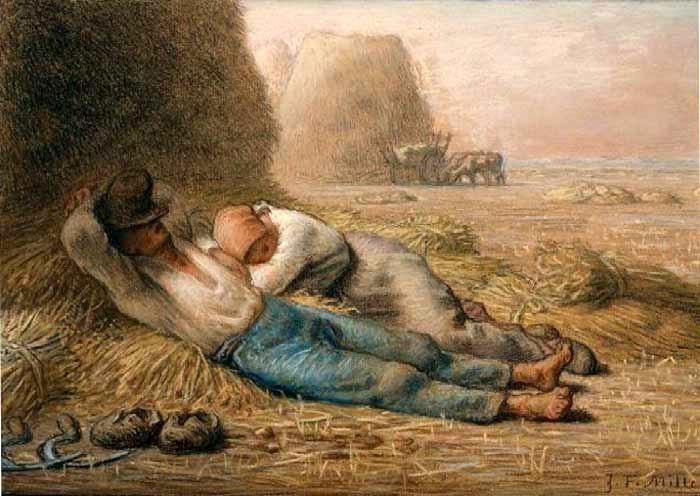
Jean-Francois Millet, La Méridienne, 1866

Jean Francois Millet, famous for his paintings of farmers and field workers, sets a different tone in this painting, The Nap. The turmoil and hardships of France’s lower class agricultural workers is often depicted in Millet’s paintings through his own experiences. The paintings, which shocked the upper class that viewed them from the comfort of cushy Paris art galleries, displayed workers in the midst of their labor. The Nap shows a couple resting in the shade of a bale of hay as the day wears on. Tools for haying lay next to the couple as well as the man’s shoes. The scene seems almost intrusive, as if somehow we have stumbled upon the sleeping workers on their bed of hay and should back away slowly as not to wake them.

The most striking this about this painting is how un-striking it is. The muted colors and the hazy quality make for a peaceful sight. The style of the painting is similar to typical Impressionist style, with that characteristic out of focus haziness and defined brushstrokes. Millet painted the painting towards the end of his life at the age of 51 (he only lived to be 60) and the influences of other prominent Impressionists can be seen in his brushstrokes. The qualities of La Meridienne are a far move from his earlier works (such as The Gleaners, in which the figures are much clearer and brushstrokes less defined). Millet’s move towards typical Impressionism does not make his work any less unique; he still is among the only Impressionists to paint domestic laborers.
Vincent Van Gogh, La Sieste (d'après Millet), 1889
Vincent van Gogh had always been an admirer of Millet, often writing letters about his fondness for Millet’s subjects, and Millet’s influences can be seen in van Gogh’s early work. While committed to an insane asylum in the late 19th century, van Gogh made copies of twenty-one of Millet’s works. In this particular copy of Millet’s The Nap, van Gogh has made the painting his own with more saturated colors and more prominent brushstrokes, as well as switched the composition of the painting. Both paintings are beautiful, whether viewed separately or alone, however something about van Gogh’s vibrant rendition is even more captivating than Millet’s original sleepy creation.
  • 7:00 AM

The Church at Auvers and Eleanor Rigby

Vincent van Gogh, The Church at Auvers, 1890


Click Album Cover or here for Song

The Beatles' "Eleanor Rigby" and van Gogh's The Church at Auvers have one thing in common; they were created by some of the greatest artists of all time, yet aren't necessarily the artists' most famous works. Both the song and the painting have characteristics of their more famous siblings, yet commonly disappear amongst the greatness. The song "Eleanor Rigby" embodies this sense of insignificance and brought together the lonely listeners of a generation.

This painting resonated with me because it brought together the feeling of loneliness that the song represents, and can be a visual representation of the line in the song that says, "Eleanor Rigby died in the church and was buried along with her name, Nobody came, Father McKenzie wiping the dirt from his hands as he walks from the grave, No one was saved.".I see the man walking back towards the church as Father Mckenzie, who only comes to Eleanor Rigby's funeral because it's his job. The brushstrokes of the path leads one's eyes toward the large, powerful church. To contrast it's size, the man is insignificant, and faceless. The facelessness adds to the feeling of loneliness and gives the impression that anyone could be that person.

  • 7:00 AM

Van Gogh Self Portrait and Anna Karenina

Vincent van Gogh, Self-Portrait with Bandaged Ear, 1889


I know when I get into a heated argument, my first urge is to cut off my ear and give it to a prostitute. But I hold back.Van Gogh, on the other hand, found that perfectly appropriate and really went with that urge. Gauguin exclaimed, “You crazy bastard! You have sliced off your ear!” and finished the argument with Van Gogh on top, one ear less than where he started. This self-destructive act to spite his competition and himself deeply moved his audience and shocked those around him. Looking at his Self-Portrait With Bandaged Ear, the pain in his eyes is evident and unyielding. The cool, chaotic palate depicts Van Gogh’s inner turmoil as he stares blankly forward, colors spinning all around him.

The horse scene in Anna Karenina evokes these same chaotic emotions, from the tension of the race and the heartbreaking crash to Anna standing up and screaming for Vronsky, her wounded lover, in front of her husband and all of Russian high society. You want to scream with her, to stand and help her get to the man she risked everything for, but as a viewer you understand how self-destructive Anna is. She may not cut off her ear to spite anyone, but her entire life with Vronsky is in spite of her socially-acceptable life. Her end itself is self-destruction in its purest form, throwing herself under a train - the very thing that brought her to Vronsky in the first place.

Both of these examples show the peak of these real and fictional characters’ self-destructive tendencies, outside of their tragic ends. They may be destructive for different reasons, but both of their desperate acts in the heat of the moment are far too similar to the other. Anna’s terrified scream for the one she truly loves is the vocalized version of Van Gogh’s slicing off his ear to prove to Gauguin how much he meant to him in a desperate effort to get him not to go back to Paris. The piece shows the static aftermath of this act, while the scene from Anna Karenina is the exact tipping point into her downward spiral. Both are equally tense and foreboding. It makes me not want to know what happens to them, makes me want to save them from themselves… but I can’t.
  • 7:00 AM

The Sickness Unto Death Pt. I: At Eternity's Gate

The Sickness Unto Death 
A Musically Guided Exploration of Artist's Struggle with Mortality
Curated by Aaron Dupuis

Vincent van Gogh, Worn Out: At Eternity's Gate, 1890

"Old man in your rocking chair
You wake up, you've been living alone

After all these years
Surrounded by these shards of mirrors
How'd it get so quiet here
You wonder where did everyone go?"
"The Sickness Unto Death," Typhoon


A couple weeks back, as I  was driving beneath the emerald canopy of Blue Ridge Boulevard and tossing project ideas about in my head, "The Sickness Unto Death" by the Portland0based indie group Typhoon began to spill from my speakers. It had been some time since I'd heard the song, but just as the cold makes the old cut on my finger ache, it brought back the ache of buried memories. Teenage heartbreaks. Long drives in the dead of night. Relatives that I'd lost. But most of all, as is always the case, it brought back the fear that lurks in the back of my head, of many heads around the world. The fear that reduced me to tears time and time again as a child. The fear of forever. Of experiencing forever, whether I continued to exist or not.

And it was from this well of fear - beautiful, terrible fear - that I drew the inspiration for my gallery. I present to you The Sickness Unto Death. Through a synthesis of contemporary lyrics, personal experience, and the paintings of the masters, I will explore the efforts of the Artist to reconcile himself with human mortality. In doing so, I hope to capture the beauty of life and expression, rather than the triumph of death. Though the lyrics themselves will not play a great part in the body of the text, I felt it necessary to include them, not only to give the gallery a proper narrative structure, but also to illustrate the timelessness of the Artist's struggle with death. That being said, I would encourage readers to give the song a listen. It's a favorite of mine.

And so it goes:

Van Gogh first took down the image of the old man in the chair in 1882, using an aged war veteran he encountered in an alehouse as his model. He wrote extensively about the drawing, which he called Worn Out, and its eventual transformation into a lithograph. The writings in question detailed his thoughts about the emotional power of the human form, and the greater implications that it seemed to hold. "It seems to me that one of the strongest pieces of evidence for the existence of 'something on high' in which Millet believed, namely in the existence of a God and an eternity," he wrote, "is the unutterably moving quality that there can be in the expression of an old man like that, without his being aware of it." Fascinated and moved by his discovery, van Gogh began a long series of lithographs and drawings of the veteran, women, and hospital patients, all in the same pose.

Vincent van Gogh, Worn Out, 1882
For eight long years, van Gogh did not return to the drawings and lithographs he had made in that formative time of his career. And in those eight long years his life had drastically changed. He had found his artistic style, collaborated with artists like Gauguin, created what would be his most famous painting, Starry Night, begun frequenting brothels, cut off his left ear, and had started to lose touch with reality. By 1890, the hallucinations and periods of madness had grown so strong that van Gogh could no longer keep their effects from affecting his work. During this time there passed entire months of inactivity, months that took their toll on the artist's outlook and work. It was directly following a mental relapse that van Gogh finally revisited the old man in the chair. This time he forsook pencil and lithograph, and went straight for his paint.

Blues, greys, whites, orange. They play off one another, but they do not dance the way that the colors of van Gogh's landscapes do. Instead they seem to tremble. The man in the painting seems smaller, weaker, than his predecessor. And where the subject of Worn Out seems to be resting his eyes, the fists in Eternity's Gate look like weary guardians of tear-filled eyes. The men are not the same. At Eternity's Gate is more than a final play on an early artistic motif, it is a mirror of van Gogh's life. He has replaced the old war veteran. He is a veteran in his own right. A veteran of art. A veteran of life.

Two short months after painting At Eternity's Gate Vincent van Gogh shot himself in the chest while out on a walk in the wheat fields of Auvers. He lived a night and the better part of the next day, managing to make his way back to his room in the local inn, where his brother Theo comforted him and recorded his final words:

"The sadness will last forever."


  • 7:00 AM

Just Your Average Mental Breakdown: Olive Trees

Just Your Average Mental Breakdown
Artists Losing It
Curated by Drew Bierwirth

Vincent Van Gogh, Olive Trees, 1889

The final piece. Van Gogh's paintings in his later life are some of my favorite paintings of all. This period of his life, though dark, was also his most creative. By 1888, the year before the creation of this piece, Van Gogh's panic attacks and epileptic fits grew in frequency, one of which led to him chasing Gauguin around with a knife and threatening his life. Later that day he cut his ear off and gave it to a prostitute. After these fits became too intense and far too frequent, Van Gogh committed himself to an asylum.

In this asylum, he got in touch with the more intense, darker elements of his art . He couldn't paint or draw for long periods of time without having an attack, but those pieces he did complete were very different from the ones of the past. His work became darker, this piece in particular showing the type of place his mind was. The trees blend seamlessly with the rolling hills, the movement and chaos of the piece unmistakably Van Gogh, but something is different. His style is shaky, the movement turbulent, and this new technique was visible in all of his work while in the asylum, especially in Starry Night - which remains his most popular work.

Van Gogh's popular works aren't the things that enchant me, though. He is absolutely part of his canvas, painting his emotions just as deftly as he paints these trees. Through, and possibly because of, all he endured, his art wasn't just a talent or a calling. It became an outlet to work things out on, to share with the world. He was so critical on himself, trying to end his life because he felt he had failed in his art and was never good enough. There are always tortured artists, but Van Gogh holds a special place in my heart for never feeling his work, in a caliber of its own, was never quite good enough - even though he became legendary to everyone else. That takes a special kind of person, and an even more special kind of person, to be strong enough to put these painful, vulnerable thoughts on a canvas and make them into something so beautiful.

  • 7:00 AM

Undergrowth With Two Figures

Vincent van Gosh, Undergrowth With Two Figures, 1890

This is the final post of my junior year. That is foreign to write, so incomprehensible to think about, but it's here. It's been a vivid, chaotic, painful, brilliant blur of a year, and now it's coming to an end. The seniors are moving on to their futures, to college, to being grown-ups - whatever that means. They leave my class to step up, to become leaders, to wander through the undergrowth and grow into what we want to be. We have big shoes to fill, and even bigger holes in our hearts.

Van Gogh's piece is all too apropos for this bittersweet end. On my first day of Art History, nine months ago, we were asked to scour the library, find a painting we liked, and sketch it. Some people did better than others, artists showing off and others making chicken-scratch on their papers. But it didn't matter. It was all about the feel of the piece, the appreciation of its movement, and about some people's first real introduction to art. I found this in a giant book simply labeled "Impressionism" by accidentally dropping it and it falling open to one page. Van Gogh. The author sort of rambled about van Gogh's developing mental illness and schizophrenia, but all I could see was the journey, the growth of the trees out of the chaotic brush, and the two ghostly figures making their way through. They blend in with the stretched trees and almost disappear into the grass, but they're there, stepping forward.

After sketching at the speed of light and trying to make my drawing barely resemble the piece, my teacher told everyone to stop and began asking people to describe them. When it was finally my turn, my teacher looked to me curiously. I've never tried so hard not to shake in my life, and never failed so badly. I somewhat coherently sputtered out how the trees looked like bars, how harsh they were against the turbulent grass, and was commended on finding a piece he'd never seen. He then moved on casually, leaving me all too relieved and red-faced, intimidated by his gaze and the seniors who'd done this before. 

Things have changed, but that was the beginning of my more mature love of art. This piece changed the way I looked at it. Looking at art used to be private, something one admires in silence and hopes other people think you "get it." But now it's something to talk about, to debate, and something that changed the way I wrote altogether. I was so lucky to get to write about this piece, the one that inspired this mini-epiphany. I guess now it's time to walk out of the undergrowth. Now it's time to make myself a path through the trees and emerge stronger, better... It's time to grow up.

Editor's Note: The students were assigned to write about the artwork that has impacted them the most. These pieces will run for  about two weeks. 

  • 7:00 AM

Wheatfield and Cypress Trees


Vincent Van Gogh, Wheatfield and Cypress Trees, 1889
After spending a lot of time with this painting, I think I probably erred in my initial reaction. I usually like Van Gogh, and after learning about this painting and particularly the significance it had for him, I really like it. However, it originally held no appeal for me at all, so I decided to write about it.

Van Gogh painted this painting as part of a series shortly after leaving a mental institution where he had stayed after a series of mental breakdowns. These paintings built on a series of earlier works he had painted of the view into the meadows outside his hospital from the window of his room. Van Gogh’s new feeling of freedom bursts out of the canvas in the rich luxurious blue of the sky and the graceful curves of the cypress trees. I think now my favorite part of this painting is the sky. I love the color he uses; it seems delicate and fragile in its beauty. Looking at the sky makes me feel that I am missing something. The clouds fit into the sky in a pattern that seems to lie just beyond my grasp.

A horizontal line sharply divides the middle of the painting. The warmth of a sunny, windblown meadow contrasts with the cold austerity of the mountains beyond and the sky that lies above. However, the painting retains a sense of continuity. The reason lies in the lines—no change seems sharp when made with a series of sinuous lines that seem to flow like water across the page. I don’t really remember why I didn’t like this painting at first. I certainly can’t think of a reason to dislike it now.

  • 7:00 AM

Starry Night Over the Rhone


Vincent van Gogh, Starry Night Over the Rhone, 1888

There is a mystery behind them. Yet, they encompass ideas of home and belonging. They are road map in the sky, guiding people back to the places they long to be, or leading them from places they wish to forget. Stars envelop the world under them in a blanket of warmth and comfort, although they serve as a constant reminder there are bigger things outthere. While gazing at Vincent van Gogh's 1888 Starry Night Over The Rhone, one wonders if they have found a Heaven on Earth.

The viewer stands on a side street adjacent to the river on the East side of the Rhone. The Rhone, a river that runs from Switzerland to Southeastern France, ends in the little city of Arles. The modern day invention of the gaslight reflects upon the calm waters, as two lovers take in the scene. The sky warns the viewer that they are minute in comparison to nature and all that surrounds them.

The encompassing sky scattered with stars appears to be the perfect backdrop for the return of Dante and Virgil. They are greeted by the one who has created the whole story, God. He creates a vision of pure joy and comfort as the two make their way up from Hell in Canto XXXIV,

To get back up to the shining world from there
My guide and I went into that hidden tunnel,

And Following its path, we took no care
To rest, but climbed: he first, then I-so far,
through a round aperture I saw appear

Some of the beautiful things that Heaven bears,
Where we came forth, and once more saw the stars.


Dante inches closer to the one he loves, Beatrice, and the place where she resides. The dark and violent tale ends on a note of joy and optimism. Although Hell does exist, great salvation awaits Dante in the stars; however, his intentions of reaching Heaven are unclear. Dante finishes his trip to the underworld with a clearer sense of death only to be baffled again by the mystery of life.


  • 11:11 AM

The Potato Eaters

Technological Effects on Society
Curated by Austin Krause
Van Gogh, The Potato Eaters, 1885

The enlightenment era was not all that it is cracked up to be. Even though it opened up a new way of thinking while changing science and math permanently, it did not do anything as dramatic as ending world hunger, or automatically spreading endless wealth through out the world. The class structure still remained the same. With new cool gadgets coming into being, they still had a price. Cuckoo clocks, telescopes, pocket watch, and many more inventions were still only affordable by middle to upper class people.

In Van Gogh's The Potato Eaters, He wanted to show that although technology advanced rapidly in the generation before, it did not effect the class structure. Gogh wanted to portray the lower class as they really were. He showed that life was just as depressing and miserable as ever for these low paid workers as it shows in the painting through the blackness and shear hell that they are living in.

  • 9:53 PM

Corridor in the Asylum


Vincent Van Gogh, Corridor in the Asylum, 1889
Vincent van Gogh’s painting of Corridor in the Asylum caught my eye with the depth in the center of the painting, which seeming like an endless reach.

This was Van Gogh’s depiction of the asylum of Saint-Paul-de-Mausole in Saint-Rémy, where he spent twelve months near the end of his life and where he painted his oils of olive groves, cypresses and roses. The painting re-kindles the memory I have of my grandmother and how she has affected my life. My grandma was sick and there was nothing I could do. However, she was never negative, always smiling and keeping the mood filled with vitality - despite her age. From the angle in which we see the corridor the front pillars are in brighter and smoother colors; but they darken as the the viewer's sight travels the distance. My feelings of hope for the health  of my grandmother diminished as doctors and others said delivered their verdicts, but she would always find a way to make me think otherwise. 

Hasmukh Amathalal’s poem "Powerless" is my comparison towards this painting and my memories. The poem’s second half especially brings me back to the day’s when my grandmother would speak with me about pursuing my dreams and sticking to my morals. Amathalal writes, “I became powerless when you went somewhere” and “I land in problems when you leave.” My grandmother was my second mother figure, and I could speak to her when my mother was busy with work. She and my grandfather had been through a lot and always made me realize how lucky I am, “You are a great source of strength and power,"  every time I think things are bad I think of my grandparents and siblings and know that things will be okay. Her death had left me in tears and sorrow, but that sorrow was quickly triumphed after speaking with my mother and knowing that my grandmother would want me to use her lessons to strive and succeed.
  • 12:00 AM

Peasant Women Digging up Potatoes and Elizabeth Bentley


Vincent van Gogh, Peasant Women Digging up Potatoes, 1885
This excerpt comes from Elizabeth Bentley, a young women who worked in a factory, and was interviewed by the House of Commons Committee in 1832.

"It was so dusty, the dust got up my lungs, and the work was so hard. I got so bad in health, that when I pulled the baskets down, I pulled my bones out of their places. I was about thirteen years old when it began coming, and it has got worse since." 

An excerpt from Isabel Wilson, 38 years old, mother and worker.

"I have been married 19 years and have had 10 bairns [children]:...My last child was born on Saturday morning, and I was at work on the Friday night... None of the children read, as the work is no regular..When I go below my lassie 10 years of age keeps house..."

Van Gogh's, Peasant Women Digging up Potatoes, is similar to other van Gogh paintings with peasants as the subject. But this one directly relates to the excerpts above. Times were tough for peasants and the working class during the time of industrialism, even more so for women. This painting depicts a women hard a work and uncomfortably bent over.  Van Gogh was an expert at capturing the laborious work that the peasant had to perform. It's telling that he doesn't show their faces - they are anyone, everyone.

Especially in comparison to the excerpt from Elizabeth Bentley, this painting is the image one would picture while listening to the words of the women above
. Women had to not only worry about themselves, but often times their children. The statement from Mrs. Wilson exemplifies the toil that had to be done.


  • 12:00 AM

Starry Night Over the Rhone and Guinevere

Starry Night Over the Rhone, Vincent Van Gogh, 1888
As she turns her gaze
Down the slope to the harbor where I lay
Anchored for a day

Guinevere had golden hair
Like yours, mi'lady, like yours
Streaming out when we'd ride
Through the warm wind down by the bay
Yesterday
Seagulls circle endlessly
I sing in silent harmony
We shall be free
- David Crosby, Guinevere


Vincent Van Gogh painted this unforgettable image, Starry Night Over the Rhone, in 1888. This painting depicts a nighttime view of the town of Arles, along the bank of the river Rhone. It was painted on a bank only a few minutes walk away from where Van Gogh was living. The painting exhibits obvious similarities to the more famous The Starry Night, although, I feel this painting is superior. Unlike The Starry Night, the eye is not immediately directed towards the sky by swirls. Instead, a horizontal line divides the painting into two halves, neither outdoing the other. This gives the viewer more freedom to wander about the painting without feeling distracted or conflicted. The more textured brushstrokes on the top half appear more aggressive and physical, while the bottom half feels comparatively serene.

When considering the couple in the foreground, I was reminded of the Crosby, Stills, Nash and Young song
Guinevere, a romantic tune set among the sights and sounds of a harbor. The lyrics from the last verse depict a couple walking along the bank of a harbor, losing themselves among the anchored ships and endless circling seagulls in the sky. Starry Night Over the Rhone reflects a similar sentiment, with the calmly anchored boats on the bottom, contrasted by the endless stars in the sky. Thinking of the painting from the point of view of the couple gives it a completely different perspective and reveals the true source of its power-an ordinary nighttime scene transformed into something extraordinary, not by any persons’ doing, but by simply being.

  • 12:00 AM

Irises


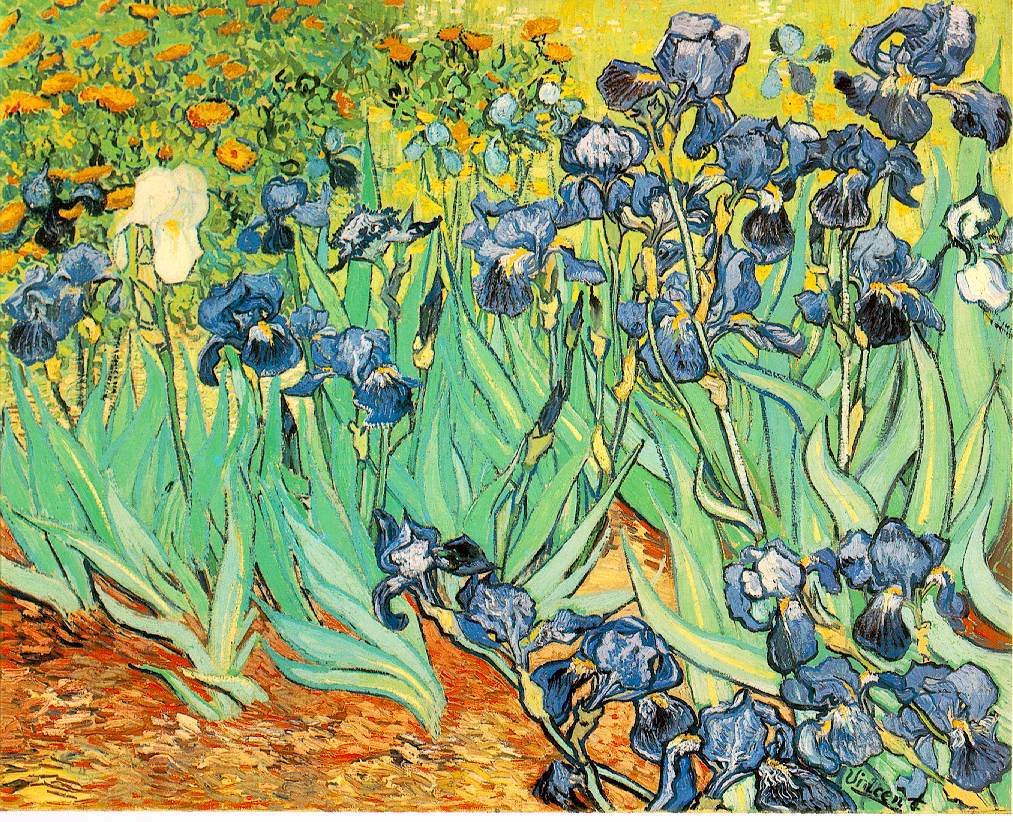
Vincent Van Gogh, Irises, 1889
Vincent van Gogh admitted himself to asylum at Saint Paul-de-Mausole, in Saint-Remy in May 1889. During his stay there he was surrounded by gardens, which obviously was the inspiration for Irises. Starry Night was also created around this time, along with about 130 other paintings.

In September of that same year a few of van Gogh’s paintings were shown in Rhone at the the Société des Artistes Indépendants Exhibition in Paris. His brother, Theo, wrote him shortly after this, “The exhibition of the Independents is over and I’ve got your irises back; it is one of your good things. It seems to me that you are stronger when you paint true things like that, or like the stagecoach at Tarascon, or the head of a child, or the underbrush with the ivy in vertical format. The form is so well defined, and the whole is full of colour.”

Van Gogh viewed this painting as a “study,” and therefore there is not drawing of it. He studied the movement of each flower individually, making them unique, and giving each one their own vivid coloring.  Also, like other artists of this time, Van Gogh was influenced by Japanese woodblock prints. This painting in particular shows the influence that the Japanese woodblocks had, especially seen through the thick and dark outlines of the flowers.

Irises is currently located in Los Angeles, at The Getty Center. It’s also on the list of the most expensive paintings ever sold, selling for 54 million dollars in 1987. 
  • 12:00 AM

The Potato Eaters

Vincent van Gogh, The Potato Eaters, 1885
When Vincent van Gogh set out to create The Potato Eaters, his goal was not to generate beauty. By choosing rough figures and painting them in such an unattractive light, Van Gogh hoped to capture their hard work and labor. He wanted the viewer to see that the everyday worker earned their food by tilling it themselves and eventually getting to eat it. Unfortunately, The Potato Eaters did not receive the response Van Gogh had hoped. The public, as well as critics, hated the piece. They despised the hideous figures, even though Van Gogh had intended for them to be ugly. The viewers disagreed with the dark colors after becoming accustomed to Van Gogh's typically colorful palette. Potato Eaters was also the artist's largest piece. Standing 82 by 114 centimeters, the dull-colored work was quite substantial. After the unanimously negative response to Potato Eaters, Van Gogh vowed to never create such a large piece again. He returned to his usual repertoire of color when creating At Eternity's Gate five years later.

At Eternity's Gate, while containing a more sorrowful subject matter, received a more positive response because of it's bright colors. The man with his head in his hands is painted in rich cerulean and sits near a red-orange crackling fire.

It is clear that people continued to dislike The Potato Eaters years later. In 1991, the Vincent van Gogh Museum was robbed. Included in the stolen works was Potato Eaters. Roughly half an hour after the crime, the burglars ditched the priceless art and fled.
  • 12:00 AM