School of Athens

Raphael, School of Athens, 1509-1511
By SAI GONDI

To Libby, Ellie, Megan, Reid, Emma, and the newbies,

I am sure we all shared similar sentiments when first entering class. The knowledgable veterans struck fear into our barren minds. There was so much to learn, so much to absorb, and we were behind. Now as veterans, we have successfully applied last year's acquired fundamentals to become even better art historians this year. Though we clearly have much to discover, walking into Art History as a second year sparked opposite emotions. We came in as knowledgable leaders, participators, and most importantly, confident students unafraid of being wrong.

We rolled into class like Aristotle and his colleagues in Raphael's School of Athens, eager for another adventure. So why am I saying all this? Well, I wanted to appreciate those who started their journey with me last year. We have come a long way intellectually and personally in regard to Art History. Thanks for continuing this adventure with me again, and all you challenge me to dig deeper and see things with new perspective each day. To the first year historians, its going to be okay. Blog posts will become routine. And with experience instinctively seeing symbols, patterns. will come easy to you, and one day you will return to class like the immortalized philosophers above. Also, thanks Mr. Luce for being our Plato, teaching us and dealing with my disgraceful Rothko jokes and religious holiday puns. To Art History 2016-2017, you are all greatly appreciated.

Editor's Note: Students were asked to give a painting to someone they cared for. These are their moving responses. 
  • 7:00 AM

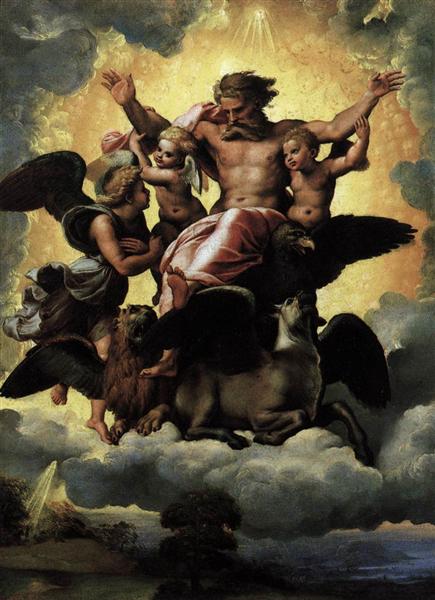
Art History Hotties: Vision of Ezekiel

Vision of Ezekiel, 1518 - Raphael
Raphael, Vision of Ezekiel, 1518
By NATALIE BEYER

Flowing hair, chiseled abs, luscious beard - everything you could ever want in a guy. Descending from heaven with a throne made up of a pegasus, lion, eagle, and an ox. How dreamy is that? Does he also have children? Could he be a great father? I'd consider this aspect a plus in my book. This painting also reminds me of a man's Facebook profile picture. But, like all Facebook profiles, we all know deep down that this picture doesn't accurately represent who this man truly is. But you say to yourself, "Hey let's give him a try." After a dating a man like this, how could you downgrade anymore if you were to break up? He's the whole package.

This Vision of Ezekiel definitely lands under the topic of "Art History Hotties." His gleaming skin, his golden hair, his, as Dr. Roark says, "big, capable hands". Should I go on, because I most obviously could. Can you see the tiny figure standing in the beam of light shining in the bottom left corner? Well, that's the man who wishes he could be God coming down from heaven. But, sadly, he's not and probably never will be.

Painted in 1518, Raphael wanted to capture Ezekiel, a Hebrew prophet's vision of God. We can see that Raphael was attempting to possibly add the components of both Greek and Roman Gods. God, in this painting, does not look like like he typically would in a painting during this time. The abs give are the dead giveaway for this. Raphael also tried to accentuate God's features by making the background bleak and dark, as compared to God and his creatures colors and glow.

  • 7:00 AM

Know Your School of Athens Goddesses: Athena

        Raphael, School of Athens, 1511                                            Unknown, Athena Giustiniani, 17th Century

In Raphael's School of Athens, the phenomenal painter purposefully segregates the painting by categorizing the left side as philosophers of mathematics, science, poetry, and music, while the right side is composed of masters in realism, logic, and ethics. To further demonstrate this division in philosophy, Raphael juxtaposes Apollo on the left side to Athena on the right side.

As the goddess of war, wisdom, courage, law, and justice, Athena is most certainly dignified as the one of powerful female figureheads in history. Placing the talented goddess in her war attire, Athena embodies fierceness and strength, which is something you don't see everyday in the Renaissance. In Raphael's School of Athens, Athena also carries the shield with Medusas' head as a display of her victory; one look at the shield will turn any human into stone, and if that doesn't scare you that I don't what does.

Being one of few goddesses who aren't associated with fertility or love, Athena is actually depicted as righteous and fair. In almost all her tales, Athena demonstrates intelligence and selflessness, as she sought to aid Greek society in times of turmoil and rid of men's arrogance and dehumanization of women. Moreover, Athena became an icon of resilience for the women of Athens through extraordinary courage and refusal to lose a battle.

In Raphael's School of Athens, I believe that the artist is taking note and praising Athena and the other female figures in the composition for their fierce behavior and the wisdom that has earned them public appreciation. As the 16th century still juggles with a division in female and male dynamics as well as the equality of human rights, Raphael moreover utilizes their presence in the painting as an advocation for a movement of female patrons in the Renaissance time period. With Athena's statue illustrated to overlook the crowd of philosophers, the significance of the other figures become minuscule, conclusively suggesting that their intelligence derives from the impacts of Apollo and Athena through the introduction of wisdom to the human race.

  • 7:00 AM

Know Your School of Athens Grumpy Old Dude: Diogenes

Raphael, The School of Athens, 1511
Girolamo Forabosco, Diogenes Drinking from the Palm of his Hand, 17th Century

“Of what use is a philosopher who doesn't hurt anybody's feelings?” ― Diogenes

Diogenes, the founder of Cynicism, certainly stands out among the other philosophers chosen by Raphael for his masterpiece, The School of Athens. He sits alone on the marble steps, mulling over the document in his hands, and appears wholly unnoticed by the other savants, who form groups and appear to share ideas. Diogenes’ philosophy mirrors his positioning in this painting, as he preferred to stay as far from other people as possible and believed that man is selfish, foolish, and thoroughly flawed.

Diogenes had a multitude of interesting encounters in his life – including his capture by pirates and subsequent sale into slavery – but the most momentous was his trip to the Oracle of Delphi, during which Diogenes received instructions to deface currency. He took this to mean political institutions above actual coin, and this prompted his mission to challenging authority, which continued after his exile to Athens and throughout the rest of his life.

Presuming that virtue in action trumped that in theory, Diogenes followed his own teachings religiously and even devoted himself to a life of poverty in efforts to critique corrupt society. He constantly challenged himself to give up more, because he believed that “it is the privilege of the gods to want nothing, and of godlike men to want little.” Diogenes focused on the influence of custom and criticized those who blindly followed tradition instead of paying attention to the true nature of the world. He once roamed the streets of Athens in daylight, lantern in hand, and told all who asked that he was “looking for an honest man.” Diogenes philosophized a life shaped by ethics and added humor, which was an altogether original practice at the time.

Raphael clearly understood the importance of Diogenes when he created The School of Athens, seeing that he set him in the forefront of the painting. Diogenes taught Cynicism to Crates, and he passed it on to his pupil Zeno, who changed it to the popular school of Stoicism. Diogenes’ placement on the right side of the painting with Aristotle represents his realism. His brazenness enabled him to openly mock many of the other philosophers pictured in The School of Athens, incorporate humor into ideology, stand resolute in his principles, and gain a place in one of the most famous works of the Italian Renaissance.

  • 7:00 AM

Know Your School of Athens Poets: Sappho

Raphael, School of Athens, 1510

I have no complaint 
prosperity that 

the golden Muses 
gave me was no 
delusion: dead, I 
won't be forgotten
-Sappho

Sappho: poet, lyricist, lesbian? It’s astonishing that a female intellectual from 620 B.C. is most renowned for her sexual preferences. Many of her poems chronicle the angst and frustrations of love. Sappho married a merchant and lived a comfortable life studying the arts and writing poetry on the island of Lesbos. She taught many female students in the ways of the art, and more often than not had affairs with them. Many of her students are the subjects of her more, shall we say, affectionate poems. For centuries, scholars and gossips alike focused more on the homoeroticism in her poems and social life than her genius. While this aspect of her life may be the most provocative, I don’t think it’s quite what Sappho meant when she said she wouldn’t be forgotten.

I love Sappho’s poetry, though I have seen little of it. The few works that have withstood time are only fragments of a larger collection. Too many poems have been lost entirely or almost, but we can tell from the remains that Sappho was rightly ranked among the best. Her use of lyric made her poetry accessible and beautiful, and she has been hailed as one of the greatest female poets in Greece. Plato called her the tenth Muse (he has the power to do that, apparently.) Sappho was the first poet to write in the first person. Her poems are personal and honest, and her messages of love, loss, and self still ring true today. It is comforting to know that, even in 600 B.C., the drama of love and life is still pretty standard.

Raphael recognized Sappho’s talent and timelessness in “School of Athens.” She stands next to Plato among the other great scholars of the age. Actually, and I’ll be honest here, no one is positive that it is Sappho next to Plato, but history scholars are pretty sure. To me, there is no disputing that it is Sappho standing there. She enriched the world and deserved to be recognized. Not many people can have a reputation that includes both sexual scandal and a vast body of intelligence. Even though only a few fragments and verses have survived the centuries, Sappho will not be forgotten.
  • 7:00 AM

Know Your School of Athens Philosophers: Old man Antisthenes

Raphael, School of Athens, 1509

Gathered under grand arches are the greatest minds of history, all making witty jokes and sharing schools of thought, having such a wonderful time -  except for one man. On the far left, behind the stunning girl in the white robe and beside the sassy Alexander the Great, there is an old man, hands in his sleeves, just listening. Though no one quite knows for sure, this man is rumored to be the great Antisthenes.

Antisthenes believed solely in the power of Virtue. After meeting Socrates, Antisthenes eschews all pleasures and materialism and chooses to live in poverty. This is not a revolutionary concept, many people chose to abandon desire in order to live fully, but Antisthenes argues that Virtue alone is sufficient for happiness.

In his school, Antisthenes has eight laws of virtue.  My favorite, however, is the last one "The wise person knows who are worthy of love, and so does not disdain to love." I hope to one day be wise enough to decide who is "worthy of love," for I am one who hates to love and does not do so very easily. I am not much of a gambler.

Standing under grand arches in the School of Athens, Antisthenes quietly watches, filled to the brim with virtue and the ease of love, as the greatest minds in history mingle. Under his breath he requests "May the sons of your enemies live in luxury."

  • 7:00 AM

Know Your School of Athens Military Boss: Alexander the Great

Raphael, School of Athens, 1511 (detail of Alexander the Great)

This could be either one of two people: Alcibiades or Alexander the Great.

Bust of Aclibiades as every Greek man
Although I don’t have any schools of thought to ramble about, I do have strategic geniuses who were actually pretty stupid in their free time. While history may try to glorify these two, let me assure you that I will expose them for the dudebros they are.

Alcibiades was basically anything but a philosopher. First, he worked for his native home of Athens, but evidently decided that Sparta looked so much cooler (that and he was charged with sacrilege). While in Sparta, he worked against his former ally of Athens, but he eventually made more powerful enemies in Sparta, and was forced to leave. He defected to Persia where he was the adviser for the satrap until his enemies demanded a recall. Yet, when he returned to Athens, he did not fall from power. On the contrary, Alcibiades became an Athenian General until (surprise, surprise) his enemies had him exiled. All in all, Alcibiades war tactician for not one, not two, but three different empires.

On the other hand, Alexander the Great spent his formative years in a pissing contest with his father that lasted for years after his death. For a brief time, 
Alexander was tutored by Aristotle beginning at the age of thirteen. In return, Alexander’s father Philip II, restored Aristotle's hometown, which he had formerly razed.

Super Alex: short, ginger, and angsty
What leads me to believe that Raphael stuck Alexander in there rather than Alcibiades was that, while Alexander may have been more jock than nerd, his contribution and intellectual legacy lives on through Alexandria. After Alexander founded the city, it became a wealth of knowledge. Of course, this didn't last for very long. It was soon destroyed by the growing Christian presence in the city.

At any rate, maybe Raphael should have just painted the city of Alexandria in there, but I digress.

  • 7:00 AM

Know Your School of Athens Mathematicians: Pythagoras

Raphael, School of Athens (Detail), 1511

A lot of words are used to describe Pythagoras. A philosopher, mathematician, scientist, and even a mystic, Pythagoras embodied the perfection and extent to which knowledge could elevate you. Pythagoras was described by many other philosophers in his day (including Herodotus and Isocrates) as but one of few who were capable of extending the reaches of modern math and science.

Pythagoras was born on the Greek island of Samos sometime around 570 BC. Very little is known of his childhood but accounts during his time claimed him to be an avid traveler visiting places like Egypt and parts of Asia all before he hit twenty. It was after his studies away that he went to Croton and created a secret society with a new religion. However, when he involved the society with town politics, he was thrown out of the city with the meeting places burned and thus, his religious group disbanded. He lived the rest of his days in Metapontum, Greece.

His contributions to the worlds of Science and art were countless. His two most important contributions to the world of science are the Pythagorean Theorem and the Musica Universalis. The Pythagorean Theorem is a well-known formula that is required knowledge for any math course involving right triangles and geometry in general. Less known is the Musica Universalis. Pythagoras was among the first people who discovered timing and occurrence of solar eclipses and lunar eclipses saying that both occur during a lapse during this theory. The theory itself states that the sun, the moon, and the earth all move according to a harmonic plan or song. Although that that is wrong, Pythagoras was among the first to realize that the moon, sun, and earth were all set by a pattern.

  • 7:00 AM

Know Your School of Athens Polymaths: Ptolemy

Raphael, School of Athens, 1511

What an exquisite back. I'm sure, at some point in time, someone looking to get their artistic weight up said something to that effect while looking at Ptolemy in Raphael's School of Athens. In fact, someone not looking deeply would likely mistake Ptolemy as an extra, one of only a handful of purposeless people in a sea of Super Important People.

Despite this cameo-as-afterthought, Ptolemy is actually just as important as Plato or Diogenes with regards to his contributions to the academic community. Known for his theories on mathematics and astronomy, he was one of the first to publish a book theorizing the distance between the Earth and the other planets. This tome, called the Almagest, was the main point of reference for astronomers and amateur stargazers alike for the next few hundred years. He also published a book called The Geography, which compiled the best and most comprehensive maps of the regions into one (somewhat) concise book.

  • 7:00 AM

Know Your School of Athens Gods: Apollo

Domeninchino, The Judgement of Midas, 1918

Apollo the sun archer. Many stories have been written about him: his birth, the slaying of Python, Hermes stealing Apollo's sacred cows. But today I am going to recount the story of the competition between Apollo and Pan.

One day in Ancient Greece, Apollo and Pan were arguing who was the better musician. Apollo, being the God of music, said that he was superior due to his lyre. Pan argued that his pipes were musically better. Refusing to back down, they agreed on consulting an outside party to judge who was the better musician.  They asked the renowned king Midas to judge the contest.  

For the competition, Apollo played the most graceful tune on his lyre.  Pan played a quick and flighty tune on his pipes.  Unable to decide who was the superior musician, Midas made both of them perform again, but this time with their instruments upside down.  Pan did so and his music closely resembled that of before.  But when Apollo played his piece with his lyre upside down, the music sounded garbled and discordant.  Midas decreed Pan to be the winner.  Apollo, infuriated by this, shouted, "You have the ears of an ass to think Pan the winner" and thus Midas's ears become those of a donkey.  Midas attempted to hide them by wearing a large cap, but his ears were eventually known to all after his barber blabbed.

In The School of Athens, Raphael attempts to unite the arts and the sciences.  On the left half of the painting, a statue of Apollo resides in an alcove in the wall while Athena sits on an alcove on the right half.  Apollo, the  god of music, contrasts in essence that of Athena as she was the goddess of knowledge and therefore science. Raphael pays tribute to both gods through his depiction of them.  
  • 7:00 AM

Know Your School of Athens Philosophers: Xenophon


Raphael, School of Athens, 1511

Would you look at that! It's the School of Athens! Wait a second...zoom in a little bit. 


A little bit more...


Wow, someone clearly doesn't enjoy the presence of his teacher, Socrates. Xenophon appears to be having the worst day of his life, which seems hard to believe. Who could be so grumpy while standing among scholars, whom seems to embody the entire intellectual world. Xenophon was a man of war, and not only did he take part in military expeditions, but he also wrote accounts of them. Xenophon's life became a series of ups and downs as he was appointed as a leader, but eventually exiled from Athens for what appeared to be fighting for the other side (Sparta at the time). Xenophon's eviction from Athenian society would justify his grumpy face. After getting kicked out, he took all of his mercenary booty he had earned and decided to settle down. Xenophon was more than just a veteran, but also a philosopher, a man of thought and author of accounts. A true legend. 

  • 7:00 AM

Know Your School of Athens Philosophers: Diagoras of Melos

Raphael, School of Athens, 1511

As an ancient day myth-buster, Diagoras of Melos often expressed his detective side by proving many so called religious miracles false. Ultimately he became the first atheist. The humanism and Greek antiquity movement pushed social norms by combining pagan and Catholicism, and similarly, Diagoras of Melos challenged the common Greek Orphic doctrine of his time. Diagoras was on a completely different level. Evidently for him, limits were non-existent, as he cuts up a wooden sculpture of Hercules and throws it into the fire, claiming Hercules' thirteenth labor would be cooking turnips. It was these schemes that led to Diagoras' exile from Athens.

Although Diagoras often contradicted the Greek mythology that Italian humanism came to love, his free-spirited arguments could not be ignored in the quest for truth and knowledge that was the Italian humanism movement. Raphael acknowledges this as he paints Diagoras as a hot mess. It was Diagoras' persistence, courage, and drive that sparked other scholars to think in a new light. Whether right or wrong, Diagoras played the devil's advocate way back in the fifth century.

Do you think Diagoras is a cool guy? You can friend him on Facebook: https://www.facebook.com/diagorasofmelos

  • 7:00 AM

Know Your School of Athens Philosophers: Socrates

Raphael, School of Athens, 1511

Socrates did not write any philosophical texts, so everything we know of him comes from his students, mostly Plato. Plato was Socrates's favorite pupil, and is shown in the middle of the School of Athens, next to Aristotle. Socrates believed that life could be broken down into questions, and the solution to any problem was found by asking the right ones. This form of thinking is known as the Socratic method. In fact, Socrates was notorious for never giving answers, only asking questions. His most famous quote is, "What I know, I do not think I know," which many take as an acknowledgement of his own ignorance.

I really like his philosophy, although I mostly know it from various works of Plato's. It seems like Socrates didn't really care about answering questions, only asking them. While he believed that virtue comes from knowledge, he also contended that knowledge consisted of asking questions. So perhaps Socrates's idea of virtue came not from knowing everything, but from knowing that you cannot know everything, and will therefore always have something to learn.

Socrates was always at odds with the Athenian political elite, and because of this they charged him with heresy and sentenced him to death by poison. But even on the edge of death, he welcomed the new experience, and according to Xenophon, truly believed that it was his time to die.


  • 7:00 AM

Structure and Paintings: School of Athens

Structure and Paintings
Analyzing Architecture and Perspective within Paintings
Curated by Max Cantu-Lima

Raphael, School of Athens, 1509-1511

"A object, surface, or space usually will feel more balanced or whole when its secondary articulation runs counter to its primary geometry." 
#88, 101 Things I Learned in Architecture School, Matthew Frederick

By now we've fully covered the concept of space and perspective. But what Raphael does within School of Athens is quite different, which propelled it to its popularity. Raphael does not solely focus on the architecture, but depicts philosophers and authors of the time. Center stage we find Plato and Aristotle discussing the difference between idealistic world-views and the greater concern with the real world. The scene itself has become iconic, brought up commonly within philosophy classes and even making its way into pop culture as the inspiration for alternative band Alt-J's music video for Tessellate. And while the subjects are done well and cleverly, the architecture behind these great minds stands tall, towering over them. For in the end, the building will last longer, outliving all of them. Its beauty remaining for future generations to see.

Raphael widens the space he was restricted to working in, making the work seem larger than its true size. He not only increases the size, but also extends it further back creating even greater depth. One indication as to the talent and genius of Raphael, are the gaps Raphael places between the barrel arches. He's creating a more complex image by doing so, separating the perspective, almost vertical, lines with horizontal ones. He does this in sets of three. This not only creates more space, but more appealing space, while also allowing the sky to peek through. It's successful because of the way he utilizes color and shadow, capturing how light plays off the walls and columns.

This painting made its way into this collection, like other paintings, for its attention to detail. Raphael became a classical master because of this painting. With this statement, I am not saying his other work lacks talent but rather this painting has so much of it in one space it has become his most remembered. Both symbolic and executed well, Raphael's complexity creates a work that the viewer could analyze for hours.


  • 7:00 AM

Angels We Have Heard on High: St. Michael Vanquishing Satan

Angels We Have Heard on High
The Imagery of Angels in Christian Art
Curated by Camille O'Leary

Raphael, Saint Michael Vanquishing Satan, 1518

Here, the archangel Michael stands atop a prone Satan, spear in hand, ready to defeat his opponent once and for all. Cloth billows around him grandly, enhancing the strong diagonal line created by the spear and Michael's body itself. This scene, taken from the book of Revelations, was painted as a gift for the French king Francis I. Raphael (or perhaps one of his assistants—more on that later) painted it while he lived in Rome, on a commission for Pope Leo X. The dark, metallic color scheme distinguishes the work from Raphael's usual lighter, rosier style, and the angel depicted here has the strength and grace of a warrior triumphing over evil.

One prominent view held by art historians maintains that the work is not by Raphael at all, but by his pupil Giulio Romano, who was notorious for overusing black. Others claim that the uncharacteristic darkness of the shadows is the result of poorly done restoration efforts. Still others take the middle road and say that Giulio painted most of it, but that Raphael helped with certain details, especially Michael's face. Art historians, apparently, can't agree on anything.

Michael, one of the most powerful archangels in Christian tradition, leads the armies of heaven. Many artists, therefore, depicted him as a warrior, and Raphael (or possibly Giulio) follows that tradition. Clad in a short tunic, sandals, and a sword, Michael's sharp, military bearing contrasts with the naked Satan writhing on the ground. No remorse shows on his face as he prepares to end his enemy's treachery. While the dullness of the colors perhaps keeps this painting from being truly great, it is still extremely well done, with Raphael's characteristic smoothness of face and limb.

  • 7:00 AM

Triumph of Galatea

Raphael, Triumph of Galatea, 1513
Galatea, a sea-nymph, fell in love with a you shepherd named Acis. She lived in the sea where she also encountered the monstrous one-eyed cyclops, Polyphemus, who fell madly in love with Galatea as well. One night, Polyphemus caught Acis and Galatea asleep and proceeded to murder Acis with a large rock. Raphael crated this scene as one of many in the Villa Farnesina for Agostino Chingi. The fresco to the left of this in the Villa shows Polyphemus coming for Galatea.

In this particular piece, Raphael creates a dramatic high renaissance picture displaying his detail of the human body with contortions and curves similar to those of Michelangelo's sculptures. Specifically, Galatea is positioned in such a way that her physical momentum pushes her away from Polyphemus, but the wind causes the flowing hair and clothing to move the opposite way. In addition to the sea-nymphs that surround her, she looks as is she is being pulled in every direction. The shifting of the bodies and colors Raphael uses in the frescoes filling the Villa provides a great example of Renaissance painting.

  • 7:00 AM

Marriage of the Virgin


 Raphael, Marriage of the Virgin, 1504
Self-contained and certain, Mary’s marriage to Joseph by Raphael takes symmetry to new levels. Everything is crisp. The lines, the vanishing point dead center, the height of the wedding party, and the social event they depict, all collaborate in an appropriate composition with a clean border. Pregnant and a virgin, Mary’s depiction in a wedding scene represents the social stigma of Raphael’s time...and our time. A pregnant woman should be wed. Surrounded with decoration, the work itself does not send the eye beyond. All that is to be seen is seen, very rare in a biblical painting, especially one with an accompanying narrative.

Not pictured in white, though the purest of the pure, Mary appears in her classic blue robes with Raphael’s added red dress, representative of the blood of Christ. The priest, most directly in line with the church, symbolizes the value of those most closely related to God. Her left hand is placed on her pregnant stomach and right hand accepting her ring. Mary’s dual commitments are represented: one to bear the Son of God, and one to her new husband. Raphael’s signature in the Church also adds to the symmetry of the piece, refusing to make one side heavier with significance. Mary and unborn Jesus, the focal point of the narrative, are balanced in importance by the Priests tilted head to the left, presenting symbolic symmetry even when visually lacking. Sharp, straight, and proper, Raphael’s work appeals to viewers and socialites through centuries.

  • 7:00 AM

Saint George Fighting the Dragon

Raphael, Saint George Fighting the Dragon, 1503-5
When I sit at my desk and prepare to write an entry for the Art History blog, I pull up the image of the piece I am to write on, and stare at it for a while. This takes between five to ten minutes. Normally I would then begin some research on the artist and the work itself to be able to address it formally. While I did look up the story of Saint George, I researched nothing else. I chose to write about this painting because I feel it represent part of me in this moment of time. For Saint George, the dragon represented Satan. He had come to slay the dragon, not only to save the princess, but also to free the city, which this dragon terrorized, feeding on its livestock.

For me, I see myself as the knight, coming to the rescue to save myself, because I also represent the city. The dragon stands for all the bad habits I have accumulated. I used to always be on time with my work, but over the last semester I feel I have sunken into a daze. Some call it Senioritis, but I think that’s too easy of a diagnosis. I can say that I do feel awful for my lateness when it comes to teachers - mainly because I respect them and because my step-father once told me “not doing your homework is like a slap in the face to your teachers.”

Now other than one instance in middle school, I would never want to do such a thing. Now that college only draws nearer, I have embarked on a quest, one that would improve who I am as a person in preparation for the future. My goals are to become better with time management and deadlines, because whether its for Painting honors or Chinese II, I struggle with the word deadline. So with that, I am off to vanquish such a terrible beasts that reside within me. Hopefully I make it out alive and that this will be my last late assignment.

  • 7:00 AM

Balthazar Castiglione


Raphael, Balthazar Castiglione, 1515
You wouldn’t notice him in the Louvre. He blends in with his surroundings, as his calm demeanor assures everyone who locks eyes with him. You might even become that person that strikes up a conversation with a painting because you feel so comfortable with the figure in front of you. We no longer feel like we are viewing a painting; more likely, the Balthazar Castiglione is watching us, and painstakingly taking notes.
The man holds incredible power in the courts of 16th century Rome and over many important figures of the time. He wrote Il Libro del Cortegiano (The Book of the Courtier), which served as a pivotal took for modern historians in understanding the Renaissance. The book describes what a true gentleman should be including moral, intellectual and physical attributes - basically a how-to bro guide. Although "bro" back then used to be some stature to attain, not one to degrade yourself to. The point that comes most across in Raphael’s 1514 genuine portrayal of Castiglione is the fact that a courtier should not have to show he is one, the simplicity is what shows everyone how much of a man he really is.

When observing his portrait, Castiglione seems to change his expression before your eyes. His eyes are neither raised nor lowered as he views you as an equal. Never known to raise his voice, or strike an unfair bargain, Castiglione was one of the most sophisticated minds of his time. The portrait does not suggest that he is a genius for the palette and reserved position offer a more unpretentious look at the man. The diplomat meditates between the two extremes of black and white with his gray ensemble, as he weighs multiple view points without coming to any hasty decisions.

  • 7:00 AM

The Dead Christ

 Perugino or Raphael, The Dead Christ, 1495
Christ in the Tomb, Perugino, 1473
In my humble opinion, The Dead Christ appears too lively to be considered dead. The scientific community has performed countless experiments whose findings have been verified by the configurations of world renowned mathematicians and even some Nobel Prize winning economists, which all support the theory that dead people cannot climb out of their coffins. The situation would change, however, if that dead person had been resurrected. My conclusions for art historians to consider would be this; The Dead Christ is a gross misnomer as this Christ appears to be resurrected. Also, art historians have not been able to discern the painter of The Dead Christ, but research and careful analysis narrowed our choices down to two Renaissance artists: Raphael or Perugino. I am about to tell you why Perugino really painted The Dead Christ.

Saint Sebastian (Detail), Perugino, 1490
Exhibit A, background. While looking at numerous paintings of both Raphael and Perugino, I realized Raphael was very fond of his backgrounds. The total darkness, though somewhat out of character for both artists, appears to be more typical of Perugino (who painted another Dead Christ called Christ at the Sepulcher with a completely black background). Exhibit B, Christ’s body. Raphael exaggerates his subjects’ muscles far more deeply with crevices that usually are inhabited by shadows. Exhibit C, Perugino likes to paint the resurrection of Christ. There are two other paintings by Perugino depicting this exact same scene. One I mentioned before and is called Christ at the Sepulcher and the other bears the title Christ in the Tomb. Both of these paintings have Christ in the exact same position as in The Dead Christ. His hands are by his sides, spread out in a welcoming fashion. Christ tilts his head to the viewer’s left, and He always stands upright in his tomb. Exhibit D, Christ’s hip. Perugino had this odd way of exaggerating the curve between his people’s belly and hips. This can be seen in The Dead Christ, Christ in the Tomb, Christ at the Sepulcher, and Saint Sebastian to name a few.

So, review the evidence for yourself. Look at the paintings of Raphael and Perugino and get back to me. If you disagree, I would love to talk it over, but in the meantime I think we can all decisively agree that Christ is either alive in this painting or a puppeteer has rigged Christ’s body with all sorts of strings and now works him like a puppet. You decide.

  • 7:00 AM